
Household Returns
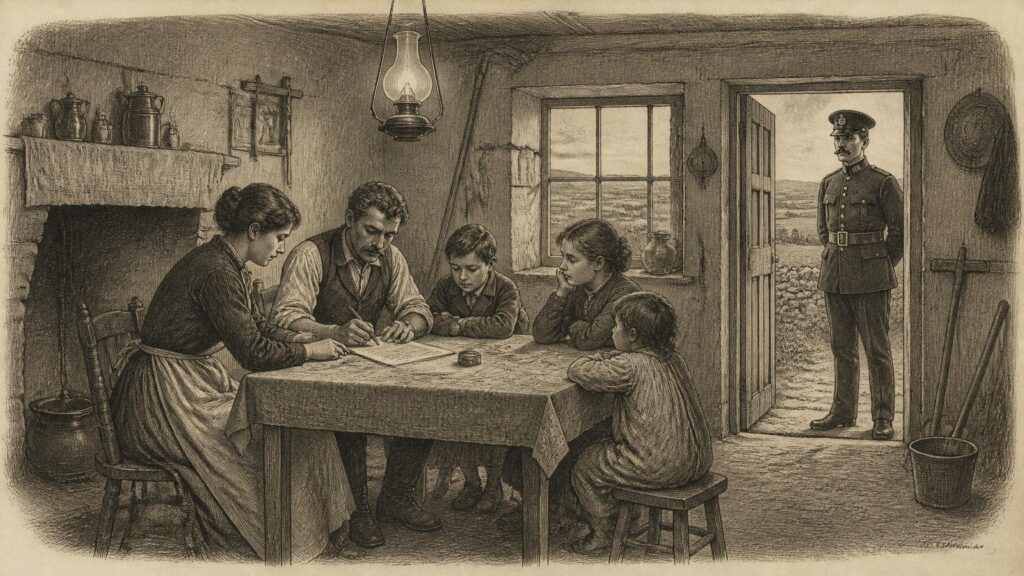
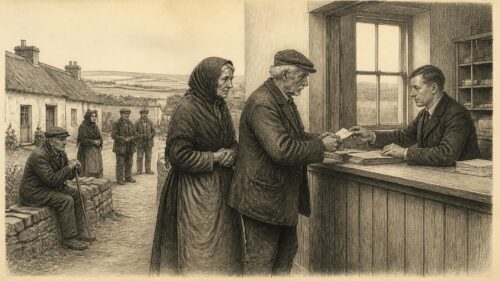
AI generated historical illustration, not a contemporary photograph.
At a Glance
When the manuscript returns of the 1926 Census became publicly searchable on 18 April 2026, Ireland acquired more than a new genealogical resource. It regained an extraordinarily detailed record of the first full count made by the Irish Free State: a national self-portrait compiled only four years after independence, in a country still marked by revolution, partition, bereavement, migration and profound economic uncertainty.
Historic Opening
The release of the 1926 Census is a major event in the historical life of the State. Census Day fell on Sunday, 18 April 1926. Exactly one hundred years later, the National Archives made the surviving household returns freely available online. The date was not chosen merely for ceremonial effect. It followed the expiry of the statutory hundred-year restriction that governed access to personal census material. In practical terms, a collection that had long been known through published tables, but inaccessible in its individual human detail, passed into public use.
That distinction matters. The published census volumes had always allowed historians to study totals: population, occupations, religion, housing, marriage, birthplaces, industry and knowledge of Irish. What had remained closed were the handwritten household forms that connect those figures to named people and particular homes. The opening therefore joins two kinds of history. It permits national interpretation of the new State while also allowing families, local historians and researchers to locate individuals within streets, townlands, farms, institutions, boarding houses and workplaces.
The census was the first undertaken by the Irish Free State, which had been established in 1922. It covered the twenty-six counties of the State, not the whole island. This geographical qualification is essential. The 1911 census had been an all-Ireland census conducted under the United Kingdom; no census was taken in 1921 amid the War of Independence; and the 1926 return belongs to the political order created after partition. It is consequently both a continuation of the older Irish census tradition and a record shaped by the new constitutional boundary.
The collection is also unusually substantial. The National Archives holds it in 1,299 boxes, containing more than 700,000 return sheets, laced into 2,494 canvas volumes corresponding to enumeration areas in the twenty-six counties. The scale alone corrects any notion that the release is a modest supplement to the 1901 and 1911 censuses. It is a vast archive of households, institutions and localities, representing almost three million persons at a decisive moment in modern Irish history.
Broken Sequence
Irish census history is marked as much by loss as by survival. A systematic government census had been taken at ten-year intervals from 1821 to 1911. Yet the manuscript returns for most nineteenth-century censuses did not survive into the present. Some were destroyed administratively before independence, while the destruction of the Public Record Office of Ireland in the Four Courts during the Civil War in 1922 consumed many older records. Surviving fragments are precious, but they cannot replace a full national series.
For that reason, the 1901 and 1911 censuses acquired an exceptional place in Irish family history. They survive in full for the island and became widely used after digitisation. Between 1911 and 1926, however, lies a long and difficult interval. It contained the Home Rule crisis, the First World War, the Easter Rising, revolutionary conflict, partition, the Civil War and the formation of a new State. A fifteen-year gap between full surviving household censuses is therefore not an ordinary chronological gap. It conceals a period in which households were divided by death, departure, politics, military service, imprisonment and displacement.
The absence of a 1921 census was a consequence of war rather than a mere bureaucratic omission. Thus the 1926 return becomes the first comprehensive household record available after the upheavals of the preceding decade. It does not reveal every experience of those years. A census form was not a witness statement, a pension file or a military-service record. Still, it provides a disciplined point of arrival: who was present at a particular address on one night in April 1926, how they described themselves, and how the State classified the household.
That evidential character should be kept in view. The return records residence on census night, not a permanent life story. A child may have been staying with grandparents; a worker may have been temporarily lodged near employment; a spouse or parent may have been absent in Britain, America, at sea, in hospital, in prison or elsewhere. A missing name need not settle a family question. Conversely, a name found at an address is powerful evidence of presence, but it does not by itself explain relationships, loyalties or feelings.
New State
The 1926 Census was produced by a State still defining its institutions and capacities. Its very existence was a statement of administrative normality after years of instability. Counting people, dwellings, occupations and resources was not glamorous work, but it was fundamental to government. The census supplied information for public administration, economic planning and social policy, while also helping the Free State describe the population over which it now exercised authority.
The official total was 2,971,992 persons. This was a decline of 5.3 per cent from the 3,139,688 recorded in the 1911 census for the corresponding twenty-six-county area. The figure must not be assigned to one simple cause. Long-term emigration had shaped Irish demography for generations; deaths in war, revolution and disease mattered; falling fertility, delayed marriage, uneven employment and rural change also formed part of the wider picture. The census documents the result, but historians must draw cautiously when explaining the many forces behind it.
The population total was among the lowest recorded in Ireland since the Great Famine. Yet it should not be treated only as a tale of decline. It represents nearly three million distinct lives in a State whose social arrangements were changing. Some households maintained deep local continuity; others included people born in Great Britain, Northern Ireland, the United States or elsewhere. The country was less internationally diverse than Ireland would later become, but it was not socially uniform, and it was connected to migration networks extending far beyond its borders.
The census also provides a corrective to retrospective images of the 1920s as a settled era beginning neatly after the Treaty. In 1926, many adults had been formed by pre-independence Ireland and had lived through the years of conflict. Children recorded on the forms were growing up under new institutions, new educational expectations and a revived public emphasis on Irish language and nationality. The return catches those generations together, often under one roof, but it does not erase the differences in their experience.
Household Evidence
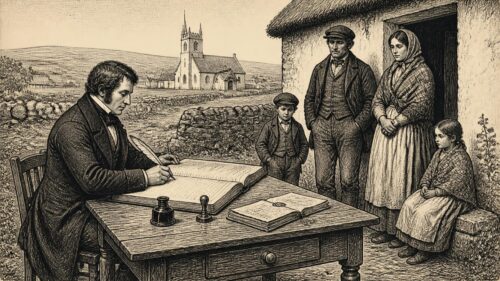
The household return was a remarkably rich document. It sought names and surnames, relationship to the head of household, age, sex, marital condition or orphanhood, birthplace, religion, Irish-language information, occupation and employment. It further asked married women about the duration of the present marriage and the number of children born, and recorded children and stepchildren under sixteen from all marriages. For agricultural households it could also record the area of the holding. Such detail allows the household to be studied as more than a list of related names.
One may trace widows and widowers, boarders, servants, employees, nieces, nephews, grandchildren and lodgers alongside spouses and children. These categories reveal something of the practical arrangements by which people survived. The conventional nuclear family was only one household form among several. A boarding-house keeper, a domestic servant, a farm labourer, a shop assistant, a resident employee, an orphaned child and an elderly relative might all appear in records of the same neighbourhood, sometimes in the same dwelling.
The form nevertheless reflects the assumptions of its makers. It organised people around a named head of household and used classifications that may sit awkwardly with present-day understandings of family, work, disability, gender or identity. The language of occupation did not always capture unpaid labour. Women entered as engaged in ‘home duties’ performed indispensable domestic and caring work, but the phrase did not carry the same status in official statistics as paid employment. The record is therefore evidence both of lived conditions and of the categories through which the State chose to see them.
Handwritten records create another difficulty. Names may be misspelled, anglicised, abbreviated or rendered inconsistently; ages may be mistaken; addresses may change; and the transcription of a difficult hand can introduce fresh errors. Search results are a beginning, not a verdict. Responsible researchers should consult the original image, compare nearby entries, test variant spellings and corroborate a finding against civil registration, parish records, newspapers, school records, probate material or other appropriate evidence.
Counting Methods
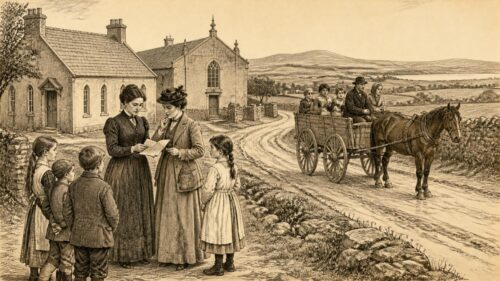
The census was not compiled by an abstract office working at a distance. The 1926 General Report describes how the forms were distributed to households by the Garda Síochána around a week before Census Day and collected shortly afterwards. Gardaí checked returns in broad terms and sometimes assisted with completion. They also prepared local summary material, organised by townland in rural districts and by street in urban areas. These arrangements gave the census a highly local administrative character.
Publicity was intended to encourage compliance and accurate returns. Clergy of different denominations, chambers of commerce, trade and labour organisations, schools and the press were enlisted to explain the exercise. Instructions were broadcast by wireless on the evening before Census Day and on the night itself. Such measures remind us that a census depends upon cooperation. Its apparent authority rests upon countless acts of reporting, interpretation, collection, checking and tabulation by ordinary residents and officials.
The results were also modern in their processing. The Census Office coded information from the schedules onto punched cards and used Powers statistical machinery to sort and count the data. The preliminary population report was issued in August 1926, within four months of enumeration. This combination of handwritten domestic returns, policing, clerical coding and mechanical tabulation belongs to a transitional administrative world: intimate local knowledge was transformed into national statistical information by an early twentieth-century machine system.
The General Report records a division of labour that deserves notice. Twenty-one women were employed on punching and checking cards against the original documents, while male clerks operated the sorting and counting machinery, assisted by junior male clerks. Such arrangements were typical of gendered office hierarchies of the period. The census thus preserves not only information about the public but an indication of how the State’s information machinery itself was staffed and organised.
Social Measure
The figures derived from the census show a predominantly rural and agricultural society. Of those at work, 51 per cent were in agricultural occupations. This was not simply a measure of employment; it describes the physical and social landscape in which many people lived. Farm size, hired labour, family assistance, seasonal work, domestic service, small-town trades and urban commercial employment all shaped the texture of daily life.
The workforce numbered 1,307,662 people, of whom 74 per cent were male and 26 per cent female in the official classification. These figures should be read alongside the limitations of occupational enumeration. Women’s unpaid work in homes, on family farms and in family businesses could be poorly represented in a system that privileged formal occupations and employment relationships. The census is indispensable for studying work, but it does not exhaust the history of labour.
Ireland in 1926 was also a young society. The Central Statistics Office notes that 29 per cent of the population was under fifteen. Life expectancy at birth was fifty-seven years for males and fifty-eight for females. Such averages do not tell an individual destiny, but they indicate the social importance of childhood illness, maternal health, infectious disease, accident, poverty and uneven access to medical care. A household return supplies names and ages; its wider statistical context helps explain why age and family structure mattered so greatly.
Housing is another field in which individual forms and published totals may now be brought together. The census asked about dwellings and household circumstances, and its published results included a dedicated housing volume. Researchers can examine overcrowding, room numbers, building materials and the co-residence of families with greater local precision than was previously possible. Yet a numerical measure of housing is not the whole experience of home. It cannot alone convey comfort, hardship, neighbourliness, authority or affection within a house.
Language Record
The Irish-language question gives the census a special place in the cultural history of the Free State. The official returns recorded several categories: Irish only; Irish and English for native speakers who also spoke English; English and Irish for those who spoke both but were not considered native Irish speakers; and the ability to read Irish without speaking it. The published language report explicitly warned that language could not be measured with the same exactness as such matters as age or birthplace.
That warning should guide present use. The 1926 census reported that approximately 18 per cent of the population had some Irish-language ability under its particular definitions. The Central Statistics Office has noted that this was the first reversal, in more than seventy years, of the long recorded decline in Irish speakers. But comparison with later censuses must be careful because later questions were framed differently and capture wider forms of stated ability or use.
The language entries can reveal family and regional patterns, especially when set beside age, birthplace, residence and occupation. They may show intergenerational differences within one household or illuminate the mixed linguistic circumstances of towns and rural districts. They cannot, however, tell us how often a person spoke Irish, in which settings they used it, whether they felt confident in it, or what cultural and political meanings the language carried for them. A ticked category is not an autobiography.
In this respect the census is especially vulnerable to over-interpretation. A researcher may be tempted to treat an ‘Irish and English’ entry as proof of fluent daily use, or a blank as proof of cultural indifference. Neither conclusion is safe without supporting evidence. Education, local custom, the wording of instructions, family self-presentation and the assistance of enumerators may all have influenced what was written. The proper historical value of the language return lies in patterns and possibilities, not in simplistic verdicts on identity.
Religious Landscape
Religion was another mandatory descriptive category, and the form instructed householders not to use the vague word ‘Protestant’ where a particular denomination could be named. The census recorded a population that was overwhelmingly Roman Catholic: 93 per cent in the official statistical comparison produced by the Central Statistics Office. Church of Ireland members and other Protestant denominations together accounted for about 6 per cent, while other stated religions formed a very small share.
These figures are historically significant, particularly when read in the context of the new southern State after partition. Yet they should not support crude claims of social unanimity. Religious affiliation did not determine every political opinion, cultural allegiance, class position or local relationship. Nor was it the only form of minority experience. The census records formal denomination more readily than it records the textures of neighbourliness, exclusion, cooperation or private conviction.
At household level, religion can help historians identify denominational institutions, mixed localities and family patterns, but it requires discretion. Personal records of belief can be sensitive even after a century, and a family’s religious designation should not be used to assign motives or loyalties without other evidence. The value of the census lies in giving researchers a documented starting point; the danger lies in allowing a category to stand for the complexity of a person.
The same caution applies to apparent absence. The 1926 form did not provide the modern category of ‘no religion’; people outside major denominations were collected within an ‘other’ category. The statistical structure therefore places limits on conclusions about nonconformity, irreligion or private doubt. Historians should describe the record as it was made rather than make it answer questions it was not designed to ask.
Migration Trails
Birthplace entries make the release particularly valuable for studying migration. The 1926 population was overwhelmingly Irish-born, with 97 per cent recorded as born in Ireland according to the Central Statistics Office’s comparison. Inward migration from outside Ireland, Northern Ireland and Great Britain was very limited. Nevertheless, individual households could contain people born in England, Scotland, Wales, the United States or elsewhere, reflecting the enduring mobility of Irish lives around the Atlantic archipelago and beyond.
Birthplace is not residence history. A person born in Scotland may have arrived in Ireland as an infant, while someone born in a Mayo townland may have spent decades in Liverpool, Glasgow, New York or Boston before returning. The census records where a person said they were born; it does not narrate every journey that followed. Researchers seeking migration stories need passenger lists, naturalisation records, newspapers, letters, work records, school registers and family testimony where available.
Still, the return can reveal return migration with remarkable immediacy. A household may bring together Irish-born parents, children born abroad and a grandparent born in a different county. It can show the local effects of imperial labour markets and overseas settlement without requiring the historian to exaggerate. Such entries make visible the fact that the Irish Free State, although demographically shaped by outward migration, was never isolated from wider movement.
Family folklore often clusters around migration: a relative ‘went to America’, ‘came back with money’, ‘was never heard from again’ or ‘belonged to another place’. These stories may contain a valuable clue, but they are not documentary proof. The 1926 Census can test parts of them, establish residence and sometimes identify an overseas birthplace, but it cannot validate a legend in full. The most useful approach is respectful scepticism: preserve the story, distinguish it from evidence, and investigate both.
Digital Afterlife
The public release did not mean that the archive instantly became perfect data. The National Archives digitised almost three million individual entries, involving roughly forty-five million data points, and has explicitly adopted a phased programme of improvement. The initial searchable material prioritised fields most often needed for identification, while further work has continued on transcription, standardisation, free-text occupations, employers and other information.
This openness about imperfection is a strength. The National Archives has acknowledged transcription issues, including approximately 3,000 missing individuals in a small number of instances, amounting to around 0.1 per cent of the enumerated population. No entire District Electoral Division is missing, but errors are concentrated in some places, including Dublin, Limerick, Wexford and Kilkenny. Digital databases are often mistaken for finished and faultless editions; this project makes clear that archival access is also an ongoing process of correction.
The release has therefore created a new collaboration between archive and public. Users can identify apparent mistakes, while archivists can test corrections against original material. This does not make every proposed amendment correct, nor should it encourage casual alteration of historical wording. It does mean that a major national collection can gain accuracy through careful, transparent review. The handwritten page remains the central authority when an index and an image disagree.
For historians, the digital afterlife of the census may be as consequential as its original publication. It enables searches across locations and names at a scale earlier generations could not manage, while preserving links to the local source. It can support studies of kinship, work, language, religion, housing and mobility, but it can also encourage decontextualised searching. The best work will move continually between the database, the original image, published statistics, local knowledge and wider historical scholarship.
Careful Reading
The release invites excitement, and rightly so. For descendants, it can close the gap between 1911 and later civil records. For local historians, it can restore streets and townlands to view. For scholars, it offers material for a more finely grained account of the first Irish Free State. But its greatest value may be methodological. It reminds us that national history is assembled from ordinary households whose records are at once precise and incomplete.
Documented evidence can establish that a person was enumerated at an address, stated an age, gave a birthplace, was classified by religion or recorded with a particular occupation. Interpretation begins when those facts are arranged into an argument about class, gender, language, migration, social change or the making of the State. Folklore and family memory may direct attention towards a person or place, but should be identified honestly as tradition unless it is corroborated. These are not rival forms of history; they are different kinds of material requiring different standards of claim.
The census does not speak with one voice. It preserves the voices and handwriting of householders, the interventions of enumerators, the categories designed by officials and the later work of archivists and transcribers. Its apparent simplicity is deceptive. Every row is the product of a particular household on a particular night, and every aggregate is the outcome of decisions about how a State counted its people.
That is why the unsealing of the 1926 Census deserves to be understood as more than a centenary release. It is a return of evidence to public memory. The document does not resolve every family mystery or offer a final account of independent Ireland’s beginnings. Rather, it supplies something better: a vast, searchable, revisable and deeply human record from which better questions can now be asked.

The 1926 Census creates a compelling bridge between national change and household experience in the first Irish Free State. Its returns can reveal migration, family arrangements, language and work after revolution and partition, yet they record residence and official categories on one night rather than complete lives. This limitation is important when comparing 1926 with 1911: conflict, emigration and the border may make absences and continuities difficult to interpret. Reading the forms alongside other evidence may alter conclusions about social change. How can researchers combine household returns with complementary records to distinguish temporary circumstances from transformations between 1911 and 1926?