

Sacred Summit
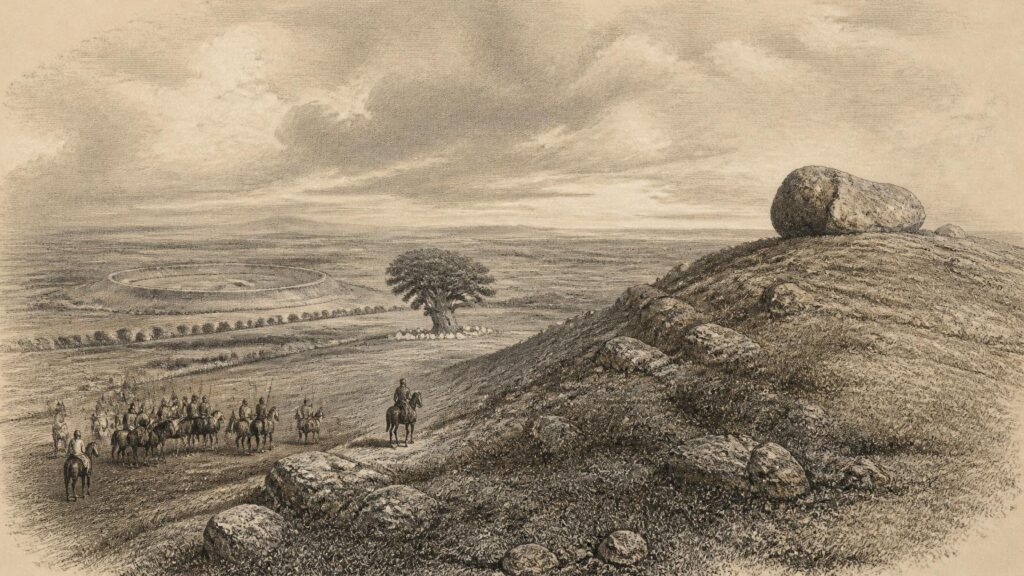
AI generated historical illustration, not a contemporary photograph.
At a Glance
On a conspicuous height above the low country west of Belfast, Crew Hill preserves the outline of an old political landscape: a place where territory, genealogy, sacred custom and military power converged. Known in medieval Irish sources as Cráeb Telcha, it is strongly identified with a royal assembly place of the Ulaid and with rites of inauguration associated with their leading dynasty. The hill’s physical remains are elusive and later farming, quarrying and reservoir works have altered it, yet its name, traditions, annalistic notices and modern archaeological investigation together make it one of the most suggestive surviving sites in the history of Gaelic Ulster.
Northern Landscape
Crew Hill stands near Glenavy in County Antrim, in the historic territory of the Ulaid. Its importance begins with position. In a generally low-lying district, the hill is a marked eminence, commanding broad views southward towards the Mourne Mountains and westward across the Lough Neagh basin. Such visibility does not prove royal use in itself, but it helps explain why the place was capable of becoming a landmark in both practical and symbolic senses. Hills on routes, boundaries and open plains could serve as meeting points, judicial places, sites of mustering and settings for the public display of authority.
The modern hill has not survived as an untouched monument. Cultivation has crossed its summit, roads and fields divide its slopes, and infrastructure connected with water supply has affected the ground. It is therefore unwise to imagine an intact ceremonial complex lying just beneath the turf. Instead, Crew Hill must be read through overlapping forms of evidence: early Irish texts, medieval annals, the history of its place-name, local recollection, surviving earthworks and stones, antiquarian reports, geophysical survey and excavation. Each contributes something; none alone settles every question.
The place is also a reminder that early medieval political geography did not coincide with later county boundaries or modern assumptions about Ulster. Ulaid was a major kingdom and cultural region whose fortunes changed repeatedly. By the period most clearly documented at Crew Hill, the Ulaid faced powerful rivals, particularly the Cenél nEógain of the northern Uí Néill. A hill associated with royal assembly could thus be a focus not merely of internal ceremony but of contest, humiliation and remembered violence.
Names Remembered
The central historical identification is between Crew Hill and the Cráeb Telcha or Craeb Tulcha of Irish sources. The name has commonly been understood in connection with a tree and a hill: an interpretation reflected in later translations such as “tree hill” or “the tree of the hill”. The precise linguistic history is more important than a picturesque English rendering. Place-name scholarship has traced forms of the name through medieval references and later cartographic and documentary survivals, making the connection with the Glenavy hill substantially more secure than a simple resemblance of sound would allow.
The Irish word cráeb can mean branch or tree, while telach denotes a hillock or eminence. The spelling varies across manuscripts and editions, as is normal in the transmission of medieval Irish writing. This variation should not be mistaken for evidence of several different places. The historical record contains forms such as Craeb Telcha and Craeb Tulcha, while the local modern form developed as Crew. The persistence of the first element is particularly striking in an area where Irish speech and naming traditions were reshaped over centuries.
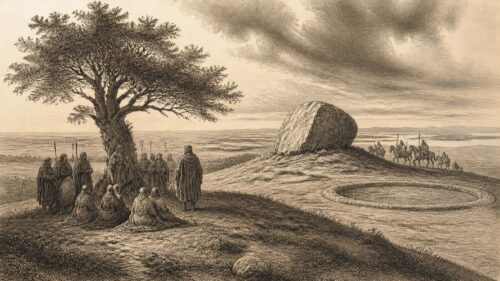
The name matters because the tree was apparently more than scenery. Medieval sources treat Cráeb Telcha as something that could be cut down in an act of war, while later local tradition retained a story of a great sacred tree and of kings made or proclaimed beneath it. A tree at an inauguration place is entirely intelligible within Gaelic political culture, where particular natural features could embody continuity between a ruling people, its territory and its royal line. Yet this must be stated with care: the sources show that a tree carried exceptional significance at Cráeb Telcha; they do not provide a surviving description of every ceremony that took place there.
Royal Ulaid
The Ulaid of early medieval records were not a single, unchanging political unit. Their name denoted a people and a kingdom whose extent, leadership and internal composition varied over time. In the eastern part of Ulster, the Dál Fiatach were the principal dynasty associated with the kingship of Ulaid, though they competed with other powerful groups, including Dál nAraidi. Royal authority was not simply inherited like a modern private estate. It depended upon kinship, military following, ecclesiastical alliances, possession of territory and public recognition among the political community.
That public recognition helps explain the importance of inauguration places. A king did not rule merely because a chronicle named his father. He had to be accepted, or at least imposed, within a landscape of competing families and subordinate lordships. Inauguration gave political change a formal setting. It brought together powerful interests, displayed a claim to ancestral legitimacy and connected the new ruler to a recognised territory. The most famous Irish royal sites are Tara, Emain Macha, Rathcroghan and Dún Ailinne, but regional kingdoms had their own places of assembly and accession. Crew Hill belongs in that wider Irish pattern, though the available evidence is much thinner than at the best-known centres.
Modern archaeological reporting rightly describes Crew Hill as a probable Gaelic inauguration site rather than as a proven and fully understood ceremonial complex. That formulation is valuable. It recognises the convergence of name, tradition, historical notices and landscape features, while refusing to pretend that archaeology has uncovered a throne platform, an inauguration route or a dated royal enclosure. The distinction is not pedantic. It is what permits the hill to remain historically important without converting possibility into certainty.
Written Witnesses
Cráeb Telcha appears in medieval Irish literature as well as in annalistic narrative. The Book of Leinster preserves references that show the name circulating in learned tradition, including a notice of a battle at Craíbe Telcha. Such material is not a contemporary field report, nor should it be treated as a straightforward map. Manuscripts were copied long after some of the events and traditions they contain, and poets could compress history into formulaic language. Nevertheless, literary preservation demonstrates that the place stood within a recognised geography of Ulster and Irish historical memory.
The annals offer firmer chronological anchors, although even they require interpretation. They were compiled and copied within monastic and learned settings, often drawing upon earlier records, and their year numbering can differ between editions. Their value lies in their relative proximity to medieval political culture and in the fact that they name people, dynasties and places in connection with events. Crew Hill is not merely a later antiquarian guess imposed on an anonymous mound; Cráeb Telcha was remembered as a location at which major conflicts and political movements occurred.
The Annals of Ulster record a battle at Craeb Tulcha in the year conventionally styled 1004, while other chronicle traditions preserve a closely corresponding account. The text identifies the opponents as the Ulaid and Cenél nEógain and makes plain the scale of loss among the Ulaid. Its named dead include Eochaid son of Ardgar, king of Ulaid, his kinsman Dub Tuinne, Eochaid’s sons Cú Duilig and Domnall, and other leading figures. The annal also records the death of Áed son of Domnall ua Néill, king of Ailech, in the counterattack. This was not a minor local affray but a costly confrontation among rulers and elite kindreds.
Battlefield Memory
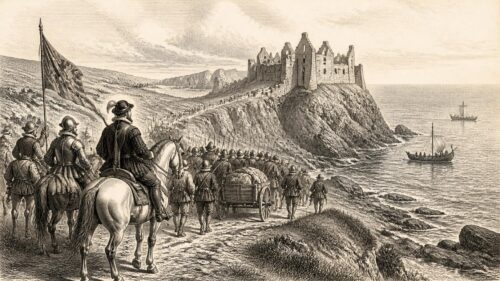
The battle traditionally called the Battle of Crew Hill belongs to a moment when the political balance of northern Ireland was unstable. Cenél nEógain, based around Ailech, pressed into the lands of their rivals, while Ulaid kings and their allies sought to maintain standing and territory. The annalistic account tells of an Ulaid defeat and a rout extending as far as Dún Echdach and Druim Bó, places usually associated by commentators with sites in County Down. If those identifications are correct, the wording implies a wide pursuit rather than combat confined to the summit itself.
This is an important corrective to visual imagination. The phrase “Battle of Crew Hill” need not mean that every participant fought on the hilltop or that the present-day road and fields exactly preserve the battlefield. Medieval battle names frequently identify a campaign or encounter by a prominent place nearby. The hill may have been the assembly centre, camp location, landmark or political objective around which warfare unfolded. Its significance in the record may arise partly because attacking there struck at the ceremonial heart of Ulaid authority.
The losses described by the annals were politically grave. Eochaid mac Ardgar’s death removed a king of Ulaid, and the fall of close relatives and regional leaders would have affected alliances far beyond a single dynasty. Later historical interpretation has seen the battle as a decisive blow to established Dál Fiatach leadership. That is a reasonable reading of the roster of casualties, but the annals themselves do not offer a neat constitutional explanation. Their immediate concern is to list the dead, preserve the humiliation of defeat and record the continued violence of the counterattack.
For Crew Hill, the battle bestowed a powerful afterlife. It tied the place to recorded names and dates and made it a site of dynastic tragedy. Local memory could therefore attach royal and martial stories to a real feature in the landscape, even when the details of those stories changed over generations. The historian’s task is not to dismiss memory because it is late, nor to repeat it as if it were a contemporary chronicle. It is to observe how written history and remembered landscape reinforced one another.
Boru Visit
Crew Hill is also associated with Brian Bóruma, better known as Brian Boru. A saga element in the tradition of the Cogadh Gáedhel re Gallaibh describes Brian’s circuit of Ireland and places him at Cráeb Telcha in 1006. The episode has long attracted notice because a visit by a claimant to high kingship would suit a major royal site in Ulster. It also accords with the wider political logic of Brian’s reign: authority was displayed through journeys, alliances, tribute, hospitality and negotiated submission, not only through conquest on the battlefield.
Yet the source demands caution. Cogadh Gáedhel re Gallaibh is a complex work, composed after Brian’s lifetime and shaped by literary as well as political purposes. It cannot be used as an unfiltered itinerary. The 2007 Queen’s University Belfast assessment of Crew Hill makes the sensible point that, even if an episode were literary invention, it could still indicate that Cráeb Telcha’s significance was understood when the narrative was composed. In other words, the passage may be valuable evidence for the reputation of the place without proving every action attributed to Brian there.
The distinction matters because Brian’s name can draw later tradition into exaggeration. There is no need to make Crew Hill the scene of a dramatic coronation, treaty or submission for the connection to be meaningful. The historical possibility that Brian visited, received hospitality or dealt with the Ulaid at a recognised royal assembly place is enough to illuminate the hill’s status. The literary record, at minimum, places Cráeb Telcha among the sites through which writers imagined the political geography of Ireland.
Sacred Tree
The most vivid episode in Crew Hill’s documented history occurred in 1099. The Annals of Ulster report that Domnall ua Lochlainn and the northern forces entered Ulaid; the Ulaid were encamped at Craeb Telcha; their mounted forces met; and the Ulaid were defeated. The victors then burned the camp and cut down Cráeb Telcha. Hostages followed. The account is unusually revealing because the cutting of the tree is narrated alongside military defeat and the taking of hostages, not as an incidental act of firewood gathering.
To destroy a politically charged tree was to attack the continuity it represented. In Gaelic inauguration practice, places, stones, wells and trees could serve as material tokens of a people’s right to rule a territory. The symbolic force did not depend upon elaborate architecture. A tree could be a living witness to precedence, ancestry and communal memory. Cutting it down at the defeated Ulaid camp announced that victory had entered the ritual as well as military sphere.
There is an illuminating sequel in 1111. The Annals of Ulster record an expedition by the Ulaid to Telach Óc, Tullaghoge in County Tyrone, where they cut down its sacred trees. Tullaghoge was the inauguration place linked with the northern Uí Néill. The parallel does not prove that the raid was formally motivated by revenge for Crew Hill, but it makes the political language of sacred trees unmistakable. These were not neutral features. To assault them was a deliberate challenge to rival sovereignty.
Local folklore at Crew Hill has retained the theme of the spreading tree, its destruction and ceremonies beneath it. Folklore is not a substitute for the annals, and it cannot tell us the species, age, exact location or ritual use of the medieval tree. Its historical interest lies elsewhere: it shows how a fragment of documented medieval meaning could remain attached to a named hill and be interpreted in later community memory. In this respect, folklore is evidence of reception and continuity, not direct proof of the early medieval ceremony itself.
Material Evidence
Several physical features have encouraged the identification of Crew Hill as an inauguration landscape. On or near the summit is the Crew Stone, a glacial erratic boulder. On the southern slope is a rock feature known locally as a stone chair or wishing chair. A bivallate rath has also been recorded, as has an apparent mound. These elements are evocative: a conspicuous stone can attract ceremonial interpretation, a chair-shaped hollow readily suggests enthronement, a rath indicates earlier settlement or enclosure, and a mound seems capable of ritual use.
Evocation, however, is not demonstration. The Crew Stone may be naturally deposited, and no secure archaeological evidence has established that a medieval ruler stood, sat or was inaugurated upon it. The stone chair has a local name and form that invite comparison with other inauguration stones, but shape and folklore cannot substitute for dated context. The rath is an important monument in its own right, yet a rath does not automatically become a royal residence, nor does every feature in an old landscape belong to one ceremonial moment.
This restraint is especially necessary because royal sites accumulate meaning. A boulder may have been a natural landmark before it became a traditional coronation stone; a later community may have used or renamed an ancient feature whose original purpose was forgotten. Conversely, absence of a carved throne or surviving platform does not disprove ritual. Gaelic inauguration could use ordinary-looking natural features precisely because authority was grounded in recognised place and community rather than in permanent monumental furniture.
Excavation Results
The most substantial modern examination of the hill arose from proposals to extend water-service facilities. Geophysical work was followed by an archaeological evaluation and excavation in 2007, undertaken under the direction of Philip Macdonald for Queen’s University Belfast’s Centre for Archaeological Fieldwork. The intervention is especially important because it tested, rather than simply repeated, the long-standing claim that Crew Hill was an inauguration site.
Investigators examined two broad areas. The first, near the summit, included the Crew Stone, linear anomalies identified by earlier magnetometry and a quarry thought possibly connected with nineteenth-century reports of stone-lined burials. The second lay on the southern slope, where a terraced area and low mound had been suggested as part of an inauguration setting. This was a targeted investigation rather than a total excavation of the hill, but it offered the chance to compare inherited interpretation with excavated stratigraphy.
The results were mixed and are valuable precisely for that reason. The excavation recovered datable material and allowed excavators to understand the sequences within their trenches, but it did not yield decisive new evidence explaining how Crew Hill functioned as a royal assembly or inauguration place. The southern mound proved to be an upstanding area of bedrock within a quarry of eighteenth- or nineteenth-century date, not a preserved ceremonial mound. That finding removed one attractive but insecure element from the reconstructed landscape.
Nor did the work establish that the Crew Stone had been adapted for royal ritual. Its significance remains possible, perhaps even plausible within the accumulated tradition of the site, but unproven. The project therefore demonstrates an essential historical lesson: an archaeologically disappointing result is not a failed result. It narrows claims, identifies later disturbance, preserves records before development and compels a clearer separation between what is known and what is imagined.
Stone Traditions
Nineteenth-century antiquarian writing added further layers to the story. James O’Laverty recorded the discovery of stone-lined burials on the summit, a report that later writers and archaeologists have treated as an indication that the hill may have attracted activity before the medieval period. The account cannot by itself establish the date, number or character of those burials. Antiquarian descriptions often lack the contextual detail expected in modern field archaeology, and the relevant ground has since been disturbed.
Modern investigation has also referred to the partial excavation of a possible Neolithic feature during an earlier evaluation on the summit. The word “possible” is crucial. Crew Hill may indeed have been a focus of prehistoric as well as early medieval activity, but the present evidence does not justify a precise prehistoric chronology or a confident narrative of continuous ritual occupation from remote antiquity to the age of the Ulaid. Such continuity is often tempting at prominent hills, yet it is a proposition requiring direct evidence.
The most defensible conclusion is both modest and significant. The hill contains or has contained features suggesting several episodes of human attention: possible prehistoric remains, enclosed settlement or land use represented by the rath, medieval political association, later cultivation, quarrying and modern utility works. Its importance was not necessarily created at one moment. Landscapes often become sacred or politically authoritative through repeated acts of recognition, in which older features are reinterpreted by later communities.
Political Geography
Crew Hill’s wider value lies in the way it complicates a map of early medieval Ireland dominated by a few celebrated centres. The classic royal sites are rightly important, but political life was also conducted at regional places whose archaeological traces are less spectacular. Cráeb Telcha shows that kingship depended upon a network of local landscapes: hills where a people assembled, churches that authenticated agreements, routes taken by armies, territories measured through tribute and cattle, and natural features invested with dynastic consequence.
The hill’s relationship to Ulaid also reveals the vulnerability of regional kingship. A royal assembly place could be a source of legitimacy, but it could equally become a target. The 1004 battle and the 1099 destruction of the tree show the danger of concentrating symbolism in a recognisable landscape. Enemies understood the language of place. To defeat an army at Craeb Telcha, burn its camp and cut down its named tree was to challenge the Ulaid at a point where political identity was visibly rooted.
That is why the records of Crew Hill should not be reduced to picturesque “coronation stone” history. The site belongs to the hard politics of alliance, warfare, hostage-taking and succession. Ritual was not separate from power; it helped make power public and intelligible. The tree, stone and hill were meaningful because people fought over the authority they represented.
Ritual Questions
What, then, can responsibly be said about inauguration at Crew Hill? The strongest conclusion is that the hill was probably an inauguration and assembly place of the Ulaid, particularly associated with the Dál Fiatach political world. The case rests on the identification of Crew with Cráeb Telcha, the hill’s prominent setting, the documented significance of its tree, later local tradition, and features comparable in broad form to elements known at other Gaelic inauguration landscapes.
What cannot responsibly be said is equally important. There is no surviving medieval description setting out the precise order of a Crew Hill inauguration. We cannot securely name the exact stone used, prove that the so-called stone chair seated a king, locate the tree to a particular square metre, or state that a particular mound was a coronation platform. The 2007 excavation did not discover material evidence that resolves those questions. Romantic certainty would make a better tourist tale, but poorer history.
Interpretation remains possible when it is clearly marked as interpretation. It is reasonable to infer that the visible hill, a distinctive tree and perhaps particular stones created a setting appropriate to public political ritual. It is reasonable to see the cutting of the tree in 1099 as an assault on Ulaid sovereignty. It is not reasonable to fill the gaps with invented ceremonies, robes, oaths or precise prehistoric origins. The power of Crew Hill lies not in an imagined pageant but in the fragmentary evidence that tells us why such a place mattered.
Later Landscapes
After the twelfth century, Cráeb Telcha recedes from the principal narrative sources. This does not mean that the hill ceased to matter locally, but it does mean that historians should avoid claiming an unbroken documented political role. The name survived, the land was cultivated and occupied, and traditions continued to gather around the stone, chair, rath and summit. In time, antiquarians and local historians attempted to knit those survivals into a coherent account of the kings of Ulster.
Such accounts have preserved useful observations and local memory, but they also demonstrate how easily categories blur. “Kings of Ulster” may be used broadly where early sources speak more precisely of the Ulaid; dates may be simplified; Brian Boru’s connection may be told with more assurance than the sources allow; and every unusual rock may become a relic of coronation. The proper response is not contempt for local history. Local custodians often saved names and stories ignored elsewhere. Rather, their claims should be compared patiently with annals, place-name research and field evidence.
The modern reservoir and related development give the site another historical dimension. They show that archaeological landscapes are not preserved outside time. Public infrastructure, agriculture and private landholding shape what can be seen and investigated. The 2007 work, although unable to confirm a detailed inauguration ritual, ensured that the potential impact of development was assessed and that observations were formally recorded. That is a meaningful form of stewardship for a place whose principal evidence is dispersed across earth, texts and memory.
Historical Legacy
Crew Hill deserves attention not because it supplies easy answers but because it preserves an unusually rich historical problem. It is a named height in County Antrim, plausibly and persuasively linked to Cráeb Telcha of medieval Irish record. It was the setting of a major conflict in 1004, was associated in literary tradition with Brian Boru’s circuit of Ireland, and was the scene of a symbolic act of destruction in 1099 when the Cenél nEógain cut down its tree. Its later reputation as an inauguration place is supported, though not exhaustively proven, by the convergence of these materials.
Its story also widens the frame of Irish history. Political authority in medieval Ireland was grounded in landscapes as much as in pedigrees. A royal people required places where legitimacy could be enacted, contested and remembered. At Crew Hill, a tree could stand for sovereignty, a hill could hold an assembly, and a military victory could become a ritual insult. The surviving evidence is incomplete, but it is sufficient to reveal a place that mattered deeply to the Ulaid and their rivals.
Evidence Boundaries
The responsible history of Crew Hill must leave some questions open. Archaeology has not confirmed every traditional feature, the annals do not narrate a full inauguration rite, and literary references cannot be read as literal reportage. Nor can the hill be assigned a securely dated prehistoric ceremonial origin on present evidence. These limitations should be understood as part of the site’s character rather than as defects to conceal.
What survives is compelling enough: a well-supported place-name identification, medieval references to conflict and sacred destruction, traditions of royal assembly, and a physical landscape in which natural and man-made features have attracted repeated attention. Crew Hill remains a rare witness to the regional politics of Gaelic Ulster. Its summit asks not for credulity but for disciplined imagination: enough imagination to see why power might gather on a hill, and enough discipline to distinguish the record from the legend.



Most striking is the article’s treatment of the felled tree in 1099 as a political act: alongside defeat, camp burning and hostage-taking, its destruction may have targeted Ulaid claims to territory and rule. The later Ulaid raid on Tullaghoge’s sacred trees suggests a shared language of sovereignty, yet archaeology cannot reconstruct the ceremonies associated with Crew Hill’s tree, stone or chair. This leaves a tension between recorded symbolic violence and uncertain ritual practice. How far should historians interpret the attacks on trees at Crew Hill and Tullaghoge as deliberate reciprocal statements about kingship, rather than wartime acts with symbolism added?