
Manorial Ireland
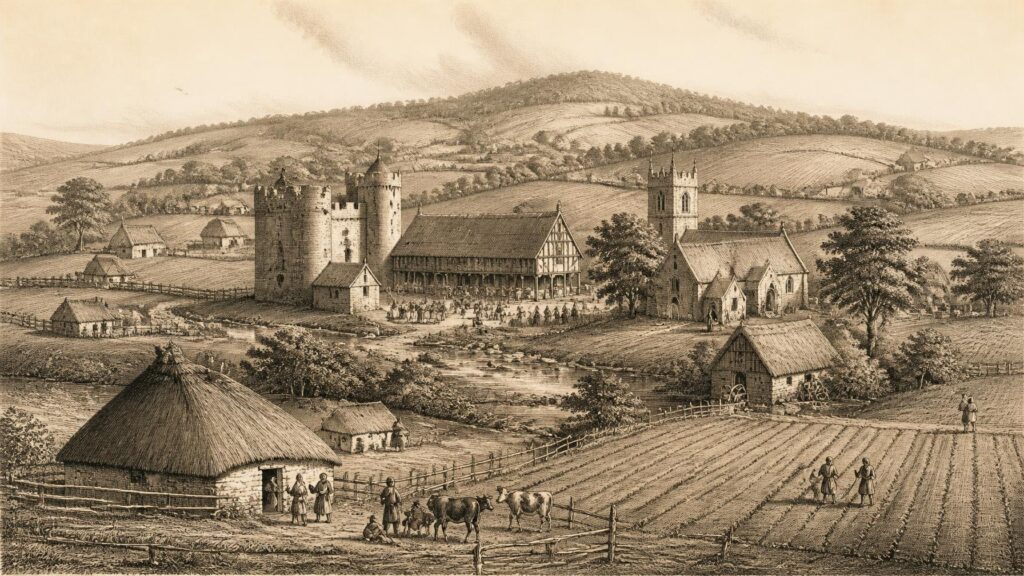
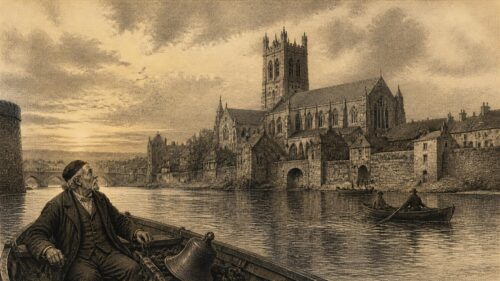
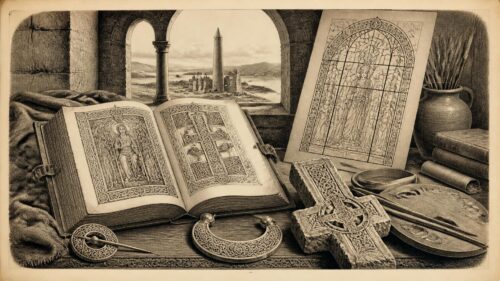
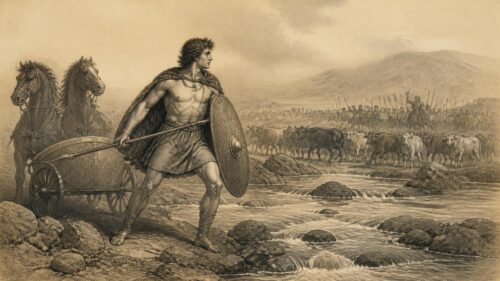
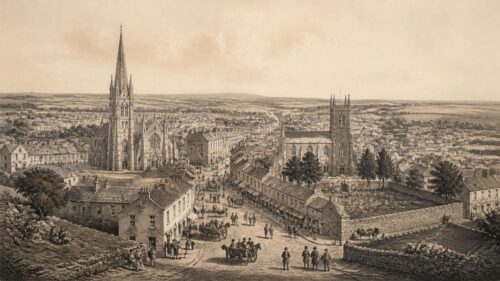
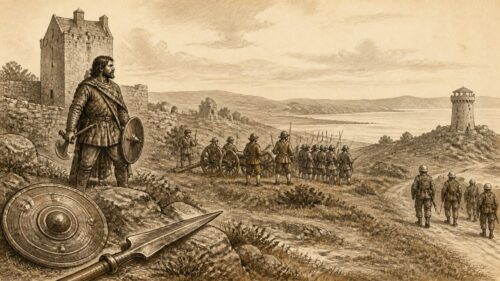
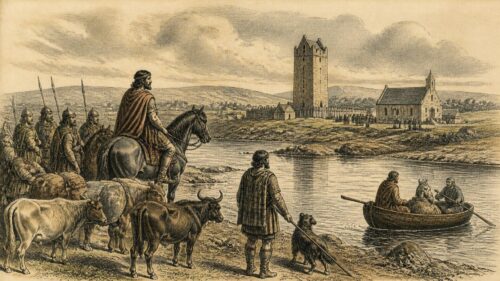
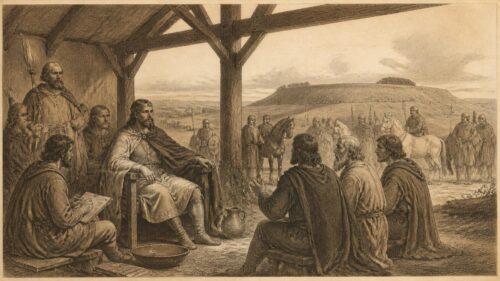
AI generated historical illustration, not a contemporary photograph.
At a Glance
A manor in Ireland was never simply a large house, nor was it a uniform national institution. It was a territorial, economic and judicial arrangement introduced and developed most conspicuously after the Anglo-Norman invasion, then adapted across centuries of conquest, accommodation and estate management. In some districts it organised fields, tenants, courts, churches and castles; in others it was thinly established or sat beside older Gaelic forms of lordship. Its surviving traces reveal not one Ireland, but several overlapping rural worlds.
Changing Meanings
The modern use of “manor” can obscure its historical complexity. A manor house may suggest a country residence, a landscaped demesne and the social pretensions of the eighteenth or nineteenth century. Medieval usage meant something wider and more exacting. A manor was an estate over which a lord exercised rights connected with land, rents, labour, local regulation and, often, a court. It might include the lord’s demesne land, worked for his benefit; holdings occupied by tenants; a settlement or borough; a parish church; mills, fisheries, woods and pasture; and a centre such as a hall, castle, motte or later tower house.
That definition must be used cautiously in an Irish setting. Historians generally associate the introduction of the manor, in its recognisably English feudal form, with the Anglo-Norman expansion beginning in 1169–70. The institution endured for a remarkably long period, but it was neither imposed evenly nor preserved unchanged. It was strongest in regions where English lordship was entrenched: parts of Leinster, Meath, Munster, the south-east and the Dublin hinterland. Elsewhere, especially beyond the more securely colonised districts, landholding and jurisdiction developed through different combinations of Gaelic lordship, church lands, tribute, clientship and military service.
For that reason, “Manorial Ireland” should not imply that every Irish community lived under a manor. It denotes a substantial but geographically and socially uneven strand in Irish history. The manor was one of the mechanisms through which settlers, ecclesiastical corporations and aristocratic families sought to make land productive, populations governable and claims to authority durable. It also became a meeting ground between imported legal language and Irish realities.
The physical evidence is similarly varied. Some manors can be read in surviving earthworks, parish patterns, deserted settlement sites, field boundaries and castles. Others survive principally in parchment: charters, rentals, extents, inquisitions, court proceedings and estate correspondence. Many have been transformed so thoroughly by later agriculture, enclosure, urban growth and rebuilding that documentary evidence offers the clearer guide. The study of Irish manors is therefore necessarily interdisciplinary, drawing on archaeology, landscape history, medieval legal history and archival research.
Colonial Beginnings
The Anglo-Norman arrival did not bring an empty landscape awaiting organisation. Ireland before 1169 possessed sophisticated political and territorial arrangements, though they differed from the models familiar to incoming lords. Kingship and lordship operated through kin groups, client relationships, tribute, ecclesiastical patronage and control of strategically important territories. Land rights could be layered and negotiated. The later manor was not laid across blank ground: it entered a country with established communities, churches, routes, cultivated land and competing claims of power.
After the initial campaigns, grants of land created lordships of exceptional scale. Powerful magnates, religious houses and bishops received or asserted authority over territories, and below them came knights, free tenants, burgesses and other settlers. The manor gave practical shape to this hierarchy at local level. It identified the lord’s resources, defined tenures, assembled obligations and created a jurisdiction through which disputes and routine administration might be handled.
In the most straightforward model, a lord retained a demesne and granted other parcels to tenants in return for rent, service or specified duties. In practice, Irish arrangements were rarely so tidy. Estates changed hands through inheritance, marriage, forfeiture, royal intervention, warfare and settlement. Holdings were divided, leased, abandoned and reoccupied. Lords often possessed scattered properties rather than compact blocks of land. The language of manor, fee, liberty and barony could overlap without meaning precisely the same thing.
Nor should the manor be reduced to agriculture. It was a political instrument. A lord who could require attendance at court, collect rents, regulate mills or markets, establish borough privileges and command service possessed more than land. He possessed a local framework of authority. Its strength depended, however, upon the lord’s capacity to enforce it. In areas exposed to warfare or lying beyond regular royal administration, formal claims could be fragile. The manorial system was always shaped by the balance between paper rights and power on the ground.
Documentary records show that ecclesiastical institutions were among the most important manorial lords. The archbishops of Dublin held a group of manors known later as the Crosslands, associated with places including Swords, Clondalkin, Finglas, Rathcoole, Tallaght and Shankill. Their holdings were not merely sources of income. They formed a jurisdictional landscape in which tenants owed rents and, in some places, suit and service at a manor court. Such examples demonstrate that medieval lordship in Ireland cannot be understood as a simple division between secular conquerors and an uninvolved Church. Bishops, chapters and religious houses were major landholders and administrators.
Landscape Patterns
Irish manorial landscapes were not replicas of English villages. The common image of a compact village surrounding an open-field system applies imperfectly and selectively. Some medieval estates did possess nucleated settlements, planned boroughs and regular field arrangements. Other manors were more dispersed, their tenants living in scattered farmsteads, small hamlets or older settlement patterns. Local soils, topography, security, lordly investment and the density of colonisation all mattered.
The relationship between castle, church and settlement is especially important. Archaeologists and historians have often treated the combination as a useful starting point for locating a manorial centre. A fortified site proclaimed lordship and provided defence or residence. A church supplied spiritual authority, burial space and a focus for community. A settlement brought tenants, craftsmen and exchange. Yet the presence of all three does not automatically prove a manor, and their absence does not disprove one. Buildings were rebuilt, churches pre-dated the conquest, and settlement might shift over time.
Knocktopher in County Kilkenny offers a particularly revealing case. Its medieval evidence has been studied as a manorial settlement rather than merely as an isolated castle site. The lordship included a complex network of relationships: castle, manor, parish, borough, tenants and court. The significance of the place lies in that combination. A motte or later fortification was not simply a military object; it could be the focal point of an estate designed to alter the organisation of surrounding society.
The manor of Dowth in County Meath illustrates another possibility: the conjunction of documentary detail and landscape survival. Meath was intensively affected by English settlement in the twelfth and thirteenth centuries. A surviving inquisition following the death of a lord in 1253 recorded the resources and values of Dowth, including demesne and tenant holdings. Such manorial extents are unusually valuable because they offer a structured glimpse of an estate at a particular moment. They do not show every aspect of lived experience, but they reveal how a lord’s officials classified productive land, income and obligation.
Field archaeology complicates the documentary view. The familiar terms in a written extent may describe arrangements whose physical form has vanished; conversely, ridge-and-furrow cultivation, earthworks, boundaries and hollow ways may preserve activities not directly recorded. Interpretation requires restraint. It is tempting to label every medieval earthwork a “manor site” or every later substantial house a “manor house”. Better practice is to distinguish observation from inference: a platform, enclosure or ruined wall is material evidence; its identification as a hall, grange, village or court site remains an argument to be tested against documents, dating evidence and comparison.
Lordly Centres
At the heart of a manor stood not always a grand residence but a centre of management. In the early phases of colonisation this could be a timber hall, defended enclosure or motte-and-bailey. Stone castles later became more common in some lordships, while ecclesiastical manors might be administered from a residence associated with a bishop, cathedral or religious community. The architectural form changed because the demands of lordship changed: security, display, domestic comfort and administrative needs did not remain constant.
The word “demesne” is central to understanding the lordly centre. It referred to land held for the lord’s own use, rather than land granted to tenants. Demesne might include arable fields, meadow, pasture, woodland, mills, fisheries and a home farm. Its cultivation could depend on direct labour services, hired workers, leasing arrangements or some mixture of these. The balance was not fixed. Economic opportunity, labour supply, war and changing agricultural practice could prompt lords to alter the way they exploited their lands.
A manorial centre could also serve as a point of collection. Grain, livestock, rents in money or kind, and other dues moved towards the lord’s estate administration. Mills were particularly significant because tenants could be obliged or encouraged to have grain ground there, turning a practical necessity into an income stream. Markets and fairs, where they existed by grant or custom, placed the lord within wider circuits of trade. The manor was thus a unit of rural authority, but not necessarily a self-sufficient one.
The surviving records of the Butler and Ormond estates are crucial to this history. The Ormond deed collections include charters, rentals, judicial material and documents relating to the Liberty of Tipperary, Kilkenny and adjacent regions. They show the extraordinary documentary reach of one aristocratic interest, but also the unevenness of survival. What historians know best is often what powerful families preserved. The archive is not a neutral map of medieval Ireland; it is evidence filtered by lordship, literacy, preservation and loss.
That qualification matters especially because the destruction of the Public Record Office in Dublin in 1922 devastated the Irish archival inheritance. Not every relevant record perished, and surviving private, ecclesiastical and British repositories are substantial. Nevertheless, lost court rolls, rentals, registers and title records leave unavoidable gaps. The absence of a manorial record is not proof that a manor did not exist. Equally, a scattered reference to a “manor” does not by itself reveal its full social or economic workings.
Tenant Lives
The manor was experienced most directly by those who paid rents, attended court, farmed plots, used common resources or bore duties to a lord. Yet “the tenants” were not a single class. Free tenants might hold land on terms that brought them into formal legal and military relationships with the lord. Burgesses in a manor town could hold distinctive privileges. Other occupiers had more restricted or dependent tenure. Labourers, servants and people with precarious access to land appear less clearly in surviving records, although their work was essential to estate life.
Medieval legal categories can be misleading if treated as complete portraits of identity. A person’s practical position depended on gender, family, wealth, language, local alliances, status and access to courts as well as on the name assigned to a tenure. Recent work on legal identity in thirteenth-century English Ireland has stressed that broad labels such as “English” and “Gael” can conceal the complexity found in actual litigation. The legal world of the lordship was not simply a binary contest between two homogeneous peoples.
The same caution applies to cultural change. The settlers who created early manorial structures were not identical to their descendants. By the later Middle Ages, many families of Anglo-Norman origin had deep local connections, spoke Irish as well as English or French-derived forms of speech, married across cultural boundaries and adapted to regional political conditions. Meanwhile, Gaelic lords engaged with castles, charters, markets and forms of landholding associated with the colonial world. The manor was one arena in which such exchanges occurred, though it did not erase inequality or conquest.
There were also practical grounds for negotiation. A lord needed tenants, rents and local peace. Tenants needed land, protection, access to pasture, mills, markets and a forum for grievances. These interests could align, but often did not. Arrears, disputed boundaries, inheritance claims, assaults, unpaid services and rights of access generated conflict. The surviving documentary record tends to preserve the moments when routine arrangements broke down, which means historians must not mistake recorded disputes for the entirety of daily life.
Women are visible intermittently in manorial documentation: as widows, heirs, landholders, litigants, tenants and parties to family settlements. Their appearance is often governed by property law and inheritance rather than by a full account of their work or social authority. Nevertheless, their presence corrects any assumption that a manor was a world inhabited only by male lords and male tenants. Household labour, food production, care, craft work and the management of holdings during absence or widowhood all underpinned estate society.
Court Authority
The manor court was among the clearest expressions of local lordship. It could hear matters connected with tenures, rents, boundaries, small debts, local order and customary obligations. Attendance itself mattered. To owe “suit of court” was to recognise a jurisdiction and to participate, willingly or otherwise, in its operation. Courts also supplied the lord with fees, information and a public mechanism for making local decisions.
They should not, however, be imagined as omnipotent. The jurisdiction of a manor court was constrained by royal law, by competing ecclesiastical authority, by the privileges of liberties and boroughs, and by political reality. Some serious pleas belonged to royal courts. In regions where royal justice was irregular, local courts might assume greater importance; where central institutions were strong, their scope could be curtailed. The distinction between what a court was entitled to do and what it actually managed to do must remain open.
Knocktopher again provides unusually good evidence. Its manorial court had roots in the early period of settlement, and later records show tenants still owing suit. By the fifteenth century juries of free tenants could be involved in proceedings over free tenements. The court continued into the early modern period, with evidence for a sitting in 1676. This longevity is significant. It demonstrates that the manor court was not a brief colonial experiment abandoned after the Middle Ages, but an institution capable of adapting to changing social conditions.
Yet court records are exceptionally scarce in Ireland compared with England. One explanation is that manor courts were not necessarily courts of record in the modern sense, so their proceedings had less reason to be copied and preserved systematically. The greater explanation is archival survival. Records were dispersed in private muniment rooms, damaged, neglected or destroyed. Consequently, historians often reconstruct court activity from charters, later deeds, references to suit, inquisitions and isolated rolls rather than from continuous series.
This scarcity has encouraged folklore and overstatement. Local traditions sometimes identify a particular field, mound or building as a court site. Such traditions may preserve genuine memory, but they require corroboration. A named “court hill” can be valuable evidence of later communal remembrance, not automatic proof of a medieval manor court. Conversely, formal court activity may have occurred in spaces that left no visible monument. The responsible history of manorial justice acknowledges both the evocative power and the evidential limits of local tradition.
Gaelic Contexts
The history of the manor is inseparable from the history of Gaelic Ireland precisely because the two were not identical. Before and after the Anglo-Norman invasion, Gaelic territories were structured through lordships whose economic and political foundations differed from the classic English manor. Terms such as túath, rí, ceann fine and clientship belong to a different legal and social vocabulary. Authority was linked to kinship, tribute, cattle, hospitality, military following and the claims of ruling lineages.
It would be wrong to present these systems as static or isolated. Medieval Ireland was connected by trade, warfare, Church organisation, migration and diplomacy. Gaelic lords borrowed, resisted and refashioned institutions associated with newcomers. Anglo-Irish lordships themselves became culturally mixed. Nevertheless, the difference matters. Calling every major Gaelic residence a manor, or treating every Irish territorial lordship as a feudal estate, flattens historical evidence and obscures indigenous forms of governance.
Church lands form a particularly revealing bridge. Ecclesiastical estates existed long before the arrival of Anglo-Norman lords, and early medieval churches could hold extensive resources and exercise authority over dependent communities. In areas incorporated into the lordship, bishops and religious houses could organise their lands through manorial forms, leases and courts. The archiepiscopal Crosslands around Dublin show this transformation vividly. Older ecclesiastical property and newer legal frameworks could coexist within a single institutional landscape.
The result was not a simple replacement of Gaelic society by a manorial order. It was a long history of coexistence, conflict and accommodation. In some areas manors became durable structures; in others they were absorbed into wider lordships or altered beyond easy recognition. The most useful interpretation sees the manor as one important framework among several, rather than as the sole key to rural Ireland.
Estate Transformations
By the sixteenth and seventeenth centuries, many medieval forms of tenure and jurisdiction were being reshaped. Tudor conquest, the expansion of central government, the Reformation, confiscation, plantation and war transformed landholding on a vast scale. The vocabulary of manor did not disappear, but its practical content changed. A manor might survive as a title, a unit of conveyance, a court jurisdiction or an inherited description while the economic relations beneath it altered.
Plantation reinforced the use of surveyed, legally defined estates in confiscated regions. New landowners required maps, leases, rentals and agents. Some estates took on features familiar from English and Scottish practice, but local conditions remained decisive. Dispossession, settlement, military insecurity and demographic change meant that the history of an estate could not be separated from the violence through which it was assembled.
The Civil Survey of the 1650s is an important source for this transformed world. Compiled in the aftermath of conquest, it recorded ownership, land quality, boundaries, buildings and claims across much of Ireland. It is indispensable, but it is not innocent. Its categories served a regime of confiscation and redistribution. When it describes a manor, a castle, profitable land or an owner, it provides evidence while also reflecting the administrative purposes of the Commonwealth state.
In County Dublin, the Civil Survey preserves information about the archbishop’s former manorial jurisdiction and the continuing obligation of suit and service in places connected with Swords and other Crosslands. The source shows how medieval institutional language could remain meaningful in the mid-seventeenth century. It also reveals continuity only in a qualified sense: the jurisdiction was being described after enormous political and ecclesiastical upheaval, not carried forward unchanged from the thirteenth century.
Later estate papers provide a different kind of testimony. Leases, rent rolls, account books, correspondence, maps and agents’ reports make it possible to reconstruct aspects of landlord-tenant relations from the seventeenth through nineteenth centuries. The National Archives of Ireland holds many such collections, though surviving material is dispersed among repositories and private hands. Estate maps can record tenant names, field names, woodland, demesne planting and divisions of land with a precision unavailable in many earlier sources.
Modern Survivals
By the nineteenth century, the manor’s medieval judicial vitality had largely faded, though some manor courts endured surprisingly late. The word survived more readily in property titles, place names and the language of estates than in the full bundle of medieval rights. At the same time, the power of landed estates over Irish rural society could be immense. It would be inaccurate to treat that power as simply medieval manorialism reborn. Nineteenth-century landlordism rested on modern law, market forces, state administration and changing patterns of tenancy, even where old manorial terms remained in use.
The records generated by the nineteenth-century state allow historians to observe property and occupation in new ways. The Tithe Applotment Books of 1823–37 identify occupiers of agricultural land liable for tithes in many parts of Ireland. Griffith’s Primary Valuation and its associated field, house, tenure and quarto books provide another detailed record of occupiers, landlords, buildings and rateable property. They are not manorial records in the medieval sense, but they illuminate landscapes once shaped by manorial and estate structures.
These sources also resist romantic simplification. The country house, demesne wall, gate lodge and tree-lined avenue can evoke a picturesque past, but they belong to histories of rent, hierarchy and frequently severe social inequality. The Great Famine, eviction, emigration, land agitation and land reform changed the ownership and meaning of estates profoundly. A surviving “Manor House” name may preserve a memory of lordship, but the history behind it may include medieval settlement, plantation title, nineteenth-century improvement or later reinvention.
Place names remain valuable clues. Names containing “manor”, “court”, “demesne”, “castle” or “grange” may point researchers towards former estates or remembered functions. They cannot be read literally without further evidence. A modern housing development called Manor Park tells little by itself; a nineteenth-century map labelling a manor house may describe a comparatively recent residence; an early deed using the term may preserve a much older jurisdiction. Good local history begins with the name but does not end there.
Historical Evidence
The Irish manor is recoverable only through a critical combination of sources. Medieval extents can set out lands, values and tenants at one moment. Charters reveal grants, obligations and claims. Court documents expose disputes and procedures. Ecclesiastical accounts can illuminate church lordship. Archaeology traces buildings, cultivation and settlement. Estate papers document later property management. Maps and valuation records allow earlier landscapes to be compared with nineteenth-century patterns.
Each source has a bias. Extents view land through lordly value; court material privileges dispute; surveys impose official categories; estate correspondence gives prominence to owners and agents; archaeology rarely identifies individuals by name. A complete account of tenant experience is seldom possible. This is not a reason for abandoning the subject, but a reason to write with disciplined uncertainty.
The most secure conclusion is that manors mattered greatly in many parts of Ireland for centuries. They organised land and authority after the Anglo-Norman arrival, supplied ecclesiastical and aristocratic lords with income and jurisdiction, and left marks on settlement, records and memory. Their significance varied by region and period. They interacted with, rather than wholly displaced, Gaelic systems. Their structures endured in altered forms long after the medieval world that produced them had passed.
The manor therefore deserves to be understood not as a picturesque relic or an imported template mechanically imposed upon Ireland, but as a changing institution embedded in conquest, accommodation, religion, agriculture, law and local life. Its history is a history of power, but also of negotiation: between lords and tenants, written claims and physical landscapes, inherited custom and new authority. In that tension lies its enduring importance to the Irish past.
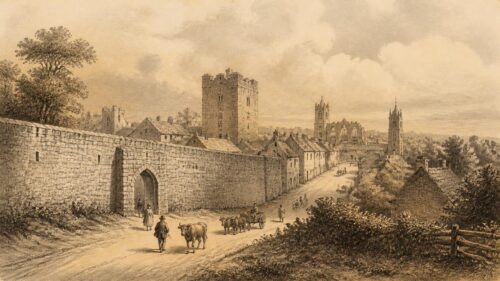
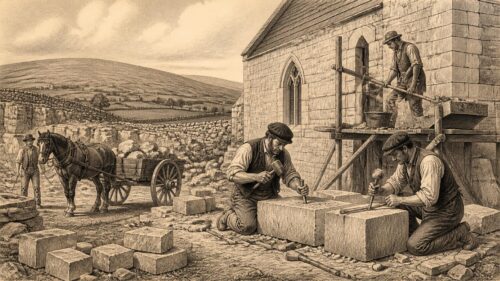
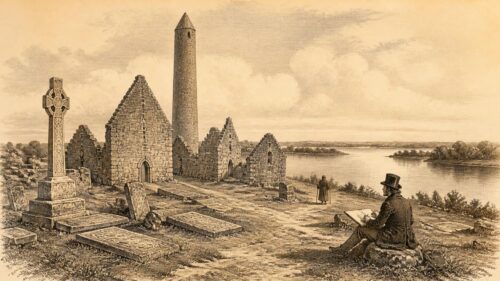
Most striking is the article’s insistence that manors were neither uniform institutions nor simple replacements for Gaelic lordship. At places such as Knocktopher and Dowth, castles, courts, tenants and landscapes can suggest organised estate authority, yet surviving evidence is partial and often filtered through elite archives. This raises an important interpretative challenge: how can historians recognise interaction, adaptation and negotiation between imported manorial practices and existing Irish systems without treating either tradition as fixed or homogeneous? What combination of archaeological evidence, records and landscape study would reveal how tenants experienced these overlapping forms of power in regions of medieval Ireland?