
Independence Origins
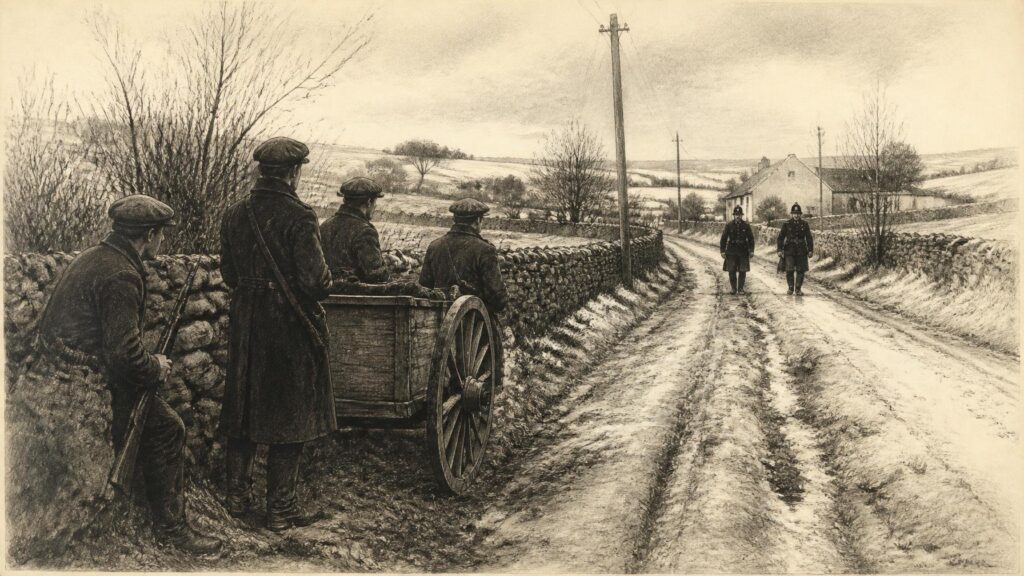
AI generated historical illustration, not a contemporary photograph.
At a Glance
The Irish War of Independence was not caused by one ambush, one proclamation, or one political grievance. It emerged from the collision of a long unresolved constitutional question with the disruptive force of the First World War, the militarisation of Irish politics, the radicalising consequences of the Easter Rising, the conscription crisis of 1918, and the rival claims to legitimacy made by Dáil Éireann and the British state. By January 1919, a substantial section of Irish nationalist opinion had ceased to believe that constitutional reform at Westminster could deliver an acceptable settlement. Armed conflict was neither automatic nor unanimously desired, but it became possible because political authority had fractured and because organised men were prepared to act upon that fracture.
Essential Question
To ask what caused the Irish War of Independence is to ask two related, but distinct, questions. The first concerns the deeper origins of the struggle: why did so many people in Ireland come to reject government from Westminster and demand an Irish republic? The second concerns the immediate descent into violence: why did that political demand turn into a guerrilla campaign between 1919 and 1921?
A satisfactory answer must resist a simple tale of inevitable national awakening. Ireland had contained competing political identities, religions, economic interests and regional experiences for generations. Many nationalists had previously sought Home Rule rather than complete separation from the United Kingdom. Many unionists, especially but not exclusively in north-east Ulster, opposed Home Rule and wished to remain within the Union. Others placed labour, land, religion, local security or family interest above high politics. The war developed amid these divisions, rather than sweeping them away.
Nor was the conflict a single, uniform rising. It was called at the time the Anglo-Irish War by many British commentators and the War of Independence by Irish republicans and later Irish state tradition. The latter title expresses the political objective of the republican movement, but it should not obscure the complexity of the period. Fighting was intense in some counties and limited in others. Dublin’s intelligence war, the mobile columns of Munster, agrarian tensions in parts of the west, and sectarian conflict in Belfast all formed parts of a wider revolutionary crisis, yet they did not have identical causes.
The best explanation therefore combines structure and contingency. The constitutional crisis before 1914 supplied the long grievance. The First World War created the conditions in which ordinary politics was suspended, armed organisations grew and imperial authority became more vulnerable. The Rising of 1916 changed the emotional and political climate. Conscription transformed a threatened British policy into a national mobilisation against Westminster. Sinn Féin’s electoral victory supplied a democratic claim to authority. Finally, the decision of Volunteers and republican leaders to resist British rule by force, and Britain’s determination to defeat that challenge, turned a contested mandate into war.
Union Legacy
The background lay in the Union of Great Britain and Ireland, which had taken effect in 1801 and abolished the separate Irish parliament. During the nineteenth century, campaigns for Catholic emancipation, land reform, local government and national self-government repeatedly exposed the limitations of governing Ireland from London. By the late Victorian period, Charles Stewart Parnell’s Irish Parliamentary Party had made Home Rule—the restoration of an Irish legislature with restricted powers—the central constitutional demand of Irish nationalism.
Home Rule was not republicanism. It accepted the Crown and envisaged Ireland remaining within the United Kingdom. Its importance lies precisely in showing that independence was not the only conceivable nationalist objective before the war. For decades, parliamentary nationalists believed that disciplined representation at Westminster could secure self-government. Their strategy also rested on an electorate broadened by reform, local political organisation and an assumption that the British Liberal Party could be persuaded or compelled to legislate.
That strategy encountered determined unionist opposition. Ulster unionists feared that a Dublin parliament dominated by Catholic nationalists would threaten their political power, economic ties with Britain and religious liberty. The fear was strongest in the industrial north-east, where unionism drew upon a substantial Protestant population and a distinctive regional economy. The formation of the Ulster Volunteer Force in 1913, and the importation of arms at Larne in 1914, demonstrated that constitutional arguments had acquired a military edge.
Nationalists responded with the Irish Volunteers, founded in November 1913. Their stated purpose was to secure the rights and liberties common to the people of Ireland, but their creation introduced a second armed volunteer force into an already unstable political situation. The organisation contained constitutional nationalists, cultural nationalists and advanced separatists. Its membership was not a ready-made revolutionary army, and many members later followed John Redmond’s call to support the British war effort. Yet the Volunteers furnished the institutional framework, military language and leadership networks from which the later IRA developed.
The pre-war crisis thus matters for two reasons. It convinced many people that the question of Irish self-government could not simply be left to normal parliamentary procedure; and it normalised the idea that political communities might arm themselves to secure their constitutional future. That did not make a republican war unavoidable. It did, however, make the use of force more imaginable when the promised constitutional settlement failed to arrive.
Broken Promise
The Government of Ireland Act received royal assent on 18 September 1914. For supporters of the Irish Parliamentary Party, this was the reward for decades of constitutional effort. Yet on the same day, a Suspensory Act postponed its operation because Britain had entered the First World War. Home Rule was therefore enacted but not implemented. It would never come into force in the form envisaged in 1914.
The suspension was initially presented as temporary. Redmond and many nationalist supporters believed that conspicuous Irish loyalty during the war would ensure the measure’s implementation afterwards. Large numbers of Irishmen enlisted in British forces for varied reasons: loyalty to the Empire, support for Belgium, economic need, local pressure, a belief in defending small nations, or confidence that service would strengthen the Home Rule cause. Their service is an essential part of the history. The revolutionary period cannot accurately be understood as a unanimous Irish rejection of Britain or of the war.
Nevertheless, delay weakened confidence in the parliamentary route. The longer the war lasted, the harder it became to restore the political conditions of 1914. Proposals for temporary exclusion of Ulster counties, and repeated negotiations that failed to settle the issue, made Home Rule appear less like a fulfilled promise than a receding and compromised one. To advanced nationalists, partition was evidence that Westminster could not or would not recognise Ireland as a political unit. To unionists, meanwhile, any settlement that endangered their position remained unacceptable.
War also enlarged the powers of the state. Censorship, emergency regulations, arrests and military administration altered the relationship between citizens and government. Some of these measures were common to wartime Britain, but in Ireland they operated against a background of suspicion, a divided constitutional crisis and a powerful tradition of resistance to coercion. The language of defending democracy abroad sat uneasily beside the withholding of self-government at home. That contradiction later became one of Sinn Féin’s strongest arguments.
It would be misleading to say that the suspension of Home Rule alone caused the War of Independence. A delay caused by a European war did not necessarily require a revolution. But the episode damaged the authority of the Irish Parliamentary Party, whose central claim was that patience and constitutional loyalty would work. When a new generation judged that this promise had failed, it inherited volunteer organisations already capable of taking a more militant course.
War Radicalism
The First World War was the great accelerant of the Irish crisis. It brought military training, weapons, censorship, emergency power and political uncertainty. It also created a wider international language of national self-determination. President Woodrow Wilson’s rhetoric was not a straightforward guarantee of independence for all subject peoples, but Irish nationalists invoked it effectively after 1918. They asked why the principle should apply to central and eastern Europe but not to Ireland.
Within Irish nationalism, the war divided those who believed that participation would advance Home Rule from those who believed that Britain’s military difficulty presented an opportunity for separation. The Irish Republican Brotherhood, a secret revolutionary organisation, worked inside elements of the Irish Volunteers. A minority of Volunteers rejected Redmond’s call to enlist and retained the original name. That minority was small in comparison with the wider nationalist population, but it preserved an armed separatist nucleus through which a rebellion could be organised.
The 1916 Rising was planned by republican conspirators who hoped to proclaim an independent republic while Britain was preoccupied by continental war. Militarily, it failed. The insurgents held buildings in Dublin and fought for less than a week before surrendering. Outside Dublin, action was uneven and limited. At first, many observers and members of the public reacted with anger at disruption, destruction and civilian suffering, rather than with enthusiasm for the rebels.
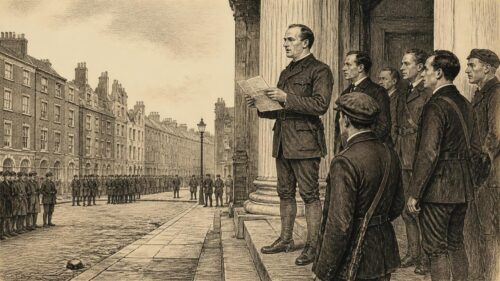
Those immediate reactions are important because they correct later mythology. The Rising did not reveal an already unanimous popular demand for war. It was the act of a determined minority, and its leaders knew that they could not count on universal support. Their Proclamation asserted a republic and claimed to speak for the Irish people, but that claim had not been put to an election.
Yet the Rising’s defeat did not end its influence. The British response converted a suppressed insurrection into a political catalyst. The execution of fifteen leaders in May 1916, together with mass arrests, deportations and the imposition of martial law, generated sympathy far beyond the insurgents’ original following. The National Archives’ material on the courts martial makes clear that the speed and secrecy of the proceedings, as well as the severity of the punishments, damaged British credibility among many nationalists. Repression did not create republican feeling from nothing; rather, it gave it martyrs, symbols and an organised cadre of former prisoners.
Rising Aftermath
The political consequences of 1916 unfolded gradually. The mistaken popular habit of describing the Rising as a Sinn Féin rebellion has obscured the position at the time: Sinn Féin had not organised it. But the party became the principal beneficiary of the changed atmosphere. It offered an electoral vehicle for separatists, former prisoners, cultural nationalists and voters disillusioned with the Irish Parliamentary Party.
In 1917, republican candidates won a sequence of significant by-elections. These contests did not prove that every voter had become a separatist, nor did they erase local considerations. They did show, however, that the old parliamentary leadership no longer possessed an unquestioned monopoly on nationalist representation. The release of prisoners and the reorganisation of the Irish Volunteers helped bind electoral politics to a more militant underground movement.
British policy repeatedly assisted this transformation. Attempts to negotiate a revised Home Rule settlement foundered over Ulster and over the terms of exclusion. The Irish Convention of 1917–18 failed to secure an agreed constitutional formula. Its failure strengthened the argument that an Irish solution could not be reached within the existing British framework. The old nationalist strategy seemed trapped between British delay and unionist veto.
This did not mean that people joined Sinn Féin for one reason. Some were motivated by the memory of executions; others by distrust of the administration, attachment to Gaelic culture, dissatisfaction with economic conditions, hostility to recruitment, local political rivalries or a belief that Ireland should determine its own status. The movement’s strength was its ability to gather these motives beneath the broad claim of national self-determination.
Interpretation requires care here. The Rising may be described as a turning point, but it was not a magical cause. Historians differ in emphasis. Some give greatest weight to the executions and coercion of 1916; others stress the later conscription crisis as the decisive mass mobilisation; still others underline the erosion of the Irish Parliamentary Party during the war. The evidence supports a cumulative explanation. Without 1916, Sinn Féin would have lacked much of its revolutionary prestige and personnel. Without the events of 1918, it might not have converted that prestige into a commanding electoral position.
Conscription Crisis
The immediate political breakthrough came in 1918. In April, the British government sought to extend conscription to Ireland as part of a wider response to the German offensive on the Western Front. The policy was linked to a proposed Home Rule arrangement, but its political effect was disastrous. A population that had not accepted compulsory service was now asked to provide men for a war directed by a parliament that had failed to establish Irish self-government.
Opposition was strikingly broad. Sinn Féin, the Irish Parliamentary Party, the Labour movement and the Catholic hierarchy joined the anti-conscription campaign. A general strike took place on 23 April 1918. The strength of the protest did not demonstrate that all participants endorsed an Irish republic, but it showed that British authority could be opposed by a national coalition. For many people, the crisis made constitutional dependence feel immediate and personal: a British government could decide that Irish men must fight in a British war.
Conscription was never imposed in Ireland. The military situation changed and the government did not proceed. Politically, however, the damage was done. Sinn Féin had taken a central role in resistance and could present itself as the party that had defended Irish interests when Westminster threatened coercion. The government’s subsequent arrests of Sinn Féin leaders in connection with an alleged German plot deepened the impression that it was governing through suspicion and force.
The crisis also transformed the meaning of self-determination. Before 1918, the concept could appear abstract or diplomatic. After the threat of conscription, it could be framed as protection against decisions imposed from outside Ireland. The anti-conscription campaign enlarged nationalist networks, increased participation and helped place Sinn Féin at the centre of public life. It did not itself order armed conflict, but it undermined the remaining political authority of the British administration among a large part of nationalist Ireland.
There is an important qualification. Unionist communities did not share this political conclusion, and not every nationalist voter saw himself or herself as a republican. The crisis created a powerful anti-government alliance, not a unanimous national consensus. Nevertheless, it altered the balance of power so dramatically that the general election at the end of the year became a test of rival claims to speak for Ireland.
Electoral Mandate
The general election of December 1918 gave Sinn Féin a major victory in Ireland. It won 73 of the 105 Irish seats at Westminster; unionists won 26 and the Irish Parliamentary Party won 6. Several Sinn Féin candidates were returned unopposed, and the electoral system magnified its seat total. The result was therefore not a plebiscite in the modern sense, nor did it grant Sinn Féin support from every part of the island. Yet it was plainly a crushing defeat for the constitutional nationalist party that had dominated Irish representation for decades.
The election had special significance because the franchise had been widened. Some women over thirty could vote for the first time, while many more men were enfranchised. Sinn Féin fought on abstention from Westminster and the creation of an Irish assembly. Its victory gave republicans something the 1916 insurgents had not possessed: an electoral basis for claiming national authority.
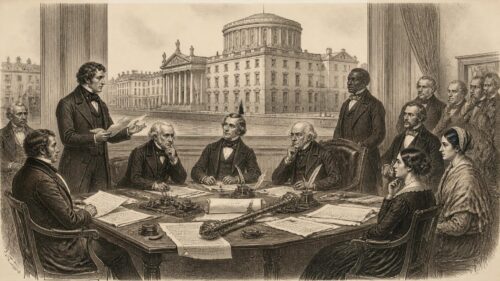
On 21 January 1919, elected Sinn Féin representatives who were free or able to attend met in Dublin as Dáil Éireann. They ratified a constitution, adopted a democratic programme and issued a declaration of independence. The Dáil also addressed an appeal to the free nations of the world. These acts were designed to establish that the Irish question was not merely a domestic disorder inside the United Kingdom, but a claim by a people to national sovereignty.
The Dáil’s authority was contested from the outset. The British government did not recognise it. Unionists rejected its claim to represent all Ireland. Some elected representatives were absent, imprisoned or opposed to its programme. Yet legitimacy in a revolutionary situation is not conferred by universal agreement. The First Dáil mattered because it gave a political centre to a movement that had previously been divided between electoral organisation, clandestine republican networks and Volunteer units.
The election did not cause the war in a mechanical sense. It offered a peaceful political route for the expression of separatist opinion, and it might conceivably have led to negotiations. But British refusal to acknowledge the Dáil’s claim, together with republican determination to make that claim effective, created a direct conflict of sovereignties. The central issue was no longer simply whether Home Rule would be implemented. It was whether Britain or the Dáil possessed the right to govern Ireland.
Armed Initiative
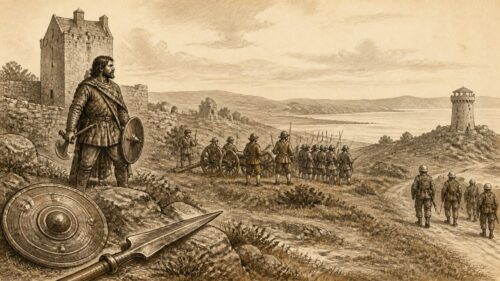
The same day that the First Dáil assembled, Volunteers of the Third Tipperary Brigade ambushed two Royal Irish Constabulary constables escorting gelignite at Soloheadbeg, County Tipperary. The constables, James McDonnell and Patrick O’Connell, were killed. The attack is conventionally treated as the opening engagement of the War of Independence.
Convention should not replace precision. Soloheadbeg was not the product of a publicly declared order from the Dáil. It was a local initiative undertaken by Volunteers including Dan Breen and Seán Treacy, acting within a movement in which arms seizures and preparations for conflict had already been discussed. The coincidence of the ambush and the Dáil’s meeting was politically potent, but it should not be turned into a simplistic story of a parliament directing an army into battle at a single appointed hour.
Nor was the IRA of January 1919 a fully formed national army. The name Irish Republican Army came to be applied to the Irish Volunteers who recognised the Dáil’s authority. Discipline, weapons, training and willingness to fight varied considerably. The campaign developed through local actions: raids for arms, attacks on police barracks, intelligence work, intimidation, sabotage and ambushes. It was both political and military. Its object was not to defeat the British Army in set-piece battle, but to make British administration difficult, costly and illegitimate.
The Royal Irish Constabulary became a principal target because it represented the everyday presence of the state in rural Ireland. This was strategically significant and morally grave. Policemen were often local men, and attacks on them brought fear and division into communities. The move from political mobilisation to killing was not an abstract constitutional step; it involved individual deaths, reprisals and widening insecurity.
Folklore has sometimes represented the outbreak as a unanimous spontaneous rising or, conversely, as a wholly conspiratorial scheme directed from Dublin. The documentary record supports neither extreme. There was planning among advanced republicans, a growing Volunteer organisation and a political atmosphere receptive to resistance. There were also local decisions, personal networks and uneven commitments. The war began through the interaction of a national crisis and local agency.
State Response
Once violence began, British policy helped shape its scale and character. At first, the administration treated republican activity largely as a policing problem. As attacks increased, it reinforced the RIC with recruits who became known as the Black and Tans and later deployed the Auxiliary Division, composed largely of former British officers. Martial law was extended across much of the south and west. Raids, arrests, curfews, internment and military courts became regular features of life in affected areas.
These measures had military logic: the authorities wished to protect police, collect intelligence and break an insurgent organisation that often operated from civilian society. Yet reprisals and indiscipline repeatedly damaged the state’s political position. The burning of property, assaults and killings associated with Crown forces provided republican propagandists with powerful evidence that British government rested upon coercion. Events such as the burning of central Cork in December 1920 intensified hostility and attracted international attention.
Republican violence also escalated. The IRA killed members of the police, military personnel, alleged spies and opponents; it enforced boycotts and sometimes used intimidation against civilians. In November 1920, the IRA’s operation against British intelligence agents in Dublin was followed by the killing of civilians and a player at Croke Park by Crown forces. Such events showed how far the conflict had moved from the limited operations of early 1919.
It is not historically adequate to assign all brutality to one side. Nor is symmetry always accuracy: the British state possessed formal authority, greater military resources and responsibility for the conduct of its forces, while the IRA fought as an insurgent army seeking to displace that authority. The war’s central tragedy was that each violent response supplied motives, recruits and justifications for the next. Repression could disrupt republican operations, but it also confirmed the republican argument that constitutional rights could not be safely secured under British rule.
By 1921, neither side had achieved a decisive military victory. The IRA had survived and made normal administration difficult, but it lacked the capacity to expel British forces by conventional means. Britain could deploy far greater force, but it had not extinguished the republican government or restored uncontested consent. The truce of 11 July 1921 arose from this military and political stalemate, not from the disappearance of the underlying national question.
Regional Divisions
The causes of conflict looked different in different places. In much of rural southern Ireland, the contest centred on the authority of police, courts, taxation and local government. In Dublin, intelligence, surveillance and assassination played an exceptional role. In Belfast and other parts of the north-east, the years around the war included sectarian violence, labour tensions and fierce disagreement over constitutional allegiance. The republican claim to speak for the whole island confronted a large unionist population determined not to enter an Irish republic.
Land and class issues could overlap with the national struggle. In some districts, disputes over grazing land, rents, labour or local power acquired republican language or were handled through revolutionary institutions. But it would be wrong to reduce the War of Independence to an agrarian revolt. The Dáil’s courts and administration won support partly because they offered practical alternatives to British institutions, yet their reach was uneven. Social conflict both fed and complicated the national campaign.
Women also made indispensable contributions as organisers, couriers, intelligence gatherers, fundraisers, nurses, propagandists and political activists. Cumann na mBan and other organisations enabled the movement to operate when male Volunteers were watched, imprisoned or on the run. Women’s involvement challenges an older narrative confined to armed male combatants. It also illustrates the breadth of the revolutionary mobilisation, while not implying that all women supported it.
Partition was not caused by the War of Independence alone, but the conflict hardened its consequences. The Government of Ireland Act 1920 provided for separate parliaments in Northern and Southern Ireland. The southern institutions failed to command republican allegiance, while Northern Ireland’s parliament was established. The Anglo-Irish Treaty later confirmed the separation of Northern Ireland from the Irish Free State, subject to provisions concerning its choice and a boundary commission. Thus a war begun over sovereignty ended not in the unitary republic proclaimed in 1916 and 1919, but in a settlement that left the island divided.
Historical Balance
The Irish War of Independence was caused by a succession of failures and choices. The failure of Home Rule to take effect discredited constitutional expectations. The First World War militarised political life and widened the language of national self-determination. The British response to the 1916 Rising transformed a defeated rebellion into a durable source of republican legitimacy. The conscription crisis drew together a broad coalition against Westminster. Sinn Féin’s 1918 victory gave separatism an electoral mandate of great, though not universal, significance. Local Volunteers then initiated and sustained armed resistance, while British coercive policies intensified the conflict.
None of these developments alone made war inevitable. A credible constitutional settlement before or during the war might have preserved the authority of parliamentary nationalism. A less punitive reaction after 1916 might have limited the Rising’s political afterlife. The abandonment of conscription might have occurred earlier, avoiding a profound mobilisation against the state. Negotiations after the 1918 election might have produced a different sequence of events. Counterfactuals cannot prove what would have happened, but they remind us that history was made through decisions as well as conditions.
The strongest conclusion is therefore neither that the war was a timeless struggle destined to occur nor that it was an accident caused solely by a handful of gunmen. It was a revolutionary conflict produced when a long constitutional dispute lost its capacity for constitutional containment. Nationalist political opinion became more radical; republican organisations acquired legitimacy and organisational depth; armed Volunteers chose to attack the machinery of British rule; and the state answered in ways that often enlarged the rebellion it hoped to suppress.
Its legacy was profound and unfinished. The conflict helped create an independent Irish state, but it did not settle every question raised by the revolutionary generation. The Treaty split the movement and led to civil war. Partition endured. Memories of sacrifice, coercion, loyalty and loss remained contested in families and communities across Ireland and Britain. To understand what caused the war is not to find one slogan or one villain. It is to recognise how promises deferred, fears entrenched, violence legitimised and political alternatives narrowed until armed conflict became, for many participants, imaginable, defensible and finally unavoidable.
The article’s cumulative explanation complicates the tempting view that the Soloheadbeg ambush alone began an otherwise inevitable war. Home Rule’s suspension, the Rising’s aftermath, anti-conscription mobilisation and Sinn Féin’s electoral success each weakened Westminster’s authority, yet support, violence and political priorities varied sharply across Ireland. This raises an important question about legitimacy: the First Dáil possessed a substantial electoral mandate, while unionists and many others rejected its claim to speak for the whole island. How should we weigh democratic endorsement, local experience and armed action when interpreting the point at which a constitutional crisis ultimately became a war of independence?