

Border Scrutiny
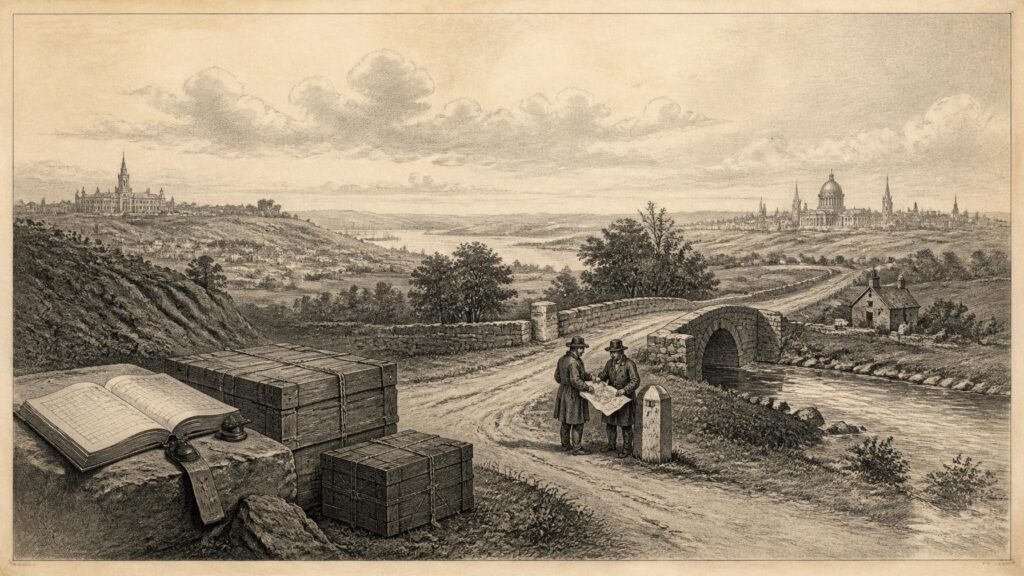
AI generated historical illustration, not a contemporary photograph.
At a Glance
Post-Brexit scrutiny in Northern Ireland is the history of a problem that could not be left at the frontier. When the United Kingdom left the European Union, the question was not simply how lorries, parcels or food should travel. It was how a state could depart from the European legal order without remaking a visible border across Ireland, disturbing the delicate constitutional balance established in 1998, or denying Northern Ireland meaningful influence over rules that continued to affect it. The result has been an unusually dense system of observation, reporting, consent, committee work, legal interpretation and political argument. Scrutiny became both a practical necessity and a symbol of a deeper contest about belonging.
Constitutional Inheritance
Northern Ireland entered the Brexit era with a constitutional settlement unlike that of any other part of the United Kingdom. The Belfast, or Good Friday, Agreement of 10 April 1998 did not remove disagreement about sovereignty. Rather, it created institutions and principles through which disagreement could be managed without the violence that had scarred the preceding decades. Its architecture operated in three directions: within Northern Ireland through devolved power sharing; between Northern Ireland and Ireland through North–South bodies; and between the British and Irish governments through arrangements recognising their continuing mutual responsibilities. The settlement also placed the constitutional future of Northern Ireland under the principle of consent: its status could change only with the support of a majority voting in a poll.
That settlement depended on more than the wording of an agreement. It grew in a particular European setting. Both the United Kingdom and Ireland were members of the European Union. Their shared membership did not abolish the international border, but it softened many of its daily effects. Common European rules, the customs union and the single market made cross-border trade less conspicuous. The transformation of the security landscape after the ceasefires and the Agreement made physical border infrastructure increasingly unnecessary and politically unwelcome. For people living near the boundary, the passage between jurisdictions became less like a journey between hostile spaces and more like an ordinary feature of work, family and commerce.
It would be misleading to claim that European membership alone produced peace. The peace process was created by difficult negotiations, constitutional change, political risk-taking and the work of communities who had endured conflict. Nor was the border ever irrelevant: differences in taxation, public services, currencies before euro adoption, law and political identity remained. Yet the shared European framework offered a permissive environment for the Agreement’s ambitions. It made it easier to imagine overlapping identities, practical co-operation and a border that was legally real but physically unobtrusive.
The Agreement’s language reflected this plural inheritance. People born in Northern Ireland could identify and be accepted as British, Irish or both, and hold British or Irish citizenship, or both. The constitutional order was consequently not a simple division between two national blocs. It recognised a population whose political and cultural affiliations might overlap. This was one reason Brexit created exceptional difficulty. Withdrawal from the European Union changed a framework within which many people had learned to conduct everyday life without being constantly asked to choose between British and Irish political spaces.
Referendum Shock
The referendum of 23 June 2016 supplied the immediate democratic event from which the later scrutiny system emerged. Across the United Kingdom, a majority voted to leave the European Union. Northern Ireland voted differently: 440,707 votes were cast for Remain and 349,442 for Leave. That result did not create a single Northern Irish view of Brexit. The vote was territorially and politically uneven, and there were Leave voters from several backgrounds. But it established a lasting constitutional tension. Northern Ireland was taken out of the European Union by a United Kingdom-wide result despite its own regional majority for continued membership.
Interpretations of that fact diverged sharply. Nationalist and republican politicians commonly presented it as evidence that Brexit had been imposed upon Northern Ireland against the preference expressed there. Unionist supporters of Brexit replied that Northern Ireland had voted in a United Kingdom referendum and that its constitutional place within the United Kingdom meant accepting the overall result. Neither argument was merely rhetorical. Each drew upon a different account of democratic authority: one stressed the distinct circumstances and popular will of Northern Ireland; the other stressed the sovereign decision of the state of which Northern Ireland forms part.
In historical terms, the referendum reopened questions that the 1998 settlement had contained rather than extinguished. Brexit forced attention onto the material meaning of the border, the value of British–Irish co-operation, the relationship between economic regulation and constitutional identity, and the degree to which Northern Ireland could be governed through majoritarian decisions made elsewhere. The referendum did not itself determine the answer to these questions. It did, however, ensure that every proposed answer would be tested against the language of consent, parity of esteem and institutional balance.
The political environment was made harder by the absence of stable devolved government for much of the early period. The Northern Ireland Executive collapsed in January 2017 and did not return until January 2020. Brexit negotiations therefore unfolded when the principal institutions intended to give local elected representatives a voice were not functioning. Civil servants continued essential administration, Westminster legislated in some areas, and political parties issued strong positions, but the absence of a working Executive and Assembly reduced the capacity for collective Northern Irish influence. That experience mattered later, because it made procedural scrutiny appear not as an abstract constitutional refinement but as a substitute for political representation that had been missing when major choices were made.
Border Problem
The central practical difficulty of Brexit was straightforward to describe and extraordinarily difficult to solve. If the United Kingdom left the European customs union and single market while Ireland remained an EU member state, some means would normally be needed to distinguish goods entering the European market from goods moving within the United Kingdom. On the island of Ireland, a conventional customs frontier risked reviving infrastructure and controls that the peace process had helped to make politically unacceptable. It also threatened to burden the dense patterns of cross-border movement on which farms, manufacturers, retailers, families and public bodies depended.
The phrase “hard border” became shorthand for this concern, though it referred to more than cameras, checkpoints or customs posts. A hard border could be experienced through paperwork, delays, regulatory barriers, policing requirements and the psychological return of a dividing line. For communities whose recent history included military installations, security checks and violence around the border, symbols mattered as much as logistics. The risk was not that any customs form would automatically destroy peace. It was that a visible re-bordering of daily life could undermine trust and make inherited constitutional anxieties newly tangible.
Several alternatives were proposed during the negotiations: technological systems, exemptions for small traders, special economic zones, regulatory alignment across the United Kingdom, or arrangements based on trusted traders. Some could reduce friction; none removed the basic problem that different regulatory and customs regimes required a means of enforcement somewhere. The eventual solution placed Northern Ireland in a distinctive position. It would remain legally within the customs territory of the United Kingdom, but would apply specified European Union rules relating principally to goods. This arrangement was intended to protect the open land border while allowing Northern Ireland businesses access to the EU market for goods.
That decision moved much of the practical frontier into the Irish Sea, between Great Britain and Northern Ireland. It was not a border in the constitutional sense: Northern Ireland remained part of the United Kingdom and its constitutional status was unchanged. Nevertheless, it introduced checks, declarations and regulatory processes for some goods moving from Great Britain. For many unionists, this was more than an inconvenience. They saw it as a disruption of the economic connections through which Northern Ireland’s place in the Union was lived and understood. For many nationalists and other supporters of the arrangement, the alternative—new infrastructure or controls on the island—was judged more dangerous to the Agreement and to cross-border life.
Protocol Design
The Protocol on Ireland/Northern Ireland was attached to the Withdrawal Agreement between the United Kingdom and the European Union. It came into practical operation at the end of the transition period on 1 January 2021. Its stated objectives included addressing the island’s unique circumstances, maintaining the conditions necessary for North–South co-operation, avoiding a hard border and protecting the 1998 Agreement in all its dimensions. The Protocol also affirmed that it did not alter Northern Ireland’s constitutional status and respected the principle of consent.
Its design was necessarily hybrid. Northern Ireland remained in the United Kingdom’s customs territory and retained access to the British market, but European rules concerning customs, the movement of goods, state aid in specified circumstances, VAT and excise provisions, and product regulation continued to apply in defined fields. The European Court of Justice retained a role in the interpretation of EU law applicable under the arrangements. The United Kingdom became responsible for implementing many rules at ports and other points of entry, while the European Union retained an interest in ensuring that goods entering Northern Ireland did not enter the single market without appropriate controls.
This structure offered a commercial opportunity as well as a constitutional dilemma. Northern Ireland could, in principle, sell goods both into the rest of the United Kingdom and into the European Union market under a more favourable arrangement than was available to businesses in Great Britain. Advocates called this dual market access an economic advantage. Critics answered that an advantage for certain firms could not answer the constitutional and administrative costs imposed on trade from Great Britain. Both propositions could be true at once. The Protocol changed incentives in a small, highly interconnected economy; it did not distribute benefits and burdens evenly.
The early years exposed weaknesses of preparation and trust. Businesses had to understand new customs declarations, sanitary and phytosanitary requirements, labelling rules and supply-chain distinctions. Some retailers struggled with movement of food products, and parcels became a recurring point of uncertainty. The United Kingdom and European Union accused one another of inflexibility or inadequate implementation. The language used by ministers and party leaders often made compromise harder. In this atmosphere, a regime intended as a technical solution became a powerful constitutional symbol.
Scrutiny emerged because the Protocol’s rules could not be treated as static. Certain European legislation could continue to apply, be amended or be replaced. The United Kingdom, no longer represented in the European Parliament, Council or Commission in the way it had been before Brexit, did not participate in EU law-making as a member state. Northern Ireland therefore faced the prospect of rules governing important parts of its goods economy being shaped through institutions in which its elected representatives had no direct vote. This concern was commonly described as a democratic deficit.
Political Fracture
The Protocol intensified existing political fractures, but it did not create them from nothing. Unionism had long attached importance to unfettered links with Great Britain and to Northern Ireland’s equal place within the United Kingdom. Nationalism had long emphasised the all-Ireland dimension, Irish identity and practical North–South co-operation. Brexit brought these perspectives into collision through trade procedures. A supermarket delivery, a veterinary certificate or a customs declaration could become evidence, in the eyes of different observers, either of a necessary safeguard for peace or of a constitutional separation from the rest of the United Kingdom.
The Democratic Unionist Party became the principal institutional opponent of the Protocol. It argued that the arrangements offended against Northern Ireland’s place in the Union and undermined cross-community consent. The party’s opposition was not confined to speeches at Westminster. In February 2022, the First Minister, Paul Givan, resigned as part of a protest against the Protocol, causing the Executive to cease operating in its full form. Following the Assembly election of May 2022, the DUP declined to nominate a Speaker or enter an Executive until its concerns about post-Brexit arrangements were addressed. The result was another prolonged period without the normal operation of devolved institutions.
Other parties approached the issue differently. Sinn Féin, the Social Democratic and Labour Party, Alliance and the Greens generally supported efforts to make the arrangements work while seeking practical mitigations. They stressed Northern Ireland’s vote to remain, the importance of avoiding a land border and the value of access to both markets. The Ulster Unionist Party criticised the Protocol but did not always share the DUP’s strategy. These distinctions matter because Northern Ireland’s politics cannot be reduced to two fixed camps. Yet the Protocol’s institutional consequences were magnified by a power-sharing system in which the refusal of a principal party to participate could prevent the formation of an Executive.
The resulting instability revealed an important historical irony. The Agreement had sought to ensure that major decisions would command broad legitimacy across divided communities. Post-Brexit governance showed how the same requirement for co-operation could make institutions vulnerable when one side believed that a foundational interest had been compromised. The Protocol did not abolish the Assembly or Executive. But the dispute over it demonstrated that constitutional rules and commercial regulation could not be neatly separated in Northern Ireland.
Scrutiny Architecture
Before the Windsor Framework, scrutiny developed across several levels. Westminster committees examined the Protocol’s operation, heard evidence from businesses, community organisations, legal specialists and political representatives, and questioned ministers. The House of Lords European Affairs Committee and its Protocol sub-committee became particularly important forums. Their reports recorded practical problems, criticised failures of communication and examined the wider constitutional implications of EU law applying to Northern Ireland. The committees did not claim to resolve the political dispute, but they made the disagreement visible in parliamentary evidence and insisted that the people most affected should have a stronger voice.
The language of a democratic deficit was not politically neutral. For unionists, it described an objection of principle: laws could apply in Northern Ireland without the ordinary participation of UK ministers and legislators in the European institutions that made them. For others, the phrase identified a real problem but not one that outweighed the need to avoid a hard Irish border. They noted that the Protocol itself included a future consent mechanism in the Northern Ireland Assembly and that many forms of international co-operation involve rules shaped beyond a single legislature. The disagreement concerned both the existence of the deficit and the remedy appropriate to it.
Evidence-gathering committees could improve information but could not provide representation equivalent to a vote in the Council of the European Union or seats in the European Parliament. Their importance lay elsewhere. They could establish a public record of how regulations affected Northern Ireland, press the United Kingdom government to provide timely explanations, identify concerns before legal acts took effect, and connect businesses and civic groups to decision-makers. In a post-Brexit order marked by technical detail, this work was significant. The difference between a proposal, a delegated act, an implementing measure and a replacement regulation could determine whether a firm faced new costs or a consumer experienced reduced choice.
Scrutiny also had an intergovernmental dimension. The Withdrawal Agreement created a Joint Committee through which the United Kingdom and European Union could supervise implementation, and a specialised committee for issues arising under the Protocol. These bodies were not substitutes for democratic institutions in Northern Ireland, but their decisions could have direct local consequences. That made transparency vital. If arrangements were devised in London and Brussels without intelligible explanation in Belfast, suspicion would deepen even where the practical result was favourable.
The scrutiny problem was therefore partly one of distance. European law-making took place outside the institutions of Northern Ireland; much UK–EU negotiation occurred between governments; and technical guidance was often written for specialists. A farmer, small retailer or manufacturer did not experience this as an elegant constitutional diagram. They experienced it in forms, costs, delivery timetables and uncertainty. Effective scrutiny required not only parliamentary debate but usable public information.
Consent Mechanism
The Protocol’s most explicit answer to questions of legitimacy was its democratic consent process. Article 18 provided that, after an initial period, the Northern Ireland Assembly would vote on whether specified provisions should continue to apply. The first such vote was scheduled for late 2024. The mechanism was unusual: it did not ask the Assembly to approve every rule, but to decide whether the core regulatory arrangements should continue. A simple majority could secure continuation for four years. Cross-community support, under the Assembly’s established procedures, could provide an eight-year period. If consent were withheld, the United Kingdom and European Union would be required to make recommendations on necessary measures.
The consent vote was significant, but its limits were clear. It came after the arrangements had already taken effect, and it did not offer a straightforward choice between the Protocol and an agreed alternative. A vote against continuation would not by itself solve the border problem. Nor did a vote in favour eliminate objections to individual regulations or to the role of European institutions. The mechanism was best understood as a periodic political checkpoint rather than a complete cure for concerns about representation.
The first consent vote took place on 10 December 2024. The Assembly voted for the continued application of the relevant provisions by a majority, but without cross-community support. Under the agreed rules, the arrangements were therefore extended for four years rather than eight, and an independent review was required. The result itself illustrated Northern Ireland’s divided political landscape. It provided a clear numerical majority for continuation while also confirming that the issue lacked the broad cross-community endorsement that many regard as essential to long-term stability.
The independent review that followed was an attempt to turn a constitutional warning light into a constructive process. Its purpose was not to reopen every question of Brexit, nor could it remove the underlying trade-off between an open land border and regulatory differentiation. It could, however, examine how the Framework affected social, economic and political life, and suggest ways to improve democratic participation, business guidance and the operation of scrutiny. Such reviews are sometimes dismissed as procedural delay. In Northern Ireland’s history, however, procedure can be a means of acknowledging that no durable arrangement is likely to survive if a substantial section of society feels unheard.
Windsor Settlement
The Windsor Framework, agreed by the United Kingdom and European Union on 27 February 2023, was presented as a new way forward. It did not abandon the central logic of the Protocol: Northern Ireland would continue to apply specified EU goods rules so that the land border could remain open. Instead, it revised and supplemented the operating arrangements. Its purpose was to reduce friction for goods intended to remain in Northern Ireland, improve access to certain medicines and consumer products, clarify VAT and excise treatment, and address the political complaint that Northern Ireland lacked an adequate say over new European rules.
Its most publicised practical device was the distinction between green and red channels. Goods moving from Great Britain to Northern Ireland and intended for final consumption or use there could move through a simplified process, subject to conditions and data requirements. Goods considered at risk of moving onward into the European Union would face fuller controls. The terminology was designed to make the arrangement understandable, though the underlying system remained legally and commercially complex. Simplification did not mean the disappearance of regulation; it meant different levels of process according to destination and risk.
The Framework also introduced the Stormont Brake. This gave members of the Northern Ireland Assembly, acting under specified conditions, a route to raise concern about new or amended EU goods rules that would apply under the Framework. If the conditions were met and the United Kingdom government accepted the notification, the government could notify the European Union that the relevant act should not apply. The mechanism was deliberately high threshold. It required thirty MLAs from at least two parties, concerns about a significant and lasting effect, and use only in exceptional circumstances. It was not a general veto by Stormont over all existing EU law.
Supporters saw the Brake as a meaningful constitutional innovation. It created a formal connection between Assembly members and the operation of European law, and it gave the United Kingdom government a treaty-based route to prevent the application of a new act in defined circumstances. Critics, including some unionists, argued that it did not restore normal democratic control because the Assembly could not shape the legislation at its European drafting stage, and because the final international action depended on the UK government. Others feared that frequent use could destabilise arrangements necessary to maintain the open border and access to the EU market.
Historically, the significance of the Framework lies not in the claim that it solved every dispute, but in its acknowledgement that the original Protocol had not achieved sufficient political acceptance. It represented a return to negotiated adaptation after years in which threats of unilateral UK legislation and EU legal action had made compromise appear remote. Its practical changes mattered, but so did its tone: the Framework sought to replace a politics of confrontation with a more managed and consultative relationship. Whether that ambition could endure depended on implementation, not announcement.
Assembly Return
The restoration of the Northern Ireland Assembly and Executive in February 2024 gave scrutiny a more substantial institutional home. The agreement associated with restoration included commitments concerning Northern Ireland’s place in the Union and the operation of the Windsor Framework. Devolution did not remove disagreement over the Framework, but it returned ministers, committees and Assembly procedures to the centre of public administration. This mattered because many post-Brexit questions—agriculture, the economy, health, consumer protection, infrastructure and environmental policy—required decisions by Northern Ireland departments as well as by London and Brussels.
A dedicated Windsor Framework Democratic Scrutiny Committee was established under Schedule 6B to the Northern Ireland Act 1998. Its remit includes examining new and replacement EU acts within the relevant scope, undertaking inquiries, engaging with business and civil society, and liaising with the United Kingdom government, Northern Ireland ministers and the Executive. The committee’s existence marks a notable institutional development. Before Brexit, Northern Ireland’s representatives participated indirectly in EU law-making through the United Kingdom’s membership arrangements. After Brexit, a domestic Assembly committee was created to watch, assess and communicate about a body of European law that could still apply locally.
The committee cannot recreate membership of the European Union. It cannot elect a commissioner, amend a proposal in the European Parliament, or direct the Council. But it can make the effects of proposed law visible earlier than would otherwise be possible. It can seek departmental assessments, gather evidence from affected sectors and provide a public record of concerns. In a system where rules may be developed far from Belfast but have consequences in Belfast, Derry, Newry, Armagh and rural border communities, that function has genuine value.
Its effectiveness depends on resources and time. Technical legislation can move quickly, while small institutions may struggle to obtain specialist legal and economic advice. Committee members must distinguish between acts that merely adjust existing rules, acts with significant practical consequences and proposals that may never take effect. They must also decide when political disagreement is best expressed through a report, negotiation with ministers, public consultation or the exceptional Stormont Brake procedure. Scrutiny is therefore labour rather than theatre: it requires reading, evidence, translation of specialist language and an ability to explain consequences without exaggeration.
Rights Protection
Post-Brexit scrutiny extends beyond trade. Article 2 of the Protocol, retained within the Windsor Framework arrangements, commits the United Kingdom to ensuring that withdrawal from the European Union does not cause a diminution of rights, safeguards or equality of opportunity set out in the relevant part of the 1998 Agreement. It specifically connects this undertaking with protections against discrimination rooted in listed EU law. The provision recognises that the constitutional settlement was not solely about borders and institutions; it was also concerned with equal treatment, identity and confidence in public life.
This has produced a distinct field of legal and institutional monitoring. The Northern Ireland Human Rights Commission and Equality Commission for Northern Ireland have roles within a dedicated mechanism established to oversee the commitment. Their work can involve advising individuals and public authorities, reviewing legislative proposals, publishing guidance and identifying where divergence between Great Britain and Northern Ireland may have equality consequences. The questions can be technical, but their importance is readily understood. If a right formerly underpinned by European law is changed in Great Britain, does Northern Ireland need a corresponding protection? If a new EU equality measure applies in Northern Ireland, how should it be implemented? What remedy is available when an individual believes the Article 2 commitment has been breached?
These issues show why scrutiny cannot be described merely as a debate about lorries. Brexit altered the legal channels through which rights protections might be maintained or developed. It also created a situation in which Northern Ireland may at times diverge from Great Britain in order to meet obligations linked to the 1998 Agreement. Such divergence is politically sensitive, especially for those who fear a widening gap between Northern Ireland and the rest of the United Kingdom. Yet it may also be the mechanism through which the United Kingdom fulfils a solemn commitment arising from the peace settlement.
Care is needed in historical interpretation. It would be wrong to say that Article 2 guarantees every social or economic preference associated with EU membership. Its scope is legally defined and subject to interpretation by courts. Equally, it would be wrong to dismiss it as symbolic. The provision has prompted continuing examination by commissions, legislators, lawyers and parliamentary committees, precisely because its operation affects the practical meaning of rights after Brexit. The fact that detailed scrutiny is necessary is itself evidence of how deeply the European and peace-settlement frameworks had become intertwined.
Economic Consequences
The economic picture has been more complicated than either celebratory or catastrophic accounts suggest. Northern Ireland’s unusual market position has created possibilities for manufacturers and food producers able to trade into both Great Britain and the European Union. Some firms have identified commercial advantages in retaining access to the EU goods market while also serving customers across the United Kingdom. Investment advocates have presented this as a potential selling point for Northern Ireland, particularly where supply chains benefit from proximity to both Ireland and Great Britain.
At the same time, costs have fallen unevenly. Large businesses with customs expertise may be better able to absorb new procedures than small enterprises. Traders moving goods from Great Britain have had to understand rules that do not apply to comparable domestic movements elsewhere in the United Kingdom. Some suppliers chose not to serve Northern Ireland, especially during periods of uncertainty. Consumers encountered changes in product availability, labelling and delivery arrangements. For firms, the burden was not always a single charge that could be calculated neatly. It could be the time spent learning a system, seeking advice, altering software or deciding that a market was too difficult to serve.
Scrutiny has a practical economic purpose because a poorly understood rule can be as damaging as a strict one. Businesses need to know what applies, when it applies and where they can obtain authoritative guidance. The later emphasis on accessible advice services and clearer engagement reflects repeated evidence that complexity itself is a policy problem. A framework can contain easements and safeguards on paper, but if a small trader cannot identify them, their value is limited.
The same point applies to statistics. Claims about dual market access, trade growth or disruption should be treated carefully. Economic change in Northern Ireland cannot be attributed to the Protocol or Windsor Framework alone. The pandemic, global supply pressures, energy costs, currency movements, changes in consumer demand and the wider United Kingdom economy all influenced outcomes. Historical judgement should resist easy causal stories. The more defensible conclusion is that post-Brexit arrangements changed the conditions under which firms made decisions, creating both opportunities and frictions that were experienced differently across sectors and places.
Public Arguments
The politics of scrutiny have generated their own folklore. One recurring story imagines that a perfect technological solution was available from the beginning and was rejected for ideological reasons. Technology can improve customs processes, share data and reduce delays, but no documented system removes the need to decide where and how rules are enforced when neighbouring territories belong to different regulatory regimes. Another story suggests that the Protocol created an entirely new border in a simple, absolute sense. The arrangements undoubtedly introduced barriers and procedures in Irish Sea trade, but Northern Ireland’s constitutional position within the United Kingdom did not change, and the legal architecture was more qualified than the slogan implies.
There is also a tendency to treat the 1998 Agreement as if it contained a single, self-executing answer to Brexit. It did not. The Agreement does not prescribe customs policy for a state outside the European Union. What it supplies is a set of principles and institutions: consent, parity of esteem, power sharing, North–South co-operation and British–Irish partnership. Different participants have honestly drawn different conclusions from those principles. The Protocol and Framework were efforts to reconcile them under conditions not envisaged when the Agreement was signed.
Documented evidence is strongest when it concerns formal legal texts, votes, committee remits and published government agreements. Interpretation begins when those facts are assigned political meaning. Unionists who describe the Framework as weakening the Union make a constitutional interpretation grounded in their understanding of economic integration and sovereignty. Nationalists who describe it as necessary protection for the all-island economy and the Agreement make an interpretation grounded in their reading of the border and North–South relations. Historians should not pretend that these are identical claims, nor should they confuse either with a simple statement of fact.
The public argument has also been shaped by language. “Protocol”, “Framework”, “Irish Sea border”, “dual market access”, “democratic deficit” and “Stormont Brake” are not neutral labels. Each condenses a large and contested set of ideas. Scrutiny is valuable partly because it slows down these slogans. A committee report, legal opinion or departmental assessment cannot settle identity, but it can clarify what a rule actually does and what remains uncertain. In a region where political language has often carried historical trauma, that modest function is important.
Historical Meaning
Post-Brexit Northern Ireland scrutiny belongs in the longer history of attempts to govern a place defined by overlapping jurisdictions. The border created after partition was never simply a line on a map. It organised trade, policing, citizenship, political aspiration and memory. The 1998 Agreement did not erase the border; it made it less dominant by embedding it in co-operation, shared European membership and a constitutional settlement that allowed multiple allegiances. Brexit made the border newly consequential because it required legal distinctions to be enforced somewhere.
The distinctive feature of the post-Brexit era is that regulation has become a principal language of constitutional politics. Earlier generations argued about flags, policing, security, representation and territorial claims. Those questions have not vanished. But they are now joined by debates over food standards, customs data, medicines, labelling, VAT and the applicability of European acts. This should not be mistaken for a trivialisation of politics. In Northern Ireland, the mundane can become constitutional because it reveals which institutions make decisions, whose market is privileged and how closely the region is connected to Britain, Ireland and Europe.
Scrutiny is consequently a form of constitutional maintenance. It does not promise unanimity. It provides ways to register dissent, obtain information and insist that rules affecting Northern Ireland are examined in Northern Ireland. In the best case, it can reduce surprises and supply evidence before disputes harden into crises. In the worst case, it can become another arena for rehearsing positions already fixed. Its historical value will depend on whether institutions use it to widen participation or merely to confirm division.
The surviving lesson from the peace process is not that difficult questions disappear when placed in a committee. It is that durable arrangements require procedures through which opponents can remain in dialogue. The Protocol dispute repeatedly showed the costs of broken trust between London, Dublin, Brussels and Belfast. The Windsor Framework and the Assembly’s scrutiny mechanisms represent attempts to restore working relationships without pretending that the underlying constitutional disagreement has ended. That is a limited ambition, but in Northern Ireland’s modern history it is not a small one.
Future Questions
As of 2026, the main post-Brexit arrangements remain subject to continuing examination rather than final settlement. The Assembly’s 2024 consent decision ensured that the core provisions would remain in force for a further four years, while the lack of cross-community support triggered an independent review. The Democratic Scrutiny Committee continues to consider European acts within its remit, and parliamentary attention has turned both to practical business guidance and to the protection of rights under Article 2. These are signs of an arrangement still being administered, tested and revised rather than one that has passed into constitutional routine.
The next questions are likely to concern capacity and trust. Can the Assembly and Executive obtain sufficiently early, expert and comprehensible information about European legislative developments? Can small businesses navigate the Framework without needing costly specialist help? Can the United Kingdom government represent Northern Ireland’s interests credibly in its dealings with the European Union while respecting the views of parties that disagree profoundly about the Framework? Can the European Union apply its single-market safeguards proportionately and transparently? And can the British and Irish governments maintain the habit of co-operation that remains indispensable to the wider settlement?
There are no frictionless answers. A fully open land border, Northern Ireland’s access to the United Kingdom market, the integrity of the European single market and full local control over every applicable rule cannot all be maximised at once. The history of post-Brexit scrutiny is the history of managing that constraint. Its institutions should therefore be judged not against an imagined perfect solution, but against whether they make inevitable trade-offs more intelligible, more accountable and less damaging to peace.
That standard is demanding. It requires governments to explain decisions before crises develop, parties to distinguish practical objections from impossible demands, and institutions to take seriously the experience of those whose work or rights are affected. It also requires historical perspective. Northern Ireland’s post-Brexit order was born from a collision between the United Kingdom’s withdrawal from the European Union and a peace settlement built in a shared European context. Its scrutiny arrangements are not peripheral bureaucracy. They are part of the continuing effort to ensure that a change in international relationship does not unsettle the fragile, hard-won relationships on the island of Ireland.
Article highlights how arrangements intended to keep the Irish land border unobtrusive transferred scrutiny to trade across the Irish Sea and to EU rules applying within Northern Ireland. The most compelling issue is whether procedural safeguards—Assembly consent, committee evidence, and consultation—can meaningfully address the democratic deficit felt when local representatives lack direct votes on relevant EU legislation. These mechanisms may improve visibility and accountability, yet they operate within a settlement shaped by competing understandings of consent, identity and economic connection. How far can scrutiny and participation reconcile the protection of cross-border peace with unionist concerns about representation and constitutional belonging?