

Shelter Sovereignty
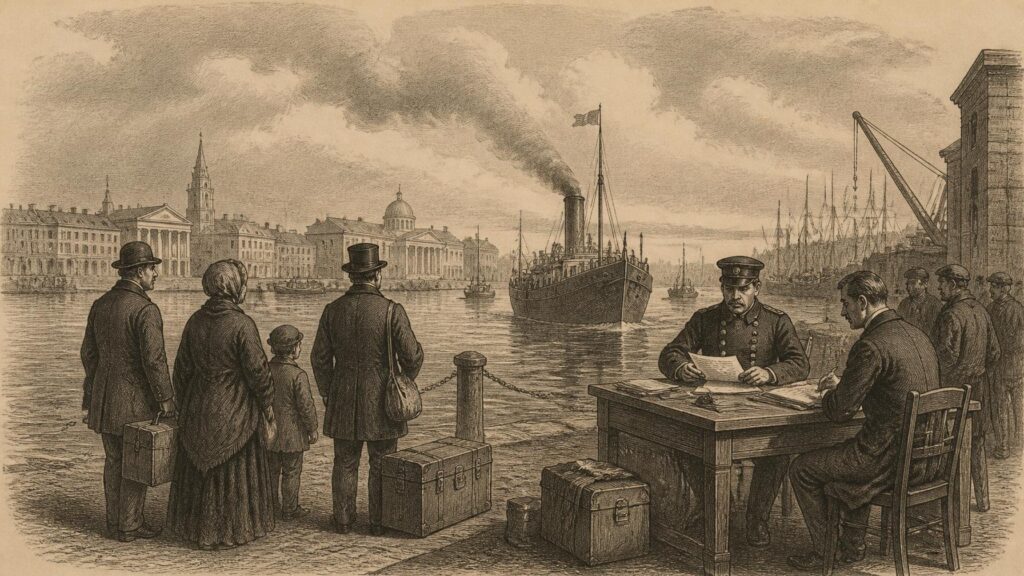
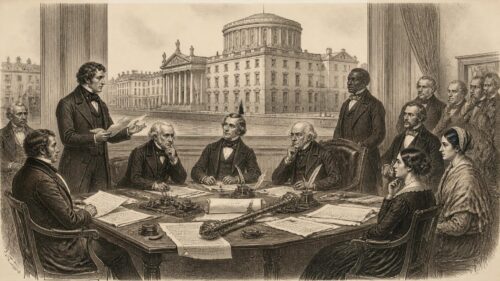
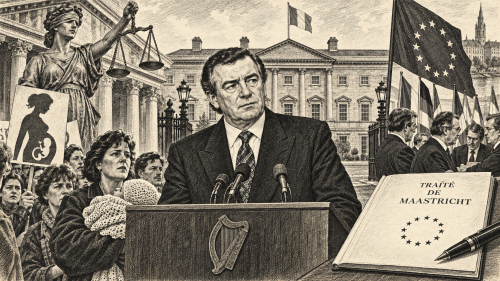
AI generated historical illustration, not a contemporary photograph.
At a Glance
Irish asylum law developed not from a single constitutional promise of refuge, but from the uneasy meeting of international obligation, executive power over borders, statutory procedure and judicial protection of personal rights. Its history reveals how a State long marked by emigration gradually became a place in which people sought protection, and how that change tested the reach of the Constitution of 1937.
Historical Setting
Asylum law can appear, at first sight, to belong wholly to the modern world of passports, international agencies, air travel and European regulations. In Ireland, however, it also belongs to an older political history. The island’s experience of colonial rule, famine migration, forced departure, political exile and diaspora created powerful cultural memories of flight and exclusion. Those memories have often appeared in public language about refugees. They should not, however, be confused with a continuous legal tradition of asylum. Ireland did not inherit a broad constitutional right for outsiders to enter its territory merely because they faced danger elsewhere. The legal history is more complicated: a sovereign State accepted international duties, enacted domestic procedures slowly, and repeatedly defended substantial governmental discretion over admission, residence and removal.
Before the late twentieth century, the Irish State was primarily understood as a country of emigration. Its constitutional imagination was shaped by questions of nationhood, citizenship, religion, language, territory and political independence rather than by mass inward migration. The Constitution adopted by the people in 1937 declared the national territory and established institutions of self-government, while its fundamental-rights provisions were framed principally in the vocabulary of citizens. That wording would later matter greatly. It required courts to decide whether some constitutional protections, although expressed in citizen-centred terms, nevertheless arose from the dignity of every human person subject to the State’s power.
It is therefore important to distinguish three connected but different ideas. A refugee is a person meeting the definition in the 1951 Convention relating to the Status of Refugees, normally because of a well-founded fear of persecution for a Convention reason. An asylum seeker is someone requesting protection whose claim has not yet been finally decided. International protection is a broader modern legal expression, covering refugee status and, in European law, other protection available to people who do not meet the Convention definition but would face serious harm if returned. These categories are legal, not merely descriptive. They determine procedures, entitlements, appeal routes and the limits placed upon removal.
The popular belief that Ireland’s history of emigration naturally translated into a settled national generosity towards asylum seekers is an interpretation, not an established fact. Political speeches, campaign material and advocacy regularly invoked Irish emigrants abroad. Such comparisons could encourage empathy, but they could also simplify differences between voluntary economic migration, exile, colonial displacement, post-war resettlement and modern claims for international protection. Documentary evidence instead shows a State adapting its legal system in response to changing numbers of applicants, international treaty duties, European integration and litigation. The record is consequently less a story of inevitable humanitarian progress than a history of uneven institutional construction.
Constitutional Language
The Constitution does not contain a clause expressly guaranteeing a right to asylum. Nor does it declare that every person fleeing persecution has a constitutional entitlement to enter Ireland. This absence is central to the subject. Claims to protection have generally depended on treaty obligations, legislation, European legal measures and administrative decisions rather than on an autonomous constitutional asylum right. Yet the Constitution has never been irrelevant. It supplies the legal setting in which legislation is made, executive decisions are reviewed and personal rights are protected.
Article 15 gives the Oireachtas the sole and exclusive power of making laws for the State. In asylum matters this means that Parliament, rather than the courts or an international organisation, establishes the principal domestic scheme governing applications, interviews, decisions, appeals and residence while claims are pending. The Executive retains considerable functions in immigration and foreign affairs, but it must act within the Constitution and the legislation enacted by the Oireachtas. Courts, in turn, may review whether officials acted lawfully, fairly and constitutionally. This division of authority explains why asylum cases often involve both intensely personal narratives and technical disputes about statutory interpretation, procedure or the proper reach of ministerial power.
The text of Article 40 illustrates a persistent difficulty. Article 40.1 states that all citizens, as human persons, shall be held equal before the law. Article 40.3.1° requires the State, in its laws, to respect and, as far as practicable, defend and vindicate the personal rights of the citizen. Article 40.3.2° specifically refers to the protection of life, person, good name and property rights. Article 40.4 protects personal liberty, again using the word citizen. On a narrow reading, an applicant without Irish citizenship would stand outside much of the textual protection. Irish constitutional law, however, did not always accept so limited an outcome.
Judicial reasoning developed the idea that certain rights arise from the status of the human person and cannot sensibly be reserved entirely to citizens. The extent of that principle has varied with the right asserted and the context in which it is invoked. Non-nationals do not have the same constitutional position as citizens in relation to entry, residence, voting, political membership or unrestricted participation in the labour market. At the same time, the State’s authority over migration does not create a legal vacuum. Once people are within its jurisdiction, they may invoke constitutional justice, fair procedures and aspects of personal-rights protection. The boundaries of these protections have been defined incrementally rather than by a single comprehensive ruling.
That constitutional structure produced a distinctive Irish question: how can a Constitution that expressly speaks so often of citizens regulate the treatment of non-citizens who are physically present in the State and dependent on its decisions? Asylum litigation turned the question from a theoretical issue into an immediate practical one. The questions were rarely abstract. They concerned detention, access to procedures, delay, family life, removal, subsistence, accommodation and the possibility of employment. The Constitution mattered not because it supplied a complete refugee code, but because it set outer limits on what legislators and administrators could do to people awaiting a decision.
International Commitments
Ireland’s most important early legal commitment in this field was its accession to the 1951 Convention relating to the Status of Refugees. The Irish instrument of accession was deposited on 29 November 1956. Ireland subsequently became party to the 1967 Protocol, which removed the Convention’s original temporal limitation and enabled its refugee definition to operate in later refugee situations. These steps placed Ireland within the international refugee-protection system, but treaty accession did not itself produce a detailed domestic statutory asylum procedure.
The Convention’s best-known safeguard is the principle of non-refoulement. In broad terms, it prohibits sending a refugee to a territory where his or her life or freedom would be threatened for a Convention reason. The principle is fundamental, but it is not a simple general licence to settle in a chosen country. It coexists with procedures by which States identify refugees, with exclusion provisions concerning serious wrongdoing, and with complex questions over responsibility between States. In Irish law, as elsewhere, the practical meaning of non-refoulement depended upon the quality and fairness of the process used to decide whether a person required protection.
For several decades after accession, Irish refugee law remained comparatively undeveloped. Ireland received some organised groups through resettlement or programme arrangements, but the machinery for individual spontaneous asylum claims was limited. This reflected the low number of such claims, the State’s geographical position and its wider history as a country whose people were more often leaving than arriving. It should not be assumed that few applications meant few legal problems. A system may be small and still have weak safeguards. Yet the small scale helps explain why comprehensive legislation was delayed until the 1990s.
The relationship between international law and the Constitution also requires care. Ireland follows a constitutional approach under which international agreements do not automatically alter domestic law merely by being concluded. Article 29 recognises Ireland’s place in the international community and permits participation in international organisations, but treaties ordinarily need domestic legal effect through legislation before individuals can enforce treaty provisions as Irish law. The Refugee Convention therefore supplied an international obligation and interpretative context, while domestic statutes supplied the procedural framework through which officials assessed claims.
This distinction is sometimes obscured in ordinary conversation. People may say that Ireland “has to grant asylum” because it signed the Convention. The legal position is more precise. Ireland must honour its international obligations, including the prohibition on return in the circumstances protected by refugee law, but it remains responsible for establishing a lawful process to identify those entitled to protection and for regulating matters not fixed by the Convention. The constitutional significance lies partly in this institutional fact: the duty is not self-executing in all respects, and domestic law must translate broad international commitment into decisions affecting individual lives.
Administrative Beginnings
The modern Irish asylum system emerged under pressure during the 1990s. Official and academic records show that application numbers had been very low in the early part of that decade but increased rapidly thereafter. The rise was connected to conflicts, persecution and instability in many regions, alongside wider changes in travel, migration routes and Ireland’s economic and political position within Europe. The arrival of larger numbers exposed how little coherent domestic machinery existed for individual claims.
Prior to this transformation, immigration control rested heavily on older instruments, including the Aliens Act 1935 and orders made under it. That framework was poorly suited to a developing refugee system. It was designed for executive control over the presence of non-nationals, not for a detailed, rights-conscious determination process involving factual inquiry into persecution abroad, reasons for flight, credibility, country information, procedural fairness and appellate review. The difference is important. Immigration law asks who may enter and stay; refugee law asks whether a person must not be returned because protection is required. They overlap, but neither can be reduced to the other.
The initial administrative response involved a succession of procedures and policy measures. Such improvisation was not unique to Ireland. Across Europe, States struggled to reconcile humanitarian commitments with administrative capacity and public anxiety about borders. In Ireland, however, the development was especially visible because it coincided with a profound reversal in the country’s migration profile. A society accustomed to measuring departure began to debate arrival, while public institutions had to create specialist expertise in a field previously marginal to domestic government.
The record from this period should also be approached with caution. Raw application figures can demonstrate pressure on a system, but they do not reveal the merits of individual claims, the quality of decisions, the number of people who later secured other forms of leave, or the personal cost of lengthy waiting. Nor should statistics be treated as proof of abuse or generosity. They are administrative evidence, useful for understanding scale and timing, not a substitute for legal or human judgment.
What can be stated securely is that the late 1990s made asylum a significant subject of Irish public law. The new prominence of asylum sharpened several old constitutional issues: the separation of powers, the limits of delegated authority, access to courts, the treatment of people without citizenship, and the extent to which administrative convenience could qualify individual rights. It also made visible the difference between a State’s international reputation and the everyday operation of its institutions. International accession was one matter; accommodation, interviews, legal advice, appeals and decisions were another.
Statutory Framework
The Refugee Act 1996 was the first major comprehensive statutory framework for refugee determination in Ireland. It was enacted at a moment when the country needed clearer legal arrangements for claims that had become far more numerous and complex. The Act created the Office of the Refugee Applications Commissioner and the Refugee Appeals Tribunal, introducing a more recognisable structure for examination and appeal. Its passage marked a decisive shift from a system shaped principally by executive immigration control towards one in which refugee status was addressed through a defined legislative process.
The Act’s importance was constitutional as well as administrative. By identifying decision-makers, setting out procedures and providing routes of appeal, it made governmental power more legally visible. Officials could not simply rely on broad impressions of national interest; they had to operate within a statutory scheme. Applicants, lawyers and courts could test decisions against identified duties. This did not eliminate discretion, delay or disagreement. It did, however, turn many matters into questions capable of legal challenge.
The legislation was not brought fully into operation at once. That delay is itself historically significant. Enacting a statute does not automatically establish a working system. Staff must be appointed, procedures designed, premises found, interpretation arranged, country information gathered and appeals heard. In the meantime, applicants may be waiting in conditions created by temporary policies and incomplete institutions. The history of asylum law is therefore not merely a chronology of Acts; it is also the history of implementation.
The Refugee Act reflected the 1951 Convention framework while operating within Irish constitutional and administrative law. It made provision for applications, declarations of refugee status, appeals and matters connected with residence. Amendments soon followed, reflecting the speed with which immigration law was changing. The Immigration Act 1999, the Illegal Immigrants Trafficking Act 2000 and later measures altered the surrounding legal environment. This pattern of repeated amendment became a feature of the field. Rather than a single settled code, Ireland developed asylum law through successive layers of statute, regulation, European obligation and judicial decision.
The Act also revealed the limits of legislation. A statutory procedure can state that an applicant is entitled to have a claim considered, but it cannot by itself guarantee promptness, consistency or humane reception. Nor does an appeal route necessarily ensure that a person has the resources, information or legal assistance needed to use it effectively. These were not accidental peripheral questions. In practice they became central to the constitutional meaning of the system. The difference between a formal entitlement and an accessible remedy would later be visible in challenges concerning delay and the prohibition on work.
Reception System
The establishment of Direct Provision in 2000 formed one of the most consequential administrative developments in the history of Irish asylum. It was introduced during a period of rapidly rising applications to provide accommodation and basic supports for people awaiting decisions. Under the system, applicants were generally housed in centres and received a small personal allowance, while many ordinary aspects of independent life were tightly restricted. The system was administrative rather than constitutional in origin, but it soon became inseparable from debates about constitutional dignity, equality, family life and the nature of State responsibility.
Direct Provision should not be described as a single unchanging experience. Centres differed in location, management, facilities, occupancy, food arrangements and access to local services. Applicants’ circumstances also differed sharply: some waited comparatively short periods; others remained for years; some were single adults, while others were families with children. Any historical account that treats all residents as having identical experiences would be inadequate. Yet the system’s core design created dependency. Housing, food, income and the ability to form a settled life were substantially mediated by the State while the applicant awaited a determination.
Supporters of the original approach emphasised the need to provide immediate accommodation and avoid destitution when the number of claims rose quickly. Critics argued that institutional accommodation, low allowances, restrictions on work and prolonged waiting produced exclusion and undermined autonomy. Both propositions can be documented as positions in the historical debate. The second gained force as reports, advocacy, parliamentary inquiries and litigation exposed the effects of long stays. The question became not simply whether the State had provided shelter, but what kind of shelter was compatible with respect for people who had committed no crime and whose claims had not been finally determined.
The title “Direct Provision” itself entered public language as shorthand for a wider asylum system, though strictly it referred to reception supports and accommodation rather than the whole legal process. This linguistic shift mattered. It connected questions of status determination to the lived reality of waiting. A person might have a legal right to remain pending a decision, but that right could be experienced as years of enforced inactivity. The constitutional significance of the reception system became clearer when courts considered whether the State could prohibit employment indefinitely while maintaining applicants in that dependent position.
There is a temptation to turn this history into folklore: a simple tale in which a single policy either proved national cruelty or represented necessary order. The documents support neither complete simplification. Direct Provision arose in response to a real administrative challenge and was maintained through successive governments. At the same time, official reviews and parliamentary consideration recorded serious concerns about living conditions, institutionalisation, delays and the effects on adults and children. Historical judgment should hold both truths together: governmental necessity was invoked, but necessity did not end the argument about proportionality, dignity or reform.
European Layers
Ireland’s asylum law cannot be understood solely through domestic statutes and the Constitution. Membership of the European Communities, later the European Union, introduced another powerful legal layer. European measures sought to create common minimum standards for refugee qualification, procedures, reception and responsibility for examining applications. Ireland’s participation has been shaped by treaty protocols and opt-in arrangements, making the relationship more complex than in some other Member States. Nevertheless, European law progressively influenced domestic legislation and the language in which Irish officials and courts discussed protection.
European rules brought several important concepts into sharper focus: subsidiary protection for people facing serious harm but not qualifying as Convention refugees; common standards of procedure; reception conditions; family unity; responsibility mechanisms often associated with the Dublin system; and the role of the Charter of Fundamental Rights where European Union law applied. These developments expanded the legal vocabulary available to applicants and their representatives. They also complicated the institutional picture. A decision could be questioned under Irish statute, constitutional rights, European Union law, the European Convention on Human Rights and international refugee law, although each source had a different scope and method of enforcement.
The European Convention on Human Rights became more directly relevant in Ireland through the European Convention on Human Rights Act 2003. That Act required courts, so far as possible and subject to rules of law, to interpret and apply statutory provisions compatibly with the State’s Convention obligations. It also required organs of the State to perform their functions compatibly with those obligations, subject to law. The Act did not make the Convention superior to the Constitution. Nor did it create a general power for courts to strike down an Act of the Oireachtas as unconstitutional. But it added an important discipline to administrative decision-making and statutory interpretation.
Europeanisation did not replace the Irish Constitution. Instead, it made the legal landscape more layered. A removal decision might raise concerns under the constitutional requirements of fair procedures, under Article 3 of the European Convention on Human Rights concerning inhuman or degrading treatment, under the Refugee Convention’s non-refoulement principle and under applicable European Union directives or regulations. Different legal tests could overlap without being identical. This multiplicity provided potential protections, but it also made asylum law difficult to navigate for people without specialist legal assistance.
The history of this period therefore challenges a common assumption that national sovereignty and international protection are simple opposites. Irish institutions retained important powers over borders, permits, removal and administration. Yet sovereignty was exercised through commitments Ireland had freely undertaken and through constitutional limits accepted by the people. The real historical question was not whether the State had sovereignty, but how it used sovereign power when the consequences for an individual could include return to danger or prolonged exclusion within Ireland.
Judicial Review
Judicial review became a major means by which asylum decisions were tested. It is not an appeal on the whole merits of a protection claim. Courts considering judicial review normally examine whether a decision-maker acted within legal authority, applied proper procedures, considered relevant material, avoided irrationality and respected constitutional or Convention standards. In asylum matters, this can be crucial. A court may not decide that an applicant is a refugee, but it may quash a flawed decision and require the matter to be reconsidered lawfully.
The importance of judicial review grew partly because asylum determination involves difficult fact-finding. Decision-makers must assess accounts of past events in distant countries, often where documentary proof is unavailable or dangerous to obtain. They must evaluate credibility without assuming that trauma produces orderly recollection. They must use reliable information about countries of origin while recognising that conditions can change. They must also determine whether fear is well founded and whether protection might be available elsewhere in the country concerned. Such decisions require expertise, but expertise does not remove the need for legality and fairness.
Irish litigation brought procedural questions repeatedly before the courts. Applicants challenged delays, errors in reasoning, failures to consider material, interpretations of statutory provisions and proposed removals. The courts generally acknowledged the State’s substantial authority in immigration control. At the same time, they refused to accept that non-citizens could be treated as beyond law. The resulting jurisprudence was often cautious. Courts were reluctant to substitute themselves for specialist decision-makers, but they insisted that the procedures through which status and removal were decided had to meet legal standards.
Constitutional review had particular force where statutory language or administrative practice imposed a blanket rule. A rule applicable to every applicant, regardless of individual circumstances or duration of waiting, invited consideration of proportionality. Was the restriction connected to a legitimate aim? Was it rationally related to that aim? Did it go further than necessary? Did it impair the essence of a protected right? These questions became especially significant in the litigation over employment, where the State’s policy imposed an absolute prohibition on work while an asylum claim remained unresolved.
Judicial review also demonstrates why it is misleading to treat constitutional law as a fixed storehouse of answers. Courts build doctrine through cases. The fact that an applicant is physically present in Ireland, lawfully awaiting a decision, may make a difference to the analysis. The length of delay may matter. The nature of the right asserted matters. So does the distinction between a modest regulation and a complete prohibition. Constitutional protection in asylum cases has thus developed not by the discovery of a single universal rule, but through decisions addressing the interaction of State power and particular human circumstances.
Work Rights
The Supreme Court decision in N.H.V. v Minister for Justice and Equality, delivered on 30 May 2017, is a landmark in the constitutional history of asylum in Ireland. The case concerned section 9(4) of the Refugee Act 1996, which prevented an asylum applicant from seeking or entering employment before final determination of the application. The appellant had spent years in the protection process, including periods after earlier decisions were quashed. He had been offered work in the accommodation centre where he lived but could not lawfully accept it because of the statutory ban.
The Court did not hold that every person seeking asylum possessed an unrestricted constitutional right to work in Ireland. That would misstate the judgment. It recognised that the State may regulate employment by non-citizens and may differentiate between citizens and non-citizens in ways connected with immigration control. The decisive problem was the absolute character of the prohibition when combined with prolonged delay. A person lawfully present, required to remain in the State while the application was processed and potentially unable to work for an indefinite period could not, the Court concluded, be subjected to a total exclusion from seeking employment consistent with the constitutional protection of the human person.
The significance of the ruling lies partly in its reasoning about personhood. The constitutional text often speaks of citizens, yet the Court treated the right to seek employment or earn a livelihood as one that could not be denied in its essence to a non-citizen who was lawfully present and caught in a process of indefinite duration. The decision did not erase the distinction between citizen and non-citizen. Rather, it established that the distinction could not justify every burden the State might wish to impose. The Constitution required a proportionate response.
The remedy was unusual and revealing. The Court did not immediately invalidate the relevant provision in the ordinary way. It allowed time for the Oireachtas to address the constitutional defect through legislation. This recognised that policy choices remained for the legislature: eligibility periods, conditions, labour-market rules and the interaction with European obligations required detailed decisions not readily designed by a court. The approach illustrated both judicial restraint and constitutional authority. The Court identified an impermissible rule but accepted that Parliament should choose the lawful replacement.
The aftermath changed the legal landscape. Ireland introduced arrangements permitting eligible applicants access to the labour market after a specified waiting period, subject to conditions. The later statutory framework also reflected the influence of European reception standards. The historical importance of N.H.V. is therefore greater than the immediate question of employment. It showed that asylum seekers were not merely objects of administration. In appropriate circumstances they could invoke constitutional protection against a rule that reduced years of lawful presence to enforced dependency.
There remains a broader interpretative point. The judgment did not create a constitutional right to asylum, and it did not make every restriction upon applicants unlawful. Its contribution was more exacting and more limited: constitutional rights may constrain the manner in which the State administers asylum, particularly where a blanket restriction becomes disproportionate because of prolonged uncertainty. This is a powerful principle, but it is not a complete answer to questions about accommodation, poverty, family life, legal aid or the speed of decision-making.
Procedural Justice
Asylum law depends upon procedure because protection turns on an official determination of facts that may be impossible to verify with certainty. A person who fled persecution may have little documentary evidence, may have travelled under false papers, may fear discussing traumatic experiences, or may come from a country where records are inaccessible. The law cannot avoid making difficult credibility judgments. What it can do is insist that those judgments are made through procedures that are intelligible, individualised and fair.
Irish statutory systems have accordingly included interviews, opportunities to provide information, decisions with reasons and appeal mechanisms. The design of such processes matters as much as their existence. Interpretation must be competent. Applicants need sufficient information to understand the procedure. Decision-makers require current and reliable country material. Vulnerabilities connected with age, disability, trauma, torture, gender or exploitation may require special safeguards. A hurried or formulaic process can be legally defective even where it has the appearance of administrative order.
The constitutional language of fair procedures is particularly important in this setting. Irish public law has long required that persons affected by serious decisions be afforded procedures appropriate to the circumstances. The content of fairness varies. A licensing dispute is not an asylum claim; removal from the State may have consequences far more serious than a routine administrative inconvenience. This does not mean every applicant is entitled to every procedural request. It means that officials and courts must assess fairness in light of the gravity of what is at stake.
The law also distinguishes a right to remain temporarily while an application is decided from a permanent entitlement to reside. That distinction is legally necessary, but historically it has often been experienced as precariousness. Applicants may lawfully reside for the purpose of the process while still facing the possibility of a negative decision and removal. Their position is neither equivalent to that of a visitor nor that of a recognised refugee or citizen. This in-between status explains why access to work, education, health care, housing and family life has generated recurring controversy.
Procedure should not be romanticised. A detailed form, an interview and a written decision do not automatically guarantee justice. Bureaucratic language can obscure rather than clarify. Equally, criticism of procedure should not imply that all applications must succeed. A lawful system may reject claims that do not meet the applicable legal tests. The historical standard is not whether every decision was positive, but whether a person facing potential return to danger had a genuine opportunity to make a case before an independent and properly structured process.
Changing Legislation
The International Protection Act 2015 represented another major legislative reorganisation. It replaced important parts of the earlier refugee framework and introduced a single procedure intended to consider refugee status, subsidiary protection and permission to remain in a more integrated manner. The Act drew together domestic law, the Refugee Convention and European Union measures. Its enactment reflected a recurring lesson from the preceding decades: separate, sequential procedures could prolong uncertainty and create a fragmented system in which an applicant moved through several legal stages before knowing whether a durable solution was possible.
The single-procedure model did not end legal complexity. It continued to involve different legal criteria and different forms of protection, while the immigration consequences of refusal remained significant. But it altered the administrative architecture. Instead of requiring an applicant to complete a refugee process and then potentially begin a separate subsidiary-protection process, the State could assess related questions within a more unified framework. This was both a practical reform and a statement about the changing character of asylum law. The Convention refugee definition remained central, but it no longer exhausted the protection questions facing officials.
Legislation continued to change after 2015, particularly as Ireland responded to evolving European Union asylum and migration measures. The International Protection Act 2026 is evidence that the field remains unsettled and responsive to broader European reform. It contains detailed provisions on screening, vulnerability, reception, detention, responsibility between Member States, examination procedures, appeals and protection decisions. For historians, the point is not merely that another Act was passed. It is that Irish asylum law has become increasingly dense, technical and intertwined with European regulations.
Such density has advantages and risks. Detailed law can make duties explicit and reduce arbitrary decision-making. It can require consideration of vulnerability, impose procedural standards and identify rights of appeal. But complexity can make the system less comprehensible to the people most affected by it. Legal change may also create transitional problems, as cases lodged under one framework continue while a new framework begins. The history of Irish asylum law repeatedly shows that the quality of protection depends not only on legislative aspiration but also on accessible implementation.
It would be wrong to assume that a newer statute necessarily provides a more generous outcome in every respect. Law reform can broaden procedural safeguards while simultaneously strengthening screening, responsibility rules, accelerated processes or removal mechanisms. Historical assessment must resist labels such as simply “liberal” or “restrictive”. Each enactment should be examined for what it actually does: who may apply, how claims are assessed, what rights exist while waiting, what review is available, and under what conditions the State may transfer or remove a person.
National Memory
Ireland’s older history of displacement remains relevant, but chiefly as political and cultural context. The memory of Irish people seeking work, safety or family reunion abroad has often encouraged comparisons with contemporary refugees. These comparisons can be ethically meaningful. They remind citizens that movement across borders has been central to Irish experience and that reception in another country can determine the course of a life. They may also challenge simplistic depictions of asylum seekers as strangers to Irish history.
Yet memory is not law. The constitutional order does not provide protection because Ireland was once a land of emigrants; it provides protection where the Constitution, statutes, treaties and judicial decisions require it. Nor can historical suffering alone settle modern disputes about admissions, accommodation or public resources. Invocations of famine ships, political exiles or the diaspora are best understood as moral rhetoric and historical analogy, not as direct precedents governing contemporary applications.
The more enduring contribution of national memory may be interpretative. It can influence the public expectations placed upon institutions. A State that presents itself internationally through stories of exile, anti-colonial self-determination and diaspora may face sharper questions when its own procedures leave people waiting for years without work or secure autonomy. That does not prove a constitutional violation. It does, however, explain why asylum has become a subject of particular moral and political resonance in Ireland.
There is also a danger in treating asylum seekers only as symbols through which Ireland re-enacts its own past. People applying for protection arrive with histories that are not illustrations of Irish national identity. Their claims concern particular countries, families, languages, conflicts and fears. A historically responsible account must therefore avoid absorbing their experiences into an Irish narrative of redemption. The law requires individual assessment precisely because collective sentiment cannot determine whether a person qualifies for protection.
Historical Meaning
The constitutional history of asylum in Ireland is ultimately a history of limits. It places limits upon the claim that sovereignty permits unrestricted control over every non-citizen within the territory. It also places limits upon the claim that international solidarity automatically creates a constitutional right of admission. Between those positions lies the actual legal development: treaty commitments accepted in 1956, domestic legislation built mainly from the 1990s, reception systems devised under pressure, European standards incorporated unevenly, and courts willing in some circumstances to vindicate the rights of non-citizens.
The Refugee Act 1996 was a foundational turning point because it created a recognisable statutory structure. Direct Provision demonstrated that legal status cannot be separated from material conditions. European law widened the framework beyond the Convention refugee definition alone. The International Protection Act 2015 sought to integrate previously divided procedures. The decision in N.H.V. established that prolonged exclusion from work could breach constitutional protection of the human person. None of these developments amounted to a final settlement. Each created new questions about implementation, fairness and the balance between administration and dignity.
Documented evidence supports a conclusion of gradual legal institutionalisation rather than linear progress. Ireland moved from limited procedures to a complex protection system, but complexity did not remove hardship. Courts became more important guardians of legality, but litigation is a slow and imperfect remedy. International and European standards influenced domestic law, but their practical effect depended on political choices, administrative capacity and the accessibility of legal advice. The Constitution supplied principled restraints, yet many rights questions remained contingent upon circumstances and statutory design.
The deepest historical lesson is that asylum law tests the practical meaning of constitutional government. It asks whether a person without citizenship, wealth or political voice can still be heard when the State exercises one of its most formidable powers: deciding who may remain within its territory. Ireland’s answer has never been simple. It has been made through statutes, offices, accommodation centres, tribunals, courts and the ordinary decisions of officials. The history remains unfinished, but it shows that constitutional principles become real only when institutions are required to apply them to people whose security depends upon the outcome.
The article highlights the uneasy relationship between Ireland’s international non-refoulement commitments and the domestic realities of Direct Provision, procedural delay and restricted access to work. Particularly striking is the Constitution’s citizen-focused language alongside judicial recognition that human dignity and fair procedures can protect non-nationals within the State. This suggests that asylum law has evolved less through one clear constitutional guarantee than through gradual legislation, Europeanisation and litigation. How should Ireland balance executive responsibility for border administration with meaningful constitutional protections for asylum seekers, and what further institutional safeguards would best ensure that legal procedures translate fairly into dignified everyday conditions?