Tuirgéis at Loch Rí845 CE
Conventionally dated to 845, Tuirgéis’s campaign demonstrated Viking access to Ireland’s inland waterways. From a defended base on Loch Rí, foreigners plundered Connacht and Mide, burning major Shannon monasteries including Clonmacnoise, Clonfert, Terryglass and Lorrha. Raids brought deaths, captives, stolen relics and disruption, though religious communities survived and rebuilt. Irish resistance remained regional: Niall son of Áed defeated foreigners in the north-west, while Máel Sechnaill strengthened his position in Mide amid dynastic conflict. Máel Sechnaill captured and drowned Tuirgéis at Loch Uair, checking rather than ending Scandinavian power. Dublin-based Vikings also continued inland operations, illustrating multiple independent active raiding groups.
Dateline
In the conventional dating of the Irish annals, 845 was a year in which violence reached far into Ireland’s inland waterways and religious heartlands. It is remembered above all for the campaign associated with the Viking leader Tuirgéis, for the burning of major monasteries along the Shannon system, and for Tuirgéis’s capture and drowning by Máel Sechnaill son of Máel Ruanaid. Yet the evidence requires care. Medieval Irish chronicles do not always align neatly in their year-numbering: notices placed under 845 in one annal may appear under 842, 843 or 844 in another. The events treated here belong to the tightly connected campaign conventionally assigned to 845, rather than to a securely documented sequence of days or seasons.
A Camp on Loch Rí
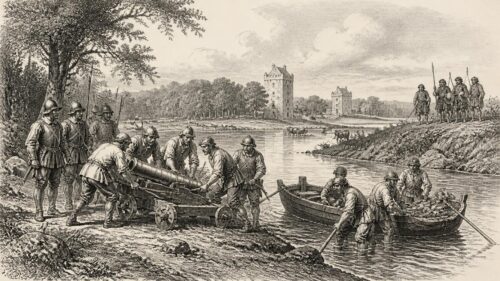
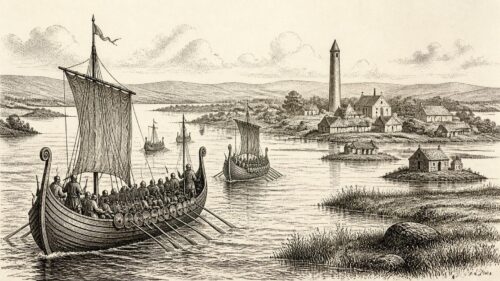
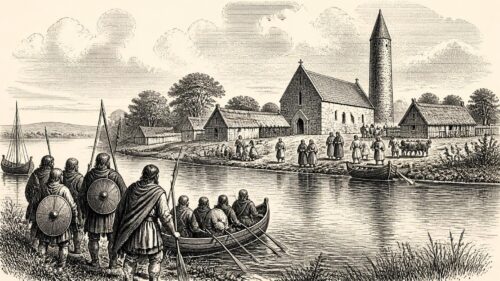
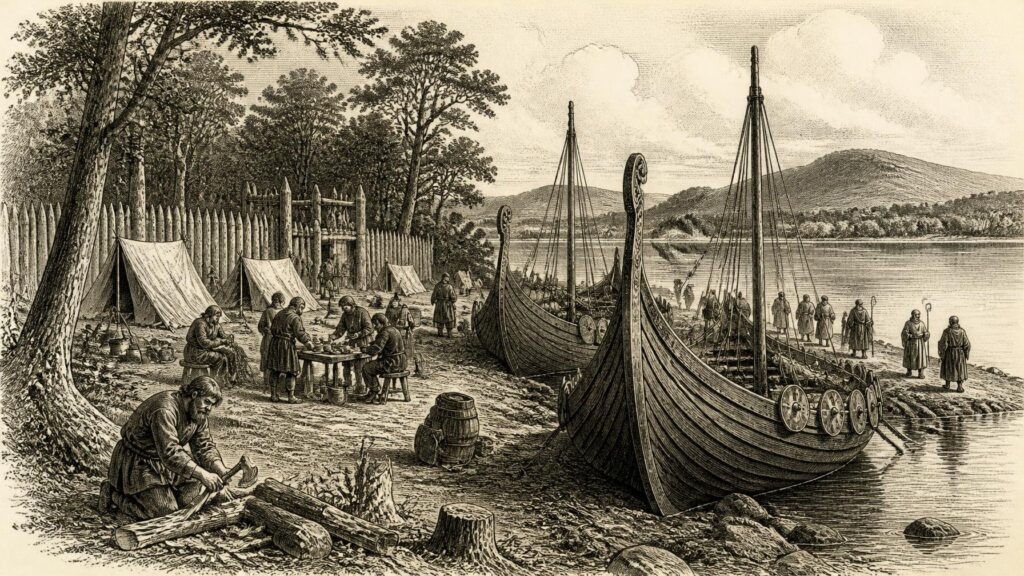
The central contemporary notice comes from the Annals of Ulster. It records an encampment, or dúnad, of the foreigners on Loch Rí, modern Lough Ree, and connects it with Tuirgéis. From there, the force plundered Connacht and Mide and burned Clonmacnoise, Clonfert, Terryglass and Lorrha, besides other ecclesiastical settlements. A dúnad should not be imagined as a fully fledged Scandinavian town. It was a defended operational base, probably dependent on ships, supplies, armed men and control of a landing-place. Its importance lay in location. Lough Ree sits on the Shannon, a water route that joined the midlands to the western and northern interior and gave raiders unusual mobility.
The choice of this region was no accident. Clonmacnoise stood beside a major Shannon crossing and close to east–west routes across the central plain. It was an ecclesiastical community, but also a populous settlement sustained by land, livestock, craft production, travellers and aristocratic patronage. Clonfert lay on the river farther west; Terryglass and Lorrha were linked to the Shannon basin and to Munster’s northern approaches. Raiding these sites could yield movable valuables, food, animals, captives and political leverage. It also struck at institutions whose abbots, clergy and client families were embedded in the authority of kings and regional dynasties.
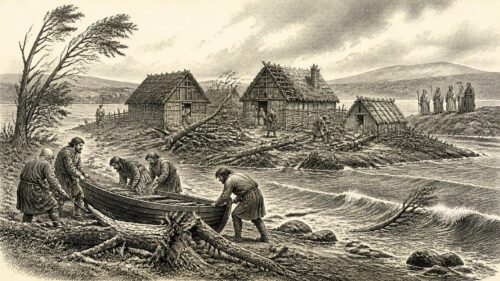
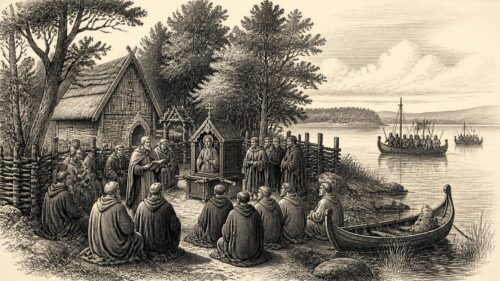
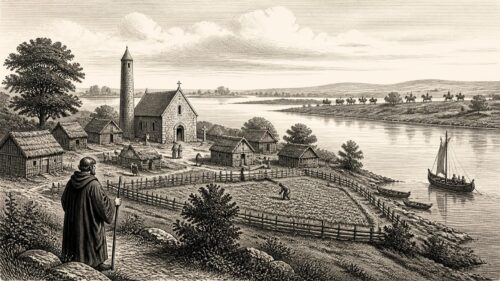
“Burned” is an unmistakably grave word in the annals, but it does not mean that every structure at each place vanished or that community life ended. Ninth-century monastic settlements commonly contained timber churches, dwellings, workshops, stores and enclosures, alongside cultivated land and burial grounds. Fire could therefore destroy buildings and possessions with terrifying speed. Communities nevertheless rebuilt, reorganised and continued their religious work. The later survival and prominence of Clonmacnoise and the other houses are reminders that the record describes a destructive episode, not an irreversible end.
Churches, People and Portable Wealth
Other notices make the human cost clearer. Dún Másc, the early medieval stronghold on the Rock of Dunamase in modern County Laois, was plundered. There Áed son of Dub dá Crích, abbot of both Terryglass and Clonenagh, was killed, as was Ceithernach son of Cú Dínaisc, prior of Kildare, together with “many others”. The deaths reveal how interwoven ecclesiastical office, learning and political rank could be. An abbot did not simply supervise prayer. He could administer estates, receive guests, oversee dependants, negotiate with secular rulers and safeguard the resources of a wealthy church. The loss of such men was a practical as well as spiritual blow.
Forannán, abbot of Armagh, was captured at Cluain Comarda with his holy objects and his following, then taken to the ships at Limerick. The entry is especially revealing. Relics and their shrines carried profound devotional authority, but they were also precious objects of metalwork and symbols of an institution’s standing. Forannán’s “following” was not an incidental detail: a great church was a community of clerics, students, household staff and dependants, not an isolated priest at an altar. The later Annals of Inisfallen adds that Patrick’s shrine was broken and carried away. Since that version is later and its chronology differs, it should be used to illuminate the tradition, not to add a confidently dated detail to the capture itself.
The annals also record the deaths of Fiachna, abbot of Finnubair Abae; Gormgal, bishop and anchorite of Lann Léire; Labraid, abbot of Slane; and two further abbots, Robartach of Achad Bó and Robartach of Domnach Mór. These notices do not establish that all died in violence. Rather, they show the continued density of Ireland’s ecclesiastical landscape even in a year dominated by raids. Monasteries and churches remained centres where prayer, burial, schooling, manuscript work, hospitality, estate management and political relationships met. The annalists’ attention to their leaders demonstrates their importance to contemporary society.
Irish Responses and Rivalries
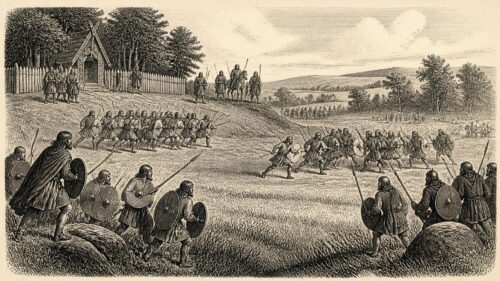
The Vikings were not the only armed actors. Niall son of Áed, king of Tara and leader of the northern Uí Néill, inflicted a rout on the foreigners at Mag Ítha, in the north-west. The surviving entry provides neither numbers nor tactics, and it does not safely identify the defeated group with Tuirgéis’s men at Loch Rí. It does, however, show that Irish resistance was active and regional. There was no united national army waiting to expel an external invader. Kings defended their own interests through mobile warbands, alliances and local knowledge, while rival dynasties competed for prestige and territory.
That internal contest is visible in Mide. The annals state that Máel Sechnaill son of Máel Ruanaid killed Donnchad son of Follaman and Flann son of Máel Ruanaid. The terse wording leaves motives obscure, but the killing of Flann, Máel Sechnaill’s brother, points to a dynastic struggle within the southern Uí Néill world. Máel Sechnaill was not yet king of Tara in 845; Niall son of Áed still held that position. He was, however, a rising Clann Cholmáin ruler in Mide, a kingdom strategically placed between the Shannon corridor, the Boyne basin and the eastern coast. The ability to act decisively against rivals at home helped make a response to Viking power possible.
It was Máel Sechnaill who captured Tuirgéis and had him drowned in Loch Uair, generally identified with Lough Owel in County Westmeath. Both the Annals of Ulster and Chronicon Scotorum preserve the core statement. This is one of the firmest events of the year, although it lacks an exact date, a description of the capture or any account of a battle. Drowning was an emphatic form of execution, and the location placed the punishment in Máel Sechnaill’s own midland sphere. His action was later remembered as a decisive triumph over Viking aggression, but it should not be inflated into the destruction of all Scandinavian power in Ireland. Viking forces remained at Dublin and elsewhere, and conflict continued.
Dublin’s Inland Reach
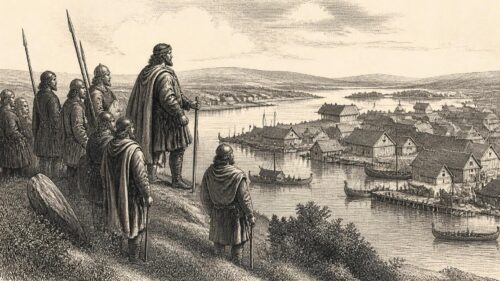
The final military notice for the year records an encampment of the foreigners of Áth Cliath, or Dublin, at Cluain Andobuir. This matters because it distinguishes a Dublin-based force from the Loch Rí group. Scandinavian activity in Ireland was not directed from one unquestioned capital or by one permanent “Viking army”. Several maritime groups could operate from separate bases, compete, raid independently or respond to different opportunities. Dublin had already become a durable Scandinavian foothold by the early 840s; the camp at Cluain Andobuir shows that its people could move beyond the coast and undertake inland operations.
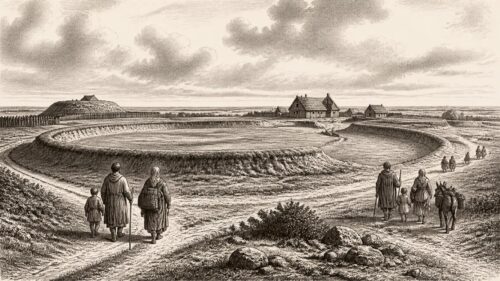
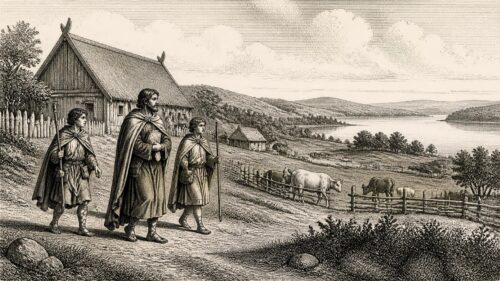
For ordinary people, the year’s consequences were likely felt in disrupted travel, insecurity around river routes, demands for food and transport, loss of livestock and the fear of capture. The sources do not permit a scene-by-scene reconstruction of village life, nor do they justify portraying every monastery as a helpless victim. Irish churches possessed dependants, patrons and sometimes substantial resources; secular Irish rulers had also attacked churches in earlier generations. What 845 demonstrates is the added reach of ship-borne raiding forces, able to turn waterways into routes of invasion and to threaten institutions that connected local communities to the wider political order.
A Checked, Not Ended, Expansion
Tuirgéis’s death became surrounded by elaborate later stories: claims that he ruled most of Ireland, seized Armagh, installed a wife as a pagan oracle at Clonmacnoise, or founded a Viking kingdom across the island. These tales belong chiefly to much later historical writing and cannot be treated as evidence for 845. The annals support a more compelling reality: a leader associated with a formidable Loch Rí base, widespread raids in Connacht and Mide, serious attacks on major churches, and a capture engineered by an ambitious Irish ruler.
Thus 845 was neither the conquest nor the liberation of Ireland. It was a sharp demonstration of how exposed the midlands had become after decades of Viking incursions, and of how quickly Irish political leaders could turn military success into authority. Máel Sechnaill’s handling of Tuirgéis enhanced his standing in Mide at a crucial moment. The monasteries of the Shannon corridor endured immediate loss but also proved resilient. Their destruction and recovery would remain part of the lived memory from which later Irish writers fashioned a larger story of conflict between the Gaels and the foreigners.
Primary Sources
- The Annals of Ulster: Year U845
- The Annals of Ulster: Year U846
- Chronicon Scotorum: Annal CS845
- Annals of Inisfallen
- Annals of Inisfallen, Irish Text
- Annals of the Four Masters
- Annals of the Four Masters: Part 67
- Vikings in Irish Chronicles, 794–902: Data
- Turgéis (Turgesius)
- Máel-Sechnaill
- Vikings in Scotland and Ireland
- Vikings in Ireland
- Viking Ireland: Afterthoughts
- Vikings in Early Medieval Ireland
- Cogadh Gaedhel re Gallaibh: The War of the Gaedhil with the Gaill
- Conservation Project at the Rock of Dunamase
- Rock of Dunamase
- Clonmacnoise Visitor Guide
- High Crosses
- Gazetteer of Ireland / Gasaitéar na hÉireann