Feidlimid at Clonmacnoise833 CE
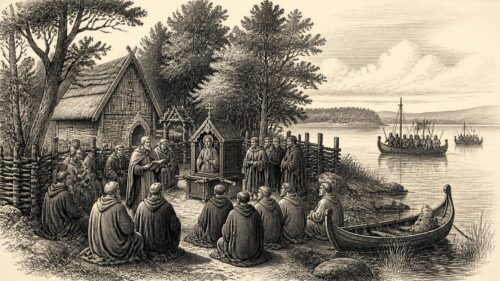
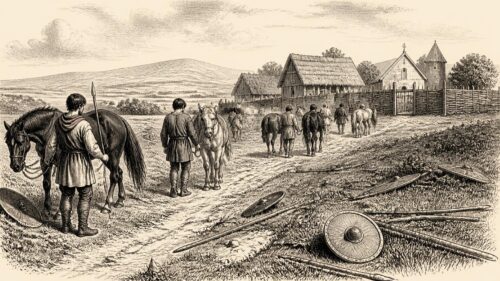
In 833, Ireland’s major churches functioned as religious centres, estates, communications hubs and political assets amid rivalry between provincial kings. Conchobar of Tara died, and Niall Caille of Cenél nÉogain succeeded him, defeating foreigners near Derry with Murchad. Feidlimid of Cashel attacked Clonmacnoise and Durrow, killing community members and burning church lands, probably targeting rival patronage networks rather than destroying churches. Kildare suffered bloodshed, while Lismore was burned amid uncertain local conflict. Viking raiders plundered Clondalkin, Druim Inasclainn and Loch Bricrenn, though Irish forces resisted. Deaths of Connacht and western Munster rulers further unsettled alliances, illustrating a connected, contested landscape.
Dateline
The events conventionally placed in 833 reveal Ireland as a country whose greatest religious centres were also centres of landholding, learning, communication and political power. This was not a single kingdom. Kings of provinces and lesser territories competed for tribute, hostages and influence, while major churches stood at the heart of those contests. The year’s annals are unusually crowded: a king of Tara died and was succeeded; a Munster ruler struck at great midland monasteries; Leinster saw violence at Kildare; and Viking forces remained capable of raiding both coastal and inland places. Yet the evidence needs careful handling. Medieval Irish annals do not always align precisely in their year-numbering: the Annals of Ulster and the Annals of the Four Masters place several entries under a year corresponding to 832 in their own systems, while Chronicon Scotorum labels the attack on Clonmacnoise 833. Modern reference works conventionally date the death of Conchobar and Niall Caille’s accession to 833. What follows uses that conventional calendar placement, while avoiding claims about an exact sequence where the sources do not provide one.
A Change at Tara
Conchobar son of Donnchad, king of Tara, died in 833. His death mattered far beyond his own midland base. The kingship of Tara was not a modern national monarchy, but it carried a powerful claim to supremacy among the Uí Néill and, potentially, over much of Ireland. Conchobar belonged to Clann Cholmáin, a leading southern branch of the Uí Néill. His fourteen-year tenure had taken place amid persistent pressure from Feidlimid son of Crimthann, the ambitious king of Cashel in Munster.
Niall Caille, of Cenél nÉogain in the northern Uí Néill, now began to rule as king of Tara. The annals associate his accession with a victory alongside Murchad over the Genti, the foreigners, at Daire Calgaig, usually identified with the important ecclesiastical settlement at Derry. The concise notice tells us neither the size of the raiding force nor the detailed course of the fighting. It does, however, show that a newly prominent northern ruler could mobilise with an ally to defend a major northern church and its district. The encounter was significant symbolically as well as militarily: Derry was a Columban foundation, and protection of such a place reinforced a king’s standing.
The political succession did not make Ireland more orderly. Niall’s accession introduced a new holder of Tara’s prestige just as Feidlimid was asserting Munster’s reach across the midlands. The rivalry between northern Uí Néill, southern Uí Néill and the Éoganacht rulers of Cashel formed the principal political background to the year. Churches and monasteries were not observers standing apart from that struggle. Their estates, personnel, relics, hospitality, legal privileges and connections to ruling families made them prizes and instruments of power.
Feidlimid’s Midland Blow
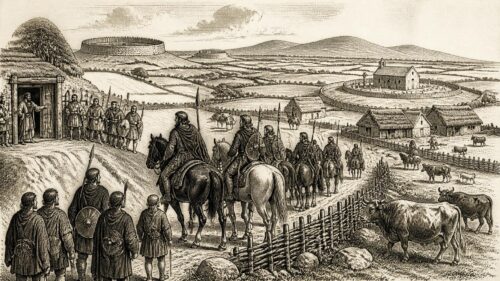
The most arresting entry for the year records that Feidlimid, king of Cashel, killed members of the community of Clonmacnoise and burned its termonn, or church lands, up to the church door. The same formula is applied to Durrow: its community was treated likewise, with its lands burned to the door of its church. This language matters. It does not say that the principal churches themselves were burned. Rather, it depicts an assault driven through the agricultural and domestic resources of the ecclesiastical settlements, stopping at the sanctuary threshold. The distinction may reflect a real limit observed by attackers, an annalist’s emphasis on sacrilege narrowly avoided, or both.
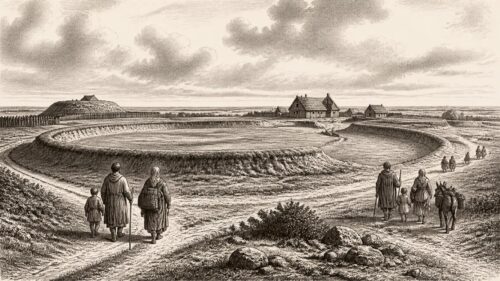
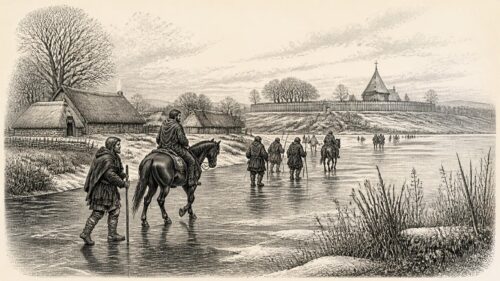
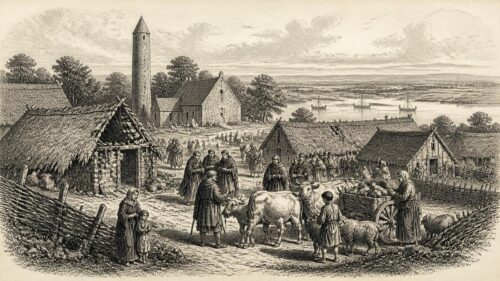
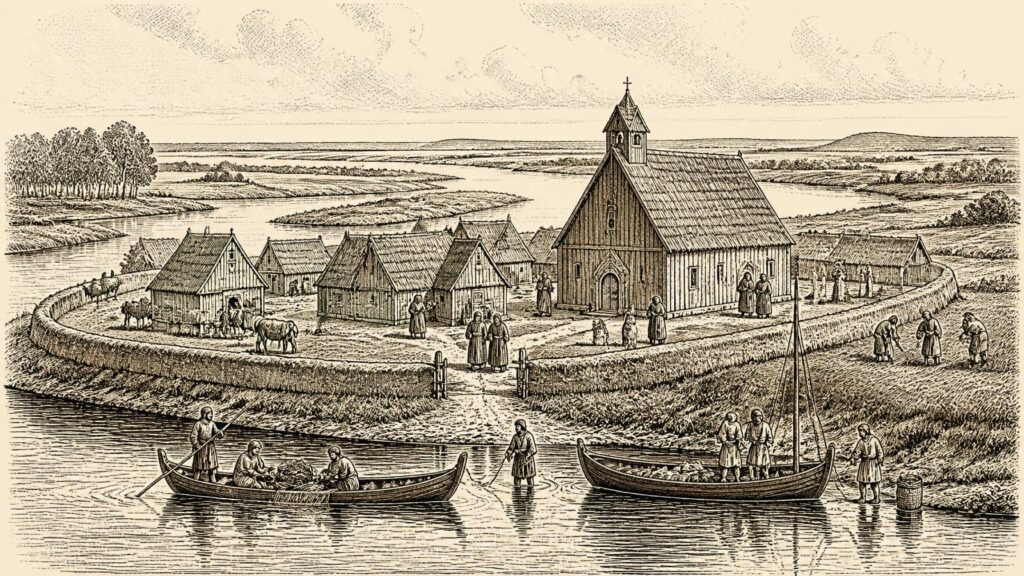
For people living in and around either settlement, the experience would have been devastating regardless. A monastery was not merely a secluded church occupied by monks. Clonmacnoise stood beside the Shannon at a major north–south water route and close to east–west overland communications along the eskers. It included clerics, students, craftsmen, tenants, labourers, dependants and visitors, as well as a large estate network. Durrow, traditionally founded by Colum Cille, was another influential foundation with strong associations in the midlands. Burning church lands could mean the destruction of timber buildings, stored food, farm structures, fences, workshops and dwellings; it could also mean the seizure or dispersal of livestock and people. The annals’ reference to killings makes clear that this was more than a demonstration of force.
Feidlimid’s action should not be flattened into a simple story of a secular king attacking religion. He himself was remembered as a religious, even ascetic, figure as well as a king. His campaigns against churches were political interventions in institutions tied to rival dynasties. Durrow had close links with Clann Cholmáin, the southern Uí Néill line of the recently deceased Conchobar. Clonmacnoise sat at the meeting-point of Munster, Connacht and the midlands and had already become contested ground in Feidlimid’s wider attempt to project authority northward. Earlier in his reign he had helped install a Munster-connected vice-abbot there. The violence of 833 was therefore an attack on wealth and people, but also on hostile networks of patronage and allegiance.
The wording of the annals also allows a glimpse of the limits of royal power. Feidlimid could raid and intimidate, but the fact that the churches remained standing and their communities continued to be recorded indicates that neither Clonmacnoise nor Durrow was erased. Great churches possessed enduring local support, spiritual authority and economic resources. They could survive an attack, preserve its memory and shape later judgement of the attacker. In this sense the annal itself is part of the aftermath: it memorialises violence against communities whose scribes and allies had reasons to remember it.
Kildare, Lismore and Local Conflict
Churches also figured directly in Leinster’s internal politics. The Annals of Ulster date a battle at Kildare to 29 August, the feast of the beheading of St John the Baptist. Cellach son of Bran routed the community of Kildare in their own monastery, and many people were killed. The entry is exceptionally precise about the day but frustratingly silent on the immediate cause. It nevertheless makes clear that the community could be treated as a military and political body, not simply as non-combatant clergy. Kildare was one of Ireland’s foremost ecclesiastical centres, wealthy, prestigious and deeply entangled with Leinster dynasties.
In Munster, the annals additionally report the burning of Lismore, associated with St Mochuda, and a slaughter among the people of Desmumu, or south Munster. No perpetrator or sequence is supplied in the surviving brief notice. It would be irresponsible to attach it confidently to Feidlimid or to identify it as a Viking raid. What can safely be said is that violence was not confined to distant frontiers. Even within the sphere of Cashel, communities could suffer burning and killing, whether through dynastic rivalry, raiding, retaliation or conflict whose specifics have disappeared.
Deaths further altered the political landscape. Diarmait son of Tomaltach, king of Connacht, died, while Cobthach son of Máel Dúin, ruler of Iarmumu in western Munster, was killed according to the Annals of Ulster. The sources preserve little detail about either event, but such deaths could immediately unsettle alliances and succession arrangements. In a political order based on kin-groups and personal lordship, the loss of a king was rarely merely private. It opened questions about who could command followers, collect dues, safeguard churches and negotiate with neighbouring rulers.
Foreigners on Water and Land
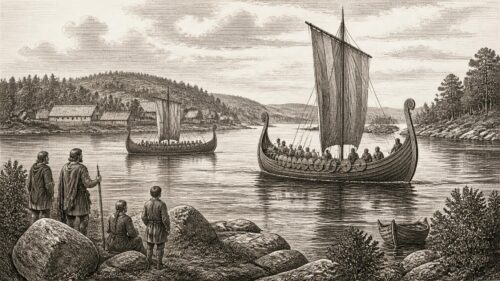
Viking activity remained an immediate fact of life, but the year does not support a picture of irresistible Scandinavian conquest. At Derry, Niall and Murchad defeated a foreign force. Elsewhere, foreigners plundered Clondalkin, west of Dublin, and burned Druim Inasclainn, usually identified with the important monastery at Mellifont or Monasterboice district in present-day County Louth. These attacks demonstrate how waterways and coastal access opened routes to valuable ecclesiastical settlements, while the successful northern resistance shows that raiders could be met and beaten.
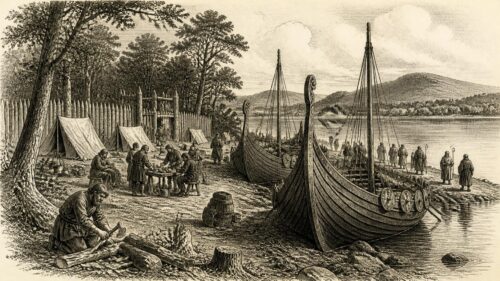
Another annal records the plundering of Loch Bricrenn, generally linked with Loughbrickland in County Down, “to the detriment” of Congalach son of Echaid. Congalach was captured and later killed “at the ships”. The wording offers a rare, stark human detail: vessels were not only instruments for sudden attacks but places of detention and execution. Still, the annals do not identify the raiders by ethnicity in this particular entry or explain Congalach’s status beyond his father’s name. The episode should therefore be read as evidence for lethal maritime raiding, not as a fully recoverable narrative.
By 833, repeated raids had made rivers, lakes and sea-loughs strategic corridors. Yet foreign groups had not established the later, more visible urban settlements of Dublin, Waterford, Wexford, Cork and Limerick in their mature form. The evidence for this year instead shows mobile raiding forces, local resistance, and an Irish political world already accustomed to organising defence, retaliation and negotiation around threats arriving by water.
What the Year Reveals
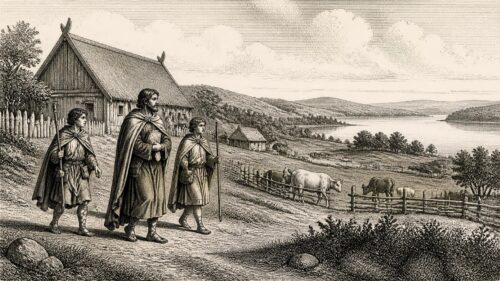
For ordinary households, 833 was likely remembered less through kingship lists than through immediate vulnerability: crops and stores burned, livestock driven away, kinsmen killed, captives taken, and obligations to lord or church disrupted. At the same time, daily life continued through the labour of farms, river traffic, craft production, worship and schooling. The very institutions attacked during the year had accumulated enough wealth, people and connections to remain worth attacking.
The year’s central lesson is that early medieval Ireland’s monasteries were inseparable from the country’s politics. Feidlimid’s assault on Clonmacnoise and Durrow, the bloodshed at Kildare, the burning at Lismore and Viking attacks at Clondalkin and Druim Inasclainn all involved places of prayer and learning. But they also involved estates, routes, royal allies and claims to authority. Niall Caille’s emergence at Tara gave the northern Uí Néill a new champion; Feidlimid’s midland violence showed that Cashel still intended to contest the balance of power. Ireland in 833 was not passive before either kings or raiders. It was a densely connected landscape in which church communities, regional rulers and armed bands each shaped the struggle for security and influence.
Primary Sources
- The Annals of Ulster, Year U833
- Chronicon Scotorum, Annals CS833–CS838
- Annals of the Four Masters, Annals M831–M832
- Fedelmid (Feidlimid)
- Niall Caille
- Conchobar
- Muirgius
- Clonmacnoise Monastic Site
- Clonmacnoise Visitor Guide
- Durrow Church and High Cross
- Irish School of Illumination, c. 650–1100
- High Crosses
- Vikings in Irish Chronicles, 794–902: Introduction
- The Vikings in Ninth-Century Ireland: Sources and Settlements
- The Beginning of the Viking Age in the West
- Annals of Inisfallen
- CELT Project: Annals of Inisfallen
- CELT Project: The Annals of Ulster
- CELT Project: Annals of the Four Masters
- List of Published Texts at CELT
- The Annals of Clonmacnoise, Being Annals of Ireland to A.D. 1408
- Vikings in Ireland and Scotland