

Sacred Power
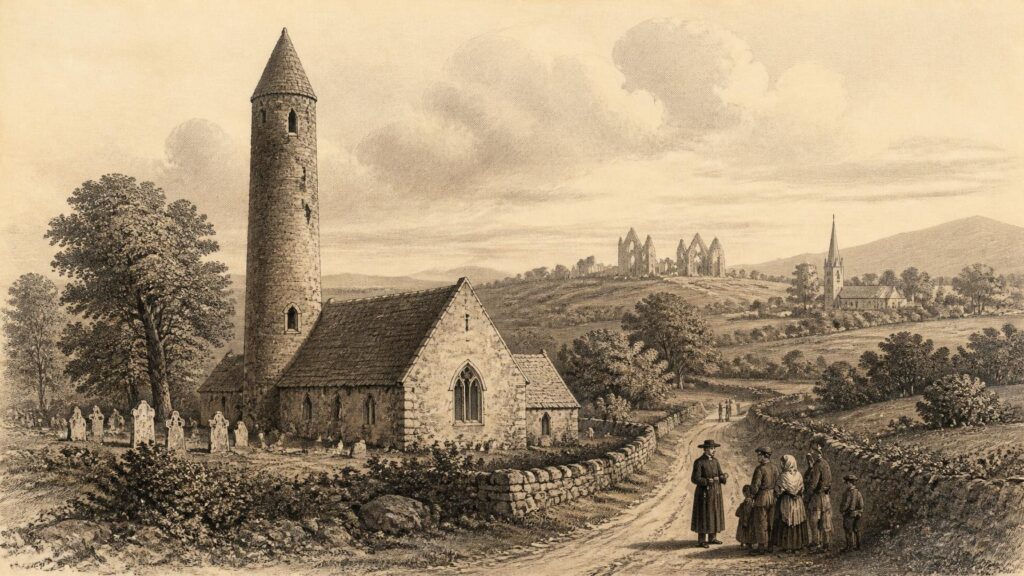
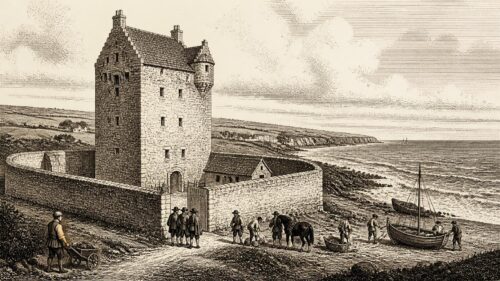
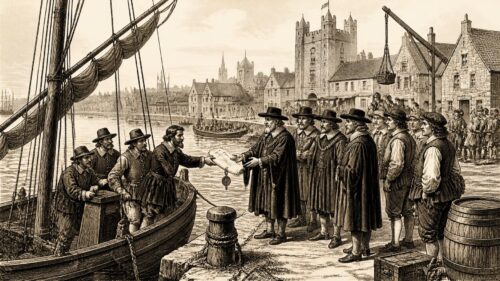
AI generated historical illustration, not a contemporary photograph.
At a Glance
Churches have shaped Ireland not merely as places of worship, but as settlements, schools, landlords, employers, patrons, political symbols and, at times, instruments of social discipline. Their history cannot honestly be reduced to a tale of saints and ruins, nor to one of domination and decline. It is a long, uneven history in which belief, power, local custom, law and human experience continually altered one another.
Christian Beginnings
Christianity reached Ireland in late antiquity, but the precise character and pace of its earliest expansion remain matters for careful historical judgement. Later medieval writers constructed powerful narratives around Patrick, Palladius and the conversion of the Irish. Those traditions preserve important memories, yet they are not straightforward contemporary reports. Patrick’s own surviving writings are the nearest evidence to his world, but they do not provide a complete institutional history of the island’s conversion. Nor should the familiar image of one missionary arriving in a wholly pagan country be accepted without qualification.
Archaeology, early texts and place-names instead suggest a gradual and regionally varied process. Christian communities took root among existing dynasties and populations, adapting to an Ireland divided among many local kingdoms. The new religion brought connections to Latin literacy, continental theology and wider networks of travel, but it also became embedded in Irish kinship, patronage and political life. Ecclesiastical foundations were frequently associated with saints whose remembered authority could validate a community’s claims to land, status and pilgrimage.
The word church therefore needs to be understood in more than one sense. It could mean a building, a community of believers, a clerical institution or a territory linked to a saintly founder. In early Ireland these meanings overlapped. An ecclesiastical settlement might include a burial ground, dwellings, workshops, guest accommodation, agricultural land and one or more places of worship. The National Monuments Service notes that many old church and graveyard sites occupy earlier ecclesiastical enclosures, some of which once contained communities approaching the scale of small towns.
This evidence also requires restraint. Surviving stone churches, round towers and crosses are highly visible, whereas the earliest timber structures have largely vanished. Their absence should not be mistaken for absence of worship or organisation. The physical record is partial, and saints’ Lives, annals and genealogies were often written or reshaped generations after the events they describe. Folklore can illuminate how later communities understood sacred places, but it cannot by itself establish the date, founder or original function of a site.
Monastic Landscapes
By the early medieval period, ecclesiastical centres were among the most important settlements in Ireland. They were not necessarily isolated retreats occupied only by monks in contemplation. Some were substantial communities with churches, cemeteries, craft activity, agricultural resources, dependent churches and lay inhabitants. Their influence rested upon land, literacy, patronage and their ability to attract devotion as well as upon religious observance.
Clonmacnoise on the Shannon offers a particularly revealing example. Its surviving remains include churches, round towers, high crosses and an extensive graveyard, but the monument is more than an impressive collection of ruins. It occupied a strategic route through the island and developed into a centre of learning, commemoration and political connection. The state heritage record describes archaeological remains there spanning more than a millennium, including a stone church built in 909 with the support of King Flann Sinna and the celebrated Cross of the Scriptures. Such evidence points to cooperation between ecclesiastical leaders and secular rulers, not to a church separate from worldly authority.
Glendalough similarly demonstrates why the term monastery can mislead if treated too narrowly. The valley’s churches, gatehouse, cemetery, tower and later buildings form an extensive ecclesiastical landscape. Its principal enclosure preserves the only surviving monastic gate from early medieval Ireland, while the wider valley contains churches associated with pilgrimage and later religious use. The National Monuments Service identifies it as one of the best surviving early medieval ecclesiastical landscapes in the world. The survival of stone structures is exceptional, but the site’s significance lay equally in its authority over people, territory and memory.
These centres helped foster manuscript culture and education. Clerics wrote annals, copied texts, compiled genealogies and participated in intellectual exchange beyond Ireland. Yet romantic claims that Ireland alone saved European civilisation during the early Middle Ages oversimplify both Irish and continental history. Irish religious communities did preserve and produce important texts, and Irish clerics travelled widely, but scholarship was sustained in many regions of Europe. A historically sound account should value Ireland’s achievements without converting a later slogan into a total explanation of the period.
Nor were ecclesiastical communities immune from violence or political rivalry. Annals record raids, burnings and attacks on churches, sometimes by outsiders and sometimes by Irish rivals. Church sites could be wealthy, strategically located and symbolically valuable. Their supposed sanctity did not guarantee security. The existence of round towers has long generated popular tales that they were built solely as refuges from Viking raiders. They may occasionally have offered protection, but their architectural form and placement show that they also served as bell towers, markers of prestige and elements of a developed ecclesiastical landscape. Folklore is part of their afterlife, not a sufficient explanation of their construction.
European Reform
The church in medieval Ireland changed profoundly during the eleventh and twelfth centuries. Earlier arrangements centred heavily on major ecclesiastical families and federations of churches associated with particular saints. This did not mean that Ireland had no bishops or no links with Rome; rather, authority was organised differently from the territorial diocesan pattern that later became familiar. Reformers sought clearer diocesan boundaries, more regular clerical discipline and closer alignment with continental canon law and religious orders.
The synod associated with Ráith Bressail in 1111 is conventionally treated as a crucial stage in this process, while the synod of Kells in 1152 further developed the diocesan framework. A University College Dublin study of Glendalough describes Ráith Bressail as laying down boundaries for new territorial dioceses and notes that Kells subsequently made Dublin an archdiocese with authority over a smaller Glendalough diocese. Such reforms did not instantly replace older arrangements. Their consequences unfolded gradually and differently from one region to another.
New religious orders deepened these links with European ecclesiastical culture. Augustinian canons, Cistercians, Dominicans and Franciscans established houses in Ireland, bringing distinctive rules, architecture and administrative connections. These communities were supported by kings, magnates, bishops and townspeople. They prayed, preached, administered estates, cared for travellers and poor people in varying circumstances, and sometimes became closely tied to the ambitions of their founders.
Kells Priory in County Kilkenny shows the medieval church operating within a new colonial and urban setting after the Anglo-Norman invasion. It was founded for Augustinian canons in 1193 by Geoffrey fitz Robert, who had received lands within the lordship of Leinster. The monument record explains that its founder established a town and provided the canons with a church site and substantial estate. The priory’s formidable walls and towers are a reminder that religious houses could be economic and defensive institutions as well as places of worship.
It is tempting to draw a clean divide between a supposedly independent Celtic church and a later Roman church imposed from outside. That formulation belongs more to later polemic than to medieval complexity. Irish Christianity had long been connected to wider Latin Christendom; at the same time, reform altered patterns of authority, landholding and organisation in real ways. The better historical question is not whether Ireland was either wholly separate or wholly dependent, but how Irish religious institutions negotiated changing local and international relationships.
Reformation Settlement
The sixteenth-century Reformation introduced a lasting confessional division whose consequences reached into law, land and political identity. The Crown’s ecclesiastical reforms in Ireland were linked to the wider Tudor break with papal authority, but they did not produce uniform religious change. The Church of Ireland developed from the pre-Reformation church that accepted the reforms under Henry VIII and subsequent English monarchs. The institutional continuity was important: dioceses, cathedrals, parish structures and much church property did not simply disappear. Yet doctrinal, liturgical and political authority changed.
Acceptance of the Reformation was uneven. Its progress depended upon royal power, local elites, language, patronage and the reach of government. In many districts, attachment to Catholic worship, clergy and sacramental practice remained strong. The result was not an instant division into two neatly separate populations. Families, communities and local authorities negotiated an uncertain confessional environment over generations. Buildings themselves could pass between uses, fall into disrepair or retain material traces of older devotions.
Drumcliffe in County Clare illustrates the caution required in reading a sacred landscape. Heritage Ireland describes it as a monastic settlement from early Christian times that was briefly transformed into a Protestant chapel during the Reformation. That short statement compresses centuries of change, but it indicates a larger truth: the Reformation was experienced not only through proclamations and theology but through the practical fate of churches, cemeteries, clergy, parish revenues and local worship.
The dissolution and reorganisation of religious houses also transformed the social economy of the church. Monastic lands and buildings entered new hands; some institutions disappeared, while others survived in altered forms or left durable marks on settlement and property. St Mary’s Abbey in Dublin, founded in 1139, was among the largest medieval monasteries in Ireland. Its surviving chapter house later became associated with the Council of Ireland, and it was there in 1534 that Silken Thomas renounced allegiance to Henry VIII. The building therefore embodies a shift from monastic governance to political rebellion and Tudor conquest.
It would be wrong, however, to describe the Reformation simply as an English Protestant imposition upon a passive Irish Catholic people. English government power was undoubtedly central, and Catholic resistance and endurance were real. But Irish Protestant communities developed their own clergy, laity, schools, cultural practices and political traditions. Their history is Irish history, not an external appendix to it. Equally, Catholic survival was sustained not solely by heroic resistance but by family networks, local patronage, religious orders and forms of ordinary practice that often left fewer formal records than state institutions.
Confessional Conflict
From the late sixteenth century through the eighteenth, religious allegiance became entangled with conquest, plantation, rebellion, civil war and landownership. This association was neither inevitable nor total: Catholics and Protestants did not all share the same politics, social rank or experience. Nevertheless, the language of religion provided a powerful means of defining loyalty and exclusion. Churches became visible symbols of competing constitutional orders.
The seventeenth century was especially destructive. War touched religious institutions of every kind, and the Catholic Confederation of the 1640s demonstrated that Catholic political organisation could bring together Gaelic Irish and Old English interests, though not without tensions. Cromwellian conquest, Restoration settlements and later Jacobite conflict redistributed property and entrenched Protestant political dominance. The position of the established church was therefore inseparable from a landholding order in which much of the Catholic majority was excluded from full power.
Penal legislation affected Catholics and Protestant dissenters in different ways and changed over time. It is often presented as a single, unchanging code, but historians must distinguish statutes from enforcement, local variation and successive modifications. Its broad effect was nonetheless to restrict Catholic civil and religious life and to support the privileged place of the established Anglican church. The Church of Ireland’s own historical account acknowledges that Catholics and Dissenters were compelled to pay tithes supporting the established ministry while providing for their own clergy.
For Catholic communities, worship could be constrained, yet parish life, devotional networks and clerical organisation persisted. By the later eighteenth and nineteenth centuries, Catholic church building became much more visible. New chapels, churches and eventually cathedrals signalled not simply religious revival but a changing public confidence. Catholic Emancipation in 1829 marked a decisive constitutional change, although it did not end the inequalities rooted in land, education or political power. It should be seen as a major stage in a longer process rather than as an immediate resolution of sectarian division.
Tithes were an especially charged issue because they joined religion to household economy and rural resentment. Payment to support a church followed by a minority could appear profoundly unjust to many Catholics and Presbyterians. The Tithe War of the 1830s was therefore not merely a theological controversy. It involved resistance, policing, local hardship and the political crisis of a state whose established church lacked the allegiance of most of the population.
Disestablished Church
The nineteenth century brought the constitutional settlement to a turning point. The Church of Ireland had been the established church despite representing a minority of the population. Census evidence from 1861 confirmed that it did not command a majority in any Irish county, a fact central to the political argument for reform. William Ewart Gladstone made Irish disestablishment a major Liberal cause, presenting it as part of an effort to address Irish grievance within the United Kingdom.
The Irish Church Act received royal assent on 26 July 1869. Disestablishment took effect on 1 January 1871, ending the Church of Ireland’s formal status as the state church and ending the Crown’s appointment of its bishops. This was not a trivial administrative alteration. It removed a constitutional symbol of Protestant ascendancy, reconfigured ecclesiastical property and required the church to develop new structures of self-government.
Disestablishment is sometimes narrated as the church’s simple defeat or as a final act of justice. Both descriptions are too narrow. For many Church of Ireland members, it meant the loss of a historic legal position and uncertainty over clergy incomes, buildings and institutions. For Catholics and Presbyterians, it removed an inequitable establishment, though it did not dissolve the wider social and political divisions of the island. For the state, it was an attempt to reform a structure that had become difficult to defend in democratic politics.
The post-1871 church reorganised through a General Synod and the Representative Church Body, with significant participation by clergy and laity. The Church of Ireland’s records describe the transition as one from a privileged minority into a voluntary church responsible for its own governance and support. Its parishes, schools, churches and memorial culture remained integral to local life across Ireland. Disestablishment removed legal privilege; it did not erase a community, its heritage or its claim to belong to the island’s history.
Independent State
Partition and independence changed the political setting again. In Northern Ireland, Protestant churches occupied a prominent place within a state whose constitutional identity was tied to the Union, though no church was established. In the Irish Free State and later the Republic, the Catholic Church possessed considerable social influence, especially through education, healthcare, welfare provision and moral authority. That influence was substantial, but it should not be described as unlimited control over government or society. Political leaders, civil servants, families, voluntary bodies and economic constraints all shaped policy.
The 1937 Constitution reflected the religious language of its time while also guaranteeing freedom of conscience and the free profession and practice of religion. The present constitutional text states that the State shall not endow any religion and shall not discriminate on grounds of religious profession, belief or status. Its original wording also accorded a special position to the Catholic Church and named several other denominations; those provisions were removed by the Fifth Amendment in 1972. This change is a useful reminder that constitutional texts, like churches, are historical documents shaped by changing public values.
Churches made constructive contributions to community life through worship, education, charitable activity, music, preservation and pastoral care. Religious women and men provided labour in schools, hospitals and institutions that the state often could not or would not fully provide. Yet a historical account must not confuse service with immunity from criticism. The same structures that delivered care could concentrate authority, limit scrutiny and expose vulnerable people to neglect or abuse.
Nor can responsibility for harmful institutions be assigned to churches alone. The State funded, regulated or relied upon many settings; local communities, professional authorities and families operated within social assumptions that stigmatised poverty, disability, unmarried pregnancy and childhood vulnerability. Shared responsibility does not dilute the culpability of particular religious congregations or individuals where evidence establishes it. It instead prevents a comforting historical fiction in which one institution alone produced a wider culture of exclusion.
Public Reckoning
The late twentieth and early twenty-first centuries brought profound reassessment. Survivors, journalists, historians, campaigners and official investigations challenged cultures of silence around institutional abuse, forced separation, coercive care and clerical wrongdoing. The resulting public record is painful, incomplete in places and morally unavoidable.
The Ryan Report, published in May 2009, examined child abuse in institutions and made recommendations directed at government departments and bodies responsible for services in the period concerned. Its significance lies not only in its findings but in its acknowledgement that state-supervised systems had failed many children. The report also showed why histories that speak vaguely of benevolent institutional care are inadequate without attention to testimony, inspection, regulation and redress.
The Commission of Investigation into Mother and Baby Homes examined institutions and related matters from 1922 to 1998, publishing its final report in January 2021. The report and the testimonies surrounding it require care in language. Conditions varied between places and periods; not every institution was managed by the same body, and broad claims should not replace evidence about particular homes. Yet the investigation documented a system in which vulnerable women and children could be subjected to profound stigma, separation and inadequate protection. It is proper to recognise the roles of church bodies and religious personnel while also recognising the failures of the State and society identified in official responses.
This reckoning has altered the meaning of church history. Buildings once admired chiefly for architecture are now also read in relation to the institutions and communities connected to them. Archives are no longer merely repositories for specialists; they are essential to personal identity, family tracing, accountability and public memory. The process is unfinished. Records may be dispersed, restricted, damaged or shaped by the assumptions of those who created them. Survivors’ testimony is indispensable, but it must be handled with respect rather than mined for spectacle.
Living Inheritance
The church in Irish history is not one story but many interwoven histories: Catholic, Church of Ireland, Presbyterian, Methodist, Quaker, Orthodox, Jewish, Muslim and other communities have all contributed to the religious landscape of the island. The subject also includes people who rejected organised religion, those whose beliefs changed, and those who experienced church authority as a source of support, conflict or harm. To write only of bishops and legislation would miss ordinary worshippers, schoolchildren, workers, emigrants, caretakers and families.
Across the island, churches remain embedded in the landscape. A ruined medieval priory, a nineteenth-century Catholic parish church, an eighteenth-century meeting house or a modern place of worship can each reveal changing patterns of settlement, migration, wealth and belonging. Their survival should not encourage a passive reverence for the past. Preservation is most meaningful when it supports honest interpretation: who built these places, who paid for them, who was excluded, what was taught within them, and how did local people use them?
The enduring lesson is that sacred institutions are historical institutions. They inherit ideals but operate through property, law, administration and human judgement. Ireland’s churches nourished learning, art, language, welfare and community; they also participated in inequalities and exercised authority capable of grave harm. Neither achievement cancels failure, and neither failure makes the historical record one-dimensional. A mature history holds both truths together, tests them against evidence and leaves room for experiences that older narratives ignored.



The article’s treatment of Irish churches as both sacred communities and holders of land, learning and political influence is compelling. It suggests that surviving monuments can reveal authority and memory, yet cannot alone explain how ordinary people worshipped, negotiated change or experienced exclusion. This is important when comparing early monastic landscapes with later confessional divisions and disestablishment: institutions changed, but religious buildings retained powerful local meanings. How might historians combine archaeology, institutional records and evidence of everyday practice to assess whether churches primarily shaped Irish society from above, or were continually reshaped by the communities who used and contested them?