

Ussher’s Falkland Sermon1622 CE
In 1622, James I’s Irish Commission investigated administration, revenue, courts, church provision, military costs, landholding and plantation policy during the replacement of Lord Deputy Oliver St John by Viscount Falkland. Commissioners documented Ulster’s plantation, where British settlement, construction and Protestant institutions often fell short, while Irish tenants remained important. Complaints revealed insecurity among Gaelic landholders and elites. Falkland arrived in September amid demands for economy and authority. At his inauguration, Bishop James Ussher urged enforcement against recusancy, provoking Catholic opposition and criticism within the Church of Ireland. The year exposed financial weakness, contested power, incomplete colonisation and persistent religious division.
Dateline
In 1622 Ireland was subjected to an unusually searching official inspection while its central government changed hands. The year did not bring a single decisive battle or statute; instead, it exposed the condition of the kingdom produced by two decades of conquest, plantation and administrative expansion. A royal commission travelled, heard complaints, examined revenue and institutions, and inspected settlement. Its work coincided with the replacement of Lord Deputy Oliver St John by Henry Cary, Viscount Falkland. The ceremonial arrival of a new deputy in Dublin therefore occurred against a less ceremonial reality: officials in London were anxious about costs, corruption, unfinished plantations, religious division and the reliability of the government’s authority.
A Government Under Review
The transition began before Falkland reached Ireland. Oliver St John, Lord Deputy since 1616, had been recalled in February 1622 amid mounting criticism of Irish government. He surrendered the sword of state in April and departed in May. Between May and September the kingdom was governed by two lords justices, Adam Loftus, lord chancellor, and Richard Wingfield, Viscount Powerscourt and marshal of Ireland. This was not a vacuum of power: the Dublin administration, courts, revenue offices and provincial presidencies continued to function. Yet it was an interval in which the Crown was plainly reassessing how Ireland had been governed and whether its money and policies had achieved their stated purposes.
The principal instrument of reassessment was the Irish Commission of 1622, a large inquiry appointed by James I. Its origins lay in English political concern during 1621, when criticism of Irish expenditure and administration joined wider fears arising from renewed European religious war. The commission’s remit was broad. It examined civil government, courts, the Church of Ireland, military expenditure, royal income, trade, plantation policy and the treatment of land. This breadth matters. The inquiry was not simply an audit of individual wrongdoing, nor merely a survey of Ulster. It treated Ireland as a connected political and financial system, in which defective justice, weak ecclesiastical provision, poorly supervised grants and unreformed local power could all threaten the Crown’s security.
For contemporaries, government was experienced in practical ways: at a court hearing, in the collection of rents and taxes, in the quartering of soldiers, or through access to office and patronage. The commission heard grievances from Catholic peers and gentry as well as from officials and settlers. Sir John Everard, a Catholic lawyer and former parliamentary opponent of the administration, was among those who contributed complaints. His involvement indicates that 1622 gave some politically excluded landowners a recognised, if constrained, route for presenting objections to Crown investigators. The inquiry did not make Irish Catholics equal partners in government, but it created a record of tensions that officials could not entirely ignore.
Plantation Put to the Test
The most visible fieldwork took place in Ulster. Since the Flight of the Earls and the ensuing confiscations, the Crown had promoted the Plantation of Ulster: the settlement of English and Scottish Protestants on much of the escheated land of six counties, alongside grants to servitors, the established church and selected Irish landholders. By 1622 this was no longer an abstract scheme. New towns, bawns, fortified houses, farms, markets and estates had altered parts of the province. But the commission tested those changes against the promises made by grantees. It asked who lived on each proportion, what had been built, whether tenants were settlers or natives, and whether obligations of defence, residence and improvement had been met.
Seven of the twenty-one commissioners were assigned to Ulster. Lord Caulfield, Sir Dudley Digges and Nathaniel Rich examined Armagh and Tyrone; Sir Thomas Phillips and Richard Hadsor inspected Donegal and Londonderry; Sir Francis Annesley and Sir James Perrot dealt with Cavan and Fermanagh. Their visits ran from late July to mid-September. The surviving material is uneven, and the commissioners did not inspect every estate in person. Nevertheless, certificates submitted by undertakers and their agents, together with local testimony and observation, created one of the fullest contemporary pictures of plantation society. The inquiry recorded buildings and tenants, distinguishing freeholders, leaseholders and cottagers: categories that reveal both the Crown’s desired social order and the varied realities on the ground.
Its findings complicated the official ideal of a cleanly remade Ulster. Plantation land was still inhabited and worked by many native Irish people, while some grantees found established tenants more convenient and profitable than importing sufficient British settlers. This did not mean that plantation had failed; the new settlements and landholding structures were real and consequential. But it did show that colonisation was negotiated through rent, labour, tenancy and local survival rather than imposed according to every clause of London’s instructions. In Leitrim and the midlands as well as Ulster, complaints preserved by the commission reveal the particular vulnerability of smaller Gaelic freeholders when titles were remade and land was redistributed.
The survey also had an environmental and spatial dimension. Plantation demanded houses grouped in settlements, enclosed ground, orchards and gardens in some schemes, and more regular leases. Such requirements encouraged a landscape of bounded farms, new roads and defensive buildings, but their fulfilment varied sharply. In Londonderry the commissioners found a further telling deficiency: despite the prominence of the London companies’ settlement, the city had no proper church for its inhabitants, relying on part of a former Augustinian house. The contrast between expensive corporate colonisation and inadequate religious provision captured a recurring weakness of the project.
Religion, Office and Obedience
Religious policy ran through the commission’s concerns because confessional allegiance and public authority were inseparable in Stuart government. The established Church of Ireland held legal privilege, but Protestant congregations and clergy were thinly spread in many districts. Catholic worship and networks of priests remained resilient, while many landowners who might otherwise have supplied local administration were recusants: people who refused conformity to the established church. The commissioners confronted a practical dilemma. Excluding Catholic lawyers and gentlemen from public roles might encourage conformity in theory, but it could also leave courts and local government short of capable personnel. Their papers reveal an administration unsure how forcefully it could pursue religious uniformity without impairing its own operations.
James Ussher, bishop of Meath since his consecration late in 1621, embodied the intellectual and political confidence of the Protestant establishment. He prepared a detailed response for the royal commission on conditions in his diocese. Yet his scholarly habits should not obscure the sharpness of his public theology. Ussher maintained wide contacts with antiquarians and Catholic scholars, but he was an uncompromising opponent of toleration for Catholic religious practice. His activities in 1622 therefore show two sides of learned life in Ireland: careful collection of evidence about churches, revenues and dioceses, alongside fierce argument over what a reformed kingdom should permit.
Falkland at Dublin Castle
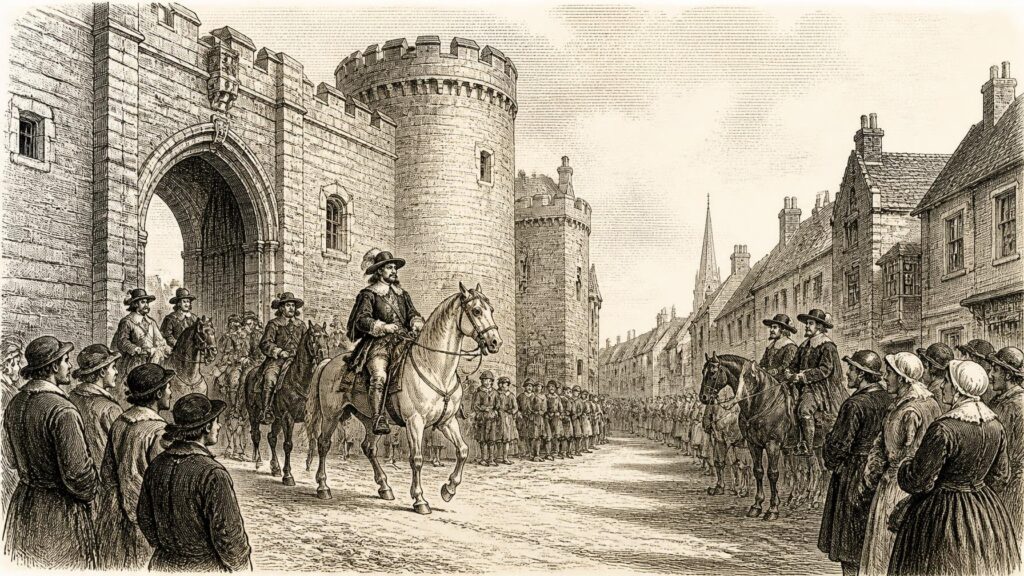
Henry Cary, Viscount Falkland, had been appointed Lord Deputy in February, but financial difficulties delayed his departure from England. He landed at Howth on 6 September and was received into Dublin with the formal attendance expected for the king’s chief governor. He was sworn in on 8 September. His accession ended the lords justices’ temporary administration, but it did not end the commission’s scrutiny. Rather, Falkland inherited its accumulating evidence and entered office while London pressed for retrenchment, reform and firmer management of the Irish establishment.
Ussher preached at Falkland’s swearing-in, choosing Romans 13:4: the ruler “beareth not the sword in vain”. The sermon urged enforcement of the recusancy laws and objected to Catholics making public use of churches. It immediately provoked Catholic protest, while the Church of Ireland primate, Christopher Hampton, reproached Ussher for inflaming old tensions. This episode is firmly attached to September 1622, and it is more revealing than a mere ceremonial detail. Falkland’s government began with an emphatic demand for Protestant authority, but also with evidence that aggressive enforcement could divide the governing elite as well as those whom it targeted.
The issue remained alive in November. On 22 November, Dublin Castle ordered Ussher to address Catholic office-holders who had refused the oath of supremacy. The instruction demonstrates that religious conformity was not confined to sermons or parish life; it bore directly on who could participate in offices of trust. At the same time, the need for such an intervention suggests the limits of policy. Refusal persisted among people whose skills, connections and local standing could not easily be replaced.
A Year of Exposure
Late in the year Miler Magrath, the long-serving Church of Ireland archbishop of Cashel, died. His extraordinary career, beginning as a Franciscan and Catholic bishop before accommodation with the Tudor church, belonged to an older Ireland of flexible clerical survival and overlapping jurisdictions. His death did not resolve those ambiguities; it merely marked the passing of a figure who had navigated them for decades.
What makes 1622 important is not that every problem received a solution. The commission exposed weak supervision, contested landholding, financial strain and unfinished religious reform; Falkland’s arrival supplied a new face at Dublin Castle, not a settled programme. For settlers, Gaelic landholders, Catholic lawyers, Protestant bishops, tenants and office-holders, the year brought closer official attention to the terms on which they lived and exercised power. Its records preserve a kingdom being measured against the Crown’s ambitions—and found more complicated, more expensive and less governable than its planners had wished.
Primary Sources
- The Irish Commission of 1622: An Investigation of the Irish Administration, 1615–1622, and Its Consequences, 1623–1624
- The Irish Commission of 1622: An Investigation of the Irish Administration, 1615-1622, and Its Consequences, 1623-1624
- Cary, Henry
- St John, Oliver
- Loftus, Adam
- Ussher, James
- Everard, Sir John
- Moryson (Morrison), Richard
- Magrath, Miler (Meiler)
- Hamilton, Malcolm
- O'Byrne, Brian
- Sources: Ulster Plantation
- The Plantation of Leitrim, 1620–41
- A Booke of Entry of Divers Reports and Certificates Concerning the State of Ireland, upon the View of Certain Commissioners Sent Thither by King James, in the Year 1622
- Versions: 1622, Ulster
- Plantations in Ulster, 1600–41
- State Papers Ireland 1509–1782: Government Papers on Irish Affairs
- Religion, Memory, and Materiality: Exploring the Origins and Legacies of Sectarianism in the North of Ireland
- PRONI 100 Treasures
- Maps
- Life of Lord Chancellor Lord Loftus
- Calendar of the State Papers, Relating to Ireland, of the Reign of James I, 1603–1625
- The Church of Ireland: Power and Distance in the Early-Seventeenth-Century Atlantic