

Salmon Reckoning
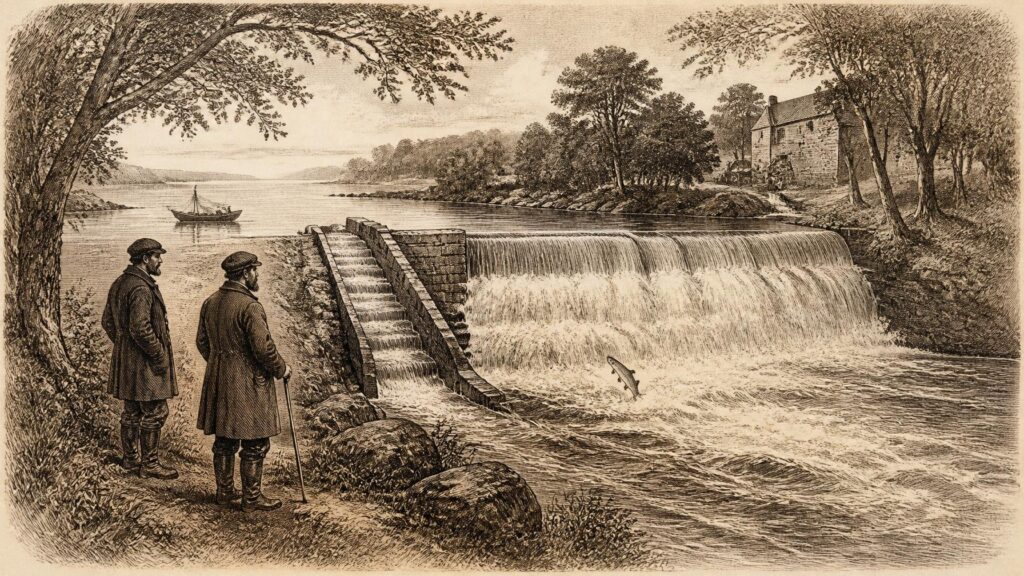
AI generated historical illustration, not a contemporary photograph.
At a Glance
Irish salmon policy has never concerned fish alone. It has repeatedly required governments and communities to decide whose claims mattered most on a migratory animal that crossed private property, public rivers, estuaries, territorial waters and, beyond them, the North Atlantic. The history of conservation is therefore not a simple advance from exploitation to enlightenment. It is a history of competing livelihoods, legal rights, changing scientific confidence and repeated recognition that a salmon taken far from its natal river may represent the loss of a breeding fish from a small and vulnerable population. Modern Irish policy, with its annual river-by-river advice, catch restrictions and habitat duties, rests upon that long and difficult reckoning.
Inherited Waters
Atlantic salmon have long held a conspicuous place in Irish economic and cultural life. They were valuable food, a commodity for sale, an object of sporting pursuit and, in many rivers, an appurtenance of landed property. Their annual return from sea to freshwater made them unusually visible to people living beside rivers, yet their wider life cycle remained obscure for much of recorded history. A fish might be caught in an estuary, in a river net, at a weir or on a rod, while the place where it had hatched and the years spent at sea were unknown. This mismatch between a local fishery and a far-ranging animal lies at the centre of the later conservation problem.
The word “policy” should be used cautiously for the earlier centuries. There were laws, customary practices, proprietary claims and periodic prohibitions, but not an ecological policy in the modern sense. Salmon were generally understood as a renewable resource whose abundance could be sustained by preserving breeding fish, controlling destructive methods and protecting access through rivers. That outlook could generate real restraints, especially around close seasons, fixed engines and the taking of fry. It also sat comfortably with vigorous commercial exploitation whenever owners and officials believed enough fish remained.
Folklore added another layer of meaning. The salmon of knowledge is one of the best-known figures in Irish narrative tradition, associated with wisdom and the Boyne. Such stories are important evidence of cultural memory, but they are not evidence for prehistoric population size, fishing law or ecological conditions. Nor should the deep antiquity of salmon in Irish tradition be made to carry precise claims about when particular fisheries began. Documentary records can establish that salmon rights, rents and methods were economically significant in later medieval and early modern Ireland; they cannot turn legend into a scientific baseline.
That distinction matters because conservation arguments often invoke an imagined former abundance. There is no doubt that Irish rivers once supported salmon runs later diminished or excluded by barriers, drainage, pollution and changing marine conditions. Yet the exact size of many earlier runs cannot be reconstructed with confidence. Historical sources are uneven. They tend to record valuable catches, disputes, leases and official anxieties rather than a complete census of fish. The responsible historical conclusion is not that the past was pristine, but that salmon were sufficiently valuable and sufficiently contested to attract regulation long before ecology became a professional discipline.
Salmon also expose the difficulty of describing Ireland as one management space. The island contains many separate river systems; the political jurisdictions of Ireland and Northern Ireland have developed distinct legal arrangements; and the Foyle and Carlingford waters have required co-operation across the border. At sea, Irish salmon mingle with fish from elsewhere in the North Atlantic. A history of Irish policy must therefore be both local and international. It begins in particular rivers, but it cannot end there.
Early Restraints
Before the nineteenth century, salmon regulation emerged from a mixture of common law, statutes, local rights and commercial practice. Fishing rights might be attached to manors, estates, corporations, monasteries before the Reformation, towns or particular river banks. Access to a river did not necessarily confer a right to take salmon from it. The result was a patchwork in which law protected property as much as fish. A proprietor concerned about poaching could describe enforcement as preservation; a tenant fisher excluded from a customary place could experience the same measure as dispossession.
Some early enactments sought to prevent methods considered especially destructive, including the capture of juvenile fish or the obstruction of migratory passage. Such rules demonstrate that people understood a basic relation between adult returns, spawning and future catches. They did not, however, amount to a uniform national system. Enforcement depended upon local authority, the resources of owners and the willingness of magistrates to act. Rivers with valuable commercial fisheries attracted more supervision than remote tributaries, and a prohibition on paper did not ensure observance during economic hardship.
The eighteenth century also saw the language of “improvement” become influential. Improvement promised that land, water and labour could be made more productive through investment, order and specialised knowledge. For fisheries, that could mean harbours, curing, better boats, hatcheries, cleared channels or new rules for gear and seasons. It could equally mean an intensified assertion of exclusive rights over resources that poorer households had used in less formal ways. Conservation and improvement were not opposites, but neither were they identical. A measure intended to increase future yield could redistribute present access.
It is tempting to treat old restrictions as proof that sustainability was the settled governing principle. The documentary evidence supports a more qualified reading. Legislators and owners often wished to keep fisheries productive, but their goals included rent, market supply, employment and orderly property relations. In a period before reliable stock assessment, decisions rested on observation, testimony and commercial expectation. Fish passage might be defended because mills and weirs were visibly preventing runs; it might also be compromised where navigation, drainage or industrial power appeared economically more important.
By the early nineteenth century, Irish fisheries had become the subject of wider administrative interest. They were discussed as a possible source of food, employment and export income, particularly in coastal regions marked by poverty. Salmon were part of this picture, though they differed from sea fisheries because their exploitation connected upriver habitat to coastal markets. The increasingly interventionist state inherited not a blank slate but a landscape full of local privileges, contested technologies and expectations that fish could be made to serve economic development.
Imperial Code
The Fisheries (Ireland) Act of 1842 marked a major attempt to consolidate and rationalise Irish fishery law. It did not create every principle later associated with conservation, but it supplied a more coherent statutory framework for salmon, trout and other inland fisheries. Later nineteenth-century Acts repeatedly amended the system, and the eventual 1959 consolidation expressly gathered legislation whose roots lay in the 1842 code. The importance of this lineage is institutional as well as legal: twentieth-century Irish salmon governance was built partly from structures designed under the Union.
The Victorian code tried to render a complex fishery legible to the state. It defined offences, regulated gear, established seasons and licensing arrangements, and created machinery for supervision. The 1848 legislation developed the framework of commissioners and boards of conservators. These boards were intended to bring local knowledge and local financial interest into administration. Licence duties helped fund the work. In principle, those who benefited from the fishery would contribute to its protection; in practice, representation and influence often followed property, wealth and established commercial interests.
Conservators occupied an ambiguous position. They were neither merely private owners nor wholly detached public scientists. They operated within districts and dealt with licences, bye-laws, enforcement and practical problems such as obstructions. This local structure could make management responsive to a river’s circumstances. It could also encourage competition between users and districts, while the cost of bailiffs, prosecutions and restoration depended on revenues that fell when fishing was poor. A system funded by the fishery was vulnerable precisely when conservation needs were greatest.
The legislation recognised fish passage as a central issue. A dam or weir could interrupt migration upstream and, by doing so, jeopardise the reproductive basis of a fishery. The principle later preserved in the Fisheries (Consolidation) Act 1959 was clear: dams constructed after 10 August 1842 on salmon rivers were required to permit fish migration, while older structures could be surveyed and altered where necessary for the fishery. Yet the law also guarded navigation and the effective working of mills or factories. Passage was a legal compromise, not an unconditional command.
This was an important feature of nineteenth-century conservation. The state did not simply identify a natural interest and override all others. It attempted to accommodate a fish’s migration alongside industrial and commercial uses of water. Fish passes, gratings, close times and restrictions on engines were technological and legal devices through which that accommodation was attempted. Their effectiveness varied enormously. The question was never only whether a rule existed, but who inspected, who paid, what counted as an adequate passage and whether other changes to the catchment had already damaged the river.
Property Conflicts
Salmon law was inseparable from conflict between modes of capture. Fixed engines, draft nets, drift nets, stake nets, bag nets, traps and rods did not merely represent different techniques; they represented different investments, locations and social groups. A fixed engine might secure a predictable intercepting position at an estuary or coast. A draft net required labour and local knowledge. Rod fishing became connected to recreation, tourism and estate culture. Each interest could claim tradition, livelihood or stewardship, while accusing rivals of taking an unfair share.
The legal history reveals that conservation could be invoked by opposing sides. Owners and anglers might condemn nets as indiscriminate; net fishers might answer that restrictions favoured privileged sporting interests and ignored coastal employment. Neither argument should be accepted wholesale. Some gear undoubtedly captured fish before they reached spawning grounds, and mixed fisheries could remove salmon from many rivers without identifying their origin. But it is also historically true that decisions about “proper” use were shaped by class, property and the ability to make a case before officials.
Poaching formed another enduring theme. Official records often describe it as a threat to conservation and lawful property, and illegal capture could indeed frustrate seasonal protections and catch controls. However, the archive is not neutral. It preserves prosecutions and official complaints more readily than the circumstances of those accused. During periods of rural poverty, a salmon might represent food or income that could not easily be replaced. Recognising this does not excuse unlawful fishing; it explains why enforcement alone could not settle the underlying social conflict.
The Great Hunger intensified the moral and economic contradictions surrounding fisheries. Fisheries were discussed as a potential means of relief and employment, yet many communities lacked capital, boats, curing facilities, market access or secure rights. Scholars of nineteenth-century Irish fisheries have stressed the limits of schemes that celebrated marine plenty without remedying structural poverty. Salmon could fetch valuable prices in urban or export markets, but that did not guarantee that nearby hungry households could benefit. The idea that Ireland possessed abundant fish did not itself create an equitable food system.
These conflicts left a durable legacy. Later conservation policy would increasingly seek to distinguish river stocks, reduce interception and restrict harvest to demonstrable surplus. In doing so it answered a biological problem that nineteenth-century law could not fully measure. But it also inherited the distributional question: when conservation requires a closure, who bears the cost, who receives compensation, and who gains if fish return to the river? Irish salmon policy has repeatedly been judged through those questions as much as through catch figures.
Industrial Rivers
Nineteenth- and twentieth-century development altered salmon habitat in ways that could not be addressed simply by regulating fishermen. Arterial drainage, embankment, channel alteration, milling, hydroelectric works, urban discharge, industrial effluent and agricultural change affected rivers at different places and times. Their effects were not uniform. Some works created partial obstacles; others removed access to extensive upstream habitat; pollution could injure eggs, juvenile fish or adults; altered flows and sediment could degrade spawning gravels. The salmon’s life cycle joined these scattered interventions together.
Hydroelectric development presented the problem particularly starkly. It supplied power and was often celebrated as national modernisation, but large barriers could transform a river’s ecological geography. Contemporary conservation assessments note that extensive potential salmon habitat in major Irish systems, including the Shannon, Erne and Lee, has been removed from the species’ range by impassable barriers associated with hydroelectric schemes. That statement is not a judgement on every development decision made in the past. It is evidence that the long-term ecological cost remains visible in the present distribution of the species.
Earlier fish-pass provisions show that legislators understood obstruction, but an effective passage is not always a complete remedy. It must work for fish of different sizes, flows and seasons; downstream-moving smolts face a different problem from upstream adults; and a pass cannot restore habitat lost above a major impoundment. The historical lesson is that mitigation language can conceal substantial ecological trade-offs. A policy framed as accommodation may still leave a population without access to much of its former catchment.
Water quality gradually became another important arena. The older fishery code was principally directed at methods of capture, ownership and physical obstructions. By the later twentieth century, the protection of fish demanded attention to sewage, agricultural nutrients, forestry operations, sediment, extraction and river engineering. The shift broadened the meaning of salmon conservation. A fishery could be closed to harvest and still fail to recover if spawning gravels were silted, flows disrupted or water quality inadequate.
This expansion of responsibility created an administrative difficulty that persists. The bodies licensing fishing are not always those controlling land use, drainage, planning, water abstraction or pollution. Effective conservation consequently depends on co-ordination across agencies and on rules that may have been made for purposes other than fish. The salmon became an indicator of the condition of a catchment, but also a reminder that no single fisheries regulation can repair a river shaped by many decisions.
Scientific Turn
Modern salmon policy emerged gradually from the recognition that traditional controls on seasons and gear were insufficiently responsive to the condition of individual stocks. A technical rule may limit fishing effort, but it can still allow the same activity when returns are poor. By the late twentieth century, Irish managers and scientists increasingly sought a system that would reserve enough adults to reproduce. The key concept was the conservation limit: a biologically derived threshold associated with maintaining a stock’s productive capacity.
In Ireland, a Salmon Management Task Force established in 1996 recommended a management rationale based on stock-specific spawning escapement targets and conservation limits. “Escapement” in this context means fish escaping capture to reach spawning grounds. The language was significant. It made explicit that fisheries should be managed not solely around what could be caught, but around what had to be left. It also implied that the relevant unit was not simply a national total. Salmon returning to separate rivers could differ markedly in status.
The international setting reinforced this change. The North Atlantic Salmon Conservation Organization adopted a precautionary approach in 1998. Its principle was not that all fishing must cease whenever uncertainty existed. Rather, it required greater caution where information was unreliable or incomplete, with priority given to conserving the resource’s productive capacity. This was a consequential change in burden of proof. Instead of demanding conclusive proof of decline before acting, managers were expected to avoid preventable harm where vulnerable stocks might be affected.
Irish research developed models to translate available information into catch advice. These methods used catch records, fish counters, habitat estimates and other data to estimate returns and likely spawning abundance. They necessarily involve assumptions and uncertainty. A conservation limit is not a crystal ball, nor is a river classification an eternal verdict. It is an evidence-based management tool, reviewed as data change. The proper historical interpretation is that the new science made decisions more transparent and stock-sensitive, not that it abolished judgement or disagreement.
Scientific advice also clarified the weakness of mixed-stock fishing. A fish taken in a coastal fishery may belong to one of many rivers. Even if the aggregate catch appears sustainable, it can include fish from a weak river whose conservation limit is not being met. A fishery nearer a river mouth is more likely, though not automatically certain, to focus on that river’s stock. This distinction between mixed and single-stock exploitation became the intellectual foundation for the most consequential Irish policy shift of the early twenty-first century.
National State
The Irish Free State and later the Republic inherited a legal and administrative framework rooted in the pre-independence fisheries Acts. This continuity should not obscure political change. Fisheries were now administered within an independent state, and institutions evolved through new legislation. But the old patchwork of statutory provisions remained cumbersome. The Fisheries Act 1925 adjusted elements of the inherited system, including licence duties and the authority of boards of conservators. The Fisheries Act 1939 made further changes to administration and enforcement.
The Fisheries (Consolidation) Act 1959 was therefore more than a technical tidying exercise. It consolidated the Fisheries Acts from 1842 to 1958 and became a central legal reference point for inland fisheries. Its schedules reveal the depth of legislative accumulation: nineteenth-century Acts on Irish fisheries, salmon fisheries and related matters were repealed and gathered into a new statutory form. The Act preserved the concern with licences, seasons, engines, obstructions, fish passes, offences and enforcement, while reflecting the administrative needs of the mid-twentieth-century state.
Consolidation did not resolve the fundamental tension between use and preservation. Salmon remained economically important to commercial nets and increasingly significant to angling, hospitality and rural tourism. This was a period when many people still expected a productive fishery to be maintained through regulation and enhancement. Hatcheries and stocking held considerable appeal because they appeared to offer a practical means of replacing fish. Subsequent science has made managers more cautious about stocking wild salmon rivers, particularly where it may affect local genetic adaptation or distract from habitat protection. That later caution should not be projected backwards as if it were obvious at the time.
By the final decades of the twentieth century, evidence of wider North Atlantic declines and poor marine survival increasingly unsettled older assumptions. Local management could improve enforcement or passage, but it could not control ocean conditions. This made the salmon a difficult political subject. Fishers asked why they should face restrictions when mortality at sea might be the larger problem. Conservationists replied that uncertainty about marine mortality strengthened, rather than weakened, the case for reducing avoidable losses in home waters. Both positions contained an element of truth.
The state’s role consequently expanded from writing rules for fishers to assembling information about fish. Catch returns, licence systems, enforcement data and scientific monitoring became components of governance. Later carcass tagging and logbooks would make that information more systematic. The change was administrative as well as ecological: a modern conservation policy depends upon recording what is removed, identifying where it was taken and comparing the harvest against an assessment of what the population can bear.
Quantified Stocks
The late 1990s and early 2000s brought a more explicit national architecture for salmon conservation. The Fisheries (Amendment) Act 1999 provided for a National Salmon Commission, intended to assist and advise the Minister on conservation, management, protection and development of the national salmon resource. Its associated scientific structure gave formal weight to technical advice at a time when competing interests remained intense. The significance of the Commission lay not in eliminating disagreement, but in placing scientific assessment at the centre of a public policy process.
In 2001, Ireland introduced mandatory carcass tags and logbooks for wild salmon and larger sea trout, and prohibited the sale of rod-caught fish. These measures addressed a basic problem of governance: an unrecorded fish cannot easily be counted against a limit. A carcass tag connected a retained fish to a licence and record. The system was not merely bureaucratic. It enabled managers to distinguish lawful retention from untagged possession and to build a more reliable account of harvest.
Total allowable catches followed in 2002 for commercial salmon fishing, while anglers faced a seasonal bag limit. The national commercial catch figure was then reduced in successive years. These quotas represented a decisive departure from the earlier reliance on effort and gear restrictions alone. Nevertheless, early quotas were framed at fisheries-district level, whereas districts could contain several rivers with differing stock conditions. A district catch might be acceptable in aggregate while still exposing a weak component stock to excessive harvest.
Scientific advice therefore moved towards conservation limits based on wetted habitat and towards risk assessment. The details of models have changed and improved, but the practical outcome was readily understood: a river should be open for harvest only where evidence indicated a surplus beyond the number of fish needed to sustain the stock. By 2005, government had committed itself to align national and district quotas with scientific advice by 2007. That commitment created an approaching test of political will.
Quantification did not mean that every uncertainty vanished. Fish counters cover some locations but not all; catch reports depend on compliance; marine survival can shift sharply; and habitat estimates cannot capture every local pressure. Yet the use of conservation limits made the terms of debate clearer. It required those seeking harvest to confront the status of the relevant stock rather than relying only on historical entitlement or average catches. It also made it possible to explain why two nearby rivers could be subject to different rules.
Coastal Closure
The most dramatic policy decision came with the end of the Irish marine mixed-stock salmon fishery after the 2006 season. The change, implemented from 2007, principally affected offshore drift-netting and some coastal draft-net activity. It followed scientific advice that fisheries should operate only on river stocks shown to be above their conservation limits, and it aligned Ireland more closely with the precautionary approach promoted through international salmon governance.
The rationale was biological and geographical. Offshore and coastal fisheries can intercept salmon from several rivers before those fish are identifiable by destination. Managers may know that some rivers are healthy while others are weak, but a net in mixed waters does not reliably separate them. Closing that fishery did not guarantee recovery of every river. It did, however, sharply reduce a source of exploitation that could not be reconciled easily with river-specific conservation targets.
The decision was controversial because it displaced a lawful commercial activity with deep local roots. It affected licence holders, crews, families and coastal communities, especially where salmon fishing formed part of a mixed livelihood. The Government appointed an Independent Salmon Group to examine hardship and the implications of full compliance with scientific advice. Compensation and transition measures acknowledged an essential point often lost in abstract conservation debate: a biological precaution can impose concentrated economic losses on people who did not create all the causes of decline.
There were also disagreements about timing, interpretation and enforcement. Contemporary discussion included concern that an abrupt ban might encourage illegal fishing, as well as arguments for a phased buy-out. Such disagreement should not be rewritten as hostility to conservation. It reflected different readings of scientific advice, practical enforcement and fairness. The eventual policy outcome nevertheless established a new principle: Ireland would manage harvest principally through single-stock river and estuary fisheries rather than a national marine mixed-stock fishery.
The numerical effect on declared catches was substantial. Scholarly analysis of the later system found a marked fall in national salmon exploitation after the closure and the introduction of single-stock management. But declining catch is not, by itself, proof of ecological recovery; it partly records deliberate restrictions. The more relevant measure is whether enough salmon return to spawn in individual rivers. On that question, results have remained mixed, because reduced exploitation cannot remove all the pressures encountered in freshwater and the ocean.
European Duties
European environmental law broadened Irish salmon policy beyond fisheries management. Atlantic salmon is listed in the European Union Habitats Directive, under provisions that require surveillance and, for listed species and habitats, conservation measures linked to Special Areas of Conservation. Ireland transposed the Directive into domestic law, and its reporting obligations require periodic assessment of conservation status. This framework shifted the emphasis from a harvestable resource alone to a protected component of biodiversity.
The practical implications are considerable. A conservation authority must consider habitat condition, range, population and future prospects, rather than only annual catches. Projects or plans capable of affecting a protected site may require assessment. This does not prohibit all development in salmon catchments, but it makes the ecological consequences legally relevant in a way that older fisheries law often did not. Fish passage, water quality, flows, riparian condition and spawning habitat become matters of conservation duty.
The 2025 national assessment reported the overall status of Atlantic salmon in Ireland as bad. It noted that habitat quality varies greatly between river systems and that the adequacy of occupied habitat for long-term survival is not known in all areas. It also identified the removal of large potential habitat areas from the species’ range in major rivers affected by impassable hydroelectric barriers. These conclusions are contemporary scientific assessments, not a verdict that every Irish river is equally degraded. Their importance lies in demonstrating that legal protection and reduced fishing pressure have not ended the conservation challenge.
European duties also helped alter the political context of the 2007 closure. Domestic scientific advice, international commitments and environmental obligations converged. Policy makers could no longer treat salmon solely as an issue to be balanced among commercial and recreational users. They faced legal obligations concerning a species whose status had to be reported and defended at a European level. That external scrutiny strengthened the case for a precautionary approach, even as it intensified controversy among those whose livelihoods were affected.
There is a danger, however, in depicting European law as a complete solution. Designation cannot by itself repair a blocked river, reverse poor marine survival or ensure effective land management across an entire catchment. Its historical importance is institutional: it created duties of assessment, planning and accountability. The outcome still depends on implementation, resources, enforcement and the willingness to address pressures that fall outside conventional fisheries administration.
Border Waters
Salmon disregard constitutional boundaries, and the Foyle and Carlingford systems have given Ireland an unusually important history of cross-border management. The Foyle Fisheries Commission was established in 1952 through corresponding legislation enacted in Ireland and Northern Ireland after legal disputes highlighted the need for a shared arrangement. Its remit covered management and protection of fisheries in the Foyle area, including a salmon fishery of major economic and cultural importance.
This co-operation pre-dated the European Union and later peace-process institutions. It is therefore a useful corrective to the assumption that cross-border environmental governance began only after the Belfast or Good Friday Agreement. The later Loughs Agency inherited and developed functions concerned with the conservation, protection, management, improvement and development of fisheries in the Foyle and Carlingford areas. As a North–South body, it provides an administrative means of managing ecological systems that cannot sensibly be divided at a political line.
The history has not been free of difficulty. Lough Foyle and Carlingford Lough have involved questions of jurisdiction and maritime boundaries, while users have had differing expectations about commercial fishing, angling, licensing and conservation. Yet the institutional achievement is substantial. A shared salmon population requires shared monitoring, compatible rules and communication across governments. The alternative would be competing policies applied to different stretches of the same migratory system.
Northern Ireland has developed its own salmon policy within the United Kingdom framework. Its department responsible for inland fisheries introduced mandatory catch and release for salmon and sea-trout angling and prohibited commercial salmon and sea-trout netting in 2014. This is not the same legal system as that of the Republic, and an all-island historical account should not erase the distinction. Nevertheless, the policies demonstrate a broadly similar response to declining stocks: curtail exploitation where conservation evidence demands it.
The border waters also show why salmon conservation is not reducible to nationalism. The fish connect Donegal, Derry, Tyrone, Louth, Down and the wider sea. The relevant institutions have had to work through practical ecology even when sovereignty questions remain unresolved. In that respect, the Foyle experience is an instructive example of conservation policy as patient, technical co-operation: counting fish, regulating seasons, protecting habitat and sharing data while larger political questions persist.
Living Habitats
Modern policy increasingly treats freshwater habitat as inseparable from harvest management. The logic is straightforward. If managers permit no harvest from a weak stock but leave its spawning grounds inaccessible, its juvenile habitat degraded or its water quality impaired, the closure may protect fish without enabling recovery. The most durable conservation measures are therefore often unglamorous: removing or easing barriers, restoring gravels, protecting riparian vegetation, improving wastewater treatment, reducing sediment and safeguarding environmental flows.
Such work requires care. River restoration is not a single recipe. A barrier that blocks salmon may also have a local heritage value, a flood-management role or links to an active water use. Removing it may improve passage but alter sediment and flow. Fish passes can be useful, but their performance must be tested rather than presumed. Stocking can appear attractive after a poor run, yet may not address the cause of decline and can create genetic or ecological concerns. Modern conservation therefore favours evidence, monitoring and adaptive management over symbolic interventions.
The freshwater stage is only part of the problem. Irish salmon spend substantial periods at sea, where survival depends on conditions that local policy cannot directly command. Changes in food availability, ocean temperature, predation, disease and wider ecosystem shifts have all been investigated as possible contributors to low marine survival. It would be misleading to assign one cause to every decline. The scientific evidence supports a more sober conclusion: marine mortality is a major constraint, and it has made rebuilding southern North Atlantic stocks especially difficult.
This uncertainty has practical consequences. If managers cannot ensure favourable ocean conditions, they may place greater emphasis on reducing controllable freshwater and home-water risks. That does not mean fishers or farmers alone are responsible for a complex international decline. It means that a precautionary policy seeks to avoid adding avoidable mortality where survival is already poor. The approach can feel unfair to communities asked to change while distant causes remain unresolved, but it is consistent with the principle that uncertainty is not a reason for inaction.
Habitat policy also brings salmon into contact with other protected interests, including freshwater pearl mussels, otters, birds and riverine habitats. These relationships can be mutually reinforcing: clean, connected rivers assist more than one species. They can also reveal competition for resources and administrative attention. The salmon’s public prominence has sometimes made it a powerful ambassador for rivers, but sound policy must protect ecological processes rather than treating one charismatic species as the only measure of a catchment’s worth.
Public Choices
The Irish salmon story is often presented as a conflict between commercial nets and recreational anglers. That contrast is real but incomplete. Commercial fishing generated income and supported skills, local identities and seasonal work. Angling brought spending to rural areas and supplied a constituency for cleaner rivers and better enforcement. Both activities could value living salmon and both could seek a harvest. The central policy question has been how to allocate a limited surplus without treating every returning fish as immediately available for capture.
After 2007, the answer increasingly became conditional access. A river assessed as meeting its conservation limit may be opened for defined harvest; another may allow catch and release only; a third may be closed. The system can appear technical, but it embodies an ethical choice: the claim of a particular user gives way when the stock’s continuation is uncertain. For many anglers, catch and release altered the meaning of the sport. For commercial fishers excluded from mixed waters, it represented the loss of a traditional livelihood rather than a voluntary change in recreation.
Fairness consequently remains crucial. Conservation policies need clear evidence, understandable rules, enforcement that does not fall selectively on the least powerful, and serious attention to economic transition. Compensation for displaced net fishers was not a peripheral political concession; it was part of making a major conservation change socially workable. Equally, benefits expected from increased river returns should not be assumed automatically. A stronger salmon run may aid angling and tourism, but only if access, accommodation, local services and healthy habitat exist.
There is also a democratic question about expertise. Scientific committees and models are indispensable, yet policy cannot be delegated entirely to them. Scientists can estimate risk, explain uncertainty and advise on catch. Elected ministers and public bodies decide how to weigh livelihoods, compensation, enforcement budgets and competing environmental priorities. The best interpretation of the modern system is not rule by science but policy informed and constrained by science. When political decisions depart from advice, the reasons should be explicit.
That transparency is especially important because salmon have become symbols. They can represent wildness, local heritage, rural income, environmental decline or national natural wealth. Symbolism can mobilise support for restoration, but it can also make debate less precise. A historical perspective helps by showing that claims of tradition, property, livelihood and conservation have all been present for generations. None is new; what has changed is the evidence about the vulnerability of individual river stocks and the legal duty to respond.
Uncertain Future
Contemporary Irish salmon management is more cautious and more data-driven than the systems that preceded it. Inland Fisheries Ireland relies on scientific advice concerning conservation limits and sustainable surplus, while technical expert structures support annual assessments. River status can change as evidence changes. The management model accepts that the same national rule is not appropriate everywhere: some fisheries may support limited retention, some must operate on catch-and-release terms, and some must remain closed.
This is a major historical transformation from the era when regulation focused chiefly on lawful gear, licensed effort and seasonal closure. Modern policy asks a prior question: can this particular population afford any harvest? It also recognises that policy is provisional. A favourable result in one assessment does not guarantee safety in future years, especially where marine survival is volatile. Conversely, a closed river is not condemned permanently if returns and habitat improve. Adaptive management is less rhetorically satisfying than a permanent solution, but it is better suited to a variable migratory species.
There are grounds for neither complacency nor despair. The closure of marine mixed-stock fishing and the sharp reduction in declared exploitation show that governments can make difficult changes. Catch reporting, tagging, conservation limits, protected sites and cross-border co-operation have created tools unavailable to earlier generations. At the same time, the recent assessment of the species’ national status as bad demonstrates that policy success cannot be measured solely by the strength of the legal framework. Recovery depends on conditions in rivers, estuaries and the ocean.
Future policy will have to confront climate change, altered hydrology, warming water, extreme flows, habitat fragmentation and continued uncertainty at sea. It will also have to maintain public legitimacy. Communities asked to accept closures need to see consistent enforcement and credible habitat action, not a system that restricts fishing while tolerating avoidable damage elsewhere. This is perhaps the clearest lesson of the long history: conservation fails when it is treated as a burden belonging to one group alone.
Salmon conservation policy in Ireland has moved from guarding a valuable fishery to safeguarding a web of living rivers and distinct populations. The older laws were not meaningless; they established durable concerns with passage, seasons and destructive capture. But the later scientific and legal revolutions exposed their limits. Ireland’s continuing task is to keep the gains of that history—local knowledge, careful regulation and public responsibility—while recognising that the fish itself sets the ultimate constraint. A salmon river can yield only what its returning fish, and its future generations, can spare.
One striking implication is that salmon conservation has shifted from regulating individual fishing methods towards protecting uncertain, river-specific populations across whole catchments. This approach recognises that a salmon caught offshore or in an estuary may belong to a vulnerable river elsewhere, while habitat damage, barriers and water quality can undermine recovery even after harvest restrictions. Yet the article also shows that conservation decisions distribute costs unevenly among net fishers, anglers, landowners and communities. How should contemporary Irish policy balance precaution for distinct salmon stocks with fair treatment of livelihoods, particularly where cross-border waters and rights complicate responsibility for restoring habitat?