

Easter Pastimes
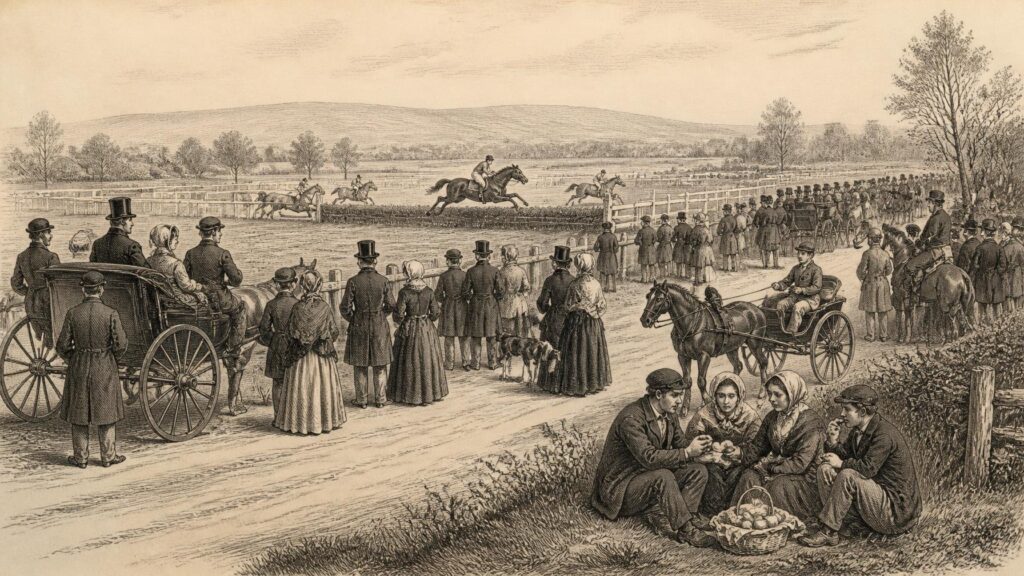
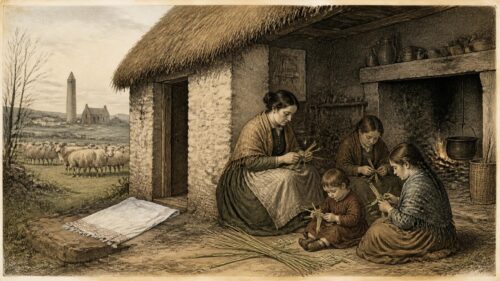
AI generated historical illustration, not a contemporary photograph.
At a Glance
Easter sporting traditions in Ireland were never one single custom, nor were they confined to what later generations would call organised sport. They comprised the playful release that followed Lent: egg eating and egg contests, rolling and breaking games, children’s fires and temporary Easter houses, excursions to fields and hills, dancing, fairground amusements, wrestling, racing and the sociability of a public holiday. Their history is best approached with care. Some practices are preserved in contemporary records; others survive through nineteenth-century description or twentieth-century folklore collection; still others are later explanations and should not be mistaken for proof of ancient origins.
Seasonal Framework
Easter arrived in Ireland as the climax of the Christian calendar, but it also operated as a social turning point. It followed Lent, a season whose disciplines had practical as well as devotional consequences in households where food production, labour and religious observance were closely entangled. The coming of Easter marked a permitted return to richer meals, visits, recreation and collective display. In a country where the timing of agricultural work, local fairs and religious festivals structured the year, the feast provided an opportunity for people to gather outdoors at the edge of spring.
The word “sport” needs a broad historical meaning here. In nineteenth- and early twentieth-century Irish usage, sport could denote horse racing, hurling, wrestling or shooting, but it could also describe a game, a contest, a frolic, a fairground diversion or an outing. A group of children rolling eggs after a meal, young people making tea by an outdoor fire, or families travelling to a racecourse were participating in forms of holiday recreation, though their scale and organisation differed greatly. Treating each as part of Easter’s sporting life makes it possible to see the connection between domestic ritual and public spectacle.
That connection matters because Easter leisure was shaped by contrast. The restraint of Lent gave force to the feast which followed it. The formal end of abstinence did not simply add eggs or meat to the table; it altered what could properly be done in public. Accounts of the period repeatedly associate Easter with new clothes, visits, walks, food shared outdoors and events that brought dispersed neighbours together. Recreation was not an accidental addition to religion. It was one means through which a community marked that the penitential interval had passed.
There was, however, no uniform Irish Easter. Customs varied by locality, denomination, class, age and date. The evidence is strongest for the twentieth century in the great body of local testimony assembled by the Irish Folklore Commission’s Schools’ Collection in 1937–39. That collection is invaluable, but it is not a medieval chronicle. Children recorded what parents, grandparents, neighbours and teachers told them, often using phrases such as “long ago” without a precise date. Its testimony shows traditions remembered in particular places, rather than proving that every custom was national, ancient or unchanged.
Evidence Limits
A historical account must distinguish three levels of material. First comes documented evidence: newspapers, diaries, race records, institutional records and contemporary descriptions. These can establish that a race meeting, fair, wrestling contest or excursion occurred at a particular time. Secondly come recollected customs: especially the Schools’ Collection, in which local informants described practices remembered from their own childhood or from earlier generations. Such material is strong evidence that the custom was remembered and meaningful in the 1930s, though its chronology is often less secure. Thirdly comes folklore and interpretation: beliefs about the dancing sun, claims of fertility, or explanations connecting Easter directly to an imagined pagan past.
These distinctions are especially important at Easter because the festival attracts confident claims of antiquity. Eggs, spring greenery, fire and outdoor assembly have encouraged writers to draw straight lines from modern custom to pre-Christian ritual. Sometimes a resemblance is real; resemblance alone, however, is not continuity. The Easter feast is firmly Christian in the historical evidence examined here. Irish people understood the day above all as a commemoration of the Resurrection and the end of the Lenten fast. A practice may have older European analogues without being demonstrably inherited from a prehistoric Irish ceremony.
Nor should the survival of a custom in a schoolchild’s copybook be turned into an unchanging national rule. One contributor might report that children boiled eggs in a field on Easter Monday; another might say that the outing took place on Easter Sunday evening; another might remember eggs being rolled, struck together or eaten in contests. Such variation is historically useful. It reveals a shared festive grammar—eggs, outdoor fire, companionship and play—rather than a centrally prescribed ritual.
The chronology of Easter itself also complicates the story. It is a movable feast, falling on different dates each year. A tradition connected to Easter therefore joined a religious calculation to seasonal expectations: lengthening evenings, the first softness of spring, the nearing end of winter work and, in many communities, a desire to be outside. Weather could frustrate the expectation, but did not erase it. The appeal of an Easter excursion, a race meeting or a children’s gathering was partly its promise of emergence into a new season.
Lenten Discipline
The basis of many Easter games was not a game at all, but food. Older Catholic fasting practices restricted the consumption of meat and, in many households, eggs and dairy produce during Lent. Rules varied in strictness over time and were modified by Church authority, economic circumstance and family practice. Nevertheless, the association of Easter with a sudden abundance of eggs was widespread in Irish memory. Hens continued to lay; the stored eggs became visible symbols of waiting, restraint and impending celebration.
The Schools’ Collection preserves many versions of this explanation. Children were told that no eggs had been eaten during Lent, or that very few had been allowed, and that Easter morning consequently brought an eager meal of boiled eggs. Some accounts describe individuals eating several; others insist that a particular number was customary. Such figures should not be treated as universal dietary law. Their importance lies in the ceremonial act: eggs were not merely consumed because they were available. They were consumed because Easter transformed an ordinary food into a sign that fasting had ended.
Good Friday and Holy Saturday formed the serious background to this release. In much local testimony, Good Friday was a day of prayer, curtailed work and special caution. The contrast with Easter Sunday was deliberate. A feast acquired its emotional force because it succeeded restraint. This helps explain why playful activity could take forms that now seem modest: a picnic, a fire, a hill walk, egg rolling or a ball game. They were not simply children passing time. They were acts licensed by the calendar.
Food also gave Easter recreation its material basis. Boiled eggs travelled easily to a field, hill or lane. Bread, tea, sugar and sometimes other provisions could be pooled among a group. A fire enabled cooking and created a centre for gathering. Children might collect fuel, build a shelter, prepare a meal and then play. These activities combined work, imitation of adult domestic life and holiday freedom. They were social performances as much as games.
Egg Customs
The egg was the dominant object in Irish Easter play. In recorded accounts it was coloured, blessed, hidden, eaten, boiled, rolled and struck against another egg. It could be part of a family breakfast, a child’s hoard or the prize and equipment of a contest. Modern commercial chocolate eggs have altered the visual culture of Easter, but they should not obscure the older importance of real hens’ eggs in rural and small-town life.
Egg eating itself could become competitive. An RTÉ archival discussion based on material in the University College Dublin folklore holdings notes that plentiful supplies after Lent encouraged egg-eating competitions. The observation should not be exaggerated into a single nationally standardised contest with settled rules. It does, however, confirm a logic seen repeatedly in local recollections: abundance invited comparison, bravado and friendly rivalry. The feast turned surplus into performance.
One simple form of play involved rolling eggs. In some descriptions children boiled eggs hard and rolled them along sloping ground. Elsewhere they hit eggs against one another, apparently testing whose shell would hold. These customs belong to a wider European family of Easter egg games, but Irish evidence should be read on its own terms. The key point is that eggs were handled, tested and shared in company. Their fragility made the game immediate; their association with Easter gave it a festive character.
The names attached to egg collecting varied. In several Irish local accounts, children went from house to house gathering eggs before Easter, and the collection or feast was called a cúbóg, cludog or a closely related spelling. Such words are valuable evidence of regional vocabulary, yet the variants caution against imposing one authoritative form. They indicate living speech, transmitted orally and written down phonetically by children. The activity itself was more consistent than the spelling: a group assembled provisions, created an outing and turned food into a communal occasion.
Outdoor Feasts
Perhaps the most evocative of these practices was the Easter house. Schools’ Collection accounts describe children building small temporary shelters from sods during Holy Week. A ring or low wall of turf formed the structure, sometimes with stones arranged as a fireplace in the centre. On Easter Monday, or occasionally on another day of the festival, the builders gathered inside or beside it, lit a fire, boiled eggs and ate together. The house was temporary but purposeful: it gave children a place of their own in which to stage a feast.
It would be wrong to call every Easter house a survival of an ancient rite. The evidence does not require that explanation. It can be understood more securely as a children’s seasonal construction, made possible by available turf, a holiday and supervised licence to build and cook outdoors. It resembled other children’s temporary dens and domestic imitations, yet Easter gave it a special menu, date and collective significance. The practice is historically interesting precisely because it joined play with competence: gathering fuel, arranging stones, managing a fire and sharing food.
Outdoor egg feasts also occurred without a constructed house. Accounts tell of boys and girls bringing provisions to a green field, lighting a fire, making tea and boiling eggs. In other places groups climbed a hill or met at a lane, roadside or open space. The setting mattered. The feast relocated domestic food into a communal landscape. It allowed young people to occupy a field or hillside not as labourers but as celebrants.
Adult supervision is sometimes implied and sometimes absent from the sources. A modern reader should resist romanticising unsupervised fires or treating all testimony as a guide to present conduct. Historically, though, the fire was central. It was practical, permitting tea and boiling; theatrical, making the outing visible; and social, drawing the group around a shared focus. The fire transformed ordinary provisions into an event.
These small gatherings also illuminate the relationship between scarcity and enjoyment. Egg collecting could have an economic dimension, particularly where household resources were limited. Yet once pooled, the food became a basis for fellowship and amusement. Easter leisure was therefore neither wholly commercial nor wholly private. It was made from local resources, cooperation and time temporarily freed from ordinary expectations.
Children’s Games
The line between feast and game was fluid. A child might eat eggs, roll them, strike them, swap them or bring them to an outdoor party. After the meal there could be ball play, running about or more informal amusement. One Schools’ Collection account specifically recalls children making tea and boiling eggs before playing ball for the remainder of Easter Sunday evening. It is a small piece of testimony, but it is revealing: formal religious observance, family food, outdoor gathering and ordinary play could all belong to the same day.
Such evidence does not demonstrate that Easter was a special national season for a particular ball game. It demonstrates something subtler. Easter created a holiday interval in which existing games could be played more freely. The calendar did not always invent a sport; it provided the occasion, audience and leisure for sport. This is true of many customary festivals. The distinctiveness lies less in the rules of play than in the communal timing.
Children’s traditions were also highly adaptable. A practice could move from Easter Sunday to Easter Monday, from a field to a lane, from a turf house to an outdoor fire without a shelter. Urban children and rural children did not share identical environments. Changes in schooling, housing, access to eggs, parental supervision and commercial sweets all affected the form of the feast. The persistence of a recognisable Easter outing therefore says more about adaptation than about frozen tradition.
Folklore can preserve the emotional truth of such games even when dates remain vague. Recollections stress anticipation: saving eggs, preparing a house, gathering sticks, waiting for the holiday and meeting companions. This emotional sequence is part of the historical evidence. It tells us why a seemingly simple boiled egg could carry excitement. It represented delayed gratification, collective preparation and the temporary enlargement of children’s freedom.
Sun Beliefs
Among the best-known Irish Easter beliefs is that the sun dances on Easter morning. Numerous Schools’ Collection entries report people rising early to watch the sunrise, sometimes from a hill or open ground. This belief belongs to the religious and folkloric atmosphere of Easter rather than to sport in a narrow sense, but it shaped outdoor movement and gathering. Watching the dawn could be an individual devotional act, a family custom or a small communal excursion.
The claim should be described as belief, not as an observed natural event. The sun does not literally dance. Folklore gave religious meaning to the visual effects of dawn and to the expectation that the day of Resurrection should be marked by a wonder in the sky. In historical terms, the importance of the custom lies in what people did because of the belief: they rose early, travelled to vantage points and made Easter morning exceptional.
It is tempting to attach every dawn watch to an ancient solar cult. The available Irish material does not justify certainty of that kind. Christian symbolism alone adequately explains why sunrise became meaningful on the feast of the Resurrection. A responsible account can acknowledge that spring, light and renewal are widespread human themes without claiming an unbroken prehistoric ceremony where documentation is absent.
Still, the dawn custom helps explain why Easter sporting traditions cannot be reduced to fixtures and competitions. The day began, for some, with prayer or watching, continued with Mass and family meals, and could then open into outdoor sociability. Recreation grew beside devotion, not necessarily in opposition to it. In local life, the categories overlapped.
Fairground Leisure
For adults and older young people, Easter Monday could mean a larger public world of fairs, trading and entertainment. RTÉ’s account of Irish Easter traditions notes fairs comprising commerce, games, sports, sideshows, food, music and gambling, with occasional organised faction fighting. Such gatherings must not be idealised. They could be convivial and economically useful, but crowds also brought drink, debt, disorder and conflict. The fair was a meeting place, not a pastoral idyll.
The fair joined market activity to leisure. People came to buy, sell, meet acquaintances, hear music, watch contests and see what was happening beyond their own townland. A holiday crowd created an audience for performers and for competitive display. Sports at such events might include informal races, tests of strength, wrestling, ball games or whatever local organisers and participants could arrange. Their precise contents differed by place and period.
Fairs also remind us that Easter recreation was shaped by social hierarchy. Landowners, shopkeepers, labourers, farm families, servants, artisans and travellers did not experience the holiday identically. Some had the means to attend a race meeting in comfort; others participated as vendors, casual workers, spectators or children on the margins. Yet the shared calendar could bring these groups into the same public space, if not on equal terms.
Women’s participation is often less fully described in formal sporting records, but Easter leisure was not solely masculine. Accounts of outings, new clothing, dances, food preparation, family visits and fair attendance all include women and girls. At racecourses, too, fashion and sociability were part of the spectacle. A history that attends only to male competitors would miss much of what made Easter sport a public holiday rather than a technical contest.
Wrestling Customs
One of the clearest links between Easter Monday and a traditional athletic contest appears in evidence for wrestling near Dublin. Julien Clénet’s University College Dublin study of nineteenth-century sport identifies reports of larger-scale wrestling bouts held according to annual custom on Easter Monday in the early nineteenth century. This is important because it provides a contemporary calendar association, rather than merely a later recollection of general holiday play.
The evidence must nevertheless be read proportionately. It does not establish an all-Ireland Easter Monday wrestling championship, nor does it prove that every district observed the day through wrestling. It indicates that annual Easter Monday bouts were sufficiently familiar in at least one setting to be described as customary. That is precisely the kind of local tradition from which a wider holiday culture was made: recurring, public and dependent on an audience.
Wrestling had obvious advantages for a fair or holiday gathering. It required little permanent infrastructure, could be watched from close quarters and created direct personal drama. It also allowed prowess, local reputation and masculinity to be displayed before neighbours. Such contests could be friendly or fiercely competitive. Surviving descriptions rarely provide enough detail to reconstruct rules, weight classes or prizes, so historians should not invent them.
Its Easter timing is best understood through leisure rather than theology. The holiday created a crowd and a break in routine; the seasonal setting made outdoor assembly feasible; the contest rewarded spectatorship. This pattern would recur more dramatically in racing. The Christian calendar supplied the date, while local society supplied the sport.
Hurling Caution
Hurling is often invoked whenever Irish sporting tradition is discussed, and it was unquestionably an important game in Irish history. Yet caution is essential in an article about Easter. The existence of hurling in a locality, or the popularity of seasonal festival sport, does not prove that hurling was universally or characteristically an Easter custom. The available evidence is stronger for hurling as a game played on Sundays, feast days and other occasions than for a specific national Easter tradition.
The GAA’s historical account of hurling emphasises the variety and regional depth of earlier stick-and-ball games, including camán. Nineteenth-century sources show that hurling could attract crowds and that contests were embedded in local social life. But the calendar was diverse. Matches might be linked to a patron day, a Sunday, a challenge between places, a wedding or a fair. It is methodologically unsound to fill gaps in Easter evidence by assuming that a famous Irish game must have been central to Easter everywhere.
This caution is not a diminishment of hurling. On the contrary, it respects the complexity of its history. Irish sport did not develop as one uninterrupted folk system in which every ancient game appeared at every ancient festival. Customs were local, contested and subject to reform, commercialisation and changing attitudes to violence, gambling and Sabbath observance. Easter pastimes should be allowed their own evidence rather than being overwhelmed by a national sporting emblem.
The same restraint applies to football, dancing, shooting and other recreations. A School’s Collection entry may recall a particular game after an Easter feast; a newspaper may advertise an event; a local tradition may remember an annual contest. Each fragment enriches the picture. None should be inflated into a universal rule without corroboration.
Racing Seasons
Horse racing ultimately became the most enduring public sport attached to Easter in Ireland, but this association developed historically. Racing had long been embedded in elite, rural and commercial life. Hunting, breeding, fairs, betting and transport linked it to the wider economy. Early nineteenth-century race meetings followed seasonal opportunity as much as religious dates: spring offered suitable ground and came as hunting activity waned.
Clénet’s study argues that, in the decades after 1825, horse racing around Dublin became more clearly associated with holiday dates including Easter Monday, Whitsuntide and St Stephen’s Day, largely for commercial reasons. This is an important corrective to the idea that racing was simply an ancient Easter ritual. Holiday scheduling delivered crowds. Crowds supported gate receipts, betting, vendors, transport and publicity. The date became traditional because organisers, spectators and commerce reinforced it year after year.
Racing also translated rural skills and horse culture into a mass spectacle. It could unite owners, riders, trainers, breeders, bookmakers, labourers, urban visitors and country spectators, although with very unequal resources and influence. The racecourse was a place where the countryside was performed for the city, and where city dwellers could seek an Easter outing in a rural setting without leaving the structures of commercial entertainment behind.
The most famous expression of this development was Fairyhouse in County Meath. Its rise demonstrates how a holiday sport can become a national institution. What began as racing in a local hunting environment grew into an event whose Easter Monday identity would be recognised well beyond Meath and Dublin.
Fairyhouse Ascendant
Fairyhouse Racecourse dates its first race meeting to 1848, when the Ward Union Hunt held a point-to-point there. The course’s own historical account records that the first Irish Grand National steeplechase followed in 1870. Those dates matter. They locate the great Easter Monday fixture in the nineteenth century, within a period of expanding organised sport, rail and road travel, commercial newspapers and popular holiday leisure.
The Irish Grand National was not merely another country race. It concentrated the drama of the steeplechase—distance, fences, uncertain ground, risk and betting—into an annual social occasion. By being held at Easter, it acquired an additional function as an outing. It gave Dubliners and visitors from further afield a destination at the beginning of the holiday season. The racecourse, fields, roads and public houses around it became part of the event’s geography.
Contemporary and retrospective descriptions frequently stress the mixed character of the crowd. Fairyhouse was not socially equal, but it was socially mixed in ways that made observers notice it. Coaches, cars, bicycles, pedestrians and later motor vehicles brought people together. Fashion, food, betting and reunion accompanied the racing. The sporting contest was indispensable, yet the pleasure of being in a great Easter crowd was nearly as important.
An 1896 Irish Times report, later reproduced from the newspaper’s archive, described Fairyhouse on Easter Monday as a powerful public attraction drawing people of different classes for outdoor enjoyment and exciting sport. Its exuberant language is not neutral social science; it advertises the romance of the day and reflects the assumptions of its writer. Even so, it is valuable contemporary testimony to the established popularity of the fixture by the late nineteenth century.
The annual date helped make Fairyhouse memorable. Unlike a competition whose time changed according to a league programme, the Irish Grand National could become part of family and local expectation. Easter Monday meant a bank holiday, a journey, a crowd and the possibility of a wager or a winner. Repetition produced tradition. The tradition, in turn, made the date commercially and emotionally difficult to alter.
Holiday Travel
Travel was fundamental to the making of Easter sport. A racecourse could not become a major holiday destination without routes, vehicles and time away from work. Nineteenth-century accounts of Fairyhouse evoke a variety of means of arrival, from formal carriages to humbler conveyances and walking. The journey itself belonged to the day. People travelled in groups, met acquaintances on the road and emerged from urban routines into the Meath countryside.
Holiday travel also made sport a form of social theatre. The visitor saw not only horses and riders but the crowd: clothing, vehicles, manners, food, vendors and public behaviour. The race meeting became a place to be seen and to assess others. For some this was a display of status; for others it was a rare opportunity to participate in a large public gathering. The same space could accommodate excitement and exclusion.
In local folklore, smaller Easter outings operated on a different scale but followed a comparable logic. A walk to a hill, a field or a gathering place took people out of the home. The journey need not be long to be meaningful. It marked a boundary between ordinary time and holiday time. Easter leisure repeatedly involved going somewhere—towards sunrise, a field, a fair or Fairyhouse.
Modern transport altered the scale but not the principle. Easier travel could enlarge crowds and broaden a meeting’s catchment area. It could also weaken very local customs, as families acquired alternative forms of entertainment or travelled further from home. Tradition was not destroyed by movement alone; it was remade by new possibilities of movement.
Revolutionary Monday
The connection between Fairyhouse and Easter Monday acquired extraordinary historical resonance in 1916. The Easter Rising began in Dublin on Monday, 24 April 1916. At the same time, the Irish Grand National was being held at Fairyhouse. The coincidence has often been retold because it places two sharply different Irelands side by side: a great established sporting occasion in County Meath and an insurrection unfolding in the capital.
The National Library of Ireland preserves evidence that Alfred West was at the Irish Grand National when he heard of the outbreak, left early and drove into Dublin, where he encountered the consequences of the fighting. Other contemporary material records that people at Fairyhouse received rumours and reports of events in the city. These are not merely colourful anecdotes. They show how news travelled imperfectly on a holiday afternoon and how ordinary plans could be overtaken by political crisis.
The juxtaposition should not be oversimplified. It is tempting to say that everyone was at the races while revolution began, or to turn the meeting into a symbol of national indifference. Neither claim can bear much weight. Many people were not at Fairyhouse; participants in the Rising had been mobilising under difficult circumstances; and some Volunteers’ absence from intended assembly points was indeed connected, in individual recollections, with Easter holiday activity. But a nation is not explained by one race meeting.
What the coincidence does reveal is the depth of Easter Monday as a public date. The Rising was planned around the Easter holiday after its original Easter Sunday schedule was disrupted. Fairyhouse had long used the same holiday for racing. Both events relied, in radically different ways, upon the meanings of a day when ordinary routines were suspended and people were expected to move, gather and watch. One was a national sport; the other a revolutionary act. Their simultaneous occurrence has fixed the sporting holiday within the memory of 1916.
Public Spectacle
By the twentieth century, the Easter sporting calendar increasingly favoured organised spectator events. This did not erase egg feasts or children’s games at once, but it changed which traditions left the largest public record. Newspapers devoted columns to racing results, betting, notable owners and crowd scenes. Institutions preserved programmes and photographs. Informal children’s customs, by contrast, usually entered the archive only when a folklorist or schoolchild wrote them down.
This imbalance of documentation can distort historical understanding. The best-recorded activity is not always the most widely practised. A famous race has results, dates and named winners; a local Easter house may survive in one paragraph from a pupil’s exercise book. Yet the small custom could have mattered deeply to those who took part. Historians need both scales: the national spectacle and the local memory.
Commercialisation also changed the meaning of Easter leisure. A fair could mix buying and selling with games; a race meeting turned attention towards admissions, betting, advertising and sponsorship. Commercial forms were not necessarily inauthentic. They were part of how communities made holidays viable and pleasurable. But they differed from the household economy of saved eggs and shared tea. The history of Easter pastimes is partly a history of movement from improvised local recreation towards ticketed, promoted entertainment.
That movement was uneven. Rural traditions survived, altered or disappeared at different rates. Urban working people retained informal games while also attending professional sport. Families could make an Easter outing and still keep domestic food customs. Change did not proceed by simple replacement. It created layers in which old forms remained legible beside new ones.
Changing Customs
Several forces reshaped Easter pastimes during the twentieth century. Religious fasting rules changed, reducing the practical accumulation of eggs which had underpinned older food customs. Shop-bought treats, especially chocolate eggs, became increasingly familiar. Housing patterns and concerns about safety reduced opportunities for children to light fires in fields or build turf shelters. School routines, motor travel, broadcast entertainment and organised clubs offered competing ways to spend a holiday.
These changes should not be framed only as loss. Some families continued Easter walks, egg hunts, sporting attendance and shared meals in new forms. Race meetings retained their public appeal because they adapted to modern media, sponsorship and transport while preserving a recognisable Easter identity. Folklore itself changed status: what had once been ordinary practice could become a remembered tradition, revived performance or heritage subject.
Memory often smooths away inconvenience. Outdoor fires and improvised dens can appear charming when recalled decades later, yet they existed within lives shaped by limited resources, demanding work and different assumptions about childhood. Likewise, older fairs could be places of enjoyment and places of intimidation. A historical article should recover the pleasure of pastimes without turning hardship or disorder into scenery.
The changing treatment of animals also matters. Horse racing has endured through regulation, professionalisation and continuing debate over welfare. Earlier rural sport included activities now regarded as unacceptable or cruel. A modern account need not celebrate them merely because they were traditional. Historical understanding requires accuracy about what people did and honesty about changing ethical standards.
Folklore Value
The Irish Folklore Commission’s Schools’ Collection is central to this history because it records details that official sporting archives rarely considered important. It captures names such as cúbóg, describes sod-built Easter houses, remembers children gathering sticks and tells of eggs being rolled or broken. Its local texture allows historians to reconstruct a landscape of seasonal play that would otherwise be nearly invisible.
Its value is not diminished by its limitations. The collection was made through a national school scheme, mediated by teachers, children and the expectations of collectors. Informants might idealise the past, combine practices from different decades or repeat a familiar explanation. Spelling can be inconsistent, and chronology is often imprecise. These are reasons to read carefully, not reasons to dismiss the material. Folklore is evidence of memory, belief and practice, but it requires contextual interpretation.
When several entries from different places independently connect Easter with eggs, fires, outdoor food and children’s gatherings, a broad pattern becomes convincing even if every detail cannot be dated. When a particular custom appears in a single locality, it remains valuable as local evidence but should not be universalised. This approach gives variation its proper place. Irish tradition was made through many local versions rather than one official script.
Folklore also preserves humour and delight. The notion that people waited through Lent for an egg feast, or that a small group could establish its own household in a turf ring for a day, conveys the imaginative dimension of the holiday. Sport and play were not only competitions. They were ways of making a season feel different.
Historical Balance
The strongest historical conclusion is therefore modest but rich. Ireland possessed a range of Easter sporting traditions whose common features were release from Lenten restraint, movement into shared outdoor space, food-centred play and public gathering. At the intimate end were egg games, fires, picnics and children’s Easter houses. At the public end were fairs, contests, dances and, eventually, the major racing festival at Fairyhouse.
The documentary record supports the importance of Easter Monday as a day for public recreation, especially in nineteenth-century and later racing culture. It supports local traditions of Easter egg feasts and outdoor play through the twentieth-century folklore archive. It supports some specific associations, such as Easter Monday wrestling in the Dublin area. It does not support a claim that every Irish sport was an Easter sport, or that all these practices descend unchanged from a pre-Christian past.
That balance is not a limitation on the story; it is what makes the story credible. Easter pastimes were powerful because they were flexible. They could be devotional, domestic, youthful, commercial or spectacular. A boiled egg shared by children beside a field fire and a steeplechase watched by thousands belonged to different social worlds, yet both answered the same seasonal desire for company, excitement and release.
Living Legacy
Fairyhouse remains the clearest surviving emblem of Ireland’s Easter sporting calendar. Its Easter festival and Irish Grand National preserve a nineteenth-century association between the holiday, travel, spectatorship and racing. The event has changed repeatedly, but its date continues to carry the accumulated weight of habit and memory. It is both a contemporary sporting occasion and a historical heir to the Easter Monday outing.
Other customs survive less formally. Families still eat eggs, arrange hunts, take walks, visit relatives and seek outdoor recreation over the holiday. These practices need not imitate a sod-built Easter house to belong to the same long history of seasonal release. Tradition survives not only by exact repetition, but through recognisable impulses adapted to new conditions.
For Emerald Archives, the most useful image of Easter pastimes is therefore not a single supposedly ancient ritual. It is a layered Irish landscape: dawn watchers on a hill; families after Mass; children carrying eggs and sticks towards a field; a small fire beneath a pot; a fair crowd listening to music and watching games; roads full of holiday travellers; and, at Fairyhouse, horses taking the fences before a vast Easter Monday assembly. Each scene has its own evidence and chronology. Together they show how a religious feast became a season of play.
Most striking is the article’s distinction between documented events and traditions remembered through the 1930s Schools’ Collection. Rather than diminishing folklore, this approach suggests that variation in egg feasts, Easter houses and outings reveals how communities adapted a shared festive framework to local circumstances. The contrast between intimate children’s gatherings and Fairyhouse’s increasingly commercial Easter Monday racing also shows how holiday leisure could change without losing its connection to release after Lent. How should historians balance the emotional and cultural value of later recollections with firmer contemporary records when interpreting whether Irish Easter pastimes represent continuity, adaptation, or both simultaneously?