

Watching Guardians
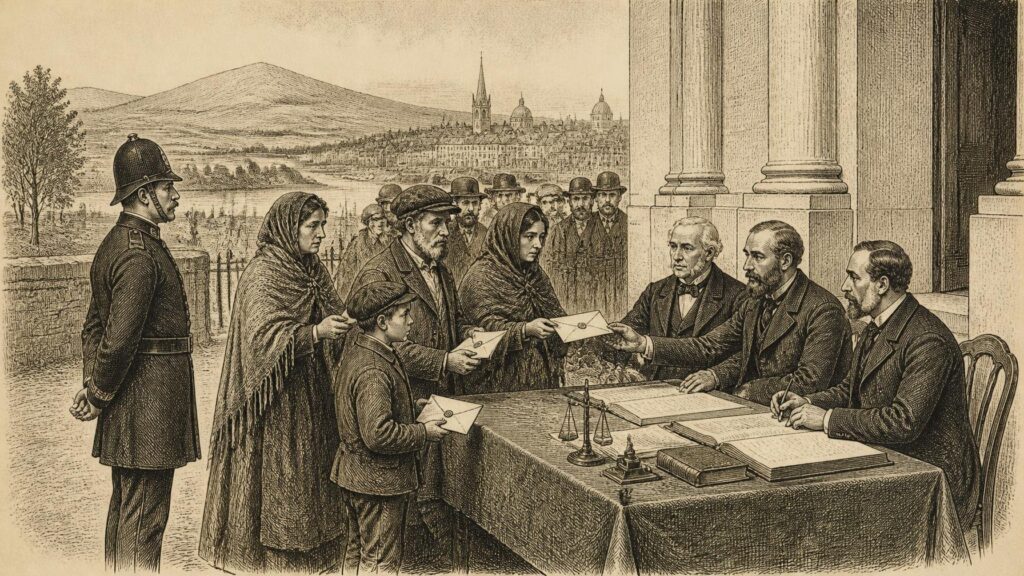
AI generated historical illustration, not a contemporary photograph.
At a Glance
Police oversight reform in Ireland is the history of a difficult constitutional question: who watches a police service entrusted with exceptional powers, while preserving its capacity to protect the public without partisan direction? The question has never been merely administrative. It has concerned the legitimacy of the State, the experience of people making complaints, the independence of criminal investigation, and the public confidence on which an unarmed police service depends. Ireland’s modern arrangements did not emerge from one master plan. They were assembled, often under pressure, after evidence of institutional weakness, public controversy, judicial inquiry and sustained argument about the proper boundary between operational policing and democratic accountability.
State Inheritance
The history of police oversight in the Irish State begins with an inheritance rather than a clean institutional beginning. The Garda Síochána was created in the early years of independence as the principal police service of the new State. Its title, usually translated as “guardians of the peace”, expressed an ambition to distance the service from the coercive reputation of the older colonial policing order. That aspiration mattered deeply. In a country emerging from revolution, civil conflict and the partition of the island, policing could not rely on consent as an abstract principle alone; it had to acquire a practical legitimacy among communities whose experience of authority had been sharply divided.
Yet the new service was also entrusted with functions that gave it considerable reach. It enforced ordinary criminal law, maintained public order, gathered intelligence concerning threats to the State, regulated traffic and licensing, and worked closely with the Department of Justice. In the twentieth-century Irish administrative tradition, ministerial responsibility to the Dáil was often treated as the principal external safeguard. The Minister was answerable politically for the department and its broad policies; the Commissioner commanded the force. Courts, criminal procedure, civil actions and parliamentary questions provided forms of accountability, but none amounted to a standing, independent system through which the public could readily challenge alleged police misconduct or examine the organisation’s performance.
This was not unique to Ireland. Across Britain and Ireland, formal complaints systems long tended to assume that a police force could investigate itself, subject to limited outside scrutiny. But the Irish setting added particular sensitivities. An Garda Síochána was a national, centrally organised service rather than a collection of locally governed forces. It was also, for much of the State’s history, closely connected to security responsibilities. The concentration of functions made clarity about responsibility important, but it also made the question of independent scrutiny more difficult. A complaint could raise an issue of individual behaviour, supervision, discipline, criminality, policy, intelligence practice or political confidence. A single internal process was unlikely to answer all of those questions satisfactorily.
Historical interpretation should resist two simplifications. It would be wrong to say that no forms of accountability existed before modern reform. Gardaí were subject to law, internal discipline, ministerial structures, judicial scrutiny and public criticism. It would be equally misleading to describe those mechanisms as an adequate substitute for independent civilian oversight. Their central weakness was structural: the service, the Government department and the ordinary disciplinary process occupied most of the ground. A person alleging serious wrongdoing could find that the matter was considered within institutions in which the police retained decisive investigative knowledge and organisational authority.
The early history therefore established a pattern that would later become a reform target. External accountability was episodic, generally activated by scandal, litigation or political controversy. Internal accountability was continuous but insufficiently independent in the eyes of many complainants. The problem was not simply whether individual Garda members acted properly. It was whether the public could see that allegations against police officers were examined by a body that was both capable and demonstrably separate from the police service concerned.
Unarmed Ideal
The unarmed character of An Garda Síochána became central to the public story of Irish policing. Most Garda members performed ordinary duties without routinely carrying firearms, and this feature was often presented as evidence of a distinctive relationship between police and public. It remains an important part of the institution’s identity. But the ideal of consent cannot itself resolve the question of oversight. A police service may be unarmed in ordinary circumstances and still exercise substantial coercive powers: arrest, detention, search, access to information, road policing, public-order intervention and the capacity to begin or influence criminal investigations.
In historical discussion, admiration for the unarmed tradition has sometimes been treated as proof that the service needed fewer external checks. That is an interpretation rather than a documented institutional conclusion. The more persuasive reading is that a consent-based model requires especially credible accountability. Where policing depends upon voluntary cooperation, public trust is not a decorative outcome. It is an operational resource. Witnesses must report crime, victims must come forward, communities must accept police presence, and people stopped or questioned by officers must believe that an abuse of power can be challenged fairly.
There was also no single experience of Garda policing. Rural districts, cities, border communities and places affected by political violence encountered the service differently. Historical memories of policing were shaped by class, geography, religion, political affiliation and experiences of crime. The State’s security concerns, particularly during periods of conflict connected with Northern Ireland, made the relationship between police power and civil liberties more contested. These conditions did not mean that every complaint was justified, nor that every internal investigation was unsound. They did mean that a credible accountability structure needed to deal with mistrust rather than assume it away.
A useful distinction is between oversight of conduct and oversight of performance. Conduct oversight asks whether a particular officer acted unlawfully, improperly or discourteously, or whether a complaint should result in criminal, disciplinary or other consequences. Performance oversight asks broader questions: whether resources are used effectively, whether victims receive appropriate service, whether strategies work, whether leadership is adequate and whether recurrent complaints reveal a systemic problem. For much of the twentieth century, Irish arrangements blurred these questions. Later reforms tried to distribute them among specialist bodies, but that distribution created a new challenge: how to make a complex system intelligible to the public.
The unarmed ideal was therefore neither folklore nor a complete constitutional settlement. It was a real and consequential feature of policing culture. The folklore began when it was used to suggest that the service was inherently immune from the ordinary dangers of institutional power. Reformers increasingly argued that confidence in Garda policing would be strengthened, not weakened, by an external mechanism that could test allegations without deference to the organisation under scrutiny.
Hidden Control
Before the 1980s, oversight of complaints against Garda members was limited and largely internal. The absence of a dedicated independent body did not necessarily mean that every complaint disappeared. Complaints could be made to Garda stations, senior officers, Ministers, representatives or courts. People could pursue civil litigation, and serious allegations might lead to criminal investigation. Yet such routes were uneven, expensive or dependent on the very organisation complained of. They did not supply a transparent, specialised pathway for ordinary complaints about police conduct.
The prevailing arrangement also reflected a wider administrative culture. Public bodies were commonly supervised through ministerial responsibility, internal hierarchy and the courts rather than through the independent regulators and ombuds institutions familiar today. The Ombudsman system itself developed only gradually in Ireland. In that context, policing was not anomalous in being comparatively closed. It was, however, exceptional in the intensity of its direct powers over individuals. The person making a complaint was often confronting an institution with records, legal expertise, disciplinary procedures and social authority unavailable to an ordinary citizen.
One practical difficulty was the appearance of self-investigation. Even when an investigation was honestly conducted, the fact that it was conducted by colleagues or superiors of the officer complained of could undermine confidence in the result. The appearance mattered because policing is public-facing. A finding that cannot command belief may fail in one of accountability’s essential purposes: demonstrating that standards are real and that wrongdoing has consequences.
Ministerial accountability had further limits. A Minister could answer questions in the Oireachtas, set broad policy and be held politically responsible for the department. But direct political intervention in individual policing cases is also dangerous. It risks compromising investigations, creating perceptions of favouritism or turning operational decisions into partisan contests. The historical problem, therefore, was not solved by demanding that Ministers decide individual complaints. Reform required a structure that could be independent of both the police service and day-to-day political pressure, while still remaining answerable through law and public institutions.
This tension has endured. Police services cannot be wholly insulated from democratic control, because they exercise public power and spend public money. Nor can they be directed case by case by politicians, because impartial enforcement of law requires operational independence. Irish reform has repeatedly attempted to separate strategic accountability from operational command. The distinction sounds simple but is difficult in practice. Decisions about targets, resources, data, public communications, discipline and major investigations can all carry operational consequences. The development of oversight in Ireland is, in part, the continuing effort to draw that line more clearly.
Complaints Board
The Garda Síochána Complaints Act 1986 marked the first major statutory attempt to create a distinct complaints mechanism. It established the Garda Síochána Complaints Board, which began operating after the relevant provisions were commenced in 1988. The Board represented an acknowledgement that the earlier position was inadequate. A member of the public who was directly affected by, or witnessed, Garda conduct could make a complaint within a prescribed period. The legislation created procedures through which complaints could be received and considered outside the ordinary station-level response.
Its significance should not be understated. The Board supplied a named public institution, a legal framework and a route for complaints that did not depend entirely on private litigation or informal political access. It also expressed a developing principle: complaints against police should receive an element of external supervision. For people who had previously encountered a closed administrative system, that was a meaningful shift.
But the Board’s structure contained the weakness that later reformers would seek to remove. It was described as independent, yet its composition included the Garda Commissioner, or a nominee, alongside government-appointed members. Investigations were normally carried out by Garda officers. The Board could supervise, request further work and make recommendations, but it did not operate as a fully independent investigative agency with its own investigators and coercive powers. In effect, it occupied a supervisory position over a process still substantially undertaken within the force.
This arrangement was not merely criticised in retrospect. Concerns arose about delay, accessibility, the scope of the Board’s authority and the difficulty of producing a result perceived as independent. The difference between receiving a complaint and controlling its investigation proved fundamental. A complaints body may be external in name while the practical evidence gathering remains internal. Such an arrangement can improve procedure, but it cannot entirely answer the concern that colleagues are investigating colleagues.
The 1986 framework also demonstrated the difference between discipline and public accountability. A complainant might seek recognition that something wrong had occurred, an explanation, an apology, a correction to practice or an assurance that another person would not suffer a similar experience. A disciplinary structure, by contrast, focuses on the employment and professional consequences for the officer concerned. These objectives may overlap, but they are not identical. The Complaints Board was asked to operate in the space between them without possessing the full institutional tools needed to command public confidence.
Later accounts of the Board have sometimes reduced it to a failure. That judgement is too blunt. It was an important transitional institution and an early legislative acceptance that policing could not be governed solely through internal discipline. Yet the evidence assembled in subsequent inquiries showed that the model was incapable of responding effectively to the gravest allegations. Its historical importance lies precisely in that contradiction: it was a reform, but its limitations helped make deeper reform unavoidable.
Donegal Reckoning
The decisive catalyst for twenty-first-century reform was the Morris Tribunal, established in April 2002 to investigate complaints concerning some Gardaí in the Donegal Division. Chaired by Mr Justice Frederick Morris, the tribunal examined a series of grave allegations and episodes, including the handling of investigations, false or unreliable allegations, treatment of suspects, the use of informants and the effectiveness of complaints mechanisms. Its work extended over years and produced eight reports.
The tribunal’s importance was not confined to the conduct of particular Garda members. It exposed institutional questions about supervision, record keeping, discipline, management culture and the capacity of existing complaints procedures to identify and correct serious wrongdoing. The tribunal’s findings were documentary and judicial, not folklore. They should be read with care, because a tribunal’s conclusions arose from particular evidence and particular circumstances. Yet their implications reached far beyond Donegal. They challenged the belief that established internal controls were sufficient when allegations concerned abuse of power by police officers.
One of the most consequential aspects of the tribunal’s work was its assessment of the complaints system. In the first volume of its report, the tribunal described the 1986 complaints procedure as woefully inadequate in the cases before it. It considered that those wronged had lacked prompt and effective redress. The language was unusually direct, but its force derived from the tribunal’s examination of evidence rather than from political rhetoric. The conclusion helped establish a public and legislative consensus that a new model was necessary.
The Donegal revelations also illustrated the limits of relying on civil litigation after the event. Civil proceedings can provide compensation and judicial findings, but they may take years, are costly and do not necessarily produce organisational learning. A police oversight system needs to do more than settle individual disputes. It must preserve evidence quickly, investigate credibly, identify patterns, recommend reform and communicate enough information to assure the public that lessons have been learned.
The Morris Tribunal did not create every reform that followed, and it would be inaccurate to treat the Garda Síochána Act 2005 as a mechanical response to one inquiry alone. Other critiques, public concerns and international models influenced the debate. Nevertheless, Donegal supplied the moment at which the inadequacy of the old architecture became impossible to ignore. The tribunal transformed oversight from a specialist concern into a question of institutional legitimacy.
There is a broader historical lesson in this episode. Police reform often begins with an attempt to isolate misconduct as the behaviour of a few individuals. Inquiries frequently show that individual wrongdoing and institutional weakness are connected. Poor supervision, weak complaint handling, uncertain standards and excessive deference can allow misconduct to continue or conceal it after the event. The most enduring reforms consequently address systems as well as persons. Ireland’s later combination of an ombuds body, inspectorate and performance authority reflected that insight.
Statutory Breakthrough
The Garda Síochána Act 2005 was the pivotal legislative settlement of this period. It replaced the older complaints model with the Garda Síochána Ombudsman Commission, widely known as GSOC, and created the Garda Síochána Inspectorate. These were different bodies with different functions. GSOC was designed to deal independently with complaints concerning Garda conduct and to investigate matters in the public interest. The Inspectorate was established to examine efficiency and effectiveness, measured against the best standards of comparable police services.
This division was conceptually important. An ombuds body could concentrate on conduct, complaints and serious incidents; an inspectorate could investigate whether wider systems and resources were fit for purpose. Neither function displaced the courts, the Director of Public Prosecutions, internal Garda discipline, the Oireachtas or ministerial responsibility. Instead, the Act added independent institutions to an already crowded accountability landscape.
GSOC began operating in 2007. Its independence was intended to be more substantial than that of the former Complaints Board. It had its own statutory identity, could employ investigators, receive complaints directly and investigate matters without waiting for a conventional complaint in defined circumstances. It also had powers relevant to serious incidents involving Garda members. The change mattered symbolically as well as procedurally. The State was no longer merely supervising Garda investigation of complaints; it was creating an external commission whose central task was independent scrutiny of Garda conduct.
Independence, however, is not a single condition that legislation can confer once and for all. It depends on appointments, funding, staffing, powers of access, legal clarity, public communication and the willingness of other bodies to comply with lawful requests. A watchdog may be legally independent yet struggle if it lacks resources or if its powers are contested. Conversely, a body embedded in legal obligations, public reporting and parliamentary scrutiny can become influential even without directing the police service itself. The history of GSOC has therefore included debates about remit, investigative capacity, timeliness and the relationship between oversight investigations and Garda disciplinary processes.
The Inspectorate’s creation recognised another practical truth: failures in policing are not always visible through individual complaints. A victim dissatisfied with an investigation might not make a formal misconduct allegation. An officer may follow procedure faithfully while the procedure itself is ineffective. A service may respond properly to each complaint but fail systematically in crime recording, victim communication, technology, staffing or supervision. Inspection enables scrutiny at that organisational level, translating comparison, audit and professional evaluation into recommendations for improvement.
The 2005 Act also articulated a duty on Garda members to account for their actions. Such provisions carry moral as well as legal significance. They reject the notion that police discretion is beyond explanation. At the same time, the Act did not transform oversight into police management. The Commissioner retained operational authority; Government and the Minister retained defined responsibilities; the new bodies had specific statutory remits. The reform’s aspiration was a balance in which police could act decisively under law, but would be subject to scrutiny that was independent, informed and visible.
Fragmented Architecture
The post-2005 framework was stronger than the model it replaced, but it was not simple. Ireland now had multiple institutions whose responsibilities could appear overlapping to the public. GSOC dealt principally with complaints and conduct. The Garda Inspectorate reviewed effectiveness and efficiency. The Department of Justice supported policy and legislation, while the Minister retained political and statutory responsibilities. The Oireachtas could question Ministers and examine public administration through committees. Courts remained essential in adjudicating criminal cases, judicial review and civil claims. Internal Garda governance and discipline continued alongside all of these mechanisms.
Complexity is not automatically a defect. Police accountability genuinely has several dimensions, and no single organisation can perform them all without becoming excessively powerful or unfocused. An investigator of individual misconduct requires different skills and safeguards from an inspector studying organisational performance. A body setting strategic priorities should not decide criminal guilt. A parliamentary committee should scrutinise public policy but should not direct a detective’s handling of evidence. The challenge is not to eliminate distinctions but to make them comprehensible and coordinated.
The Oireachtas Library and Research Service, in its later examination of governance and accountability, described the 2005 and 2015 legislation as the principal foundation of the modern framework. This is a useful historical formulation because it avoids the idea of one final reform. The architecture developed in stages. It was revised as experience revealed shortcomings, and each added layer altered the responsibilities of the others.
One recurrent issue was the relationship between complaints investigation and discipline. GSOC could investigate alleged Garda misconduct, but disciplinary action was not simply identical to an ombuds investigation. The evidential threshold for criminal proceedings differs from the standard applicable in employment or disciplinary processes. Fair procedures for Garda members must be respected, just as complainants require fair treatment. Delays can arise where parallel criminal, disciplinary and civil processes must be managed without prejudicing one another. These legal realities can frustrate complainants seeking a quick answer, yet they also protect against arbitrary decision-making.
Another issue was transparency. Oversight bodies must publish enough information to explain their work and expose systemic concerns, while protecting complainants, witnesses, investigations and legal rights. Too little publication can create suspicion that oversight is secretive. Too much can compromise privacy or due process. The historical movement has generally favoured clearer public reporting, but the balance remains case-specific. The demand for transparency is strongest precisely when allegations are serious; that is also when legal constraints are most likely to be acute.
It is tempting to portray a fragmented system as evidence of bureaucratic failure. A more cautious interpretation is that Ireland was learning to separate functions previously concentrated within a narrow state structure. The costs of separation were duplication, complexity and occasional uncertainty. Its benefit was that no single institution should be judge, investigator, employer, policy-maker and public advocate in the same matter. Whether the balance has been achieved remains open to argument.
Whistleblower Crisis
During the 2010s, new controversies widened the reform agenda beyond the complaints process. Public concern about Garda whistleblowers, the handling of penalty points, recording practices, investigations and senior governance created another crisis of confidence. These events differed from the Donegal matters in their detail, but they revived familiar questions: could serious internal concerns be raised safely; did leadership respond appropriately; could external institutions obtain reliable information; and were oversight arrangements sufficiently clear and robust?
Whistleblowing occupies a distinctive place in police accountability. A member of the public usually sees only the outcome of an encounter with police. An insider may see patterns, records, incentives and managerial decisions inaccessible to outsiders. Yet insiders who disclose concerns may face professional, social and personal risks. A credible oversight structure must therefore include routes through which Garda personnel can make protected disclosures, as well as a culture in which raising concerns is treated as part of professional responsibility rather than betrayal.
The events of this period also exposed the limits of an approach focused exclusively on misconduct by individual officers. Some disputes concerned data, systems, supervision and the reliability of information supplied to public bodies. They required examination of governance at senior levels. This helped generate support for a body with a continuing role in overseeing the organisation’s performance and leadership rather than merely reacting to individual complaints after harm had occurred.
Reform debates in this period were frequently contentious. Political opponents, Garda representative bodies, journalists, civil-society organisations and officials did not always agree about facts, remedies or institutional responsibility. Historians should distinguish that contest from the documentary record of inquiries, legislation and official reports. It is fair to say that public confidence was affected and that the controversies accelerated reform. It is not sound historical method to treat every allegation made in public debate as established fact. The significance of the period lies in the way it compelled the State to reconsider the whole accountability chain: internal reporting, external investigation, departmental governance, commissioner leadership and parliamentary scrutiny.
The resulting reforms did not rest on the assumption that every Garda member or manager had failed. Rather, they reflected the institutional principle that a police service should be able to withstand close examination. Accountability is strongest when it is not reserved for exceptional scandal. Regular reporting, public meetings, strategic planning, inspection and independent complaints investigation make scrutiny part of normal governance. That was the direction in which the next major reform moved.
Public Authority
The Garda Síochána (Policing Authority and Miscellaneous Provisions) Act 2015 established the Policing Authority, which began work on 1 January 2016. Its purpose was distinct from that of GSOC. The Authority did not investigate individual complaints or reopen individual ombuds investigations. Instead, it oversaw the performance of the Garda Síochána in providing policing services. It received responsibilities previously exercised by Government or the Minister, including important roles in appointments, strategy, priorities and performance oversight.
The Authority’s public meetings with the Garda Commissioner became one of the visible symbols of the new model. Their importance was not that public questioning could substitute for detailed inspection or investigation. Rather, they created a regular forum in which the Commissioner could be asked to explain organisational performance, priorities, challenges and responses to concerns. In a system historically accustomed to limited public visibility, this was a cultural change. It moved part of the relationship between police leadership and external oversight from private departmental exchange into a public institutional setting.
Its remit illustrated the careful distinction between operational independence and accountability. The Authority could set policing priorities and performance targets, approve strategic and annual planning documents, and keep Garda performance under review. It was not intended to direct specific operations or investigations. This distinction was designed to prevent political or external interference in individual policing decisions while ensuring that Garda leadership remained answerable for the service’s overall delivery.
The Authority also showed how oversight bodies can generate information rather than merely receive it. By reviewing plans, examining performance data, monitoring implementation of Inspectorate recommendations and conducting public engagement, it could identify concerns before they became the subject of a formal complaint or inquiry. In theory, such preventive oversight is one of the strongest forms of accountability. It seeks to correct conditions that permit failure rather than simply apportion blame after failure has occurred.
There were nevertheless difficulties. The multiplication of bodies made it hard for citizens to know where to bring concerns. A person dissatisfied with a Garda interaction might approach the Authority when GSOC was the appropriate route; a person concerned about broad performance might send a complaint to GSOC when the issue was strategic. Lines between governance, inspection and conduct could be debated. The solution was not necessarily to abolish distinction, but it strengthened the case for a clearer statutory framework and better public explanation.
The Authority’s establishment was a major step in the history of Irish police oversight because it widened the focus from wrongdoing to governance. It accepted that public trust depends not only on whether misconduct is investigated, but also on whether policing is planned, resourced, supervised and evaluated in a transparent way.
Northern Contrast
Any Irish history of police oversight should recognise that Northern Ireland developed through a separate legal and political path. Its policing institutions were shaped by the legacy of the Royal Ulster Constabulary, the conflict known as the Troubles, the Belfast or Good Friday Agreement of 1998 and the subsequent reforms associated with the Independent Commission on Policing for Northern Ireland, commonly called the Patten Commission. Direct comparison must therefore be cautious. Northern Ireland is not a laboratory version of the Republic, and the Republic’s reforms were not simply copied from its neighbour.
Nevertheless, Northern Ireland provided an important nearby example of ambitious institutional redesign. The Police Ombudsman for Northern Ireland was created under legislation following the Agreement period, while the Northern Ireland Policing Board gained a significant role in holding the Police Service of Northern Ireland to account. The statutory framework enabled the Ombudsman to investigate complaints and, in defined circumstances, examine police practices and policies. The Board’s arrangements combined political and independent membership, reflecting an attempt to provide democratic legitimacy in a deeply divided society.
The relevance to the Republic lay partly in contrast. Northern Ireland’s post-Agreement reforms were explicitly bound up with a peace process and the need to make policing acceptable across communities with sharply different historical allegiances. The Republic did not face the same institutional problem. An Garda Síochána already had a national identity and a long-established unarmed tradition. Yet both jurisdictions confronted a shared democratic proposition: police legitimacy cannot rest on historical reputation alone; it requires independent means of testing complaints and scrutinising performance.
The two systems also reveal different ways of dividing oversight functions. In Northern Ireland, the Police Ombudsman has had a more prominent role in certain serious and historical matters, alongside the Policing Board’s governance responsibilities. In the Republic, GSOC and later its successor structure have concentrated on Garda conduct, while the Policing Authority and Inspectorate have addressed performance and inspection. The details cannot be collapsed into a single all-island model. They arise from different legislation, political settlements and institutional histories.
Folklore can easily distort this comparison. One recurring claim is that a model successful in one jurisdiction can simply be transplanted into the other. The documentary record suggests a more complicated reality. Institutions work through legal powers, leadership, public expectations, resources and historical context. Northern Ireland influenced Irish debate by demonstrating the importance of visible independence, but it did not remove the need for the Republic to construct arrangements suited to its own constitutional order.
Future Framework
The Policing, Security and Community Safety Act 2024 represented the latest major legislative recasting of the Irish framework. Most of its provisions commenced on 2 April 2025. The Act repealed the Garda Síochána Act 2005 and sought to consolidate and strengthen governance, oversight and accountability. It continued An Garda Síochána as the State’s police service, provided for a Garda Board, created a revised authority structure, expanded the community-safety framework and reconstituted GSOC as Fiosrú, the Office of the Police Ombudsman.
The change of name was more than cosmetic. Under the new framework, the police complaints body is led by a Police Ombudsman and has an expanded statutory structure and powers. The objective remains recognisably connected to the history traced above: investigation of complaints and other matters concerning Garda conduct must be independent, effective and capable of public confidence. But the legislation also reflects lessons accumulated since 2005 about access to information, preservation of evidence, duties to cooperate, protected disclosures and the handling of serious incidents.
The new Policing and Community Safety Authority brings together functions previously divided between the Policing Authority and the Garda Inspectorate. Its statutory objective is to oversee and assess, independently and transparently, Garda performance relating to policing services, supporting their effective provision and continuous improvement for public safety. The merger is an effort to reduce fragmentation without erasing the distinction between organisational oversight and individual complaints investigation. Inspection becomes part of a broader authority charged with assessing performance, priorities and accountability.
The Act also places community safety more explicitly alongside policing. This is historically significant because it challenges the assumption that police alone are responsible for preventing harm. Housing, health, education, local government, youth services and community organisations all affect safety. The idea has appeared in policing debates for decades, but its statutory prominence signals a shift from a narrow focus on crime response towards a broader public-safety model. Such a shift may improve prevention, though it also raises questions about coordination, local capacity and the risk that responsibility becomes diffused among too many agencies.
It is too early to make a historical verdict on arrangements that only recently commenced. Legislation can establish powers and offices, but it cannot by itself create trust. The effectiveness of Fiosrú and the new Authority will depend on appointments, resources, expertise, independence in practice, cooperation by Garda leadership, the quality of published information and the experiences of complainants and communities. Historians can identify the intention of the 2024 Act; they cannot yet claim that it has resolved the problems that produced it.
That uncertainty is not a weakness in the historical account. It is a necessary limit. Reform should be judged over time by evidence: investigation quality, timeliness, implementation of recommendations, treatment of complainants and Garda personnel, openness of reporting, organisational learning and public confidence. The new framework is best understood not as the end of police oversight reform in Ireland, but as the current chapter in a longer institutional experiment.
Historical Meaning
The long movement from internal control to layered independent oversight is one of the clearest changes in the governance of the Irish State. In the earlier model, a complaint about police conduct was largely absorbed by the police and departmental system. By the mid-2020s, the formal framework included an independent Police Ombudsman, a Policing and Community Safety Authority with inspection functions, a Garda Board, ministerial and parliamentary accountability, courts, internal governance systems and protected-disclosure arrangements. This is a substantial transformation in institutional design.
Its significance should not be measured solely by the number of agencies created. More bodies do not necessarily mean better accountability. An overly complicated structure can be inaccessible, slow and difficult to navigate. The most important historical change is normative. It is now accepted in Irish public law and policy that Garda accountability must be independent in relevant respects; that complaints cannot be left wholly to internal investigation; that performance must be assessed externally; and that public confidence is a legitimate object of governance rather than a public-relations afterthought.
There is also a change in the understanding of police independence. Earlier debates sometimes treated any outside scrutiny as a threat to policing. Modern reform has developed a more precise view. Operational independence protects policing from improper direction in individual cases. It does not mean exemption from law, reporting, inspection, ethical standards, budgetary scrutiny or external examination of conduct. Indeed, operational independence may be strengthened when the boundaries of responsibility are clear. A Commissioner who can resist improper political instruction must also be able to explain decisions within a lawful oversight framework.
The historical record cautions against triumphalism. The Complaints Board was introduced as an advance and later proved inadequate. The 2005 framework was described as transformative and was later supplemented. The 2015 Authority added visibility and strategic oversight, yet fragmentation remained a concern. The 2024 Act seeks to answer that concern, but its consequences cannot yet be known. Reform is therefore cumulative and revisable, not final.
For citizens, the enduring question is practical rather than theoretical. If a person believes a Garda member has acted wrongly, can they reach an independent body, be treated fairly, receive information and see that evidence is tested? If a pattern of poor practice emerges, can the system identify it before greater harm occurs? If police leadership fails to meet public standards, is there a lawful route to challenge and correct that failure without partisan interference? The history of Irish police oversight is the gradual attempt to make the answer to those questions more convincingly yes.
That history belongs within the wider story of Irish democracy. It concerns not only the Garda Síochána, but the relationship between public power and public trust. The guardians require authority to do their work. In a constitutional State, they also require watchers who are independent enough to ask difficult questions, informed enough to understand the answers, and visible enough for the public to believe that accountability is real.
The article highlights a persistent tension: Ireland’s layered oversight system aims to strengthen trust, yet its complexity may make accountability difficult for complainants and the wider public to understand in practice. Its comparison with Northern Ireland suggests that structures shaped by conflict, political settlement and policing culture cannot simply be transplanted. For an unarmed national service dependent on cooperation, visible independence may be as operationally important as effective investigation. How might Ireland make its different oversight bodies more intelligible and coordinated, while preserving the independence needed for fair policing and credible scrutiny across the State in future crises of confidence?