

Republican Statesman
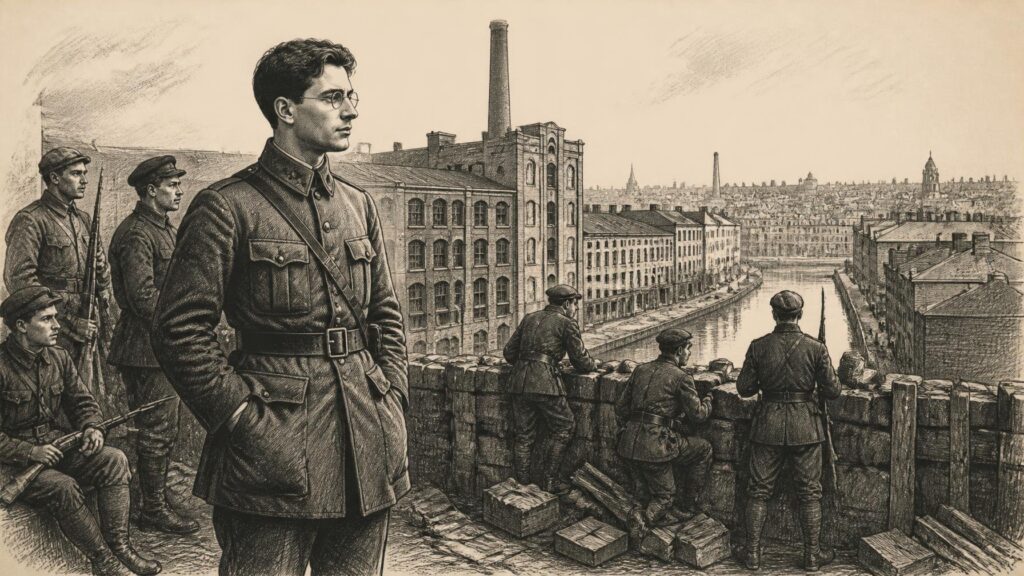
AI generated historical illustration, not a contemporary photograph.
At a Glance
Éamon de Valera was among the most consequential and divisive figures in modern Irish history. Across six decades he was a revolutionary commander, president of Dáil Éireann, opponent of the Anglo-Irish Treaty, founder of Fianna Fáil, head of government, architect of constitutional change and President of Ireland. His exceptional longevity in public life makes simple verdicts difficult. He helped define the sovereignty and institutions of the Irish state, yet his political choices also sharpened divisions over partition, civil war, religion, economic development and Ireland’s place in the world.
Childhood Formation
De Valera was born in New York City on 14 October 1882. His mother, Catherine Coll, had emigrated from Bruree in County Limerick; his father, Juan Vivion de Valera, was a Spanish-born artist of Basque background who had lived in Cuba before making his way to the United States. The circumstances of the parents’ marriage were later obscured by the absence of a surviving documentary record, a gap eagerly exploited by political adversaries. The documented evidence does not justify many of the stories that circulated about his parentage. In particular, claims that he was the child of a Limerick farmer belong to political folklore rather than credible chronology.
His father left the family while ill and died when the child was very young. In 1885, aged about two and a half, Edward de Valera was brought from America to the Coll family at Knockmore near Bruree. The separation from his mother became permanent in practice, though not in sentiment. He grew up within a poor rural household, familiar with labour, frugality and the limited prospects of smallholders and labourers. Later recollections describe open wells, candles, scarce meat and agricultural work. Such memories should not be treated as a complete social history of late nineteenth-century Limerick, but they help explain the importance he attached to self-command, education and upward mobility.
His childhood was Irish in setting but transatlantic in origin. That combination would matter throughout his career. Opponents sometimes questioned whether an American-born man could personify Irish nationality; de Valera instead turned his American citizenship and connections into political assets. He could present himself as rooted in rural Ireland while also understanding the potential of the Irish diaspora. The tension between those identities was real, but it became a source of political reach rather than a disabling contradiction.
Scholarly Ambition
Education changed de Valera’s prospects. After attending Bruree national school, he won support to continue at the Christian Brothers’ school in Charleville and later entered Blackrock College in Dublin. The move from a labourer’s cottage to an elite Catholic school was a remarkable social advance. It placed him in an environment shaped by discipline, Catholic intellectual culture and aspirations to professional distinction. He proved especially able at mathematics, a subject that trained habits of abstraction and precision which friends and opponents alike later recognised in his political style.
He attended the Royal University and subsequently University College Dublin, where he studied mathematics and mathematical physics. His academic career did not develop in a straight line. He taught in several institutions, including Carysfort Training College and St Patrick’s College, Maynooth, and experienced unsuccessful applications for permanent university posts. Yet he became a respected teacher. His early public identity was not that of an agitator but of a serious, somewhat reserved mathematician and educator. This is important because the later image of de Valera as a born political leader can conceal how contingent his entry into revolutionary politics was.
In 1910 he married Sinéad Flanagan, a teacher and Irish-language activist. Their marriage joined his emerging professional world to the Gaelic revival. Sinéad was a committed Irish speaker and a formidable organiser in her own right. The household they built was large, Catholic and politically immersed, though his public obligations often kept him away for prolonged periods. It is tempting to portray Sinéad merely as the patient wife of a great man. Documentary evidence instead suggests a politically alert partner who handled correspondence, family pressures and aspects of a public life that rested heavily upon domestic labour.
Revolutionary Entry
De Valera’s movement into nationalist politics came through the cultural and political currents of the years before the First World War. He joined the Gaelic League, improved his Irish and attended language courses in the west. He also became involved in the Irish Volunteers after their foundation in 1913. The Volunteers emerged in response to the Ulster Volunteer Force and the crisis over Home Rule, but they contained a wide range of opinions. Some saw them as a constitutional pressure group; others regarded them as the nucleus of an armed national force.
The outbreak of war in 1914 transformed the setting. John Redmond’s call for the National Volunteers to support the British war effort split the organisation. De Valera remained with the minority Irish Volunteers, who rejected Redmond’s intervention. During 1915 he became commandant of the Third Battalion of the Dublin Brigade and joined the Irish Republican Brotherhood. Neither development made him one of the inner circle planning the Easter Rising. He was not a signatory of the Proclamation and did not occupy the same pre-1916 position as Patrick Pearse, Tom Clarke or James Connolly. His later prominence should not be projected backwards.
Nevertheless, he acquired military responsibility at a decisive moment. He was tall, disciplined and capable of imposing order; these qualities contributed to the authority he exercised among Volunteers. He was also politically attentive. The Rising gave him a stage on which personal survival, military command and the changing public response to British repression would combine to elevate him. His reputation was therefore made by 1916, but not solely by his conduct in the fighting. It was also made by what followed.
Easter Command
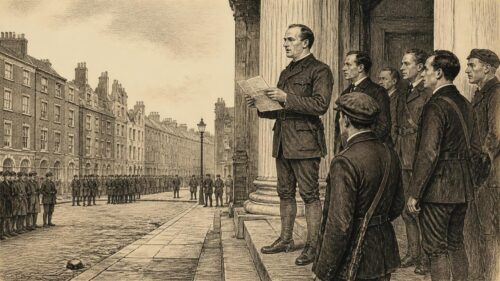
During Easter Week 1916 de Valera commanded the Boland’s Mill garrison, which included positions around the Grand Canal and Mount Street. This was a strategically significant sector because British troops coming from Kingstown, now Dún Laoghaire, might approach central Dublin by that route. The garrison’s outposts helped inflict serious casualties on British forces moving into the city, especially near Mount Street Bridge. The episode later became an important element in his standing among republicans: unlike many political leaders, he had commanded men under fire.
The Rising failed militarily. Dublin suffered extensive destruction, civilians were killed and the insurgents surrendered. De Valera was court-martialled and sentenced to death, but the sentence was commuted to penal servitude. The precise reasons continue to be discussed. His American birth may have been relevant; so too may the later timing of his trial, by which point the execution of other leaders had changed public opinion and increased official caution. It is wiser to acknowledge uncertainty than to reduce the commutation to one neat explanation.
Imprisonment transformed him. The execution of the principal signatories and commanders left a depleted republican leadership. De Valera survived when Pearse, Clarke, Connolly, Joseph Plunkett, Thomas MacDonagh and others did not. Survival was not itself a political programme, but it gave him an unusual symbolic value. Released under the general amnesty in 1917, he emerged into a country where popular anger at executions, wartime hardship and the failure of constitutional nationalism had opened a path for Sinn Féin and the republican movement.
Prison Politics
In prison, de Valera developed relationships that helped him move from military officer to political leader. He encountered figures including Eoin MacNeill and participated in discussions on language, history and political strategy. His manner could be formal and uncompromising, but he possessed patience, stamina and a capacity to absorb detail. These traits were suited to the organisational struggles of the next years. He won the East Clare by-election in July 1917, defeating the Irish Parliamentary Party candidate by a large margin. The result was a major sign that the electoral landscape was changing.
Later that year he became president of Sinn Féin and president of the Irish Volunteers. Sinn Féin was then being remade from a small separatist organisation into the political vehicle of the republican movement. Its programme contained differing assumptions: Arthur Griffith had associated Sinn Féin with a dual-monarchy model, while many rising leaders sought an independent republic. De Valera’s election did not erase these differences, but his public association with 1916 and his electoral mandate gave him authority to hold a broad coalition together.
When the United Kingdom held its general election in December 1918, Sinn Féin won a sweeping mandate in much of Ireland, though unionism remained dominant in much of Ulster. The elected Sinn Féin MPs refused to sit at Westminster. Instead, they established Dáil Éireann in Dublin in January 1919 and declared Irish independence. De Valera was absent in the United States for much of the following period, but he became president of the Dáil in April 1919. The title and constitutional forms were significant: the revolutionary movement was seeking not merely to defeat British authority but to demonstrate that an alternative Irish government existed.
American Mission
De Valera travelled to the United States in 1919, seeking diplomatic recognition, money and support from Irish America. The mission was ambitious. He hoped to persuade the United States, fresh from the language of national self-determination associated with President Woodrow Wilson, to recognise the Irish Republic or at least to press Britain more strongly. He also sought to control fundraising for the republican cause. His American birth gave him a special claim upon diaspora audiences, and his appearances drew large crowds.
The tour produced funds and publicity, but it also generated conflict. Irish-American politics was fragmented, with rival organisations, established leaders and different expectations of the movement in Ireland. De Valera quarrelled with John Devoy and other influential figures connected to Clan na Gael. He founded the American Association for the Recognition of the Irish Republic, which competed with older networks. The dispute was not simply personal. It concerned money, control, strategy and the relationship between Irish revolutionaries and their supporters abroad. Yet his own strong sense of authority made compromise harder.
Diplomatic recognition did not come. American officials were unwilling to jeopardise relations with Britain, and the international settlement after the First World War did not offer Ireland the opening republicans had hoped for. The mission’s limitations did not negate its importance. It helped finance the movement and made de Valera internationally recognisable. It also shaped a lifelong conviction that Ireland should act independently in foreign affairs and should not accept that British strategic interests automatically defined Irish interests. That conviction would later inform his handling of neutrality.
Treaty Crisis
By 1921 the War of Independence had brought violence, repression and political exhaustion. A truce began in July, followed by negotiations between British representatives and an Irish delegation. De Valera, then president of Dáil Éireann, held exploratory discussions with David Lloyd George but did not travel to London as one of the plenipotentiaries. Instead, Arthur Griffith, Michael Collins and others were appointed. This decision has been endlessly debated. Critics have alleged that he avoided responsibility while leaving colleagues to accept an impossible settlement; defenders have argued that he believed negotiations required a delegation operating within carefully defined limits.
The Anglo-Irish Treaty, signed in the early hours of 6 December 1921, created the Irish Free State as a self-governing dominion within the Commonwealth. It required an oath connected to the Crown and confirmed the possibility that Northern Ireland would remain outside the new state. It also retained British naval facilities at specified ports. The settlement went far beyond Home Rule, but it fell short of the republic proclaimed in 1916 and affirmed in 1919. The National Archives’ records of the negotiations underline how compressed and pressured the final days were; participants believed that refusal could bring renewed war.
De Valera opposed the Treaty, though he accepted that it had been negotiated under extraordinary pressure. He advanced alternative proposals, commonly associated with ‘Document No. 2’, envisaging an external association rather than dominion status. For him, the decisive issue was constitutional allegiance: an Irish republic could not be reconciled with an oath to the British Crown. He also feared that acceptance would weaken the claim to national unity. His opponents replied that the Treaty offered the freedom to achieve greater freedom, and that rejecting it risked catastrophe. Both positions drew upon sincere nationalist principles, but neither could prevent a fatal split.
Civil War
The Dáil approved the Treaty in January 1922 by 64 votes to 57. De Valera resigned as president and became the leading political figure among anti-Treaty republicans. The division was not merely theoretical. It separated former comrades, families and local communities. The provisional government established under the Treaty faced armed opposition from IRA units that rejected the settlement. After the occupation of the Four Courts by anti-Treaty forces and its bombardment by National Army artillery in June 1922, civil war began.
De Valera’s responsibility for the conflict has remained one of the hardest questions in his career. He was not the military commander of the anti-Treaty IRA, and his authority over armed units was limited. In July 1922 he proposed a republican political organisation, Cumann na Poblachta, but it did not resolve the military crisis. His critics maintain that his refusal to accept the democratic Treaty vote helped legitimise armed resistance. His defenders point to the coercive conditions under which the Treaty was negotiated and to the use of force by the pro-Treaty government. Historical explanation requires both facts to be held together: the anti-Treaty side lost the parliamentary vote, and the ensuing war was devastating.
The anti-Treaty campaign ended in 1923. Thousands had been imprisoned, many had died and the new state had used executions and extensive emergency powers. De Valera was arrested in August 1923 and held until July 1924. The conflict permanently shaped Irish politics. Its principal electoral parties would be descendants of the opposing camps, while personal memories of bereavement and bitterness endured for decades. De Valera emerged from defeat convinced that republican objectives had to be pursued through mass electoral politics, however qualified that acceptance might initially be.
Constitutional Opposition
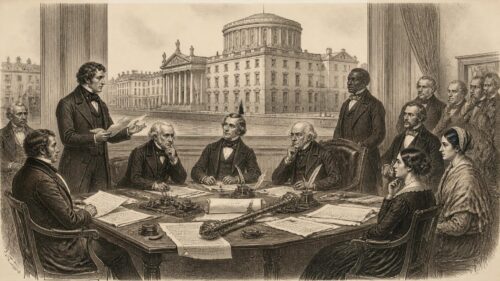
After his release, de Valera faced a strategic choice. Sinn Féin’s abstention from the Free State parliament preserved its rejection of the Treaty but excluded it from the institution where laws, budgets and public administration were being decided. De Valera gradually concluded that abstentionism had become politically sterile. His proposal to enter the Dáil while treating the oath as an empty formula was rejected by the Sinn Féin leadership. In March 1926 he and his supporters founded Fianna Fáil.
The new party was a major innovation. Its name, Fianna Fáil, evoked legendary Irish warrior bands and was paired with the slogan ‘The Republican Party’. Yet it was designed to operate in the constitutional system created by the Treaty. Fianna Fáil initially refused to take the oath, but after legal and political pressure it entered the Dáil in 1927. De Valera argued that the oath was a constitutional obstacle which could be removed by using the institutions themselves. This was a notable shift from the absolutism of 1922, though he presented it as tactical rather than as abandonment of republican principle.
Fianna Fáil rapidly became the chief opposition to the Cumann na nGaedheal government led by W. T. Cosgrave. It appealed to republicans, small farmers, urban workers and voters dissatisfied with austerity or the social conservatism of the existing administration. Its growth was aided by de Valera’s personal authority, but it depended equally on a disciplined national organisation and gifted colleagues such as Seán Lemass, Frank Aiken and Seán T. O’Kelly. The party’s success showed that the civil-war divide could be translated into elections rather than armed confrontation.
Party Creation
Fianna Fáil won office in the general election of February 1932. De Valera became president of the Executive Council, the title then used for head of government under the Free State constitution. His administration was a minority government at first, but it moved quickly to dismantle Treaty provisions which republicans considered symbols of subordination. It removed the oath of allegiance for legislators, reduced the role of the governor-general and pursued a series of constitutional measures intended to diminish the Crown’s place in Irish public life.
These changes were more than ceremonial. They showed that a party born from anti-Treaty republicanism could use parliamentary majorities and legal amendment to alter the foundations of the state. De Valera’s constitutional method also helped normalise Fianna Fáil as a party of government. The state it inherited had survived a civil war and a difficult first decade; the state it reshaped became increasingly distinct from the dominion created in 1922. The process was gradual, contested and constrained by external realities, but it was decisive in the political education of independent Ireland.
His government also faced a domestic challenge from the Blueshirts, associated with Eoin O’Duffy and initially organised to protect Cumann na nGaedheal meetings from IRA disruption. Their uniforms, marches and authoritarian rhetoric alarmed many observers in an era of European fascism. De Valera prohibited a proposed Dublin demonstration in 1933 and used emergency powers against both the Blueshirts and the IRA. This was a reminder that his government’s commitment to constitutional rule could coexist with coercive state action. The Ireland of the 1930s was democratic, but its democracy was defended through restrictive powers that remain open to criticism.
Government Power
De Valera’s leadership style combined formidable command of detail with a capacity to delay decisions until options had narrowed. Admirers saw seriousness, patience and strategic discipline. Critics saw evasiveness, mistrust and an inclination to keep authority concentrated in his own hands. Both impressions have support in the historical record. He held important ministerial portfolios alongside the leadership of government, notably External Affairs, and maintained close control over the direction of Fianna Fáil. His stature could overshadow colleagues, including those who managed much of the practical work of economic policy and administration.
He cultivated a language of national self-reliance. This appealed powerfully in a country whose independence was recent and incomplete. But self-reliance could mean several things: legal sovereignty, economic protection, cultural revival, military preparedness or moral independence from larger powers. De Valera was adept at holding these meanings together. His speeches often presented the Irish state as a small nation entitled to its own judgement, neither a satellite of Britain nor an instrument of any outside ideology.
That vision did not resolve the problem of partition. De Valera never accepted the permanent division of the island, but he recognised that the government in Dublin lacked the power to compel Northern Ireland into a united state. The political language of national unity remained central to Fianna Fáil, while practical policy was limited by unionist opposition, British responsibility for Northern Ireland and the realities of international relations. His career demonstrates the difference between a constitutional claim and the means available to implement it.
Constitutional Settlement
The Constitution of 1937, Bunreacht na hÉireann, was the most enduring achievement associated with de Valera’s governments. It was approved by referendum on 1 July 1937 and came into operation on 29 December. The text replaced the Free State constitution, created the office of President of Ireland, named the head of government Taoiseach, and gave the state the name Éire in Irish and Ireland in English. It also set out fundamental rights, institutions of government and the position of the courts.
De Valera was closely involved in its drafting, though the Constitution was the work of several people, especially the legal adviser John Hearne. It should not be regarded as the product of one mind alone. Its language reflected Catholic social thought, democratic constitutionalism, Irish cultural nationalism and the practical requirements of state administration. The special position accorded to the Catholic Church was controversial from the outset, even though the Constitution also recognised other named religious denominations and did not establish Catholicism as the state religion.
Articles 2 and 3 made a constitutional claim concerning the national territory, while acknowledging in practice the existing jurisdiction of the state. For nationalists, these provisions expressed an uncompleted national unity. For unionists, they were a source of apprehension. The Constitution also contained provisions concerning women and the family which have attracted sustained criticism, particularly the language describing women’s life within the home. Its durability is striking: amended many times, it remains the central legal framework of the state. That endurance is a measure of de Valera’s constitutional achievement, though not proof that every original provision was wise or just.
Economic Programme
Fianna Fáil’s early economic strategy was shaped by the Great Depression, rural poverty and a belief that political independence required greater economic autonomy. De Valera’s government pursued protectionist policies, promoted native industry and sought to reduce dependence on British markets. The most dramatic dispute came over land annuities, payments linked to earlier British-financed land purchase schemes. In 1932 the government withheld the payments, arguing that obligations inherited under the Treaty should not continue.
Britain responded with tariffs, and the Irish government retaliated. The resulting Economic War damaged agricultural exports and imposed real hardship, particularly on cattle farmers. It also encouraged industrial development behind tariff walls. Supporters saw the policy as a necessary assertion of sovereignty and a stimulus to domestic manufacturing. Critics regarded it as costly, economically inefficient and excessively ideological. Neither interpretation alone is sufficient. The policy imposed pain, but it also changed the political and economic imagination of the state by making industrialisation and import substitution central public goals.
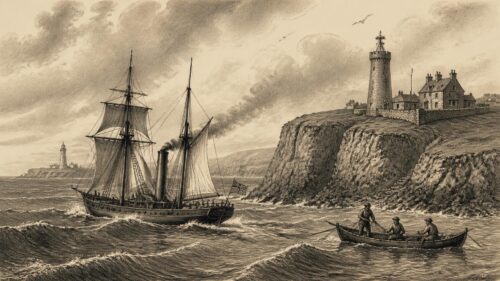
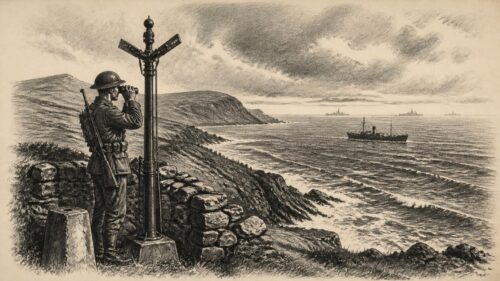
The Anglo-Irish Agreements of 1938 ended the dispute, settled financial questions and returned the Treaty Ports of Berehaven, Cobh and Lough Swilly to Irish control. The ports’ return was of exceptional importance. It completed a major aspect of sovereignty and made a policy of neutrality more practicable when European war came. In retrospect, 1938 marked a turning point: the state had resolved a major quarrel with Britain while securing greater independence of action. De Valera’s government could therefore enter the crisis of 1939 with assets that earlier Irish administrations had lacked.
Wartime Neutrality
When the Second World War began in September 1939, de Valera declared a state of emergency and maintained Irish neutrality. In Ireland the conflict was commonly known as the Emergency. Neutrality was not an effortless withdrawal from world affairs. The state faced the possibility of German invasion, British intervention, economic blockade and political destabilisation. It also had to consider the fact that Northern Ireland was part of the United Kingdom and became an important Allied military base.
De Valera’s principal purpose was to keep the state out of a war in which Ireland had limited military capacity and a deeply complicated relationship with Britain. He believed participation on Britain’s side could reopen civil-war divisions and compromise the independence the state had acquired. Historians associated with the Royal Irish Academy’s Documents on Irish Foreign Policy project stress the strategic calculation behind this position: Irish neutrality aimed to prevent the country becoming a battlefield between much larger powers. At the same time, Ireland quietly provided forms of assistance beneficial to the Allied side, while publicly insisting on formal impartiality.
Neutrality carried moral and practical costs. Censorship restricted reporting and public debate. Shortages affected daily life. The government’s treatment of belligerent personnel was not entirely symmetrical, and Allied aircraft crews who crossed the border could often return to British territory while German personnel were interned. The state also faced the unavoidable contradiction of neutrality on an island partly used for Allied operations. De Valera’s policy was therefore neither isolation nor simple even-handedness; it was a constrained strategy of national survival, secrecy and calculated co-operation.
Diplomatic Controversy
The most notorious incident of de Valera’s wartime record occurred in May 1945, when he visited Eduard Hempel, the German representative in Dublin, to offer condolences after Adolf Hitler’s death. De Valera maintained that diplomatic relations still existed and that failure to call would have been a breach of formal courtesy. The decision provoked condemnation, especially in the United States and Britain. It has remained one of the most difficult actions to defend in his public career.
Context matters but cannot erase the offence. De Valera was adhering to his conception of strict diplomatic neutrality, and the Irish government had been anxious not to create precedents that might compromise its position. Yet the visit followed the exposure of Nazi crimes and came after the death of Franklin D. Roosevelt, for whom no comparable personal visit to the American representative had been made. The asymmetry was obvious to contemporary critics. It injured Ireland’s international reputation and gave force to accusations that legalism had overwhelmed moral judgement.
It would nevertheless be historically inaccurate to equate the decision with sympathy for Nazism. Ireland did not join the Axis, and de Valera’s government considered Germany a potential threat to the country. The better judgement is that the condolence visit was a serious political and moral error produced by an excessively rigid understanding of diplomatic form, personal confidence in his own reasoning and the habits of neutrality developed during the Emergency. Explaining the error is not excusing it.
Social Conservatism
De Valera’s Ireland was shaped by a conservative Catholic public culture, but he was not solely responsible for creating it. Church influence, inherited social attitudes, poverty, emigration and the limited capacity of the state all affected policy. Still, his governments helped give constitutional and administrative expression to a vision of society centred on family, religion, rural life and national cultural distinctiveness. He often spoke of a self-sufficient Ireland of sturdy households and local communities, an image later associated with the idealised landscape of his 1943 St Patrick’s Day broadcast.
That image has often been treated as evidence that de Valera wanted Ireland to remain permanently poor, rural and cut off from modernity. It is more accurate to regard it as an idealised moral vision rather than a complete economic blueprint. His governments also supported industrial development, electrification and public administration. Yet the language was revealing. It gave insufficient weight to urbanisation, women’s equal citizenship, pluralism and the aspirations of people whose lives did not fit a Catholic rural norm.
Women’s organisations challenged aspects of the 1937 Constitution and the social assumptions surrounding it. Their objections show that criticism was not simply imposed by later generations; it existed at the time. Likewise, censorship and restrictive moral legislation cannot be attributed to one leader alone, but de Valera’s governments operated within and reinforced a system that limited cultural expression and personal autonomy. His legacy must include the state-building achievements of the period and the exclusions embedded in its dominant social ideals.
Postwar Challenges
Fianna Fáil lost office in 1948, ending de Valera’s long first period as Taoiseach. The inter-party government that succeeded it declared Ireland a republic in 1949 and left the Commonwealth. This did not diminish de Valera’s historic role in reducing the Crown’s constitutional position, but it showed that the final formal step could be taken by his opponents. The Republic of Ireland Act also prompted the British government to legislate that Northern Ireland would remain within the United Kingdom unless the Parliament of Northern Ireland consented otherwise, entrenching partition in a new way.
De Valera returned as Taoiseach in 1951 and again in 1957. These later administrations confronted economic stagnation, emigration and the pressures of a changing Europe. By this stage he was an elder statesman, revered by many supporters but criticised as remote from a younger Ireland. Seán Lemass increasingly represented a more outward-looking economic approach within Fianna Fáil. The contrast between the two men can be overstated, since Lemass had long been a senior colleague, but it captured a real shift from protection and austerity towards export-led development and closer European engagement.
De Valera’s later premierships were less innovative than his 1930s governments, yet they remained significant. He continued to embody continuity between the revolutionary generation and the established state. For supporters, his presence guaranteed that the republic’s foundational ideals had not been forgotten. For critics, it prolonged the political dominance of a generation whose assumptions no longer met Ireland’s social and economic needs. Both perceptions help explain why his eventual move to the presidency carried symbolic weight.
Final Offices
In 1959 de Valera was elected President of Ireland and was inaugurated on 25 June. The presidency offered a dignified conclusion to a career marked by partisan conflict. Under the Constitution, the office was not an executive one, but it had ceremonial, constitutional and representative importance. He was re-elected in 1966 and served until 1973. By then he was elderly and his sight had seriously deteriorated, but his presence at Áras an Uachtaráin connected the state’s highest office to the generation of 1916.
His presidency also altered public memory. The former insurgent became the constitutional head of the state created through decades of compromise, amendment and electoral competition. This was not merely personal transformation. It illustrated the broader passage of Irish republicanism from revolution to statehood. The political movement that had once rejected the institutions of the Free State had reshaped those institutions and come to identify with their continuity.
De Valera died on 29 August 1975. His funeral drew international attention and reflected the scale of his historical stature. The event did not settle arguments about him. Rather, it confirmed that he had become inseparable from the story of twentieth-century Ireland. Few leaders have participated so directly in so many stages of national political development: insurrection, revolutionary government, diplomatic campaigning, civil war, opposition, constitutional revision, wartime crisis and the ceremonial life of the mature state.
Historical Judgement
Judgements of de Valera have often been sharply polarised. One tradition casts him as the indispensable maker of independent Ireland: a survivor of 1916 who gave institutional form to sovereignty, maintained democracy amid European dictatorship and protected the state during the Second World War. Another portrays him as a gifted but obstructive leader whose Treaty stance deepened civil-war division, whose social vision narrowed Irish life and whose neutrality sometimes became moral blindness. These are not equally persuasive in every respect, but each points to part of the record.
The documentary record resists the comforting legend of an all-seeing national father. De Valera made mistakes, delayed decisions and sometimes treated opposition as a failure of understanding rather than a legitimate democratic difference. Nor should he be reduced to a villain of modernisation. He accepted electoral politics after civil war, helped establish constitutional stability and led governments that strengthened Ireland’s external autonomy. His capacity to change tactics while retaining core principles was one of his greatest political skills.
His enduring importance lies partly in the questions his career leaves behind. What does sovereignty mean for a small state beside a larger neighbour? Can national unity be asserted without coercion? How should neutrality balance survival, law and moral responsibility? Can a constitution preserve inherited values while protecting citizens excluded by those values? De Valera did not answer these questions finally. He ensured, however, that they became central to the political life of independent Ireland. His legacy is therefore not a settled monument but a continuing argument within Irish history.
De Valera’s transition from anti-Treaty leader to founder of Fianna Fáil is striking because the article presents it as both tactical adaptation and continuation of republican aims. His decision to enter the Dáil suggests that constitutional participation could transform a state whose legitimacy he had previously resisted, while civil-war memories continued to shape loyalties. This raises a question about whether institutions change movements, or movements reshape institutions from within. How should we interpret de Valera’s move from abstentionism to parliamentary politics: as pragmatic compromise, principled constitutional strategy, or an attempt to reconcile revolutionary sovereignty with democratic legitimacy in independent Ireland?