

Sheltered Justice

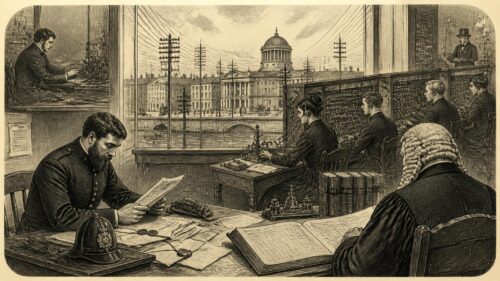
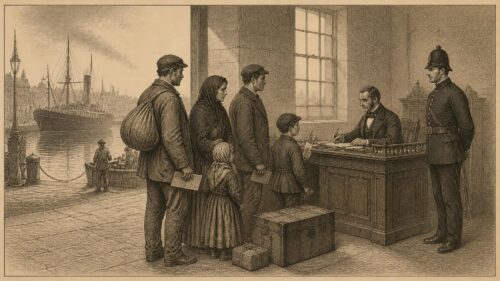
AI generated historical illustration, not a contemporary photograph.
At a Glance
The history of domestic violence law reform in Ireland is a history of the home becoming visible to law. For much of the twentieth century, violence within marriage was commonly obscured by the idea that family life belonged to a private sphere. The gradual creation of remedies—from the first barring orders to the criminalisation of coercive control—did not simply add statutes to the books. It altered who could ask a court for protection, who could remain in a home, what conduct counted as abuse, and what responsibilities lay upon the Gardaí, courts and State services.
Private Silence
Domestic violence was not absent from Irish life before reform; rather, it was frequently difficult to name in public, difficult to report, and still harder to address through an effective legal remedy. Historical evidence must be handled carefully here. Silence in official records cannot establish that abuse was rare. It more readily reveals the limits of available language, the risks of disclosure, dependence within marriage, and the lack of services through which a person might safely seek help. In the Republic of Ireland, family law, property law, criminal law and social attitudes all shaped those limits.
Older legal arrangements did not provide a single, coherent body of domestic-violence law. Assault and other offences could in principle be prosecuted, but criminal procedure was not designed chiefly to secure continuing safety in an intimate household. A person facing violence could encounter the cruel practical question that later reform would confront directly: if the danger was in the shared home, who had to leave it? The answer could be shaped by ownership, income, marital status, children and access to somewhere else to live. Criminal prosecution, where it occurred, did not necessarily supply immediate or durable protection.
The constitutional and social setting of the early State matters, though it should not be treated as a simple explanation for every individual experience. Marriage and the family occupied a specially valued place in public discourse. Women’s paid employment, reproductive choices and economic independence were restricted in ways that changed only gradually. The effect, in many cases, was to make leaving an abusive household financially hazardous. The legal difficulty was therefore never confined to whether violence could be condemned. It concerned whether a person and any children could be protected without being made homeless or deprived of essential support.
It is tempting to describe earlier Ireland as a society that regarded domestic abuse merely as a private matter. That phrase captures an important reality but needs qualification. Individual relatives, neighbours, clergy, doctors, police officers and lawyers could intervene, and individual women did resist, seek assistance and make their experiences known. Yet the institutions of the State did not initially offer a dedicated, readily accessible system of protective orders. The broad historical pattern is more precisely described as institutional inadequacy: abuse within domestic relationships lacked the recognition, specialised process and support structure that later campaigners demanded.
Public Voices
The women’s movement changed the terms in which abuse was discussed. Women’s Aid dates its foundation to 1974, when a group led by Nuala Fennell responded to public appeals for help. Its retrospective account records that women and children seeking safety had sometimes had to leave for England because Ireland then had neither refuges nor domestic-violence legislation capable of allowing them to remain securely at home. Such testimony is important historical evidence, although it is a service organisation’s account of its own origins and should be read as that: an informed contemporary memory of campaigning, not a complete census of every form of assistance then available.
The refuge movement did more than provide emergency accommodation. It made a previously secluded injury politically intelligible. A refuge, helpline or court-accompaniment service turns an individual crisis into evidence of a recurring social problem. It also exposes why an exclusively criminal response is inadequate. A person may require a safe bed, money, legal advice, child care, transport, privacy, medical attention and someone able to explain court procedure. Campaigning thus pressed for institutional change in several directions at once: public funding, trained responders, legal orders, police policy and a public vocabulary that did not excuse violence as a domestic disagreement.
Women’s Aid’s historical material identifies 1976 as the year of the first domestic-violence legislation and notes that its barring orders could last three months. Its account also marks the opening of a Dublin refuge in 1976, the development of the National Freephone Helpline in 1992, and later efforts to train Garda recruits. These milestones should not be mistaken for a smooth ascent from ignorance to safety. They instead show the interdependence of voluntary activism and law. Protective legislation became more useful because organisations existed to tell people about it and help them use it; services, in turn, could demonstrate the gaps that legislation left behind.
Public language evolved as well. The earlier phrase “battered wives” reflected the visible physical injuries around which much early campaigning was organised, but it was not a full description of domestic abuse. Subsequent reform and advocacy increasingly addressed threats, intimidation, harassment, sexual abuse, controlling conduct and the effect on children. This expansion was not simply semantic. A legal system that recognises only an assault at a particular moment may overlook the pattern of surveillance, isolation, financial restriction and fear by which abuse can be maintained over time.
First Remedies
The Family Law (Maintenance of Spouses and Children) Act 1976 introduced the first statutory barring order. Section 22 allowed a court to exclude a spouse from the family home where there were reasonable grounds for believing that the safety or welfare of the applicant spouse or dependent children required it. The innovation was profound in practical terms. Rather than assuming that the person at risk must flee, it enabled the court to order the alleged wrongdoer out of the household. It converted occupation of the family home from a matter determined solely by possession or ownership into one that could be qualified for protection.
This remedy was nevertheless narrow. It was situated within law about spouses and children, not within a comprehensive account of domestic abuse. Its original duration was limited, and the legislation did not give the Garda Síochána a specific power to arrest for breach. The gap between a court order and its enforcement is central to the history. An order may state who must leave a home, but its value depends upon whether its terms are understood, served, monitored and enforced when danger persists. Protection on paper is not necessarily protection at a doorstep.
The Family Law (Protection of Spouses and Children) Act 1981 replaced the 1976 barring-order regime. According to the 1985 Oireachtas Joint Committee report on marriage breakdown, the 1981 Act preserved the central test of safety and welfare but materially changed enforcement. It gave Gardaí a power to arrest a person reasonably believed to have breached a barring order. It also created a protection order: an interim restraint, available while an application for a barring order was pending, against threatening, molesting or putting the applicant or dependent children in fear.
The 1981 scheme illustrates an enduring tension in reform. Barring a person from a home is a serious intervention in family and property life, yet failure to grant prompt protection can expose the applicant and children to grave harm. Courts consequently had to distinguish the protective function of an order from a general mechanism for resolving marital breakdown. The 1985 committee noted judicial uncertainty and concern that a restrictive interpretation could deny relief where conduct endangered welfare without fitting a narrow model of physical violence. Its recommendation for a clearer statutory statement was an early recognition that legal categories could lag behind lived patterns of abuse.
Judicial Limits
The committee’s discussion of the Supreme Court decision known as O’B is revealing. It recorded that the judgment had influenced the grant of barring orders and that, after it, applications could be refused unless physical violence was present. The committee did not say that physical assault was unimportant; rather, it warned that conduct seriously imperilling health, safety or welfare might not always take that form. Threats and repeated coercive conduct can make a home unsafe even before an assault is proved in court.
This was a legal, not merely rhetorical, difficulty. Family law often seeks defined tests and evidential thresholds, while domestic abuse may consist of a cumulative pattern whose individual incidents can appear minor when isolated. The history of domestic-violence reform repeatedly returns to this problem. What is the relevant unit of harm: a single blow, an explicit threat, an ongoing campaign of intimidation, or the whole domestic environment in which a person’s choices have been constrained? Ireland’s later recognition of coercive control can be understood, in part, as an answer to that older problem.
The 1985 report also acknowledged criticism from persons barred from their homes, many of them men, who experienced orders as humiliating, financially disruptive and unjust. That evidence should not be ignored, because a legal system must provide fair procedures and be alert to the seriousness of exclusion from a home. Yet the committee’s own conclusion was clear: the barring order remained a necessary legal remedy where conduct made life impossible or posed a serious danger to a spouse or children. It rejected the idea that abolishing the remedy would improve justice, observing that injunctions or prosecution would not provide an equivalent practical response.
The committee further noted a lack of counselling or welfare help for those whose conduct had led to exclusion. This is historically significant. It shows that, even in the 1980s, Irish policy debates included both protection and the possibility of changing abusive behaviour. Such ideas must not be used to transfer responsibility from perpetrators or to make a victim’s safety contingent upon a respondent’s participation. But they demonstrate that lawmakers understood an order alone could not repair the underlying social and personal conditions of violence.
Broader Protection
The Domestic Violence Act 1996 was the major consolidating measure of its period. Enacted on 27 February 1996 and largely brought into operation on 27 March, it repealed and re-enacted, with amendments, the 1981 provisions. Its long title made its purpose plain: protection for spouses, children, dependent persons and people in other domestic relationships whose safety or welfare required it because of another person’s conduct. The Act provided for safety orders, barring orders, interim barring orders and protection orders, and it included offences and powers of arrest without warrant for breaches.
Its significance lay in breadth as well as consolidation. The 1996 Act did not confine protection to a conventional married household. It extended the framework to a wider range of domestic relationships, although eligibility and the particular orders available still depended on statutory definitions and property interests. A safety order could restrain violence or threats without requiring the respondent to leave the home. A barring order could exclude the respondent. An interim barring order and a protection order supplied forms of shorter-term relief while a full application was proceeding. This architecture remains the foundation of Irish civil protection law.
In historical perspective, the Act joined civil and criminal functions without erasing the distinction between them. The applicant sought a civil order intended to prevent future harm; breach of that order was a criminal offence. This arrangement recognised that many people need preventive intervention before, or apart from, a criminal trial. It also addressed a practical reality: an applicant may want violence to stop without wishing to initiate a process whose outcome could include imprisonment of a partner who remains connected to children, income or housing. That fact does not reduce the seriousness of abuse. It explains why a flexible protective jurisdiction was necessary.
However, broader eligibility did not mean universal access. Property rules retained particular importance for barring and interim barring orders. The law had to balance protection with rights in a home, and that balance could make the strongest form of exclusion unavailable to a cohabitant with weaker legal or beneficial ownership. Such restrictions were not accidental technicalities. They arose from the difficulty of reconciling urgent personal safety with constitutional and property interests. Their persistence is evidence that law reform involves choices among rights, not merely an expanding list of protections.
Amendments in 2002 and later changes in civil-partnership, cohabitation, family and court legislation adjusted the 1996 framework. By the time the Domestic Violence Bill was introduced in 2017, the Department of Justice described the task as one of updating and consolidating a body of law already altered by several enactments. This legislative layering matters. The history is not accurately told as a pause between two landmark Acts. It is a continuing process in which relationships recognised by family law, court procedure and the rights of children affected who could seek protection.
Reform Debates
Law reform does not end once a principal Act is passed. The Law Reform Commission’s 2013 Report on Aspects of Domestic Violence examined bail where a person was charged with breaching a domestic-violence order and considered harassment in domestic cases. It recommended retaining the summary character of breaches rather than making them offences punishable by five years’ imprisonment simply to permit refusal of bail on preventive grounds. The Commission reasoned that the central statutory purpose was effective access to safety and barring orders, and that existing bail conditions could restrict contact and be revoked if broken.
This conclusion illustrates the care required in legal reform. Stronger punishment is not invariably the same as stronger protection. The Commission also recommended clear prosecution not only of breaches of protective orders but of any accompanying substantive offence, such as assault causing harm or harassment. In other words, the law should neither trivialise disobedience to a court order nor allow the breach charge to eclipse serious underlying violence. This approach separates the symbolic appeal of harsher penalties from the operational question of what will best protect applicants and preserve workable procedures.
The Commission’s consideration of stalking is equally important. It noted that many harassment prosecutions concerned former spouses or partners, and that digital communications were creating forms of abuse not easily captured by older assumptions about following or watching someone in public. The domestic sphere was no longer bounded by a front door. Telephone calls, text messages, email and social media enabled contact, surveillance and intimidation at distance. Later law would expressly reflect electronic communication within the terms of protective orders.
These debates show that reform was driven by more than one source. Survivor support organisations supplied knowledge of daily risk. Courts exposed procedural and interpretative difficulties. The Law Reform Commission analysed constitutional and criminal-law questions. Departments drafted consolidating legislation. The Oireachtas debated and enacted it. International standards increased pressure to examine whether domestic law recognised the full range of violence against women and domestic violence. No single institution can claim authorship of the change.
Modern Framework
The Domestic Violence Act 2018 was enacted on 8 May 2018 and commenced on 1 January 2019. It repealed the Domestic Violence Act 1996 and the Domestic Violence (Amendment) Act 2002, while consolidating their core civil remedies. Its statutory title records a notably wider programme: emergency barring orders, television-link evidence, accompaniment in proceedings, consideration of children’s views, information on support services, engagement recommendations for respondents, limits on attendance and reporting in court, and provisions concerning forced marriage.
The Act retained the familiar four civil orders—safety, barring, interim barring and protection orders—but added the emergency barring order. That order may last for up to eight working days and can be made where there is an immediate risk of significant harm. Crucially, in specified circumstances it can be available even where the applicant has no legal or beneficial interest in the home, or has a lesser interest than the respondent. It was designed to meet a danger exposed by the earlier property-based structure: a person could need removal of an abusive cohabitant immediately yet lack the ownership standing for an interim barring order.
The 2018 Act also widened access to safety orders for people who had been in intimate relationships without having cohabited. This recognised that serious domestic abuse is not confined to a shared address. Former partners may use repeated contact, threats or monitoring to control someone after separation, and parents who do not live together may remain connected through children. The distinction between safety and barring orders remained important: an order restraining violence and communication may be available where exclusion from a home is not, but it may not deliver the same form of security.
In deciding applications, the courts must consider an extensive, non-exhaustive set of factors. The statutory approach directs attention to the history of violence, threats, fear, the safety and welfare of dependent persons, the need for accommodation and other circumstances. This is a marked advance on a narrow focus upon a single physical incident. It does not dispense with evidence or fair hearing. Rather, it authorises a court to understand evidence in a domestic context and to make a reasoned assessment of present and future risk.
Coercive Control
The best-known criminal innovation of the 2018 Act is the offence of coercive control. It came into force with the Act on 1 January 2019. The offence addresses persistent or controlling behaviour by one intimate partner or former partner towards another where that behaviour has a serious effect and the accused knows, or ought reasonably to know, that it will have such an effect. The statutory formulation is deliberately more demanding than a description of an unhappy or controlling relationship. It requires a sustained course of conduct and serious impact.
Its historical importance lies in recognition. Earlier law could deal with discrete assault, threats, harassment or breach of an order. Coercive control makes legally visible a pattern in which a person may be isolated from friends, deprived of access to money, monitored, humiliated, frightened or constrained in ordinary daily choices. The offence does not claim that psychological abuse is newly discovered. Its novelty is the decision to regard a particular pattern of non-physical behaviour as capable of criminal wrong, rather than as background material relevant only to another offence or a civil application.
Nevertheless, criminalisation should not be represented as a final solution. Coercive control may be difficult to investigate and prove because its evidence can be dispersed across messages, bank records, testimony, medical notes, witness accounts and the survivor’s explanation of an evolving relationship. Legal recognition may increase willingness to report, but reporting can itself be dangerous. It requires police response, specialist training, prosecutorial understanding, interpreters where needed, safe accommodation and support through a demanding process. The historical lesson is that legislation works through institutions and people, not by force of wording alone.
The 2018 Act also strengthened procedural protections. It restricts direct personal cross-examination between applicant and respondent in domestic-violence proceedings, permits evidence by television link in defined circumstances, and gives an applicant the right to be accompanied. These provisions acknowledge that a courtroom can reproduce intimidation unless procedure is adapted. Privacy restrictions on publication likewise reflect the sensitivity of family proceedings, while creating the familiar democratic tension between openness of justice and the safety of participants.
International Standards
Ireland signed the Council of Europe Convention on Preventing and Combating Violence against Women and Domestic Violence, generally called the Istanbul Convention, on 5 November 2011. It ratified the Convention on 8 March 2019, and it entered into force for Ireland on 1 July 2019. The Convention did not create Ireland’s domestic-violence law; decades of Irish campaigning and legislation preceded it. But it supplied a comprehensive international framework through which Irish measures could be assessed, covering prevention, protection, prosecution and integrated policy.
Ratification is therefore best understood as both culmination and obligation. It marked that Ireland had put in place legislative measures considered necessary for treaty participation, including the 2018 reforms. It also subjected the State to continuing international scrutiny through GREVIO, the Convention’s monitoring mechanism. International evaluation can identify gaps between law and lived access to protection, including questions about refuge capacity, services, data, training and the experiences of groups who may face additional barriers.
There is a danger in treating treaty ratification as proof that a problem is solved. Treaties establish commitments; they do not themselves provide a late-night court sitting, a safe room, a trained Garda, a solicitor, an interpreter or a place for a child to sleep. Yet international standards have historical value precisely because they shift the frame from isolated criminal incidents to the State’s wider duties. They encourage the view that violence against women and domestic violence are matters of equality, human rights and public responsibility.
Continuing Questions
The history of reform leaves several enduring questions. The first is access. An order is useful only if a person knows it exists, can obtain legal assistance where necessary, can attend court safely and has confidence that a breach will be treated seriously. The Courts Service now provides public guidance on who may apply and which orders may be sought, but the legal scheme remains necessarily detailed. Relationship categories, residence, dependency and property interests can be difficult to understand during a crisis.
The second is material security. The law’s great conceptual achievement was to move beyond the assumption that the person subjected to violence must leave home. Yet safety may still require departure, and departure requires housing, income and support. Refuge provision remains indispensable, not evidence that the law has failed but evidence that legal remedies cannot substitute for somewhere safe to live. Historical accounts of the refuge movement make clear that this has been true since the 1970s.
The third is inclusion. Domestic violence legislation has expanded beyond the traditional married couple, but eligibility rules still matter. Current professional and academic discussion continues to examine the effect of property qualifications and the protection available to cohabitants, parents of adult children, people in non-cohabiting relationships and adults at risk who live with carers. These are not marginal technical disputes. They decide whether the most effective remedy—exclusion from a home—can be obtained by a particular person in a particular emergency.
The fourth is historical interpretation. It would be misleading to claim that Ireland moved suddenly from total legal silence in 1976 to complete protection in 2019. The record instead shows stages: activism made violence publicly discussable; the 1976 Act first made exclusion from the home possible; the 1981 Act improved enforcement and interim relief; the 1996 Act created a broader, coherent scheme; and the 2018 Act consolidated that scheme while responding to coercive control, electronic communication, procedure and emergency risk. Each stage both solved and revealed problems.
Lasting Legacy
Domestic violence law reform in Ireland has changed the legal imagination of the home. A household is no longer treated simply as a private domain into which law should hesitate to enter. It is recognised as a place where liberty, bodily integrity, safety, children’s welfare, property and equality may all be at stake. Barring orders and safety orders gave courts preventive powers; enforcement provisions made disobedience a public wrong; later reforms extended recognition to diverse intimate relationships and patterns of coercive behaviour.
That achievement belongs partly to legislators and courts, but it also belongs to the women who sought help, wrote letters, made applications, entered refuges, answered helplines and organised for change. Their experiences supplied the moral and practical case for reform. The archival record is stronger on statutes and institutional milestones than on every private life affected by them. That imbalance is itself part of the history: law can preserve the text of an Act more easily than the fear, calculation and courage behind an application for protection.
The most defensible conclusion is neither triumph nor despair. Ireland’s domestic-violence law has become substantially more developed, more explicit and more attentive to patterns of abuse than the limited remedies of the 1970s. Its effectiveness, however, remains dependent on implementation, accessible courts, fair procedures, enforcement, housing and specialist support. Sheltered justice is not achieved when a statute is enacted. It is achieved, imperfectly and repeatedly, when the protections promised by law can be used by the people who need them.






One striking theme is that legal protection became meaningful only when paired with refuges, policing, court access and practical help with housing and children. The article also shows an enduring tension: orders excluding someone from a shared home may be essential for safety, yet they must operate alongside fair procedures and property rights. The recognition of coercive control and digital harassment suggests that domestic abuse law has had to move beyond isolated incidents towards patterns of behaviour. In considering Ireland’s reforms since the 1970s, how should policymakers balance accessible protective orders with evidential fairness, sustainable support services and housing needs?