

Unfinished Reckoning
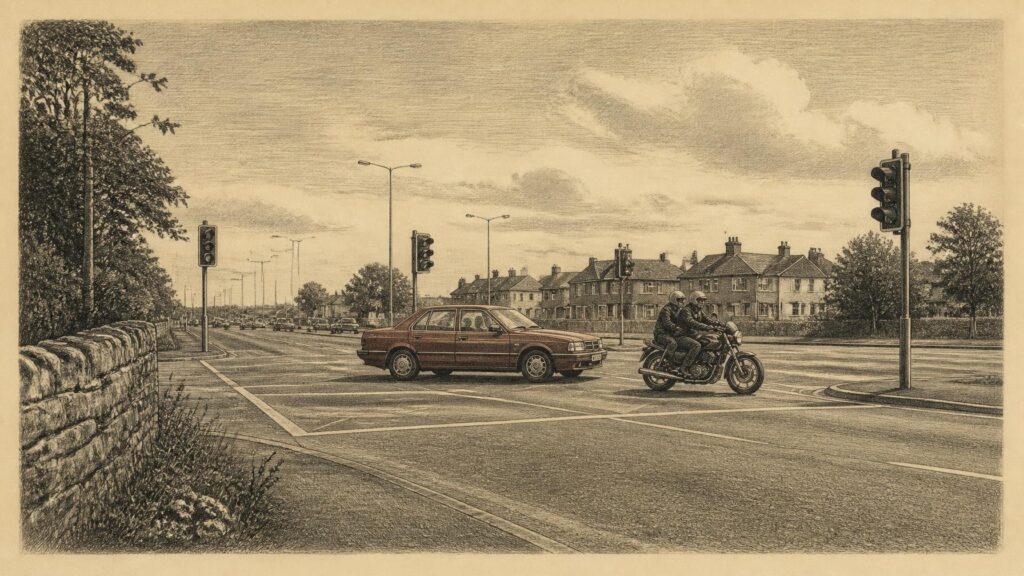
AI generated historical illustration, not a contemporary photograph.
At a Glance
Thirty years after Veronica Guerin was murdered on 26 June 1996, the event retains a grave and unsettled place in Irish history. Her killing at traffic lights near Newlands Cross was an assault on a working journalist, but it was also understood at once as a public challenge: could organised criminal power intimidate the press, dictate public life, and expose the limits of the State? The answer fashioned in the months and years afterwards was consequential, though neither simple nor complete.
Thirty Years
The thirtieth anniversary falls on 26 June 2026, a date which invites more than the familiar image of an exceptionally courageous reporter cut down by gangland violence. Guerin’s life, her working methods, the political climate of mid nineteen nineties Dublin, the prosecutions that followed, and the institutions created in the aftermath all deserve scrutiny in their own right. Commemoration can turn difficult lives into neat legends. History must instead preserve complexity: the fear in which she worked, the professional arguments surrounding her methods, the enormous public response to her death, and the distinction between what courts established and what has subsequently passed into popular certainty.
Her murder was not Ireland’s first experience of political or criminal violence. It was, however, the first murder of a journalist in the Republic, and its symbolism was immediate. A reporter who had made organised crime visible was killed publicly, in daylight, as she drove home from Naas. The setting mattered. This was not a secret disappearance or an obscure underworld settling of accounts. It was a deliberate, conspicuous act in the everyday traffic of the capital’s western approaches. The shock derived partly from the manner of the killing and partly from an apprehension that the violence associated with illegal drug markets had acquired a confidence and reach that could no longer be treated as peripheral.
The anniversary also comes after three decades in which the language of Guerin’s legacy has often been compressed into a single phrase: that her death led to the Criminal Assets Bureau. The connection is real and substantial, but it is not the whole story. Legal proposals concerning criminal proceeds had existed before she died. Her killing, together with the murder of Detective Garda Jerry McCabe earlier that June, supplied extraordinary political urgency and public force. The resulting measures were not a magical cure for organised crime, nor were they solely the product of one tragedy. They nevertheless marked a significant change in the Irish State’s willingness to pursue illicit wealth as well as individual offenders.
Early Formation
Veronica Guerin was born in Dublin on 5 July 1958, not 1959 as some later accounts stated. The Dictionary of Irish Biography records her upbringing in a family of five children, her education at Holy Faith, Killester, and a diploma in marketing management from the Dublin Institute of Technology. Before journalism she had worked in the Irish League of Credit Unions and in her father’s accountancy practice. She was also active in Fianna Fáil circles, becoming involved in Ógra Fianna Fáil and working as a researcher and public relations adviser. These earlier experiences mattered. They gave her political contacts, organisational confidence and familiarity with public argument before she entered a newsroom.
Her route into reporting was unorthodox rather than accidental. After business ventures and public relations work, she contributed to Phoenix and wrote business material for the Sunday Business Post. She joined the Sunday Tribune in 1993. That period produced the interview with Bishop Eamon Casey in Ecuador, secured after the former bishop had left Ireland amid controversy over his relationship with Annie Murphy and their child. The episode made Guerin conspicuous in a competitive media environment. It also demonstrated a characteristic that would become central to her reputation: persistence in reaching subjects directly, rather than waiting for them to consent to conventional interview arrangements.
In January 1994 she moved to the Sunday Independent. Although later remembered almost exclusively as a crime reporter, her interests were wider. She worked on business, political, clerical and paramilitary stories. Yet Dublin’s criminal underworld increasingly became the field with which her name was associated. Her ability to obtain information, to cultivate sources and to seek direct encounters with people who did not want to be questioned gave her columns an immediacy that readers recognised. The same approach brought risks that were increasingly impossible to separate from the work itself.
It is tempting to describe Guerin as a born journalist and leave it there. The evidence suggests something more particular. She came to reporting after work in politics, business and public relations, and brought a forceful, highly personal manner to a press culture in which such visibility could attract both acclaim and criticism. Her supporters saw a reporter prepared to go where others would not. Her critics, including some fellow journalists, questioned whether a conspicuous, confrontational style could compromise safety or professional judgement. Those disagreements did not make her responsible for the violence directed at her. They do, however, form part of the historical record and explain why the story of Guerin cannot be reduced to an uncomplicated civic fable.
Journalistic Method
Guerin reported at a moment when public concern about drugs and crime in Dublin had deep roots, especially in communities affected by heroin use, poverty and intimidation. Organised crime was not a novelty, but it had become a potent subject in the press and popular imagination. Figures such as Martin Cahill had already acquired notoriety. The danger in such reporting was that gangland could become theatre: a realm of nicknames, rumour and semi mythological reputations. Guerin’s best work sought to connect personalities to money, influence, threats and the human costs of criminal enterprise.
Her method often involved approaching alleged criminals and their associates in person. This was not simply bravado. It was a means of testing claims, seeking replies, and making clear that the people who profited from crime were not beyond public attention. But it also placed her in close physical proximity to men who had reputations for violence. The distinction is important. A journalist does not forfeit protection because she works boldly, nor does courage eliminate the practical question of how employers, police, colleagues and public institutions should respond when threats become evident.
Archive material recorded by RTÉ in 1995 captures the force of her public position. Speaking after she had been shot in the leg, Guerin argued that crime reporting was necessary because it compelled political attention. She also spoke of the need for education and alternatives to crime in city communities. That element of her view is sometimes lost beneath retrospective celebration of an individual crusader. Her account did not imagine criminality merely as the work of a few monstrous characters. It acknowledged wider social conditions while insisting that violent and wealthy offenders should not be shielded from scrutiny.
Her working life also illustrates the precarious boundaries of Irish journalism at the time. She was employed by a large newspaper but had entered the profession outside the more conventional route of newsroom training and gradual promotion. Her name became part of the story. This could amplify a report’s impact, yet it also made her unusually identifiable to enemies. The task of historical judgement is not to declare that she was either flawless or reckless. It is to recognise that a press culture which rewards exclusives and personality can leave individual reporters carrying an intolerable portion of the danger generated by public interest reporting.
Rising Danger
The threats against Guerin were neither vague nor imaginary. In October 1994, shots were fired through the front window of her home. On 30 January 1995, a gunman shot her in the leg at her house. RTÉ archive reporting and the Dictionary of Irish Biography preserve the sequence as evidence of an escalating campaign of intimidation. After the shooting she publicly declared that she would not be intimidated. Such statements were rightly admired, but the chronology also raises difficult questions about protection. A Garda escort was provided for a time, but Guerin sought its removal because it impeded the direct reporting on which she relied.
That decision has sometimes been treated as the decisive proof of personal fearlessness or, less generously, as evidence of fatal carelessness. Neither conclusion is sufficient. A permanent escort might reduce one danger while making confidential meetings, source cultivation and ordinary reporting impossible. The choice belonged within a broader failure of circumstances: a journalist who had already been attacked in her home and shot in the leg was continuing to work in a world where threats, information, police intelligence, private fear and commercial journalism intersected. Responsibility for her murder rests with those who planned and carried it out, not with the victim’s determination to continue working.
In September 1995 Guerin went to the home of John Gilligan to ask about the source of his income. The Dictionary of Irish Biography records that she was assaulted and that threats were made against her son. She later brought assault charges. The reported threats against a child added another cruel dimension to the pressures upon her. They showed that intimidation was designed not merely to silence an individual journalist but to make reporting incompatible with family life. It is one reason why her death was received as a public injury: the criminal message was understood to be directed at other reporters as well.
There is a tendency in anniversary accounts to make every warning appear to point inexorably towards the final attack. Historical life does not feel inevitable while it is being lived. Guerin continued to publish, to pursue leads, to defend her work and to negotiate the daily hazards of reporting. Colleagues, family, Gardaí and editors acted with information that was incomplete and changing. Looking back, the sequence is terrifyingly clear. At the time, the extent of the conspiracy and the precise timing of the final attack were not known to the people trying to protect her.
Fatal Afternoon
On Wednesday 26 June 1996, Guerin attended Naas District Court in County Kildare in connection with a motoring matter. As she returned towards Dublin shortly before one o’clock, her red Opel stopped at the traffic lights at the junction of the Naas Road and Boot Road near Newlands Cross. A motorcycle drew alongside. The pillion passenger fired six shots into her car. Guerin died almost immediately. The essential circumstances were established in the later criminal proceedings: two helmeted figures on a motorcycle, a firearm, six bullets, and a deliberate killing at a public road junction.
The brutal clarity of those facts has often encouraged retellings filled with cinematic detail. Some details are well documented in judicial accounts; others have grown through books, documentaries, films and repeated reporting. The responsible historical position is to hold to the evidence. Brian Meehan was convicted in 1999 of murder after the Special Criminal Court found that he drove the motorcycle from which the gunman fired. His appeal against that conviction was dismissed by the Court of Criminal Appeal in 2006. The identity of the person who fired the weapon was not established by a murder conviction. That distinction matters, particularly where public memory has often repeated assertions as though all were judicial findings.
The first response was one of grief, anger and astonishment. RTÉ’s contemporary archive preserves statements from family, colleagues, politicians and trade union representatives. Taoiseach John Bruton described the murder as an attack on democracy. The Dáil observed a minute’s silence. The National Union of Journalists and editors framed the killing as an assault on press freedom. These phrases were not empty ceremonial language. They identified the wider significance of killing a reporter whose work concerned the very people suspected of exercising violent influence outside lawful authority.
Within days, books of condolence drew members of the public, and the country observed a minute’s silence for Guerin and Detective Garda Jerry McCabe, murdered on 7 June during an attempted robbery in Adare. The conjunction of the two killings intensified the national sense of disorder, though their circumstances were different. It would be misleading to collapse them into one event. Yet together they altered the political atmosphere. The State faced public pressure to demonstrate not simply sympathy, but capacity.
Public Shock
Public shock is sometimes dismissed as an emotional episode, distinct from serious politics. In 1996 it became a political fact. Guerin’s death focused attention on organised crime, Garda resources, drug trafficking, witness intimidation, bail, the right to silence and the visible wealth of suspected criminals. The Dáil was recalled for a special debate on crime on 25 July. Government measures were proposed and enacted with unusual speed. The killing had exposed a gap between the public’s expectation that the State could control violent criminal networks and the apparent difficulty of doing so through existing institutions.
That response must be viewed critically as well as sympathetically. The historian cannot assume that every measure adopted in an atmosphere of outrage was necessarily wise, proportionate or caused solely by the murder. Academic analysis of Irish penal policy has described 1996 as a pivotal punitive moment, when heightened fear of crime and intensive media coverage helped drive major legislative and institutional changes. The same scholarship cautions against imagining that the country had suddenly discovered crime in June 1996. Problems of drug markets, deprivation, policing and criminal violence had developed over years.
Guerin herself had spoken about social alternatives as well as enforcement. Her legacy has therefore been invoked by people with different political emphases: advocates of stronger policing and asset seizure, defenders of independent journalism, campaigners against drug harm, and those who emphasise the need for prevention and community investment. None owns her memory outright. The historical record supports an understanding of her as a reporter who believed publicity could force public action, but it does not permit certainty about how she would have judged every later policy made in her name.
The public reaction also changed the status of journalists’ safety. Irish reporters had long covered paramilitarism, corruption and criminality, but Guerin’s murder demonstrated that domestic organised crime could target a journalist openly. The point was later reinforced, in a different political context, by the murder of Lyra McKee in Derry in 2019. To remember Guerin is therefore not only to remember a past crime. It is to recognise the continuing vulnerability of those whose work makes violent organisations and powerful interests visible.
Legal Record
The legal aftermath was extensive, difficult and at times frustrating. The Garda investigation was vast and produced arrests, intelligence and prosecutions connected to drug trafficking and firearms. Yet the murder case demonstrated the hazards of relying on accomplice evidence within violent criminal networks. Witnesses may have knowledge, but they may also have motives to minimise their own role, settle scores, seek protection or reshape accounts in light of changing advantage. Courts must test such testimony rigorously, even when public desire for a conviction is overwhelming.
Paul Ward was convicted in 1998 as an accessory before the fact to Guerin’s murder and sentenced to life imprisonment. In March 2002 the Court of Criminal Appeal quashed the conviction and set aside the sentence. The court concluded that the accomplice evidence on which the case substantially depended was unreliable and that the evidence did not establish Ward’s involvement in planning the crime. This reversal was not a technical footnote. It was an assertion that fair procedures and proof beyond reasonable doubt remain necessary in the most shocking cases.
Meehan’s case followed a different course. Convicted of murder in 1999 and sentenced to life imprisonment, he appealed on issues including accomplice corroboration and mobile telephone evidence. The Court of Criminal Appeal dismissed the appeal in July 2006. A later application to quash the conviction on the basis of alleged new facts was also unsuccessful. Thus the lawful record is clear: Meehan’s conviction stands. It is equally important not to expand that record beyond what it says. A conviction of the motorcycle driver does not make every subsequent claim about all participants, planners or the gunman an established fact.
John Gilligan was tried in 2001 on a charge of Guerin’s murder and firearms offences. The Special Criminal Court found him not guilty of those charges, while convicting him on serious drug offences. He received a twenty eight year sentence for importing cannabis resin, and his appeal against those convictions failed. The acquittal on murder is not erased by public suspicion, media narrative or the moral certainty felt by many observers. In historical writing, an acquittal must be stated plainly. Courts are concerned with proof of particular charges; their findings do not necessarily settle every question asked by the public, but they define what may honestly be called established in law.
This incomplete resolution explains the title of an unfinished reckoning. Guerin’s killers did not achieve the silence they sought. The investigation dismantled or disrupted important criminal operations and transformed public policy. Yet the criminal proceedings did not produce a complete judicial account of every role in the murder. That is not an invitation to fill the gap with folklore. It is a reason to preserve the boundary between evidence, inference and allegation.
Legislative Roots
The Criminal Assets Bureau is the most visible institutional legacy associated with Guerin’s murder. Established on 15 October 1996 under the Criminal Assets Bureau Act 1996, it brought together Garda personnel, Revenue officials, social welfare expertise, legal staff and financial investigators. Its purpose was to deny and deprive criminals of assets obtained through criminal conduct. This multidisciplinary design was significant. Rather than treating organised crime solely as a matter for conventional criminal prosecution, the Bureau pursued wealth through civil, tax and social welfare mechanisms.
Its origins, however, predate June 1996. The Law Reform Commission’s 1991 report on confiscation of the proceeds of crime had already recommended stronger powers, including restraint measures capable of freezing assets before trial. The Criminal Justice Act 1994 had addressed confiscation and restraint in particular circumstances. The Proceeds of Crime Act 1996, enacted on 4 August, enabled the High Court to make interim, interlocutory and disposal orders in relation to property that constituted the proceeds of crime. The later Bureau Act supplied the specialised institutional machinery. Guerin’s murder was therefore a catalyst, not the sole intellectual beginning of the policy.
This distinction strengthens rather than weakens the account of her legacy. Public tragedies often accelerate measures that have been discussed for years but lacked political momentum. The killings of McCabe and Guerin made it impossible for government to defer the question of how the State should confront conspicuously wealthy criminal networks. The legislation was shaped by earlier legal thought, but the atmosphere of June and July 1996 gave it exceptional urgency. Contemporary political debate, government statements and later Bureau accounts all recognise that relationship.
Thirty years later, the Bureau reports that more than €251 million has been returned to the Exchequer since its establishment. Such figures should not be used to suggest that organised crime has been defeated. Criminal markets change, and the Bureau itself describes an evolving task. Yet its endurance demonstrates the importance of the institutional response. Guerin’s memory is attached not only to a roadside memorial or annual tribute, but to a continuing state practice: following money, testing unexplained wealth through lawful process, and seeking to deny criminal networks the status and protection that visible assets can confer.
Enduring Memory
Guerin has been remembered through journalism awards, union commemorations, a memorial at Dublin Castle, documentaries, books and films. Such memorial forms have introduced her to generations too young to remember 1996. They have also simplified events. Dramatic storytelling favours the lone hero, the identifiable villain and the final vindication. The actual history is more resistant. Guerin was a highly individual reporter, but she worked among colleagues and sources; she faced danger, but not in isolation from institutional choices; her death produced major change, but not a final victory over organised crime.
Folklore enters this story at several points. It includes the confident naming of an unconvicted gunman, the assertion that every legislative reform appeared from nowhere after the shooting, and the claim that one person’s reporting single handedly transformed the country. Such narratives arise because the murder was emotionally overwhelming and because uncertainty is difficult to bear. They should be acknowledged as part of public memory, but not mistaken for documentary proof. The verified record is compelling enough: a journalist was repeatedly threatened, attacked and ultimately murdered; one man remains convicted of murder; a major drug investigation followed; and the State created lasting mechanisms aimed at criminal wealth.
Her career also continues to provoke a useful question for journalism. How should the press report criminality without glamorising it, exposing sources, endangering reporters or converting public service into personal performance? There is no answer that retrospectively secures Guerin’s safety. But the question belongs to her inheritance. To honour her merely by praising courage is inadequate if news organisations, public authorities and audiences do not also confront the structures that make courageous work dangerous.
Historical Judgement
Veronica Guerin’s place in Irish history rests on facts that require no embellishment. She was an Irish journalist who entered the profession by an unusual route, developed a distinctive and combative reporting style, investigated organised crime under conditions of escalating threat, and was murdered in public on 26 June 1996. Her death shocked the country, became a defining moment in discussion of press freedom and crime, and helped energise a far reaching state response.
The anniversary should also preserve what remains unresolved. Courts supplied important findings, but not a total account of the conspiracy. Legislation changed the tools available to the State, but did not abolish criminal markets or social harm. Commemoration has kept Guerin’s name alive, but sometimes at the cost of reducing a complicated reporter to a flawless icon. A mature remembrance makes room for admiration without evasion. It honours her family’s loss, respects the law’s limits, and recognises the continuing duty to protect journalists who ask dangerous questions.
Thirty years on, the deepest meaning of Guerin’s story may be that democratic institutions are tested not only by great constitutional crises, but by whether ordinary public life can proceed without violence silencing scrutiny. At Newlands Cross in 1996, organised crime attempted to make a journalist’s work too dangerous to continue. The subsequent response showed the capacity of Irish society to refuse that demand. Its imperfections are part of the truth. So is its enduring resolve.
The article’s distinction between courtroom findings and later mythology is especially important, because Veronica Guerin’s public legacy has often merged courage, unresolved criminal responsibility and the creation of the Criminal Assets Bureau into a single narrative. Its account suggests that her murder sharpened political urgency without making enforcement alone an adequate response to organised crime, intimidation or the social conditions surrounding drug markets. Remembering her therefore involves both press freedom and historical judgement. How might Ireland commemorate Guerin in ways that honour her investigative determination while encouraging debate about journalist protection, asset seizure, due process, and community-based crime prevention today?