Trade Bargain1785 CE
In 1785, proposed commercial reforms exposed the limits of Ireland’s post-1782 legislative independence. Thomas Orde’s initial trade bargain, approved in modified form by the Irish Commons, was altered in Britain to require Irish conformity with British navigation and colonial legislation. Opposition led by Henry Grattan and Henry Flood defeated the revised scheme, leaving trade relations unresolved. Debate also highlighted restricted parliamentary representation, while William Drennan’s pamphlet urged Catholic-Protestant reform. Dublin’s Irish Academy was founded, reflecting learned and civic institutions. Richard Crosbie’s balloon flight thrilled Dublin, whereas a balloon-linked fire devastated Tullamore, demonstrating urban vulnerability and contrasting scientific excitement and disaster.
Dateline
In 1785, Ireland’s most consequential public argument concerned trade, but it was also an argument about sovereignty. Three years after the constitutional changes commonly called Grattan’s Parliament had secured a measure of legislative independence for the Dublin legislature, ministers in London and Dublin sought a permanent commercial settlement between the two kingdoms. The proposal promised wider access to markets. Its opponents feared that, in accepting it, Ireland would surrender the practical control over commerce that made parliamentary independence meaningful. The scheme’s failure exposed how narrow the new constitutional settlement remained, while events in Dublin and the provinces revealed a society alert to science, print, civic institutions and sudden urban danger.
Trade and Constitutional Authority
The immediate issue was an unequal trading relationship. Earlier concessions had opened important avenues for Irish commerce, yet Irish producers still faced exclusions and duties in Britain, especially in relation to colonial goods and particular manufactures, while British goods entered Irish markets freely. Irish manufacturers worried about competing with better-capitalised British firms; consumers and traders also operated amid smuggling, boycotts of British imports and commercial uncertainty. These were not merely abstract questions of tariffs. They bore on employment for urban artisans, the prospects of linen, woollen and other manufacturers, and the price and availability of everyday goods.
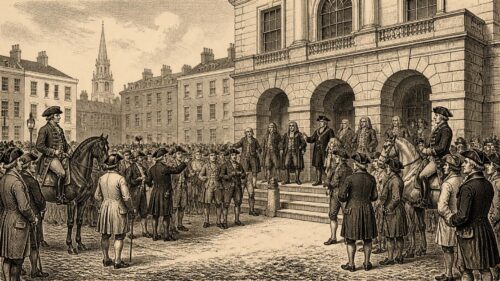
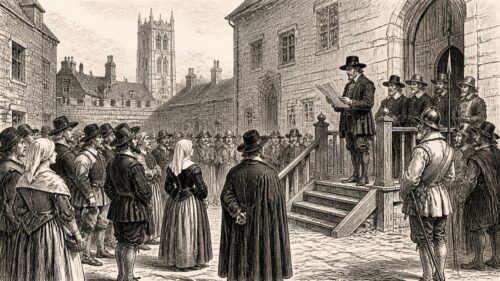
Thomas Orde, chief secretary to the lord lieutenant, the Duke of Rutland, introduced a set of commercial resolutions in the Irish House of Commons in February. The original proposals aimed to remove prohibitions on trade between Britain and Ireland and to align duties. A politically sensitive provision concerned an Irish contribution towards imperial naval expenditure once Irish hereditary revenue passed a specified level and annual revenue matched annual expenditure. Henry Grattan was prepared to support commercial concessions but resisted an open-ended commitment that might drain Irish resources or compromise the legislature’s financial discretion. The Commons passed the revised eleven propositions on 12 February, after the proposed contribution was more tightly qualified.
The apparent agreement did not survive its passage through British politics. William Pitt the Younger’s ministry faced agitation from British mercantile and manufacturing interests, anxious about Irish competition, colonial commerce and the East India trade. The scheme returned in a more extensive set of twenty propositions, passed by the British House of Commons on 30 May. Their crucial innovation was constitutional rather than simply fiscal: in fields touching navigation, colonial trade and aspects of overseas commerce, Ireland would be required to conform to British legislation. What had been presented as reciprocal commercial liberalisation could therefore be read in Dublin as an arrangement by which the Irish Parliament accepted rules made elsewhere.
That distinction transformed the Irish debate. Grattan, who had accepted the principle of the original bargain, now opposed the amended plan. Henry Flood also attacked it, particularly where it might deny Ireland the protective duties available to an industrialising state. Their objections were not a simple rejection of trade with Britain. They argued that a legislature which could not decide the commercial conditions of Irish trade was not fully independent. The controversy demonstrated that the constitutional achievement of 1782 had created expectations as well as limits: Irish politicians could legislate, but the relationship with Britain and the empire still set sharp boundaries around what that power could accomplish.
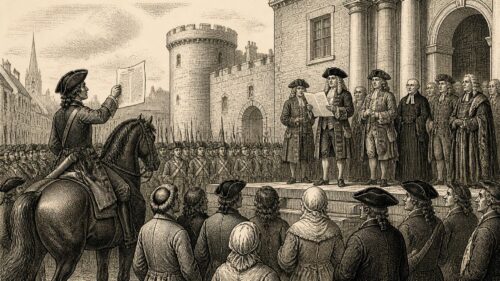
On 12 August Orde sought leave to introduce the revised measure in Dublin as a bill for commercial intercourse on supposedly permanent and equitable principles. The government’s case stressed opportunities for Irish sailcloth, easier access to British materials such as rock salt and bark, and duty-free British coal. Yet the objections proved insuperable. By 15 August the Rutland administration had abandoned the bill after an embarrassing defeat. No comprehensive settlement was enacted. The year therefore ended not with an integrated British–Irish market, but with the commercial and constitutional relationship unresolved.
Representation, Print and Reform
The commercial crisis unfolded beside another unresolved question: who, in practice, did the Irish Parliament represent? It was a two-house legislature of peers, Church of Ireland bishops and a Commons elected through a highly restricted and uneven system. Its new legislative autonomy did not make it a popular parliament in the modern sense. The Volunteer movement, formed during the American war and still influential in political discussion, had pressed for parliamentary reform; the failure of the 1783 Volunteer convention’s reform effort remained fresh in political memory.
In 1785 William Drennan, a Belfast physician and political writer, brought that dissatisfaction into print in Letters of Orellana, an Irish Helot. First published in the Belfast News-Letter and then issued in Dublin, the pamphlet addressed northern counties absent from the 1784 National Assembly of Delegates. Drennan argued that a parliament nominally free of British legislative control still fell short if its representation was distorted. He appealed for a political union of Catholics and Protestants and urged the Volunteers towards reform. This was not yet the programme or organisation of the United Irishmen, founded only in 1791, but it shows that ideas later associated with that movement were already circulating in the year’s pamphlet culture.
Print itself became an unexpectedly contentious part of the commercial negotiations. A proposed British provision on copyright alarmed Irish printers and booksellers, whose trade included inexpensive reprints and exports. Edmund Pery, speaker of the Irish Commons, warned that the measure could destroy the printing business in Ireland without materially assisting Britain. Newspapers carried the dispute, connecting the livelihood of printers, booksellers and readers with the larger question of whether regulations made in London could govern an Irish trade. In 1785, the commerce of books became a vivid instance of how economic policy and legislative authority could not easily be separated.
Learning Takes Institutional Form
Amid political frustration, Dublin gained an institution with a far longer future. The Irish Academy, subsequently the Royal Irish Academy, was founded in 1785 under the presidency of James Caulfeild, earl of Charlemont. Its royal charter followed in January 1786, a distinction worth preserving: the learned society began in 1785, but was not yet chartered in that calendar year. Its intended field was unusually broad, embracing science, antiquities, history and polite literature. In time it would collect manuscripts and objects central to the study of Ireland’s past, but its foundation already expressed the confidence of a Dublin elite that scholarship, experiment and the preservation of antiquities deserved a permanent national forum.
The Academy belonged to an urban world of societies, lectures, newspapers, libraries, printers and cultivated patrons. It did not represent Ireland socially as a whole: education, wealth and institutional influence remained unequally distributed, and the political nation was overwhelmingly Protestant and propertied. Nevertheless, its establishment is firm evidence that intellectual life was being organised in new ways. The same year’s parliamentary record also includes measures relating to infirmaries in Cashel and Queen’s County, the Dublin Foundling Hospital, the Rotunda Hospital and property registration. Such legislation does not describe ordinary experience in full, but it points to a state and civic culture increasingly preoccupied with hospitals, urban administration, charity and the formal recording of property.
Balloon, Fire and Town Life
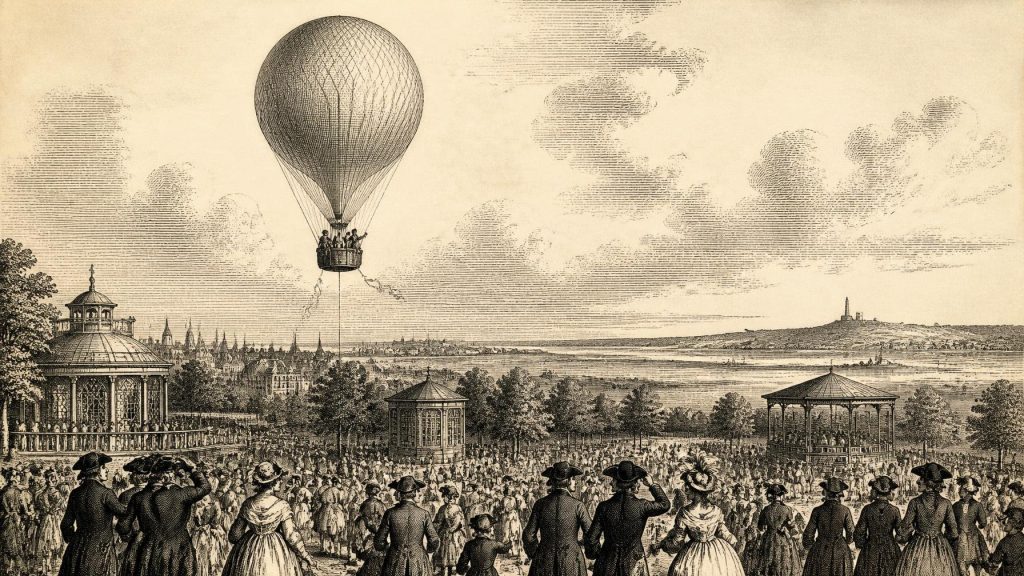
Two balloon episodes gave 1785 an extraordinary public character. On 19 January, Richard Crosbie ascended from Ranelagh Gardens before a crowd reported at more than 30,000 and landed safely at Clontarf. His hydrogen balloon flight is recognised as the first manned flight in Ireland by an Irishman. It was both a scientific spectacle and a commercial entertainment: a highly visible demonstration of the new European fascination with aerial experiment. The journey from fashionable Ranelagh to the north side of Dublin made the city itself the stage on which novelty, engineering and mass spectatorship met.
On 10 May, a balloon experiment in Tullamore ended disastrously when fire spread through the town. Later descriptions commonly associate the catastrophe with a balloon striking a chimney and state that roughly one hundred houses were destroyed, but the surviving contemporary evidence is too limited to treat every detail or total as certain. What is secure is the date, the connection with the balloon craze and the scale of the destruction. Tullamore then contained many combustible thatched buildings; the fire underlined the vulnerability of rapidly developing market towns to wind, flame and dense building patterns. Later observers remembered the town’s rebuilding as a phoenix-like recovery, an image that became part of its civic identity.
Thus 1785 should not be reduced to a failed bill. It was a year in which the Irish Parliament tested the meaning of its independence and refused a commercial arrangement judged incompatible with it. Reformers used newspapers and pamphlets to demand a wider political nation. A learned academy was founded to investigate and preserve knowledge. Ballooning supplied wonder in Dublin and catastrophe in Tullamore. Together, these developments show an Ireland connected to Atlantic and European currents, yet determinedly occupied with its own constitutional, economic and civic future.
Primary Sources
- History of the Commercial and Financial Relations between England and Ireland from the Period of the Restoration
- Ireland’s Role in British Colonial Capitalism: “Men of Capitals” and Pitt’s Irish Proposals, 1784–1785
- British and Irish Politics in 1785
- Proceedings and Debates of the Irish House of Commons: Saturday, 12 February 1785
- A Letter from the Secretary of State to the Mayor of Cork
- Manners, Charles
- Drennan, William
- Letters of Orellana, an Irish Helot
- Crosbie, Richard
- Balloonatics and the Great Fire of Tullamore on 10 May 1785
- From 1785: The Royal Irish Academy
- Royal Irish Academy
- Irish Royal Academy
- About the Royal Irish Academy Publishing
- History of Parliament in Ireland
- Political Developments in the 1780s and 1790s
- Irish Statute Book: Pre-Union Irish Statutes, 1785
- Ecclesiastical Lands Act 1785
- Statute Law Revision Act 2015
- A Chronology of Ireland