Essex Trade1673 CE
In 1673, Lord Lieutenant Essex’s proposed trade report portrayed Restoration Ireland through estimates of land, rents, livestock, housing, goods and scarce circulating coin, privileging taxable wealth over poorer households and local life. English restrictions on cattle imports encouraged exports of processed provisions, wool and fish through Dublin, Cork and Atlantic markets, although benefits were uneven. Essex governed within Protestant political dominance amid English anti-Catholic pressures. Investigation and hostility prompted Archbishop Peter Talbot’s departure for France, while October proclamations targeted Catholic arms, offices, clergy and institutions. Enforcement varied, but Catholic worship became more precarious. Presbyterians retained favour, illustrating selective confessional policy.
Dateline
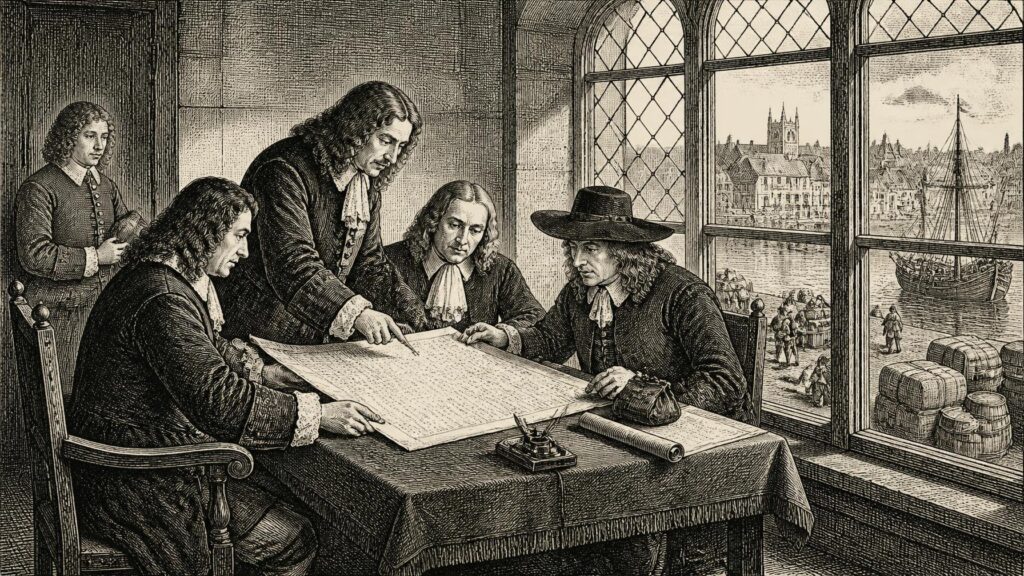
Ireland in 1673 was not defined by a single battle, parliament or royal visit. Its most revealing landmark was instead a memorandum: a proposed report on the state and improvement of Irish trade, dated 25 March. Prepared for the lord lieutenant, Arthur Capel, earl of Essex, it attempted to turn the kingdom into an intelligible balance sheet of land, houses, livestock, goods, ships and money. That exercise of government was never merely economic. It illuminated a country still living with the settlement imposed after the wars of the 1640s and 1650s, dependent on pastoral exports, ruled through a Protestant establishment, and entering a year in which Catholic religious life would again be driven into greater insecurity.
A Kingdom Measured for Trade
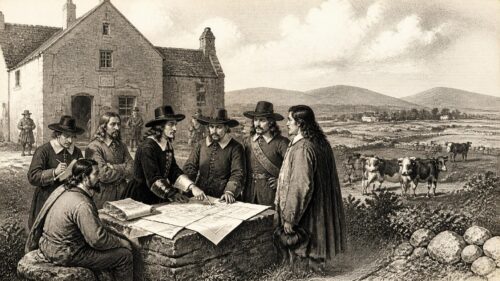
The Council of Trade’s paper offered a striking, if necessarily approximate, survey. It reckoned Ireland to contain about twelve million English acres of arable, meadow and good pasture, with another two million acres of rocky, boggy or scrubby ground considered largely unprofitable. Annual rents were put at £900,000; livestock at £3 million; housing with one or more chimneys at £2.5 million; and corn, household goods, merchandise and shipping together at about £1 million. Coin actually circulating in trade was estimated at only £250,000 to £300,000. Such figures should not be mistaken for a census or a neutral portrait. They were estimates made to guide policy, and their exclusion of cabins without chimneys is itself telling: some of the poorest dwellings, and therefore many of the poorest people, disappeared from this official picture.
Still, the report captures the physical and social geography of Restoration Ireland. Productive land, cattle and other stock outweighed cash. Bog, mountain, rough grazing, lough and strand were treated as obstacles or marginal resources by administrators seeking revenue, although they were parts of lived local landscapes. The paper’s categories also reveal the priorities of a government based in Dublin Castle: taxable rents, saleable commodities, visible houses and maritime commerce mattered more than subsistence, customary access to land, Irish-language society or household labour. It was an Ireland viewed from the state’s desk, but it was a consequential view, because such calculations informed the schemes and regulations by which officials hoped to make the kingdom more profitable.
Pasture, Provisions and Ports
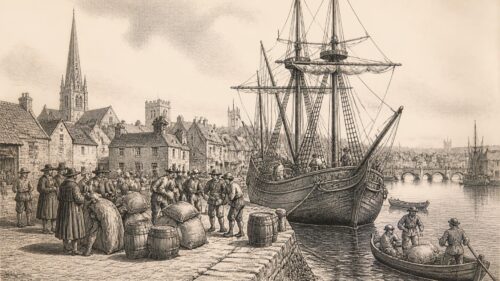
The report appeared in an economy already being redirected by English restrictions on Irish livestock imports. The Cattle Acts of the 1660s had greatly narrowed the English market for live Irish cattle and for certain animal products. By 1673, this was not a new shock but an established condition shaping decisions on farms, estates and quays. Graziers and merchants had reason to seek other outlets. Salted beef, butter, hides, tallow, fish and wool became central to a changing export pattern, while sheep-rearing acquired added importance. The adjustment did not mean that pastoral Ireland ceased to be a cattle country; rather, livestock was increasingly processed, preserved and channelled into provision trades serving foreign ports and Atlantic markets.
Irish merchants were consequently less tied than before to a simple exchange of cattle for English manufactured goods. Dublin’s growing predominance was one outcome of this changing commercial world, but Cork and other ports also connected producers to overseas demand. The gains were uneven. A merchant with access to credit, a ship or a port network stood differently from a tenant farmer, labourer or cottier whose livelihood still rested on wages, seasonal work, a small holding and the local price of food. The official calculation of only a small stock of circulating coin hints at the limits of a cash economy beyond its commercial centres. Much everyday exchange continued through credit, rent obligations, labour and goods rather than ready money.
These economic developments gave 1673 a wider imperial setting. England’s rulers wished Ireland to enrich the Stuart monarchy without becoming an inconvenient commercial rival. Debate in and around government therefore concerned not simply how to improve Ireland, but which improvements were acceptable to England. Competition in wool and provisions could provoke hostility from English interests. Irish prosperity was welcome when it supplied revenue and shipping; it became suspect when it competed too successfully in external markets. Essex’s trade reckoning thus belonged to a relationship in which Ireland was formally a separate kingdom but subject to decisions increasingly made across the Irish Sea.
Essex and the Protestant Interest
Essex had arrived as lord lieutenant in August 1672, succeeding Lord Berkeley. His position in 1673 was powerful but constrained. The lord lieutenant represented Charles II, presided over the Irish executive and dealt with land, revenue, security and religion, yet he depended on royal instructions, networks at court and cooperation from officials and landowners. Essex’s private instructions had allowed room for discretion over Catholic appointments to commissions of the peace and over religious toleration. His personal inclination was comparatively pragmatic. But pragmatism could not remove the structural priority given to the established Church of Ireland and to Protestant control of civic and political authority.
The English political crisis of spring 1673 made that tension sharper. Charles II withdrew his Declaration of Indulgence in March under parliamentary pressure, and the English Test Act received royal assent on 29 March. The Act itself applied to England, Wales, Berwick, the royal navy and specified islands, rather than legislating directly for Ireland. It should therefore not be presented as an Irish statute. Its importance for Ireland lay in the political message and pressure it generated: the retreat from indulgence strengthened demands that Irish government demonstrate its commitment to the Protestant interest. In a kingdom where the large Catholic majority had little secure access to public power, such pressure had immediate human consequences.
Peter Talbot’s Departure
The year’s most clearly documented religious crisis centred on Peter Talbot, the Catholic archbishop of Dublin. Talbot had exercised his pastoral office with unusual openness in the preceding years, holding synods and a visitation, but he was an obvious target once suspicions of Catholic political influence intensified. On 26 March 1673 the English House of Commons called for his banishment. In April, Francis Byrne accused him of exercising foreign jurisdiction and raising money contrary to law. Essex appointed a committee to hear evidence in May. On 8 May, Oliver Plunkett, the Catholic archbishop of Armagh, attended the inquiry as a defence witness.
Talbot had obtained a pass for France in April and left Ireland in June. His departure was not a simple judicial punishment after a completed criminal trial; it was a retreat shaped by administrative investigation, political hostility and the vulnerability of Catholic ecclesiastical authority. Essex also moved against his own chief secretary, Sir Henry Ford, whom he suspected of passing information to Talbot. The episode exposed rivalries within government as well as confessional antagonism. Dublin Castle did not operate as a united machine: officers, churchmen, courtiers and local interests all sought influence, while the actions of one Catholic archbishop could be interpreted through the fears and manoeuvres of Westminster politics.
October Proclamations
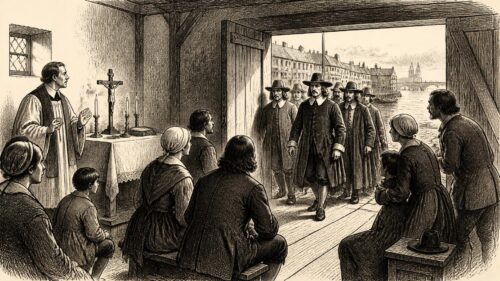
The pressure became more systematic in autumn. From October, proclamations ordered the disarming of Catholics, their removal from civic office, the banishment of Catholic clergy and the suppression of Catholic institutions. An edict dated 27 October ordered priests and religious to leave Ireland. Enforcement was variable rather than total: Essex was not equally zealous in carrying every measure through, and the proclamations were not uniformly executed across the island. Yet that qualification must not obscure their force. They altered the calculations of clergy and lay households, made open worship more hazardous and signalled that accommodation could be revoked by executive order.
Oliver Plunkett’s experience conveys the disruption. In the spring he had spent six weeks travelling through Connacht, continuing the pastoral work that the Catholic hierarchy had rebuilt after the Restoration. A letter of 30 January shows him still concerned with staffing the pulpit and schools of Armagh, appointing the Jesuit Stephen Rice to that work. By the end of the year, however, Plunkett and Archbishop Hugh Brenan had taken refuge in south Armagh. Catholic bishops, priests, members of religious orders, teachers and the families who sheltered them faced renewed concealment and movement. The year did not extinguish Catholic practice, but it ended the relatively public scope available to it in the early 1670s.
Plural Protestant Ireland
Religious policy cannot be reduced to a neat opposition between a Protestant state and a Catholic population. Ulster’s Presbyterian communities, largely connected with settlement from Scotland, were also outside the episcopal Church of Ireland. They had received a royal financial grant, the regium donum, from Charles II in 1672, an acknowledgement of their significance and loyalty despite nonconformity. Its continuation formed part of the background to 1673. The contrast was instructive: the government could show limited favour to Protestant dissenters while moving against Catholic clergy. Confessional identity, political trust and perceived security mattered as much as abstract theology.
No major Irish battlefield belongs securely to 1673. The year’s conflict was instead administrative, economic and devotional: in reports that converted land into value, in regulations that channelled trade, in disputes over office and allegiance, and in proclamations that made religious ministry precarious. Essex’s trade paper and the October measures seem at first unrelated. Together they show how Restoration authority worked. The same government that sought fuller knowledge of pasture, houses and coin also sought a more controllable political and religious order. For many inhabitants, Ireland in 1673 was not an abstract kingdom of rents and commodities, but a place where the reach of the state was felt in markets, parishes, ports, civic offices and the decision of whether worship could safely be conducted in public.

Primary Sources
- The intended Report of ye Councell of Trade to his Excellencie ye Lord Leiut. & Councell of Ireland
- Capel, Arthur
- Talbot, Peter
- Plunkett, St Oliver
- Ford, Sir Henry
- English translation of a letter by Archbishop Oliver Plunkett to Fr Oliva, General of the Society of Jesus
- The Polititians Cathechisme: for his instruction in divine faith, and morall honesty
- CAPELL, Arthur (1632-83)
- Stowe MS 200-217
- Essex papers, 1: 1672-1679
- Economic Trends, 1660-91
- Part 4 of History of the Commercial and Financial Relations between England and Ireland from the Period of the Restoration
- The Anglo-Irish livestock trade of the seventeenth century
- John Locke and Irish Linen Manufacture: A New Manuscript
- Some observations made by W. P. upon the trade of Irish cattel
- Ireland Under the Stuarts, Volume III
- Timeline for Presbyterianism in Ireland
- The Origin of the Regium Donum
- Charles II, 1672: An Act for preventing Dangers which may happen from Popish Recusants
- Religion and belief: Key dates 1604 to 1689
- Catholics and Protestants
- The Commonwealth of Ireland
- The Intrigue to Deprive The Earl of Essex of the Lord Lieutenancy of Ireland