
Ranger Off Carrickfergus1778 CE
In 1778, Captain John Paul Jones’s Ranger captured HMS Drake off Carrickfergus, exposing Ireland’s weak coastal defences amid imperial war. Fear of attack encouraged Belfast’s first Volunteer company and similar locally organised Protestant corps, which later strengthened demands for political and commercial influence. Wartime disruption prompted limited trade concessions, though these fell far short of free trade and intensified Patriot dissatisfaction. Gardiner’s Catholic Relief Act improved property rights for qualifying Catholics but preserved political exclusion and most penal restrictions. Road building, cultivation, mapping and Dublin’s changing streetscape also reflected gradual improvement. Together, these developments revealed mounting pressures for Irish change.
Dateline
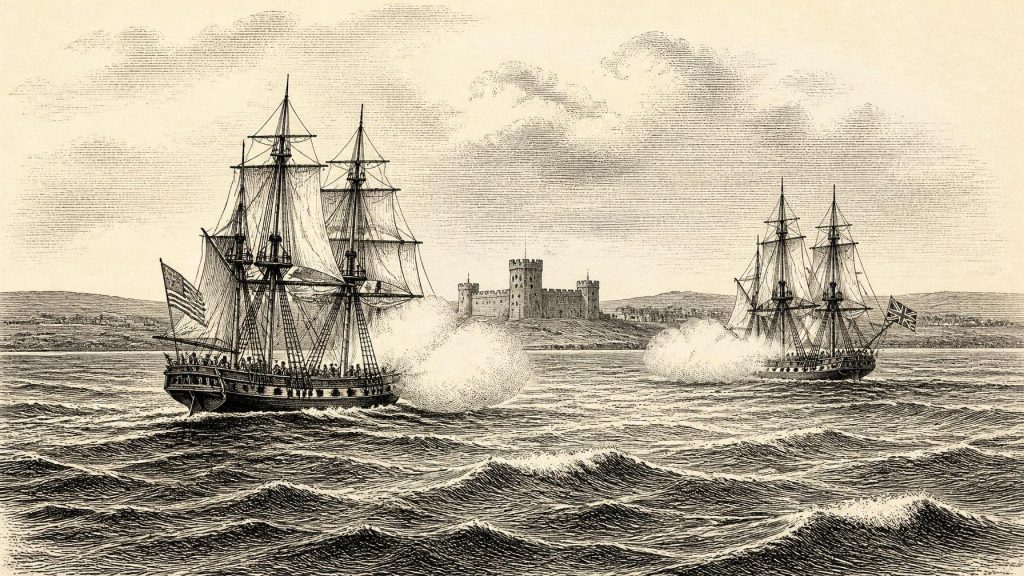
The most sharply dated Irish event of 1778 occurred at sea. On the evening of 24 April, within sight of the Antrim coast, Captain John Paul Jones’s Continental Navy sloop Ranger defeated and captured HMS Drake off Carrickfergus. The clash was brief in the scale of the American Revolutionary War, but its setting made it unusually unsettling for Ireland. A war that had begun in Britain’s North American colonies had reached the North Channel, exposing both the vulnerability of Irish waters and the weakness of the island’s conventional defences.
That vulnerability helped give 1778 its importance. The year did not yet bring the celebrated free-trade settlement of 1779–80, nor the constitutional changes of 1782. It did, however, bring together three developments with large consequences: war in the Atlantic world, the first rapid spread of Irish Volunteer companies, and a significant, though limited, relaxation of the penal laws against Catholics. Ireland remained governed through a Protestant political system closely bound to Westminster, but the pressure points of that system were becoming more visible.
War at the North Channel
Jones had sailed from France in April in the eighteen-gun Ranger, taking the war into waters normally regarded as Britain’s own. France’s alliance with the United States in February, followed by open Franco-British war later that year, transformed the strategic position of Ireland. Its long coastline, valuable harbours and proximity to Britain made it both a potential base and a potential target. Regular troops had already been drawn away from Ireland for imperial service, while coastal communities had reason to fear privateers as well as a major enemy landing.
On 24 April, Jones drew the Royal Navy sloop Drake out from Carrickfergus. After an engagement of about an hour in the North Channel, the damaged British vessel struck her colours. Her commander, Captain George Burdon, was among the dead; other members of her crew were killed or wounded. Jones put a prize crew aboard and continued around Ireland’s west coast before returning to Brest with the captured ship. The action was an American naval success, but for those living around Belfast Lough it was above all a local alarm: an enemy vessel had operated close to a busy Irish port and taken a Royal Navy ship.
The episode should not be exaggerated into an invasion scare caused by one battle alone. Fear of French intervention, the depletion of the garrison and uncertainty in wartime trade were already present. Yet Ranger made those anxieties concrete. Coastal defence was no longer an abstract concern debated in Dublin Castle or Westminster; it was something merchants, shipowners and inhabitants of Ulster could see in the waters beyond Carrickfergus.
Belfast Volunteers Take Shape
Against this background, Belfast became associated with the beginning of a new kind of armed association. The first Belfast Volunteer company was formed on St Patrick’s Day, 17 March 1778, to help protect the town amid apprehension of French attack. Other independent companies followed in Belfast and elsewhere. They were locally organised bodies rather than a normal branch of the regular army: men supplied or helped finance uniforms and equipment, selected officers in some corps, drilled publicly, and built their authority through local connection and display.
The Volunteers began as a response to defence, not as a settled programme for constitutional change. Their immediate usefulness nevertheless gave them political weight. They brought armed, disciplined Protestant inhabitants—especially men of property, commerce and the urban middling ranks—into a public association outside the normal machinery of Dublin Castle. Their parades, uniforms and meetings made loyalty to king and country visible, while also inviting a difficult question: if Irish people organised to defend the kingdom, should they not also have a stronger voice in its trade and government?
That question became more powerful because the Volunteers were not socially or religiously comprehensive. Ireland’s political nation remained restricted. Catholics could not vote in parliamentary elections or sit in parliament, and the House of Commons itself was dominated by patrons, borough interests and the Protestant landed elite. The new corps thus widened political participation for some people while leaving the great Catholic majority outside their ranks and outside the franchise. The ambiguity mattered: the Volunteers could speak in the name of Ireland while reflecting the limits of the Protestant Ascendancy.
Trade Concessions, Not Free Trade
Commercial grievance formed the other major pressure of 1778. The American war disrupted Atlantic markets on which Irish producers and merchants depended. Linen remained Ireland’s principal export manufacture, while food, provisions, hides and other goods moved through ports such as Cork, Dublin, Belfast, Newry and Waterford. But Irish commerce operated within an imperial system designed chiefly in British interests. Long-standing restrictions narrowed direct access to colonial markets and protected competing British manufacturers.
In April, Lord Nugent moved at Westminster for consideration of Irish trade. Lord North’s government accepted that some enlargement was necessary, and measures passed that year offered useful but limited relief. Irish-built vessels gained recognition for certain purposes as British-built ships; the fisheries received encouragement; and some goods could be exported directly from Ireland to British colonies in America or settlements on the African coast. Irish cotton yarn also received an opening in the British market.
These measures fell well short of a general commercial equality. The initial proposals encountered fierce resistance from British manufacturing and mercantile interests, and the legislation retained important exclusions, including major Irish manufactures. The distinction is crucial. In 1778 Ireland received partial concessions, not the “free trade” later demanded with much greater force. But the disappointment helped persuade many Irish merchants and Patriot politicians that piecemeal favours were inadequate.
Henry Grattan, already an increasingly prominent Patriot MP, registered concern at the condition of the economy during the 1777–8 parliamentary session. He was not yet leading the famous parliamentary struggle of the following year, but he understood quickly that the Volunteers might become a useful source of leverage. The alliance was still forming: commercial discontent supplied an issue, volunteer organisation supplied visibility and confidence, and the international war supplied urgency.
A Limited Catholic Relief
The year also brought a carefully framed change in the legal position of Catholics. The Irish Catholic Relief Act, often called Gardiner’s Act after the MP Luke Gardiner, received royal assent on 14 August 1778; its provisions operated from 1 August. Its preamble praised the “peaceable behaviour” of Catholic subjects and presented relief as conducive to the kingdom’s prosperity and strength. The language was telling. Reform was justified less as equality than as prudent government in wartime.
The Act allowed Catholics who took the prescribed oath and declaration to take long leases—up to 999 years, or terms based on lives—and enabled them to inherit, devise and transfer qualifying property on substantially the same terms as Protestants. It also removed the old device by which a Catholic’s eldest son could secure the family estate by conforming to Protestantism. For Catholic families with capital, leases and inheritance, these were meaningful gains: they made longer-term improvement, investment and family planning more secure.
Its limits were equally real. The Act did not grant the parliamentary vote, admission to parliament or full equality in public life. It did not end the penal system, and its benefits depended on legal qualifications and economic means beyond the reach of many poor tenants and labourers. Nevertheless, it marked the first substantial Irish statutory relief of the later eighteenth century. The succession of Hugh O’Reilly as Roman Catholic bishop of Clogher on 28 March also illustrates the continuing institutional life of a church which, despite legal disabilities, retained clergy, diocesan organisation and a large lay population.
Roads, Fields and Changing Landscapes
Military danger and parliamentary argument did not define everyday life everywhere. A report associated with Charles Vallancey’s 1778 work in west Cork offers a valuable, if impressionistic, view of regional change. Vallancey described more carriage roads between Cork and Bantry than he had known two decades earlier, cultivation climbing hillsides, bog margins being reclaimed, valleys producing corn and potatoes, and mountains carrying black cattle. His phrase that the southern coast from Skibbereen to Bandon appeared “one continued garden” should be read as an observer’s flourish, not as a statistical survey. Even so, it records intensifying cultivation, road building and the growing importance of the potato in a changing rural economy.
That same year George Taylor and Andrew Skinner published their road map of Ireland, dated 13 November. Such mapping did not create roads, but it reflected a country increasingly understood through routes between towns, markets, estates, ports and military points. Grand juries funded much county road and bridge work through local taxation; travel remained slow and uneven, especially in mountainous or boggy districts. Yet the network was expanding, connecting produce to ports and making the movement of soldiers, news, printed matter and political ideas more practicable.
An Old Tower Comes Down
Dublin provided a small but evocative sign of change in 1778. The damaged round tower beside St Michael le Pole’s church, near Dublin Castle and the Dubh Linn from which the city took its name, was taken down for safety after a severe storm had weakened it in 1775. Its precise early-medieval origins had long invited speculation. Its removal was not a national political event, but it showed an eighteenth-century capital remaking inherited spaces according to safety, improvement and urban utility.
By the close of 1778, then, Ireland had not been remade. Its parliament remained restricted, its Catholics remained politically excluded, and its trade remained constrained. But the year had supplied a memorable naval warning off Carrickfergus, a new voluntary military movement rooted in Belfast, an incomplete opening in commerce, and a first substantial relief measure for Catholics. These were not separate stories. Together they revealed an island drawn more deeply into imperial war, while acquiring new means to argue that Irish security, prosperity and public life required change.
Primary Sources
- Ranger I (Sloop)
- Ranger vs HMS Drake
- Battle Between USS Ranger and HMS Drake, April 24, 1778
- Captain John Paul Jones, Continental Navy, to Lieutenant Elijah Hall, Continental Navy, May 7, 1778
- Meeting Ireland's Terms
- The American War and Free Trade
- The Belfast Letters, the Irish Volunteers 1778–79 and the Catholics
- 1778–82: Volunteering Ascendant
- Parading Culture: Parades and the Construction of Protestant Identity in Ulster, 1688–1914
- Gardiner, Luke
- Grattan, Henry
- Yelverton, Barry
- An Act for the Relief of His Majesty's Subjects of this Kingdom, Professing the Popish Religion
- The Catholic Relief Act, 1778
- Sir John Dalrymple and the Origins of Roman Catholic Relief, 1775–1778
- Pre-Union Irish Statutes
- General Vallancey's Survey of the South of Ireland, ca. 1777–1790
- Vallancey's Military Surveys of 1776–1777 and 1796 as Relating to County Kilkenny and its Immediate Environs
- A New and Accurate Map of the Kingdom of Ireland from Actual Surveys
- Poor Law Unions and their Records
- St Michael le Pole's Parish Church
- Grattan's Parliament
- Background: Chronology of Key Events 1169 to 1799