
Year by Year
Explore Year by Year articles from the most modern historical year back to the oldest.
3,307 Articles Archived

Derryvree Stratum
Archived: 21 September 2026
The modern label 30,992 BCE cannot identify a precise Irish event, but overlaps the calibrated range of BIRM-166, a freshwater deposit at Derryvree, County Fermanagh. Sediments between tills show a locally ice-free MIS 3 interval, with treeless, sedge-rich wetland, pools, bogbean, mosses and cold-adapted insects. Ireland’s climate and ice cover varied regionally before the Last Glacial Maximum; Crag Cave records milder episodes. Castlepook Cave fauna demonstrates cold-stage reindeer, mammoth, giant deer, predators and lemmings, though deposits are not contemporaneous. A possibly cut-marked reindeer bone suggests, but cannot prove, human presence. Glacial erosion and disturbance limit conclusions; settlement evidence is absent.

Pleistocene Grazers
Archived: 21 September 2026
About 30,993 BCE, Ireland lay within the unstable later Marine Isotope Stage 3, not a precisely recoverable historical year. Derryvree, County Fermanagh, preserves an ice-free freshwater wetland between glacial advances, indicating cold, treeless tundra with mosses, sedges, aquatic plants, insects and seasonal grazing. Castlepook Cave, County Cork, contains mammoth, reindeer, giant deer and predators, demonstrating a variable mammoth-steppe fauna before the Last Glacial Maximum. A marked reindeer femur may indicate brief Upper Palaeolithic human activity, but remains unconfirmed and cannot establish settlement. No evidence supports institutions, agriculture, ritual or enduring population; later ice heavily erased much earlier archaeology across Ireland.

Derryvree Siltbed
Archived: 21 September 2026
Thirty thousand nine hundred and ninety-four BCE is best treated as a broad MIS 3 horizon, not a recorded Irish year. At Derryvree, Fermanagh, freshwater silts between glacial tills, dated roughly 31,700–36,900 years ago, preserve evidence of cold, open, wetland terrain. Other deposits and Kerry speleothems show repeated climatic shifts. Southern caves contain varied cold-stage fauna, including mammoth, reindeer, giant deer, predators and lemmings, though old collections require caution. A possibly cut-marked Castlepook reindeer bone may indicate human activity, but no settlement is known. Advancing ice, altered coasts and erosion made Ireland environmentally unstable and obscured earlier landscapes from view.
Tundra Bryophytes
Archived: 21 September 2026
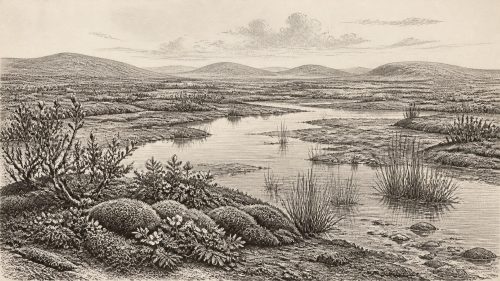
Although 30,995 BCE cannot be treated as a precise Irish historical year, it falls within MIS 3, when climates and ice margins fluctuated. At Derryvree, County Fermanagh, freshwater sediments between glacial tills preserve evidence of a locally ice-free wetland, with tundra vegetation including mosses, aquatic plants, dwarf willow and mountain avens. Castlepook Cave in Cork records diverse Ice Age fauna, though its long accumulated deposits cannot establish contemporaneous animal communities. A possibly modified reindeer bone raises, but does not prove, early human presence. No secure Palaeolithic settlement evidence currently exists. Later glaciation reshaped landscapes and destroyed or buried much evidence.

Milfoil Tundra
Archived: 21 September 2026
About 30,996 BCE, Ireland’s evidence is environmental rather than historical. At Derryvree, County Fermanagh, freshwater silts and organic deposits between glacial tills record a cold, ice-free interval during Marine Isotope Stage 3. Water-milfoil, sedges, mosses, bogbean and dwarf shrubs indicate treeless, muskeg-like tundra wetland shaped by short summers and freezing conditions. Elsewhere, southern cave deposits show intermittent presence of mammoth, reindeer, giant deer and predators. A possibly cut-marked reindeer bone suggests, but cannot prove, human visitation. No secure settlement evidence exists. Changing ice, sea levels and geography governed habitats, preserving only fragmentary traces of Late Pleistocene Ireland at this date.
Avens Wetland
Archived: 20 September 2026
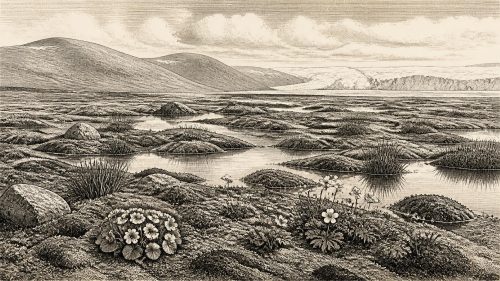
Labelled 30,997 BCE, this period cannot be dated annually and is best understood within later Marine Isotope Stage 3, roughly 33,000 years ago. At Derryvree, County Fermanagh, organic sediments beneath glacial till preserve evidence of an open, periglacial wetland, including bogbean, sedges and mountain-avens. They demonstrate a local tundra ecosystem before later ice advance, not island-wide conditions. Ireland’s ice sheet changed regionally and asynchronously. Southern cave deposits record reindeer, mammoth, giant deer and predators in open habitats. A possibly cut-marked Castlepook reindeer bone suggests fleeting human activity, but lacks corroborating settlement evidence. Its history is environmental change, glaciation and fauna.
Unfrozen Basin
Archived: 20 September 2026
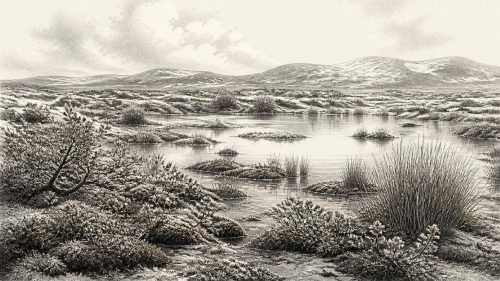
At the notional date of 30,998 BCE, Ireland lay within the climatically unstable later Marine Isotope Stage 3, not a precisely datable historical year. At Derryvree, County Fermanagh, freshwater sediments between glacial tills preserve evidence of an ice-free basin with sedges, mosses, aquatic plants, insects and cold-adapted vegetation. Castlepook Cave, County Cork, records mammoth, reindeer, giant deer, bear and hyaena, indicating wider open-country habitats. A possibly cut-marked reindeer bone offers inconclusive evidence of human activity. No settlements, polities or cultures are securely known. Renewed ice expansion later buried such environments, preceding the Last Glacial Maximum and erasing much earlier evidence.

Marshland Sedges
Archived: 20 September 2026
Around 30,999 BCE, Ireland has no recoverable annual history, only sparse evidence from Marine Isotope Stage 3. At Derryvree, County Fermanagh, freshwater organic sediments between glacial tills indicate a locally ice-free interval within a cold, treeless periglacial landscape of sedges, grasses, mosses, pools and marshes. Castlepook Cave, County Cork, preserves remains of reindeer, mammoth, giant deer and other Ice Age fauna, although its mixed deposits cannot reconstruct a single community. A possibly cut-marked reindeer bone may indicate human activity, but remains unconfirmed. No evidence supports permanent settlement, social organisation or named events; the period is best understood as environmental change.

Disturbed Femur
Archived: 20 September 2026
Around 31,000 BCE, Ireland lacked written records, and archaeological dates remain broad rather than annual. During Marine Isotope Stage 3, the island was entering expansion of the British-Irish Ice Sheet, though conditions varied regionally. Derryvree, County Fermanagh, preserves freshwater silts indicating cold, periglacial tundra wetlands with sedges, mosses and sparse vegetation, but no human occupation. Castlepook Cave, County Cork, contains diverse Pleistocene fauna, including reindeer, mammoth and hyena. A marked reindeer femur may indicate stone-tool butchery, yet its disturbed cave context cannot prove settlement. Evidence supports changing habitats and possible human presence, while leaving population, culture, routes and society unknown.

Intertill Mosaic
Archived: 20 September 2026
Labelled 31,001 BCE only conventionally, this period cannot be reconstructed to a single calendar year. Derryvree, County Fermanagh, preserves freshwater silts between glacial tills, documenting a cold, largely treeless periglacial mosaic of wetlands, aquatic plants, sedges, mosses and sparse open vegetation during an interval between ice advances. Lower sea levels altered surrounding landscapes, while growing ice sheets created variable barriers. Cave fauna, especially at Castlepook, indicates reindeer, mammoth, giant deer and predators in broader cold-stage Ireland. A possibly cut-marked reindeer bone suggests fleeting human presence, but proves neither settlement nor culture. Evidence reveals a changing landscape vulnerable to renewed glaciation.
Some records do not yet have a verified historical year and are awaiting chronological placement.