Derryvree’s Sedgewater Interval30999 BCE
Around 30,999 BCE, Ireland has no recoverable annual history, only sparse evidence from Marine Isotope Stage 3. At Derryvree, County Fermanagh, freshwater organic sediments between glacial tills indicate a locally ice-free interval within a cold, treeless periglacial landscape of sedges, grasses, mosses, pools and marshes. Castlepook Cave, County Cork, preserves remains of reindeer, mammoth, giant deer and other Ice Age fauna, although its mixed deposits cannot reconstruct a single community. A possibly cut-marked reindeer bone may indicate human activity, but remains unconfirmed. No evidence supports permanent settlement, social organisation or named events; the period is best understood as environmental change.
Dateline
There is no event that can responsibly be assigned to Ireland in the single modern calendar year 30,999 BCE. Nobody on the island kept a calendar of that kind, and the archaeological and geological evidence cannot resolve a particular season, much less a named year, so far back in time. The date is best treated as a point within the later Ice Age: roughly 32,948 calendar years before AD 1950, the conventional radiocarbon “present”. It falls within Marine Isotope Stage 3, a long, unstable cold phase before the Last Glacial Maximum. For Ireland, the evidence is sparse, local and sometimes difficult to date; its value lies in showing changing environments rather than supplying an annual chronicle.
A Date Within Broad Ranges
The most useful chronological language is therefore calibrated range rather than apparent precision. A freshwater organic deposit at Derryvree, near Maguiresbridge in County Fermanagh, produced a conventional radiocarbon age of about 30,500 ± 1,100 radiocarbon years BP. Calibration converts such a measurement into a broad calendar-age span, commonly given at approximately 36,900–31,700 calibrated years BP. In BCE terms, that is roughly 34,950–29,750 BCE. The notional year 30,999 BCE sits within that large interval, but it was not dated itself. The deposit records an episode in a changing landscape, not a moment frozen in an Irish historical diary.
This distinction matters because radiocarbon years are not calendar years. Atmospheric carbon concentrations have varied greatly through time, while old samples have measurement uncertainties and deposits may accumulate over generations or centuries. Nor should a date on a bone automatically be treated as a date for a cave layer, an animal population, or human activity. Recent reassessment of older Irish radiocarbon determinations, using improved collagen-extraction methods, has shown how necessary that caution is. Deep-time Ireland is reconstructed by bringing together stratigraphy, pollen, plant macrofossils, insects, bones, landforms and carefully calibrated scientific dates.
Fresh Water Between Ice Deposits
Derryvree is especially important because roadworks exposed fine sand and organic freshwater sediment enclosed between two layers of glacial till. Till is debris deposited by ice. The sequence therefore supplies a robust relative order: glacier ice affected the locality; an ice-free interval allowed water and organic sediment to accumulate; later ice overrode or sealed the site beneath a further till. It is a powerful, if local, record of environmental change in northern Ireland.
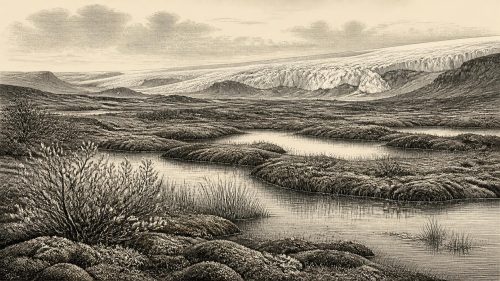
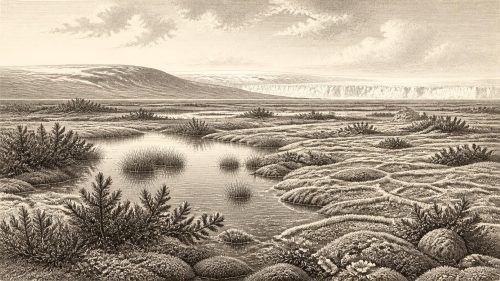
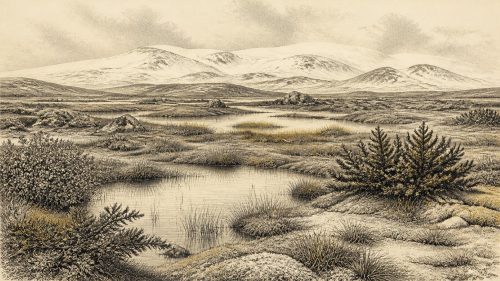
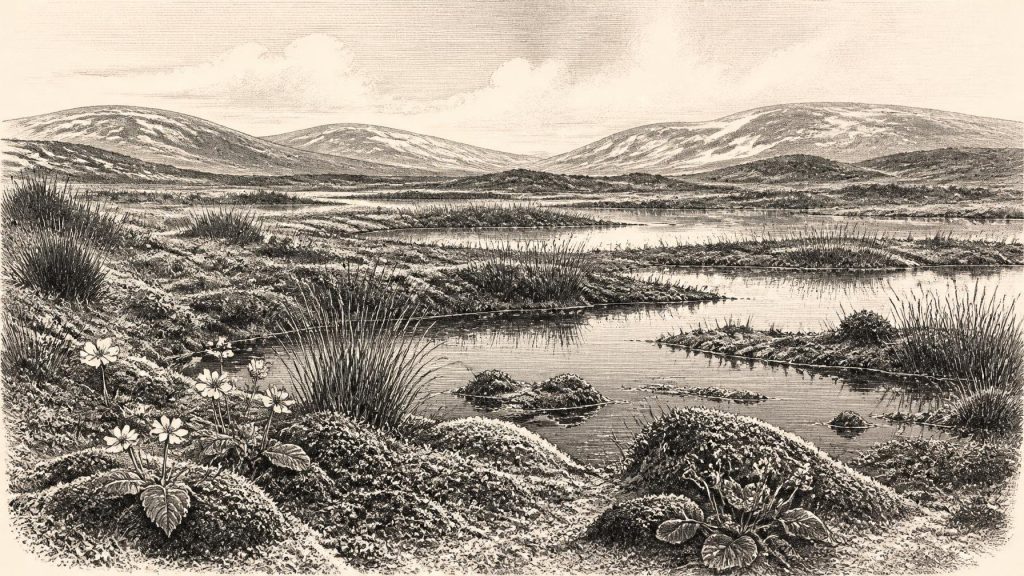
The organic bed preserves a surprisingly detailed ecological assemblage. Pollen, mosses, plant fragments, seeds and insect evidence indicate open, cold, periglacial country rather than forest. Sedges, grasses, hardy herbs and mosses grew around wet ground and shallow water. Finds associated with bogbean (Menyanthes trifoliata) and mountain avens (Dryas octopetala) show that aquatic or waterlogged niches and cold-tolerant vegetation existed together. Such evidence supports a mosaic of pools, marshy margins, frost-affected ground and more exposed mineral surfaces. It does not justify imagining a uniform landscape across all Ireland, nor a permanently snow-covered wasteland.
Seasonality must have been severe. A short growing season could nevertheless have produced a burst of plant growth around water and sheltered hollows, supporting invertebrates and grazing animals. Winter freezing, wind exposure, sparse soils and poor drainage would have sharply constrained productivity. The familiar wooded Ireland of later prehistory was still far in the future. At Derryvree, the most secure picture is of a treeless, biologically active wetland embedded in an austere cold-climate landscape.
An Island Landscape in Transition
Ireland at this time lay within the wider climatic system that governed Britain, the Atlantic shelf and north-west Europe. The British–Irish Ice Sheet was not a static object: its growth, changing margins and later retreat took place over millennia, with different sectors behaving differently. The Last Glacial Maximum, when ice reached its greatest late-glacial extent, came later than the Derryvree interval. Around 30,999 BCE, parts of Ireland may have been ice-free while other districts retained ice or were influenced by advancing glaciers. Existing evidence does not permit a reliable map of the ice edge for this exact year.
Lower sea levels altered coastlines and shelf landscapes, but they do not prove a simple, continuously usable land route for people or animals. The Irish Sea region was shaped by changing ice, water, terrain and climate. The presence of animals in Ireland demonstrates that movements into and within the island were possible during particular periods; it does not identify a route, establish a permanent connection, or show that every species arrived at the same time. Regional change was fundamental, but its detail remains unevenly known.
Caves, Mammals and Uncertain Associations
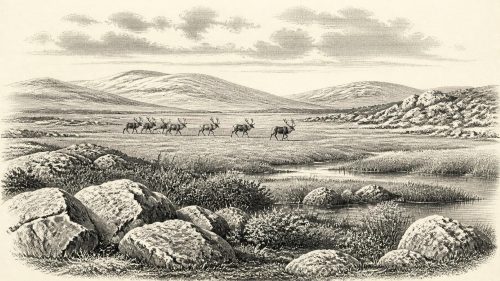
In southern Ireland, Castlepook Cave near Doneraile in County Cork is the principal faunal archive relevant to this broad period. Antiquarian excavations recovered a rich and complex collection including remains attributed to reindeer, giant deer, woolly mammoth, brown bear, wolf, Arctic fox, lemmings and spotted hyaena. Together, these animals point towards episodes when cold-adapted and open-country fauna inhabited or reached Irish landscapes. A mammoth bone from disturbed cave sediment received an early radiocarbon determination of 33,500 ± 1,200 BP, while modern dating work has demonstrated that some Castlepook specimens are substantially older than dates obtained by methods used in the 1990s.
The cave is not a straightforward snapshot of one living community. Carnivores could carry bones in; animals might die in fissures or use shelter; water, sediment movement, excavation and collecting could mix materials of different ages. Cave deposits can therefore reveal which species occurred in Ireland during broad phases, yet still leave uncertainty about whether particular animals encountered one another, or exactly when they occupied the cave. The evidence supports an Irish Ice Age fauna, not a neat scene of mammoths, hyaenas and reindeer assembled on one day.
The Human Question
The question of people is more difficult still. A reindeer femur from Castlepook has been presented in County Cork heritage material as around 33,000 years old and as bearing a deep mark consistent with cutting by a stone tool. If that interpretation is confirmed by further taphonomic study, secure dating and contextual evidence, it could indicate the processing of a reindeer by a small Upper Palaeolithic party during the wider MIS 3 period. It would be an important discovery, because it would extend evidence for human activity in Ireland far beyond the better documented terminal-Pleistocene and Mesolithic record.
But it cannot establish a settled population in 30,999 BCE. No securely associated hearth, stone-tool assemblage, dwelling, burial, food-processing floor or repeatedly occupied campsite of that age has been recovered from Castlepook. The National Museum of Ireland continues to state that clear evidence for human presence in Ireland during the Palaeolithic has not emerged. The responsible conclusion is consequently limited: the marked bone is a significant and potentially consequential item, while its human interpretation and wider implications require continued testing. It is evidence to investigate, not proof of an Irish hunting settlement.
What Cannot Be Recovered
There is no basis for describing political authorities, diplomacy, warfare, named groups, religious ceremonies, learning, art or trade in Ireland at this date. There are no known houses, graves, monuments, workshops or artefact assemblages from which to reconstruct social organisation. Even if occasional hunter-gatherers reached the island, their language, identities, kinship, beliefs and movements remain unknown. Comparisons with Upper Palaeolithic communities elsewhere in Europe can suggest that mobile groups often relied on detailed environmental knowledge and made sophisticated stone, bone and antler equipment; they cannot fill Ireland’s evidential silence with invented local customs.
Similarly, reindeer and other large mammals make seasonal hunting conceivable, but they do not demonstrate an Irish economy. A single possible cut mark cannot reveal whether a carcass was hunted, found, scavenged, killed elsewhere or processed by one person rather than several. It cannot show whether meat, fat, hide, sinew or antler was used, although each was valuable to Ice Age hunters elsewhere. The strongest historical subject for this date is not a kingdom or a battle, but a changing ecological threshold: ice, freshwater, cold-adapted plants and animals, and perhaps a fleeting human trace.
A Landscape Rather Than a Chronicle
Ireland around 30,999 BCE is therefore illuminated by the Derryvree freshwater bed and the Castlepook faunal record, not by year-specific events. Derryvree proves that a cold, open and locally ice-free wetland environment existed during a broad Middle Midlandian interval. Castlepook shows that remarkable Ice Age mammals formed part of Ireland’s longer Pleistocene story, while its marked reindeer bone poses an important but unresolved question about people. Future excavation, direct dating and microscopic analysis may alter the balance of evidence. For now, the honest account is of a harsh but living landscape whose sediments and bones preserve fragments of a past far older than Ireland’s historical memory.
Primary Sources
- The Quaternary of South Fermanagh: Field Guide
- A Reconsideration of the Radiocarbon Dating of the Marine Isotope Stage 3 Fauna from Southern Ireland
- The Irish Quaternary Fauna Project
- New Insights on the Fauna of Ireland’s Younger Dryas and Early Holocene from Alice and Gwendoline Cave, Co. Clare
- First Evidence of a Late Upper Palaeolithic Human Presence in Ireland
- Growth and Retreat of the Last British–Irish Ice Sheet, 31,000 to 15,000 Years Ago: the BRITICE-CHRONO Reconstruction
- Trimlines, Blockfields and the Vertical Extent of the Last Ice Sheet in Southern Ireland
- Oscillating Retreat of the Last British-Irish Ice Sheet on the Continental Shelf Offshore Galway Bay, Western Ireland
- Dublin Radiocarbon Dates II
- Prehistoric Details
- Heritage Artefacts of County Cork
- Archaeology Research Excavation Grant 2022: Castlepook Cave Final Report
- 2022:564 – Castlepook Cave, Castlepook South, Cork
- The Quaternary of the Mayo–Galway Region: Regional Pleistocene Geology
- Quaternary Geology of the Beara Peninsula
- Menyanthes trifoliata
- Dryas octopetala
- Field Guides
- Outreach and Education Resources
- Mesolithic – Iron Age
- First Evidence of a Late Upper Palaeolithic Human Presence in Ireland – Atlantic Technological University Record