Castlepook’s Mammoth-Steppe Archive30993 BCE
About 30,993 BCE, Ireland lay within the unstable later Marine Isotope Stage 3, not a precisely recoverable historical year. Derryvree, County Fermanagh, preserves an ice-free freshwater wetland between glacial advances, indicating cold, treeless tundra with mosses, sedges, aquatic plants, insects and seasonal grazing. Castlepook Cave, County Cork, contains mammoth, reindeer, giant deer and predators, demonstrating a variable mammoth-steppe fauna before the Last Glacial Maximum. A marked reindeer femur may indicate brief Upper Palaeolithic human activity, but remains unconfirmed and cannot establish settlement. No evidence supports institutions, agriculture, ritual or enduring population; later ice heavily erased much earlier archaeology across Ireland.
Dateline
“30,993 BCE” is a modern chronological label, not a recoverable Irish year. No calendar, written record, named community or datable event allows historians to describe this point in time with annual precision. The responsible approach is to place it within a broad archaeological horizon: the later part of Marine Isotope Stage 3, an unstable phase of the Last Glacial Period before the greatest expansion of the last British–Irish Ice Sheet. Around this notional date, Ireland’s history is recorded not in chronicles but in buried silts, pollen, plant fragments, insects, animal bones and the scars left by later ice.
The closest useful chronological anchor is Derryvree, near Maguiresbridge in County Fermanagh. There, a road cutting through a drumlin exposed freshwater silts and fine sands trapped between two thick sheets of glacial till. A conventional radiocarbon determination of 30,500 ± 1,170 radiocarbon years BP was obtained from the organic deposits. Calibration converts this into a broad calendar range, commonly placed at roughly 36,900–31,700 calibrated years BP, or approximately 34,950–29,750 BCE. That range encompasses 30,993 BCE, but it is a span of millennia, not a date for a single season or generation.
A Wetland Between Glaciations
Derryvree is therefore the strongest direct guide to conditions in at least one Irish locality around this remote point in time. Its sediments accumulated during an interval when the site was ice-free, after one advance of ice had laid down till and before a later advance sealed the wetland beneath another. This does not prove that all Ireland was free of ice at once. It proves something more precise and more valuable: in the Fermanagh locality, shallow freshwater, sediment, plants and small animals existed long enough to form a preserved organic record.
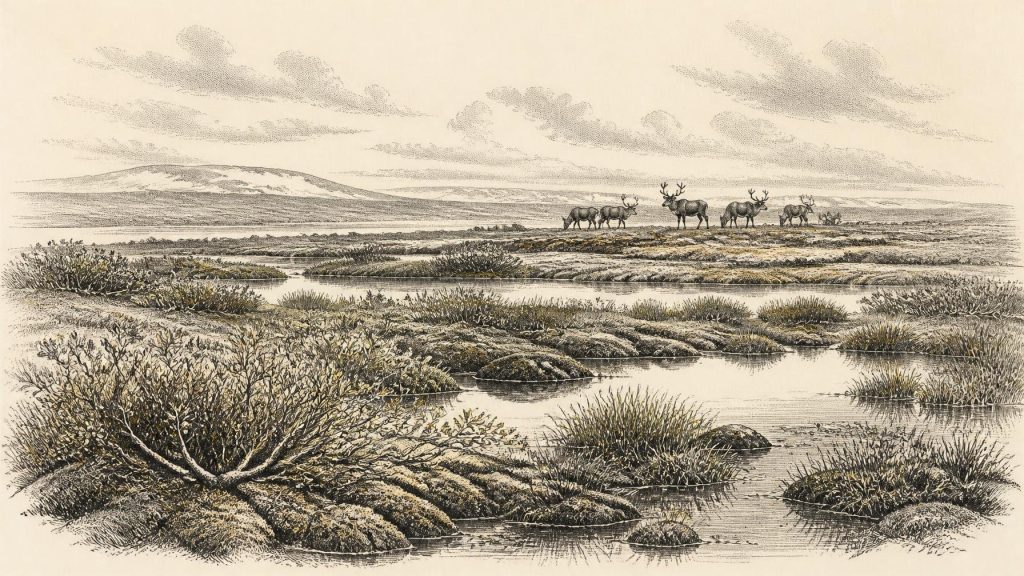
The environmental evidence indicates a cold, open and largely treeless landscape. Mosses, sedges, grasses, herbs and dwarf shrubs were important components of the vegetation. Finds associated with the deposit include aquatic and wet-ground plants such as bogbean and alternate water-milfoil, while dwarf willow, mountain-avens and lesser clubmoss indicate conditions familiar from Arctic or alpine environments. Insects and plant remains point to a muskeg-like mosaic: waterlogged ground, mossy margins, pools and patches of tundra vegetation rather than a uniform frozen desert.
This was not the wooded Ireland later generations would know. Trees, if present anywhere nearby, were not forming a closed forest around Derryvree. Winters were severe, the growing season short, and frost processes would have shaped exposed soils. Yet the organic bed is an important corrective to an image of an entirely lifeless island. Freshwater habitats could support plants, insects and other small organisms even in a harsh climate, while the surrounding open country provided forage for cold-adapted herbivores.
Ice, Water and Regional Uncertainty
At 30,993 BCE the last glaciation was intensifying, but the ice sheet had not yet reached its fullest known extent. Research on the British–Irish Ice Sheet shows that its growth, advance and retreat were regionally variable. Offshore records suggest smaller or fragmented ice masses in parts of the Irish–Scottish region during Marine Isotope Stage 3, while later advances transformed the landscape much more drastically. The maximum phase is generally placed considerably later, around 24,000–20,000 calibrated years BP in Ireland and adjacent seas.
The distinction matters because Ireland should not be imagined either as wholly ice-covered or as a stable, hospitable peninsula. Its geography, coastlines and routes of movement differed greatly from those of today because sea level was lower, but ice, cold seas, shifting river systems and seasonal conditions were formidable constraints. The Derryvree record captures only one local window. Elsewhere, glaciers, bare ground, permafrost-like conditions, river valleys, caves and patches of grassland may have produced very different landscapes over relatively short distances.
The Animals of Southern Caves
County Cork’s Castlepook Cave, near Doneraile, supplies another major body of evidence for this wider period. The cave has yielded remains attributed to mammoth, reindeer, giant deer, brown bear, wolf, fox, Arctic fox, hare, lemmings and spotted hyaena. Modern re-dating has shown that parts of the southern Irish cave fauna are substantially older than earlier radiocarbon programmes suggested. In particular, the Castlepook evidence demonstrates that, before the Last Glacial Maximum, Ireland could at times support a much richer cold-stage mammal community than its modern fauna implies.
These remains should nevertheless be read carefully. A cave bone assemblage is not a census of creatures living together on one day. It may combine animals deposited over long periods, bones moved by water or sediment, material accumulated by carnivores, and remains disturbed by old excavations. At Castlepook, spotted hyaenas are especially significant because hyena activity can bring, break and modify bones in caves. Mammoth, reindeer and giant deer bones establish the presence of large herbivores in the wider regional environment; they do not automatically describe a single herd, hunting ground or seasonal migration route.
Even so, the faunal evidence supports an interpretation of open, productive grazing country in suitable phases. Reindeer and mammoth depended on substantial plant resources, while predators and scavengers could exploit herbivores and carrion. The combination of large grazers, carnivores, freshwater wetlands and exposed ground evokes a variable north-western extension of the wider Ice Age ‘mammoth-steppe’ world. It was an ecosystem of mobility and seasonality, not a settled agricultural landscape.
The Reindeer Femur Question
Castlepook also raises the most intriguing, and most limited, question of human history at this depth in time. A reindeer femur from the cave collection has been reported as bearing a deep linear mark interpreted by palaeozoologist Ruth Carden as a cut or chopping trace made with a sharp stone implement while the bone was fresh. The specimen has been publicly associated with an age of about 33,000 years. If microscopic study and contextual reassessment ultimately sustain the interpretation, it would show that one or more people handled a reindeer in Ireland during the Upper Palaeolithic, far earlier than the island’s formerly accepted human record.
That possibility must not be inflated into a story of a settled population. A radiocarbon date on bone dates the animal’s death within a range; it does not independently date the making of a surface mark. Nor does one modified bone identify the people involved, their language, sex, age, homeland, technology beyond the proposed sharp tool, or the duration of their stay. Castlepook has produced no securely associated hearth, stone-tool assemblage, dwelling floor, burial, artwork or repeated occupation surface from this horizon. The evidence can support a hypothesis of brief human activity; it cannot support a village, tribe, permanent colony or line of descent to later Irish populations.
Society Without Institutions
Accordingly, there is no evidence for political affairs, diplomacy, territorial rule or organised conflict in Ireland around 30,993 BCE. There were no known Irish kingdoms, chiefs, monuments or institutions. Nor can archaeologists responsibly identify a local ethnic group or attach later Gaelic, Celtic or national identities to this period. If people did reach the island, they may have travelled in small, highly mobile Upper Palaeolithic groups, as hunter-gatherers elsewhere in north-west Europe did. But that is a comparative possibility, not a demonstrated social history of Ireland.
The same caution applies to everyday life and economy. There is no evidence here for cultivation, livestock, pottery, metalworking, houses, long-distance trade networks or established exchange centres. A humanly made mark on a reindeer femur, if confirmed, would suggest the practical use of animal resources: meat, marrow, sinew, hide or bone may all be considered possibilities. The surviving evidence cannot choose among them. It does, however, show why large herbivores would have been economically significant to any visitors capable of exploiting them.
Belief, Culture and Learning
No Irish evidence from this period demonstrates religion, ritual, burial practice, symbolic art or formal learning. It would be wrong to infer a belief system from an animal bone or to project the celebrated cave art of France and Iberia onto Ireland. People elsewhere in Europe had developed sophisticated artistic and technological traditions by this broad stage of the Upper Palaeolithic, but an Irish connection remains unproven. Absence of evidence does not prove that no symbolic activity occurred; it means that none has survived in a context where it can be securely recognised.
The principal story of Ireland around 30,993 BCE is therefore environmental change. Derryvree preserves an ice-free freshwater wetland within a cold, treeless landscape. Castlepook preserves evidence of a striking Ice Age fauna and a serious but unresolved question about human intervention. Later glacial advances destroyed, buried and reworked much of the island’s earlier surface archaeology. The result is a fragmentary archive, yet it is enough to replace the old image of a simple, empty prehistory with a more compelling one: an Ireland of tundra pools, mossy ground, large mammals, shifting ice margins and perhaps fleeting human contact at the Atlantic edge of Upper Palaeolithic Europe.
Primary Sources
- A Middle Midlandian Freshwater Series at Derryvree, Maguiresbridge, County Fermanagh, Northern Ireland
- The Irish Quaternary Fauna Project
- A Reconsideration of the Radiocarbon Dating of the Marine Isotope Stage 3 Fauna from Southern Ireland
- Exploring Controls of the Early and Stepped Deglaciation on the Western Margin of the British Irish Ice Sheet
- British–Irish Ice Sheet and Polar Front History of the Goban Spur, Offshore Southwest Ireland Over the Last 250,000 Years
- Early Deglaciation of the British-Irish Ice Sheet on the Atlantic Shelf: Dating the Glenulra and Owenduff Moraines, County Mayo, Ireland
- Timing and Pace of Ice-Sheet Withdrawal Across the Marine–Terrestrial Transition West of Ireland During the Last Glaciation
- Stratigraphic and Palaeo-Geomorphological Evidence for the Glacial-Deglacial History of the Last British-Irish Ice Sheet in the North-Western Irish Sea
- New Insights on the Fauna of Ireland’s Younger Dryas and Early Holocene from Alice & Gwendoline Cave
- First Evidence of a Late Upper Palaeolithic Human Presence in Ireland
- The Origin and Status of the Red Deer in Ireland
- Could Brown Bears Have Survived in Ireland During the Last Glacial Maximum?
- Irish Pleistocene Biostratigraphy
- Pleistocene Vertebrates in the British Isles
- Figure 6.— The Subdivision of the Quaternary Period in Ireland
- Cenozoic: Tertiary and Quaternary
- Heritage Artefacts of County Cork
- Mammoth Cave
- 32564: Castlepook Cave, Ballyhea, Cork
- The Geological Heritage of County Leitrim
- The Mesolithic in Ireland: When Was It?
- Menyanthes trifoliata L.
- Salix herbacea L.
- Selaginella selaginoides (L.) P. Beauv.
- On the Discovery of Hyaena, Mammoth and Other Extinct Mammals in a Carboniferous Cavern in County Cork