
Year by Year
Explore Year by Year articles from the most modern historical year back to the oldest.
3,295 Articles Archived
Ard Monann
Archived: 26 September 2026
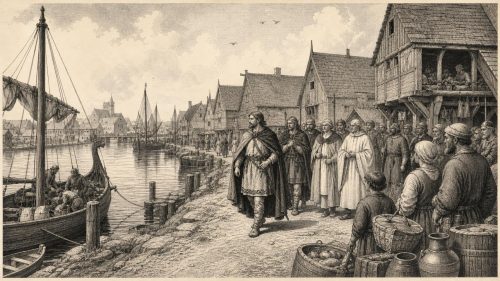
In 1075, Tairdelbach Ua Briain, king of Munster, led a broad coalition northwards seeking hostages from Airgíalla and Ulaid, but his heir Muirchertach was defeated at Ard Monann near Ardee, exposing limits to Ua Briain power. Nevertheless, Tairdelbach secured Dublin after Gofraid's exile and Domnall's brief reign, installing Muirchertach in the commercially and strategically vital Hiberno-Norse city. Annals also record deaths among northern rulers and churchmen, fires at Louth and Clonard, and Dublin's ecclesiastical links with Canterbury. Rural farming, woodland resources and urban craft and trade underpinned political and religious institutions; an abundant mast crop highlighted the economy sustaining them.

Armagh Fire
Archived: 26 September 2026
In 1074, Ireland’s annals emphasised ecclesiastical affairs, dynastic violence and unstable political authority rather than major warfare. Tairdelbach Ua Briain maintained an expanding, but negotiable, supremacy over Munster, Leinster, Dublin and other regions following earlier campaigns. Donnchad Ua Cellaig of Uí Maine and Ragnall Ua Madadáin, heir of Ailech, were killed amid succession struggles. On 6 May, fire devastated Armagh’s churches, bells and settlement divisions. After Bishop Dúnán’s death, Dublin sent Gilla Pátraic to Canterbury, where Lanfranc consecrated him and received his obedience. Clerical deaths across Ireland reveal interconnected churches whose religious, economic and social roles sustained wider local communities.

Bachall Ísu
Archived: 26 September 2026
In 1073, Ireland’s contested kingship was marked by Conchobar Ua Máelshechlainn’s sacrilegious murder beside the Bachall Ísu, followed by conflict in Mide. His severed head was taken from Clonmacnoise to Toirdelbach Ua Briain’s Kincora, then returned with gold. Toirdelbach, expanding after Diarmait mac Máel na mBó’s death, raided Gailenga, killed Brega’s king and demonstrated authority without securing permanent control. Sitriuc son of Amlaíb and Brian Bóruma’s grandsons died on Man. Religious deaths, pilgrimage, and fires at Clonard and Kells highlighted ecclesiastical importance. Annals portray power as dependent on warfare, cattle, alliances, hostages, towns and sacred legitimacy across a divided island.

Diarmait's Death
Archived: 26 September 2026
In 1072 Diarmait mac Máel na mBó, dominant ruler of Leinster, Osraige and Dublin, was defeated and killed at Odba by Conchobar Ua Máelshechlainn of Mide, probably with Tairdelbach Ua Briain’s support. His death shattered a personal network of alliances rather than a unified kingdom. Tairdelbach swiftly raided and secured hostages in Leinster and Osraige, gained Dublin’s submission, and consolidated Munster authority. Annals also record killings among regional rulers and ecclesiastical leaders, illustrating pervasive conflict. Cattle-raiding, captives, hospitality obligations and Dublin’s trade reveal political power’s economic and social foundations. Odba initiated Tairdelbach’s contested pursuit of Irish overkingship in ensuing years.

Shannon Bridges
Archived: 26 September 2026
In 1071, Diarmait mac Máel na mBó’s southern Irish dominance weakened after dynastic losses, while his ally and foster-son, Tairdelbach Ua Briain of Munster, increasingly supplied the military force behind their authority. Tairdelbach took Leinster and Mide hostages for Diarmait, raided midland rivals, and mobilised Munster to build Shannon bridges at Áth Caille and Killaloe, improving strategic communications. Violence, depositions and killings affected Ulaid, Donegal and the midlands. Kildare, Glendalough and Clondalkin were burned amid Leinster instability. Despite warfare, farming, craft production, trade and ecclesiastical learning continued, as Tairdelbach’s infrastructure, diplomacy and campaigns foreshadowed his rising power in southern Ireland.

Leinster Succession
Archived: 26 September 2026
In 1070, Ireland’s fragmented political order was reshaped by dynastic losses, regional expansion and recurrent violence. Murchad, Diarmait mac Maíl na mBó’s heir and Dublin’s ruler, died, while Diarmait’s son Glún Iairn was killed, weakening Leinster’s succession. Tairdelbach Ua Briain of Munster secured hostages in Leinster and eastern Ireland, and Osraige’s king submitted to him. Killings, executions and blinding affected rulers and heirs across Ulster, the midlands and Connacht. Churches remained influential but vulnerable to conflict, notably at Termonn Da-Beóc. Clerical deaths and Clonmacnoise improvements reveal active religious networks. Despite warfare, farming, trade and urban life in Dublin continued there.
Murchad's Raid
Archived: 26 September 2026
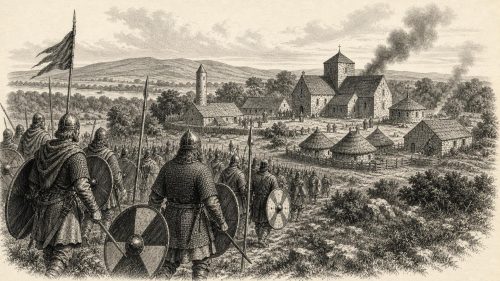
Annals for 1069 record fires, deaths and warfare, while offering only a partial view of Irish society. Diarmait mac Maíl na mBó dominated Leinster and Dublin, where his son Murchad commanded combined forces. Murchad invaded Mide, burning Granard, Fore and Ardbraccan, but suffered severe losses interpreted as saintly vengeance; he died in Dublin in 1070. Fires also damaged Downpatrick, Ardstraw, Lusk and Swords. Clerical and regional rulers died or were killed. Accounts of broken oaths stressed sacred sanctions. Behind annalistic moral judgement lay competing dynasties, vulnerable wealthy churches, rural economies, and Hiberno-Norse Dublin’s commercial, maritime and political power in Ireland.

Tairdelbach's Ascendancy
Archived: 26 September 2026
In 1068, Irish annals portray Tairdelbach Ua Briain’s growing ascendancy amid fragmented regional kingship. His rival cousin Murchad Ua Briain was killed during a raid in Tethba, strengthening Tairdelbach’s control of Munster. An ordinance credited to him promised security sufficient for livestock to remain unprotected at night. Visiting Leinster, he acquired Brian Bóruma’s sword and a Saxon royal standard from Diarmait mac Maíl na mBó, reflecting dynastic and Irish Sea politics linked to English exiles. Northern rulers died violently, while Armagh’s successor successfully visited Munster. Church deaths, Clonfert’s disruption, trade, farming and manuscript culture reveal political, ecclesiastical and maritime networks.

Connacht Invasion
Archived: 26 September 2026
In 1067, Leinster, Munster, Osraige and Hiberno-Norse Dublin invaded Connacht, reflecting volatile alliances among Irish rulers. Connacht’s king, Áed Ua Conchobair, initially ambushed the coalition, but was killed about a week later at Turloch Adhnach by Áed Ua Ruairc’s Bréifne army. Ua Ruairc seized Connacht’s kingship, though the Ua Conchobair dynasty later recovered. Annals differ in detail but confirm the campaign’s sequence and significance. Other violence included dynastic killings and blinding in Munster. Kildare’s church burned, while ecclesiastical leaders and poet Murchad Ua Carthaig died. The year exposed political rivalry, military burdens, and enduring religious, learned and economic institutions alike.

Halley's Comet
Archived: 26 September 2026
Irish annals portray 1066 as a year of fractured kingship, diplomacy, violence, religious authority and remarkable natural phenomena. Diarmait mac Maíl na mBó, Tairdelbach Ua Briain and Áed Ua Conchobair shaped high politics, with gold payments illustrating competitive alliances. Deaths and killings, particularly in Bréifne, exposed contested succession and conflict involving churches. Annals commemorated leading ecclesiastics, reflecting monasteries’ political, economic and spiritual roles. Observers recorded Halley’s Comet in late April and an exceptional hazelnut harvest. Dublin’s trade and coinage connected Ireland internationally. Irish writers also noted William’s English conquest, though it caused no immediate major transformation in domestic Irish politics.
Some records do not yet have a verified historical year and are awaiting chronological placement.