
Connacht Under Siege1067 CE
In 1067, Leinster, Munster, Osraige and Hiberno-Norse Dublin invaded Connacht, reflecting volatile alliances among Irish rulers. Connacht’s king, Áed Ua Conchobair, initially ambushed the coalition, but was killed about a week later at Turloch Adhnach by Áed Ua Ruairc’s Bréifne army. Ua Ruairc seized Connacht’s kingship, though the Ua Conchobair dynasty later recovered. Annals differ in detail but confirm the campaign’s sequence and significance. Other violence included dynastic killings and blinding in Munster. Kildare’s church burned, while ecclesiastical leaders and poet Murchad Ua Carthaig died. The year exposed political rivalry, military burdens, and enduring religious, learned and economic institutions alike.
Dateline
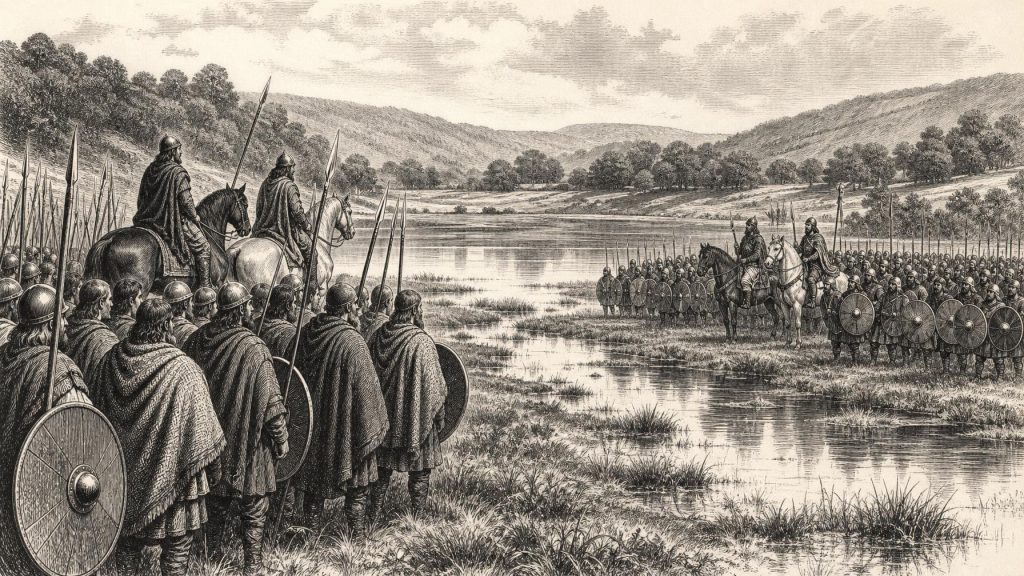
Ireland’s political balance shifted sharply in 1067. The year’s central drama was a major invasion of Connacht involving the rulers of Leinster, Munster and Osraige, together with troops from Hiberno-Norse Dublin. Its immediate outcome was unexpected: the Connacht king, Áed Ua Conchobair, survived the first encounter and struck back effectively, only to be killed about a week later by an army from Bréifne. His death at the battle of Turloch Adhnach opened the provincial kingship to his rival Áed Ua Ruairc and demonstrated how rapidly alliances and fortunes could change.
Reading a Fragmentary Record
The events are preserved principally in the Irish annals, including the Annals of Ulster, Annals of Tigernach, Annals of Inisfallen and the later Annals of the Four Masters. They agree on the broad sequence but differ in names, emphasis and detail. The Annals of Inisfallen, written from a Munster perspective, present the campaign as a devastating assault on Connacht from several directions. The Annals of Tigernach provide the fullest description of the opposing armies and lavish praise upon the fallen Connacht king. Such language preserves political memory rather than neutral reporting. Exact days are not supplied, and places such as Turloch Adhnach and Turloch Sampaite cannot be identified with complete confidence. What can responsibly be said is that the campaign and Áed’s death were placed in 1067 by independent annalistic traditions.
A Coalition Enters Connacht
The invasion brought together three of Ireland’s most powerful political interests. Diarmait mac Máel na mBó, king of Leinster and a dominant figure in Dublin, marched with Leinstermen and the “foreigners”, the annalists’ conventional name for the Hiberno-Norse inhabitants of the port. Tairdelbach Ua Briain, king of Munster, mobilised men from across his province. The Annals of Tigernach also name Domnall Ua Gilla Pátraic and the forces of Osraige. This was therefore not a border raid by one neighbouring kingdom but an extensive coalition capable of drawing soldiers and supplies from southern and eastern Ireland.
Diarmait and Tairdelbach were closely connected. Diarmait had encouraged his younger ally’s rise against Donnchad mac Briain, and Tairdelbach had secured the Munster kingship in 1063. Their cooperation allowed them to project power far beyond their own heartlands. Yet relations with Áed Ua Conchobair had not always been hostile. An entry placed under 1066 records Diarmait and Tairdelbach paying him thirty ounces of gold in return for assistance. The reversal in 1067 illustrates the practical nature of high-level diplomacy: friendship was sustained by common advantage, payments, fosterage, marriage and hostages, but could dissolve when rulers saw an opportunity to weaken a former partner.
Ambush and Counter-Invasion
Áed Ua Conchobair did not wait passively for the invaders. The sources describe him attacking or ambushing the coalition near a place called Turloch Sampaite; the Annals of Ulster connect the expedition with Loch Cime. In the fighting Conchobar Ua Conchobair, king of Ciarraige Luachra in north Kerry, was killed with a number of nobles. His presence among the invaders shows that Tairdelbach’s army included subordinate kings whose service was expected in return for recognition, protection or reward. Áed’s counterstroke inflicted a serious loss, although it did not end the wider assault.
About a week later, according to the Annals of Inisfallen, a second danger entered Connacht. Áed son of Art Uallach Ua Ruairc advanced from Bréifne, the expanding kingdom centred in what is now counties Leitrim and Cavan. The Annals of Tigernach claim that his force numbered “three score hundreds”, conventionally understood as 6,000 men. Medieval figures of this kind should be treated cautiously, but the statement conveys the chronicler’s impression of a formidable hosting. The Bréifne army was not merely reinforcing the southern coalition: Ua Ruairc belonged to a rival branch of the wider Uí Briúin kindred and possessed his own claim to the overkingship of Connacht.
The Battle of Turloch Adhnach
The two Áeds met at Turloch Adhnach. The annals describe fierce fighting between the Connachtmen around Áed Ua Conchobair, known as Áed in Gaí Bernaig, “Áed of the Gapped Spear”, and the Bréifne forces around Áed Ua Ruairc. Ua Conchobair was killed, as was Áed Ua Conceanainn, king of Uí Diarmata, with many other leading men. The scale of aristocratic losses suggests that this was a significant provincial battle rather than a brief skirmish.
Áed Ua Conchobair received an unusually elaborate obituary. He was praised as the steersman of northern Ireland’s valour, the Cúchulainn of the Gaels and a generous distributor of clothing, wealth, gold and horses. Beneath the poetic grandeur lies an important expectation of kingship: a successful ruler rewarded followers, supported churches and learned people, and converted tribute into visible generosity. Áed Ua Ruairc claimed the kingship of Connacht after the victory, although the Ua Conchobair dynasty was not eliminated. The dead king’s son Ruaidrí would later challenge Bréifne dominance and recover the provincial kingship.
Violence Beyond the Main Campaign
Other entries reveal instability at more local levels. Tadc Ua Muirecáin, ruler of Tethba in the midlands, was killed by Muintir Tlamáin at Maenmagh. Donn Sléibe Ua Gadhra, an eligible successor to the kingship of Luigne in north Connacht, was killed by Brian Ua Gadhra, apparently in a dynastic dispute. In Munster, Tairdelbach Ua Briain captured Máel Sechnaill son of Gilla Brigte, ruler of the Déisi, and handed him to Ua Bric, who blinded him. Blinding was a calculated political punishment: bodily impairment could make a captive ineligible for kingship while avoiding the consequences of immediate execution. These episodes show power being contested within dynasties and subordinate kingdoms as well as between provinces.
Churches, Offices and Fire
The Annals of Ulster record that Kildare, including its church, was burned. No cause is given, so the fire cannot safely be attributed to the year’s military campaigns. Fire was a recurring danger in ecclesiastical settlements, where even stone churches stood among timber houses, workshops, stores and fences. Kildare was one of Leinster’s foremost religious centres, associated with Brigid and possessing substantial lands, dependants and political importance. Its burning would have disrupted worship, hospitality, craft production and the storage of food and valuables, although the record says nothing about casualties or reconstruction.
Several senior churchmen also died. Célechair Mugdornach, bishop of Clonmacnoise, belonged to the influential Meic Cuinn na mBocht ecclesiastical family. Scolaige son of Innrechtach held the office of airchinnech at both Muckno and Downpatrick, while Echthigern, son of the celebrated scholar Flann Mainistrech, was airchinnech of Monasterboice. An airchinnech was not simply a parish priest: he could administer church lands, dependants, revenues and hospitality. The concentration of offices within learned families demonstrates how closely religious authority, property and kinship remained connected before the major reforms of the twelfth century.
Learning and Cultural Memory
The drowning of Murchad Ua Carthaig in Loch Calgaich deprived Connacht of a man styled its chief poet and chief ollamh. The annals’ terminology also contains the older and ambiguous title “chief druid”, but this should not be taken as proof of an organised pagan priesthood surviving in 1067. Learned poets inherited vocabulary and functions from pre-Christian traditions while working within an overwhelmingly Christian society. An ollamh stood at the summit of a demanding professional hierarchy, preserving praise poetry, genealogy, law, history and political lore for royal patrons.
Célechair’s death also has a later literary significance. His son Máel Muire became one of the principal scribes associated with Lebor na hUidre, the Book of the Dun Cow, the oldest surviving manuscript written substantially in Irish. The manuscript itself should not be assigned to 1067, but the family connection places the year within the intellectual world from which it emerged. At Clonmacnoise, scholarship, manuscript production, worship, hospitality and political commemoration were sustained by intergenerational communities rather than isolated monks.
Livelihoods Behind the Armies
The annals reveal little directly about the year’s harvests or ordinary households. Broader evidence indicates a predominantly rural population living through livestock farming, dairying and cereal cultivation, with cattle serving as food, productive wealth, tribute and military spoil. Large armies depended upon contributions from subject communities and could consume or destroy local supplies as they travelled. The Annals of Inisfallen’s claim that Connacht suffered “total destruction” is rhetorical, but repeated hostings would have burdened farmers through requisitioned animals, damaged crops, disrupted grazing and the loss of labourers.
Ireland also possessed increasingly important commercial centres. Dublin supported merchants, mariners and specialist craftspeople and connected Irish rulers with Britain and continental markets. Its participation in Diarmait’s army reflects the political value of controlling a wealthy port as well as its military resources. Monastic settlements such as Clonmacnoise and Kildare likewise functioned as centres of exchange and skilled production. Thus the struggles of 1067 were financed by a mixed economy in which cattle and agricultural renders remained fundamental while silver, coin, imported goods and urban craftsmanship were becoming increasingly influential.
A Provincial Turning Point
The year did not produce a lasting ruler of all Ireland, nor did the coalition permanently conquer Connacht. Its importance lies instead in the sudden removal of Áed Ua Conchobair and the transfer of provincial supremacy to Áed Ua Ruairc. The campaign displayed the reach of Diarmait mac Máel na mBó and Tairdelbach Ua Briain, the value of Dublin’s Hiberno-Norse manpower and the capacity of Bréifne to intervene decisively in Connacht. Alongside battle and dynastic punishment, the records of a burned church, dead ecclesiastics and a drowned poet preserve glimpses of the religious and learned institutions that endured amid political violence.
Primary Sources
- The Annals of Ulster: Year U1067
- The Annals of Tigernach: Annal T1067
- Annals of Inisfallen: Annal AI1067
- Annals of the Four Masters: Annal M1067
- Chronicon Scotorum
- Chronological Synchronisation of the Irish Annals
- The Chronology and Sources of the Early Irish Annals
- Diarmait (Diarmait mac Maíl (Máel) na Mbó)
- Ua Briain, Tairdelbach
- Ua Ruairc, Áed
- Ua Conchobair, Ruaidrí na Saide Buide
- Conn na mBocht
- Máel-Muire
- Clonmacnoise Monastic Site
- Clonmacnoise, County Offaly
- Monasterboice Monastic Site
- Monasterboice, County Louth
- High Crosses
- Viking
- The Economy of Early Medieval Ireland
- Early Medieval Ireland: Archaeological Excavations, 1930–2009
- The Zooarchaeology of Medieval Ireland
- Medieval Ireland: Territorial, Political and Economic Divisions
- Landscapes of Kingship in Early Medieval Ireland, AD 400–1150
- The Roles of Poets
- Lebor na Cert
- TEI Header for Lebor na hUidre
- Irish Script on Screen: MS 23 E 25 (Leabhar na hUidhre)
- Early Christian Monasteries
- Irish Historic Towns Atlas: Downpatrick