
Year by Year
Explore Year by Year articles from the most modern historical year back to the oldest.
3,295 Articles Archived

Shannon Raiders
Archived: 26 September 2026
In 1065, Ireland’s fragmented kingdoms saw raids, succession struggles and reprisals. Forces led by Áed Ua Ruairc and Diarmait Ua Cellaig plundered Clonmacnoise and Clonfert, using vessels moved from the western sea to the Shannon. Áed Ua Conchobair of Connacht defeated them, recovered boats and pursued rival dynasties; church chroniclers presented this as saintly judgement. Killings in Ulster, including Donnchad Ua Mathgamna at Bangor, reflected internal conflict and contested sacred authority. In Mide and Munster, further deaths and Murchad Ua Briain’s attack at Kincora exposed political instability. Ecclesiastical obituaries, trade, farming and nut abundance reveal a connected society beyond warfare.

Donnchad's Deposition
Archived: 26 September 2026
In 1064, annalists recorded a redistribution of power in Ireland. Donnchad mac Briain, son of Brian Bóruma, was deposed from Munster, travelled penitentially to Rome and died there. His nephew Toirdelbach Ua Briain, backed by foster-father Diarmait mac Máel na mBó of Leinster, secured kingship through campaigns, hostage-taking and cattle raids against southern rivals. Diarmait’s authority embraced Dublin and Irish Sea connections following Echmarcach mac Ragnaill’s death. Northern dynastic deaths affected Telach Óc and Ailech, while Armagh lost its successor of Patrick, Dub dá Leithe. Clerical and scholarly deaths underline the year’s cultural change, while warfare inflicted hardship without unity.

Munster Kingship
Archived: 26 September 2026
In 1063, Tairdelbach Ua Briain, backed by his foster-father Diarmait of Leinster and Dublin, secured recognised kingship in Munster, although Donnchad mac Briain remained until 1064. Ardgar mac Lochlainn’s military progress through Connacht compelled regional rulers to acknowledge his temporary superiority, while an assault on a refuge at Cera caused heavy loss of life. Deaths among kings and churchmen altered local politics. Pilgrimage and ecclesiastical centres retained political importance. Later annals report sickness and scarcity, cautiously interpreted. Warfare, billeting, hostage-taking and raids, including Limerick’s burning, burdened rural communities, revealing Ireland’s fragmented, coercive kingship and interconnected trade, church and rural life.

Connacht Raided
Archived: 26 September 2026
In 1062, Ireland remained divided among competing dynasties. In Connacht, Áed Ua Conchobair defeated western rivals but lost his son in retaliatory violence, before Ardgar Mac Lochlainn raided the province for cattle and captives. Killings destabilised successions in Mughdorna, Fernmag and Ulaid. In Munster, campaigns by Diarmait of Leinster and Toirdelbach Ua Briain further undermined Donnchad mac Briain. Deaths of leading Columban and northern churchmen marked ecclesiastical change. Annalistic dating varies, particularly for Connacht events. Warfare damaged households through livestock seizures, captivity, destruction and disrupted farming, while urban trade and church networks linked Ireland to Britain, Alba and maritime worlds.

Kincora Destroyed
Archived: 26 September 2026
In 1061, Ireland lacked a supreme king and regional rivalries intensified. Connacht’s Áed Ua Conchobair raided Munster, destroying Kincora and damaging Killaloe, thereby exposing Donnchad mac Briain’s weakening authority. Áed was briefly displaced by the Ua Flaithbertaig of western Connacht, but defeated them and killed Ruaidrí. Elsewhere, battles, killings and deaths reshaped northern and eastern lordships, while Diarmait mac Maíl na mBó pressed Munster and projected power towards Man. Severe epidemic disease afflicted Leinster, and Glendalough was burned. Deaths of churchmen highlighted ecclesiastical institutions’ importance. Differing annal dates complicate chronology, but collectively portray fragile power, violence, hardship and political change.

Donnchad's Submission
Archived: 26 September 2026
In 1060, Donnchad mac Briain, weakened by earlier defeats, apparently submitted to Diarmait mac Maíl na mBó of Leinster, transferring treasure and acknowledging his supremacy, though Ireland remained politically fragmented. Diarmait’s family projected power through Dublin and the Irish Sea. Ecclesiastical centres were contested and vulnerable: Armagh’s abbacy provoked armed conflict, Kells and Leighlin burned, and Clonmacnoise suffered a raid. Regional rulers died or were killed, while religious figures, notably Conn na mBocht, were remembered for charity and administration. A plentiful mast crop supported pig husbandry within a rural economy where cattle, churches and trading towns underpinned wealth and authority.

Murchad's Defeat
Archived: 26 September 2026
In 1059, Irish annals record widespread warfare, raiding and dynastic upheaval amid a politically fragmented island. Diarmait mac Máel na mBó of Leinster campaigned in Mide and pressured Munster, while his son Murchad killed rival heirs but was defeated by Conchobar Ua Máelshechlainn at Durrow. Northern rulers seized cattle and captives in Airgíalla and Dál Araide. Connacht and neighbouring regions saw multiple killings and deaths among ruling lineages. Obituaries of church leaders underline ecclesiastical power and learning. Despite conflict, rural farming, herding, crafts, trade and Dublin’s Norse-Gaelic economy sustained society, supplying the wealth and resources contested by kings across Ireland.

Sliabh gCrot
Archived: 26 September 2026
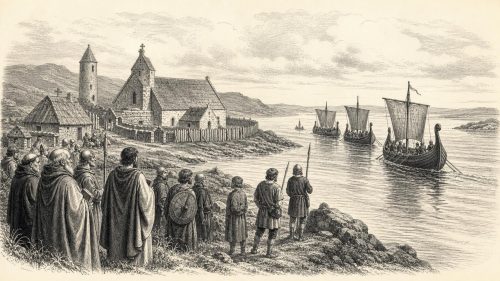
In 1058, Toirdelbach Ua Briain and Diarmait mac Máel na mBó led Leinster, Osraige and Hiberno-Norse forces against Munster’s Donnchad mac Briain. Limerick was burned, perhaps by its defenders, and Diarmait defeated Donnchad at Sliabh gCrot in the Galtees, accelerating his decline. Emly’s church and monastic settlement also burned, while churchmen, regional rulers, poets and ascetics figured in annalistic notices. In Mide, Gallbrat Ua Cerbaill was killed amid dynastic rivalry. Dublin crews joined Magnus Haraldsson’s unsuccessful English expedition, demonstrating Irish Sea connections. The fragmented records portray interconnected warfare, religion, commerce and politics across Ireland and neighbouring lands during the year.
Munster Decline
Archived: 26 September 2026
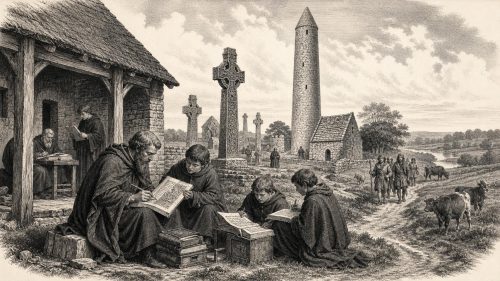
In 1057, Ireland remained divided among provincial dynasties, Norse-Irish towns and local rulers, with Donnchad mac Briain’s Munster supremacy increasingly challenged by Diarmait mac Maíl na mBó, Tairdelbach Ua Briain and other rivals. Killings of Munster claimants and neighbouring kings exposed unstable succession. Dublin-linked forces plundered Inis Cathaig but suffered heavy losses, while raids and conflicts occurred across Connacht, Leinster, the midlands and north. Church communities also suffered, notably the murder of Cork churchman Mugrón Ua Mútáin. Abundant woodland mast coincided with livestock disease, threatening rural livelihoods. These pressures foreshadowed Donnchad’s defeat in 1058 and wider political upheaval soon afterwards.
Fragile Alliances
Archived: 26 September 2026
In 1056, Ireland remained divided among competing provincial rulers, as Diarmait of Leinster, Donnchad of Munster, Áed of Connacht and Conchobar of Mide pursued fragile power. Annals record dynastic killings, disputed raids and major cattle seizures, including captives, while a Christmas raid ended in drownings. Churches were influential communities, marked by deaths of prominent clergy, notably Armagh's Áed Ua Forréid. Scholar Flann Mainistrech of Monasterboice died, whereas Marianus Scotus joined Cologne's Irish monastery, illustrating international learned links. Rural farming supported cattle wealth, while Dublin's trade underpinned Leinster. Lightning deaths and storm-related disaster underscored life's vulnerability. Sources vary in reliability, dating.
Some records do not yet have a verified historical year and are awaiting chronological placement.