A Kingdom Changes Hands1,064 CE
The Shape of the Record
The surviving Irish annals make 1064 unusually significant for Munster, but they do not provide a continuous story of the year. They preserve selected deaths, changes of office, raids and dynastic reversals—events considered memorable by ecclesiastical chroniclers. Their entries can also disagree over sequence or emphasis. The central facts are nevertheless clear: Donnchad mac Briain, son of Brian Bóruma, was deposed and departed for Rome; his nephew Toirdelbach Ua Briain secured the Munster kingship; and a major generation of rulers, churchmen and learned figures passed from the scene.
The Annals of Inisfallen identify 1064 as a leap year and place 1 January on a Thursday. The Annals of Ulster add calculations concerning the paschal cycle and indiction. Such details were not decorative. Correctly reckoning years and the date of Easter was a serious intellectual and religious responsibility, connecting Irish scriptoria with the wider Latin Christian world.
Donnchad’s Fall
Donnchad mac Briain had ruled in Munster for much of the half-century following the Battle of Clontarf. His authority, however, never reproduced the exceptional supremacy achieved by his father. Rival branches of Dál Cais remained dangerous, while powerful kings in Leinster and Connacht repeatedly intervened in Munster. By the early 1060s Donnchad faced an especially effective coalition between his nephew Toirdelbach Ua Briain and Diarmait mac Máel na mBó, the expansionist king of Leinster.
The decisive military and diplomatic preparation belonged largely to the preceding years. The annals place Toirdelbach’s assumption of the Munster kingship as early as 1063, after campaigns in which he and Diarmait burned Limerick, compelled regional rulers to surrender hostages and defeated forces loyal to Donnchad. Hostages were instruments of government rather than merely prisoners: their delivery publicly acknowledged submission and gave an overlord security against rebellion.
In 1064 the Annals of Ulster, Tigernach, the Four Masters and Chronicon Scotorum agree that Donnchad was deposed. He then went on pilgrimage to Rome and died there. Some accounts specify that he died at the monastery of St Stephen, having embraced penitence. No exact date for either his departure or death survives. The language of repentance gave his end a Christian dignity, but pilgrimage also offered a recognised path out of an untenable political position. The former ruler exchanged a contested kingship for the status of a penitent pilgrim at Christianity’s western centre.
Donnchad’s removal ended the direct rule of Brian Bóruma’s surviving son and opened a new phase in Uí Briain power. Toirdelbach, a grandson of Brian through the murdered Tadc mac Briain, had spent years challenging his uncle. His success did not arise from an automatic law of inheritance. Irish kingship depended upon eligibility within a royal kindred, military support, alliances, fosterage, wealth and the ability to compel lesser rulers. Diarmait was Toirdelbach’s foster-father and principal external patron, making their relationship both personal and political.
Toirdelbach Takes Control
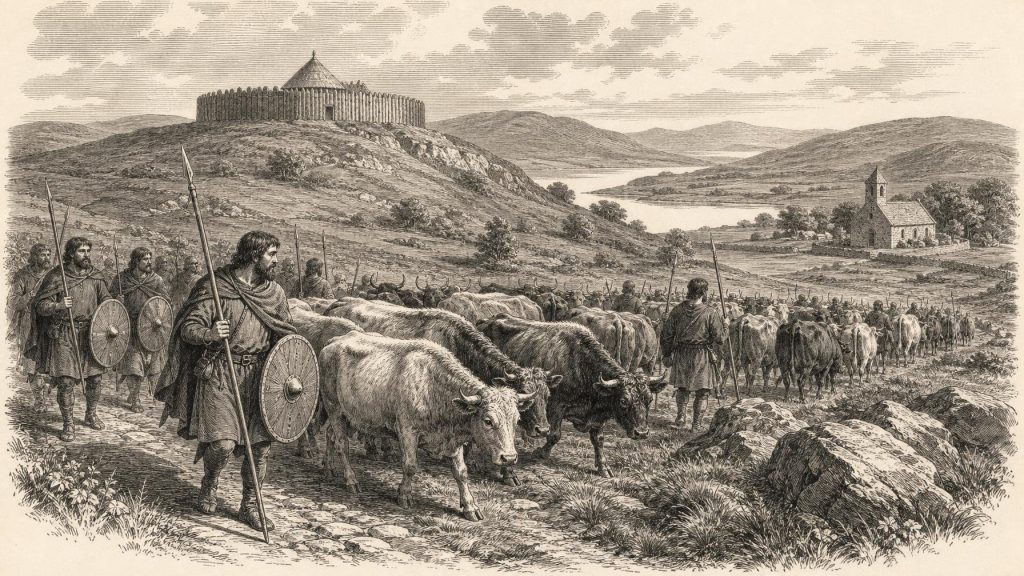
Toirdelbach’s position was still something to be demonstrated on the ground. The Annals of Inisfallen record a great foray by him into Corcu Duibne and Éoganacht territory during 1064. The chronicler declared that the cattle and other livestock seized were beyond counting. The wording is probably rhetorical, but the raid itself belongs firmly to the year.
This was more than simple plunder. Corcu Duibne occupied much of the Dingle peninsula and neighbouring western districts, while Éoganacht dynasties retained deep-rooted claims and local authority across southern Munster. By raiding these regions, Toirdelbach punished resistance, rewarded followers and displayed his reach beyond the Dál Cais heartland. The same annals record the killing of the king of Eóganacht Locha Léin and of Ua Cerbaill, another Éoganacht king, although they do not state that Toirdelbach caused either death. These notices nevertheless show a southern political landscape under severe pressure.
Cattle were central to that landscape. They supplied dairy foods, meat, hides and draught power, while also serving as measures of wealth, tribute and status. A successful cattle raid weakened an opponent’s households and dependants while enriching the victor. Herds taken in war could be distributed as rewards, consumed by an army or used to support clients. To the people whose animals were driven away, the consequences included reduced food security and diminished capacity to sow or transport produce.
Diarmait mac Máel na mBó’s support remained fundamental. By 1064 he controlled Leinster and exercised authority over Dublin through his son Murchad. He had used Dublin’s ships and warriors in campaigns around the Irish Sea, while his interventions in Munster had helped place Toirdelbach in power. It would be misleading to call the new Munster king merely a puppet: Toirdelbach had his own dynastic following and would become a formidable ruler. At this stage, however, Diarmait was the stronger partner, and the change in Munster greatly extended Leinster influence.
Irish Sea Connections
The death of Echmarcach mac Ragnaill, recorded in 1064 by several annals, marked another ending. Echmarcach had twice ruled Dublin and had also held power in Man and the Isles. Diarmait expelled him from Dublin in 1052, and Murchad mac Diarmata defeated him in Man in 1061. The annals call him king of the foreigners or identify him simply as Ragnall’s son. Modern biographical reconstruction places him on pilgrimage to Rome in company with Donnchad, although the annalistic entries themselves do not describe their journey together. Some uncertainty also remains over whether Echmarcach died late in 1064 or early in 1065.
His career demonstrates that Dublin, Waterford, Man, the Hebrides and western Britain formed an interconnected political and commercial world. Ships carried warriors, pilgrims, merchants and luxury goods across the same waters. Dublin’s Scandinavian-founded population had become deeply entangled with Irish dynasties, and control of the town was valuable for its fleet, craftspeople, markets and overseas connections. By 1064 Dublin was no longer an independent rival to Diarmait but a major resource within his wider power.
Deaths in the North
Northern Ireland also experienced important dynastic losses. Muirchertach Ua Néill, king of Telach Óc, was killed by the Uí Chremthann. The annals provide no battle narrative, leaving the immediate cause uncertain. His death reflects the persistent competition among branches and neighbours of the Northern Uí Néill, for whom Telach Óc in present-day County Tyrone was an important royal centre.
Ardgar son of Lochlann, king of Ailech, died at Telach Óc in the same year. He was buried at Armagh in what the Annals of Ulster call the cemetery of the kings. Burial at Ireland’s leading Patrician church proclaimed both status and association with a sacred centre. Ardgar’s family, later known as the Meic Lochlainn, would become one of the strongest dynasties of the northern eleventh and twelfth centuries. His young son Domnall Ua Lochlainn eventually emerged as a major claimant to the overkingship of Ireland, but that later achievement should not be projected backwards as an immediate succession in 1064.
The annals also record that Diarmait Ua Lorcáin, an eligible successor to the Leinster kingship, was killed by Cenél nÉogain in Ulaid. Why a Leinster claimant was present in the north is not explained. His death is a reminder that aristocratic politics crossed provincial boundaries through military service, alliance, exile, fosterage and marriage.
Armagh and the Learned Orders
A firmly dated ecclesiastical event occurred on 1 September: the death of Dub dá Leithe, successor of Patrick at Armagh. The Annals of Ulster state that he died after worthy penitence and that Máel Ísu son of Amalgaid took the abbacy. Dub dá Leithe belonged to Clann Sínaig, a kindred that had long exercised influence over Armagh’s senior office. His career included service as fer léigind, or head of learning, and involvement in struggles over control of the abbacy.
Dub dá Leithe was also associated with a now-lost compilation of annals, poetry and saga material used by later chroniclers. His death therefore mattered not only institutionally but culturally. Armagh was a place of worship, education, manuscript production, royal burial and political negotiation. Like other major monasteries, it supported a substantial surrounding community of craftspeople, farmers, tenants, students and clerics.
Several other churchmen died during the year, including the superiors of Ardstraw, Ardbraccan and Donaghmore in Mag Itha. The death notices reveal a dense network of religious settlements extending from Meath to the north-west. These communities varied greatly in size, but their leaders managed lands, relics, dependants and relationships with local kings.
The blind Ua Lonáin, described as chief poet—and by the Four Masters also chief historian—of Munster, likewise died in 1064. No surviving work can securely be assigned to him. His title nevertheless illustrates the standing of professional learning. Court poets preserved genealogies, praised patrons, criticised failures and shaped dynastic memory. Their craft was sustained through training and patronage rather than casual entertainment.
Life Beyond the Annals
Most inhabitants of Ireland appear nowhere in the annual record. They lived in farmsteads, ringforts, unenclosed settlements, monastic communities and the growing port towns. Mixed farming supported daily life, with cattle especially prominent alongside sheep, pigs and cereal cultivation. Houses were principally built from timber, earth, thatch and woven materials, while stone was increasingly visible in prestigious churches, crosses and some defensive or high-status structures.
No nationwide famine or epidemic can securely be assigned to 1064 itself. Later compilations place shortages and disease in the immediately preceding year, but their chronology should not be silently transferred. What can be said is that warfare and livestock seizure created sharp regional hardship. For families in raided districts, high politics arrived as lost animals, burned stores, disrupted planting, billeted troops and demands for tribute.
Thus 1064 was not a year of Irish unification, but one of substantial redistribution. Donnchad’s long rule ended in pilgrimage and death; Toirdelbach secured Munster through force, alliance and cattle wealth; Diarmait’s influence reached from Leinster into Munster and across the Irish Sea; and deaths at Telach Óc and Armagh altered northern political and ecclesiastical leadership. The year’s annalistic fragments reveal an Ireland whose kingdoms remained distinct, yet whose rulers, churches, scholars, ports and sea routes were closely and continually connected.
Primary Sources
- The Annals of Ulster: Year U1064
- Annals of Inisfallen
- Annals of Inisfallen: Annals AI1062–AI1068
- The Annals of Tigernach: Annal T1064
- Annals of Loch Cé
- Annals of Loch Cé: Irish Text, LC1064
- Chronicon Scotorum
- Annals of the Four Masters: Annal M1064
- Donnchad
- Ua Briain, Tairdelbach
- Diarmait (Diarmait mac Maíl (Máel) na Mbó)
- Echmarcach
- Dub-dá-leithe
- Ua Lochlainn (Mac Lochlainn), Domnall
- Exploring the Irish Annals
- Early Medieval Ireland, AD 400–1100: The Evidence from Archaeological Excavations
- Kingship, Society, and Sacrality: Rank, Power, and Ideology in Early Medieval Ireland
- Transformation – A Concise History of Ireland
- High Crosses
- Animals and the Economy of Medieval Ireland: A Zooarchaeological Analysis of the Faunal Remains from Caherconnell Cashel, Co. Clare
- Reflections on Kingship, the Church and Viking-Age Silver in Ireland
- The Vikings in Ireland
- The Vikings in Scotland and Ireland in the Eleventh Century
- Leinster Marshal Thesis