Mac Lochlainn at Fordruim1,153 CE
Ireland in 1153 was dominated by a contest for supremacy between Toirdelbach Ua Conchobair, the ageing king of Connacht, and Muirchertach Mac Lochlainn of Cenél nÉogain. Toirdelbach remained the high-king recognised by many later lists, but his authority was neither uncontested nor comparable to government over a unified kingdom. Power depended upon alliances, hostages, tribute, military service and the ability to place dependable rulers in strategically important territories. During this year Mac Lochlainn successfully challenged Connacht influence in Munster and the midlands, while dynastic upheaval in Mide altered the political balance at the centre of the island.
Reading the Record
The principal annals do not arrange every episode in exactly the same way. The Annals of Tigernach place the partition of Munster and the first expulsion of Toirdelbach Ua Briain under 1152, while the Annals of the Four Masters group these developments with the campaigning of 1153. Mac Carthaigh’s Book also assigns the alliance against Ua Briain to 1153. The great northern intervention and the defeat of Ruaidrí Ua Conchobair at Fordruim are firmly recorded under 1153 by both Tigernach and the Four Masters, but no precise day can responsibly be supplied.
A Succession in Mide
Murchad Ua Máelshechlainn, the long-reigning king of Mide, died at Durrow, the Columban monastery known to the annalists as Dearmach Coluim Chille. His obituary praised a ruler whose influence had at times extended beyond Mide into Airgialla and much of Leinster. Such language was celebratory, but it reflects the strategic importance of his kingdom. Mide stretched across the central approaches between the Shannon and the Irish Sea and was repeatedly divided, restored and redistributed by stronger provincial kings seeking access through the midlands.
Murchad’s son Máel Sechlainn succeeded him and quickly acted against possible rivals. He killed Domnall Ua Cathasaigh, lord of Saithne, and blinded his kinsman Conchobar son of Domnall Ua Máelshechlainn. Blinding was a familiar instrument of dynastic politics: a physically impaired claimant could be judged unfit for kingship without being executed. Elsewhere, Diarmait Mac Murchada, king of Leinster, released Niall Ua Mordha of Laois after he had been blinded despite guarantees offered by clergy and laymen. The entry shows both the political importance of solemn protections and the limited ability of guarantors to prevent powerful rulers from violating them.
Derbfhorgaill Returns
The most famous personal dispute of the period also changed course. In 1152 Derbfhorgaill, daughter of Murchad Ua Máelshechlainn and wife of Tigernán Ua Ruairc of Bréifne, had been taken into Leinster by Diarmait Mac Murchada during a campaign against Ua Ruairc. Later storytelling turned the episode into a simple tale of adultery and abduction, but contemporary political circumstances were more complicated. Derbfhorgaill was a member of Mide’s ruling dynasty, and control of her person, household goods and cattle carried political as well as personal significance.
In 1153 Toirdelbach Ua Conchobair led an army against Mac Murchada and recovered a daughter of Ua Máelshechlainn with her cattle. The Four Masters subsequently state that Derbfhorgaill returned to Ua Ruairc, while Tigernach says that she fled from the Leinstermen. These accounts support her return but leave her precise agency uncertain. Ua Ruairc also entered Ua Conchobair’s submission and delivered hostages, temporarily restoring his position within the Connacht king’s alliance.
The Struggle for Munster
Munster remained divided between the Uí Briain of the north and the Mac Carthaig rulers of Desmond. Tadhg Ua Briain joined Toirdelbach Ua Conchobair, Diarmait Mac Carthaig and Diarmait Mac Murchada against his own brother, Toirdelbach Ua Briain. Mac Carthaigh’s Book describes the agreement as having been made despite oaths, relics and guarantees, language intended to emphasise broken faith. The displaced Toirdelbach sought refuge with Muirchertach Mac Lochlainn in Cenél nÉogain. Munster was then partitioned between Tadhg Ua Briain and Diarmait Mac Carthaig, extending Connacht influence deep into the south.
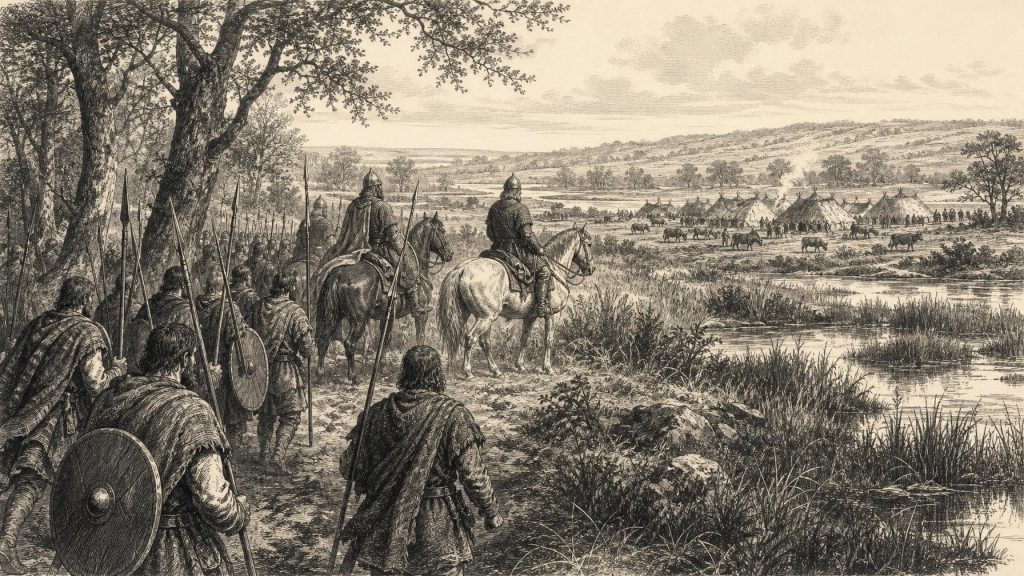
Mac Lochlainn answered by leading the forces of northern Ireland southwards to restore the exiled Ua Briain. From a base at Craeb Thene, probably in the Westmeath midlands, he advanced with a selected force against Tadhg Ua Briain, defeated his troops and routed Leinster cavalry supporting them. The northerners returned with captured cattle after also plundering part of Tethbae. Cattle were sustenance, movable wealth and political currency; their seizure weakened an enemy while feeding and rewarding an army.
The campaign then turned against Connacht. Toirdelbach Ua Conchobair withdrew westwards across the Shannon at Athlone, but his son Ruaidrí remained with troops from western Connacht and Síl Muiredaig. As Ruaidrí’s men were pitching camp at Fordruim, Mac Lochlainn’s forces attacked without warning and defeated them. The dead included Gilla-Cellaig Ua hEidin, king of Aidhne, his son Áed, Brian Ua Dubda of northern Uí Fhiachrach, and several members or associates of the Ua Conchobair dynasty. The loss of regional rulers made the reverse more serious than an ordinary raid: Connacht’s network of subordinate kings had been struck directly.
A Reordered Midlands
After Fordruim, Mac Lochlainn advanced to Lough Ennell, where Máel Sechlainn Ua Máelshechlainn submitted and delivered hostages. Mac Lochlainn confirmed him in Mide from the Shannon to the sea and attached the north Leinster territories of Uí Fháeláin and Uí Fhailge to his sphere. He assigned Uí Briúin and Conmaicne to Tigernán Ua Ruairc and carried away hostages guaranteeing obedience. These were not permanent administrative boundaries. They were political settlements intended to reward allies, contain Connacht and make Mide a barrier against renewed western expansion.
Tadhg Ua Briain was soon captured and blinded by his brother Diarmait Finn Ua Briain. Toirdelbach Ua Briain regained half of Munster through Mac Lochlainn’s support, although illness delayed his return and his followers were billeted across territories in Mide and the north. Hosting armies imposed heavy costs upon ordinary communities required to supply food, fodder and shelter. Diarmait Mac Carthaig meanwhile had Gearr na gCuinneog Ua Bric, lord of the Déisi, killed while a prisoner, illustrating the continuing instability within Munster despite its imposed partition.
Crossings, Churches and Authority
Control of the Shannon was made visible in two recorded works. Máel Sechlainn destroyed the wicker bridge and fortress at Athlone, obstructing the principal route from Connacht into Mide. Toirdelbach Ua Conchobair answered by constructing a wicker bridge at Áth Liag, modern Ballyleague, farther north. These structures were more than conveniences for travellers. Bridges and defended crossings allowed rulers to move troops, cattle and supplies, while denying the same routes to opponents. Their rapid destruction or construction shows how warfare could reshape communications without creating permanent stone fortifications.
The church remained a major political and economic presence. The Four Masters record the deaths of Áed Ua Maeleoin, successor of Ciarán at Clonmacnoise; Colmán Ua Breislein, a priest and distinguished scholar of Kells; and Dúnlaing Ua Cathail, successor of Cóemgen at Glendalough. Their titles belonged to older monastic traditions, even as the diocesan settlement proclaimed at the Synod of Kells in 1152 was reorganising ecclesiastical authority.
Flaithbertach Ua Brolcháin, abbot of Derry and successor of Colum Cille, conducted a visitation among communities in Ulster. According to the Four Masters, he received a horse from each chief, a sheep from each household, substantial gifts from Ua Duinn Sléibe and an ounce of gold from the ruler’s wife. The entry reveals a Columban federation capable of collecting dues over a broad area. It also shows an economy in which animals, silver currency and weighed gold could all express obligation and status.
New religious institutions were developing alongside these older federations. Mellifont, Ireland’s first Cistercian abbey, was expanding during the 1150s, and its daughter house at Bective had been founded by Murchad Ua Máelshechlainn in 1147. In 1153 its founder’s death linked the passing of an old-style king with a religious movement bringing new architecture, communal organisation and international connections into Ireland.
Life Beyond the Armies
The annals chiefly describe rulers, clerics and violent changes of power, not the majority who worked farms and maintained households. Archaeology indicates a predominantly rural society of dispersed farmsteads, cultivated fields and livestock enclosures. Families tended cattle, sheep and pigs, grew cereals, processed milk, ground grain and produced textiles. The repeated appearance of cattle in the year’s political record reflects this wider economy: armies captured herds, returning exiles travelled with livestock, and tribute was often assessed in animals.
Sea travel also remained essential and dangerous. Flaithbertach Ua Canannáin, king of Cenél Conaill, drowned with his wife Dub Choblaig, a daughter of Toirdelbach Ua Conchobair, and their ship’s company off Cairbre Drom Cliab on the Sligo coast. Their marriage embodied an alliance between Connacht and the north-west; their loss demonstrates how political relationships could be undone by accident as well as war.
By the close of the year, Mac Lochlainn had emerged stronger, Ua Conchobair’s southern ascendancy had been checked, and Mide had become the northern king’s principal midland bulwark. Nothing was settled permanently. The bridges, hostages, partitions and restorations of 1153 were instruments of a political order that had to be renewed continually—and that could be overturned as quickly as an army could cross the Shannon.
Primary Sources
- Annals of the Four Masters, Part 26
- Annals of Tigernach, Part 23
- Mac Carthaigh's Book, Part 4
- Mac Lochlainn, Muirchertach | Dictionary of Irish Biography
- Ua Conchobair, Tairdelbach (O'Conor, Turlough) | Dictionary of Irish Biography
- Ua Conchobair, Ruaidrí | Dictionary of Irish Biography
- Ua Máelshechlainn, Murchad | Dictionary of Irish Biography
- Derbfhorgaill | Dictionary of Irish Biography
- Ua Ruairc, Tigernán | Dictionary of Irish Biography
- Mac Murchada, Diarmait (MacMurrough, Dermot) | Dictionary of Irish Biography
- Mac Carthaig, Diarmait Mór | Dictionary of Irish Biography
- Ua Briain, Tairdelbach | Dictionary of Irish Biography
- Gilla meic Liac (Gelasius) | Dictionary of Irish Biography
- Mac Fáeláin, Fáelán | Dictionary of Irish Biography
- Derbforgaill: Twelfth-Century Abductee, Patron and Wife
- Derbforgaill and the Expulsion of Diarmait Mac Murchada
- The Battle of Móin Mhór, 1151
- Bective Cistercian Abbey | Monastic Ireland
- Mellifont Cistercian Abbey | Monastic Ireland
- Glendalough | Monastic Ireland
- Early Medieval Ireland: Archaeological Excavations, 1930–2009
- The Archaeology of Livestock and Cereal Production in Early Medieval Ireland, AD 400–1100
- The Decline of the Cow: Agricultural and Settlement Change in Early Medieval Ireland
- The Zooarchaeology of Medieval Ireland