Affrica Founds Grey Abbey1193 CE
Dateline
In 1193, Ireland remained a patchwork of competing lordships rather than a country governed from a single centre. The Anglo-Norman settlement, established after 1169, was entrenched in many eastern and southern districts and in parts of Ulster, but its reach was neither uniform nor secure. Gaelic dynasties continued to rule extensive territories, make and break alliances, and contest land, tribute and succession. The surviving notices for this year are short, uneven and sometimes contradictory. Yet, read carefully, they reveal a society in which violence, lordship, monastic patronage and new patterns of settlement were all closely intertwined.
A Year of Local Power Struggles
The clearest strictly year-dated political news comes from the annals. Eochaidh Ua Baighill was killed by the Uí Fhiachrach of Ard Sratha, in the north-west. Such a terse notice tells us little about the immediate dispute, but it is a reminder that power was exercised and resisted at the level of regional kindreds as well as great kings. In the same year Cathal Odhar, a member of the Mac Carthaigh family of south Munster, was killed by Domhnall Mór Mac Carthaigh. The wording in Mac Carthaigh’s Book calls the killing treacherous, signalling not simply warfare but a bitter conflict within a ruling family.
Munster’s divisions mattered beyond the family concerned. The same chronicle records that the Gallaibh—a term generally used in Irish annals for the incoming English or Anglo-Norman settlers—built a castle at Brí Uis with the consent of an Ó Briain ruler, supposedly to restrain Domhnall Mac Carthaigh. The chronicler itself adds the caution “if the general report be true”. That qualification should be retained: the report cannot safely be treated as an independently verified account of a completed building campaign. Even so, it captures an important reality of 1193. Castles could be instruments of alliance as well as conquest, and Gaelic rulers sometimes authorised, employed or opposed the military resources of their new neighbours according to immediate political need.
Another entry records the killing of Cú Mide Ó Floinn, described as king of Uí Thuirtre and Fir Lí, by followers of John de Courcy at Aentreabh. Uí Thuirtre and Fir Lí lay in the northern sphere where de Courcy had carved out a powerful lordship after his seizure of eastern Ulster in 1177. The notice does not establish the scale of the encounter or prove that de Courcy was personally present. It does, however, place his followers in violent contact with an Irish ruler in 1193 and demonstrates that the outward expansion of his lordship did not amount to uncontested control.
John de Courcy’s Northern Lordship
De Courcy’s position makes the northern events especially significant. By 1193 he was among the most formidable Anglo-Norman magnates in Ireland, with a power base in Down and eastern Ulster. His marriage to Affrica, daughter of Gofraid, king of Man and the Isles, linked his lordship to the wider Irish Sea world: Man, the Hebrides, Cumbria, western Scotland, north Wales and Ireland were connected by sea routes, dynastic ties, ecclesiastical networks and raiding as well as by trade.
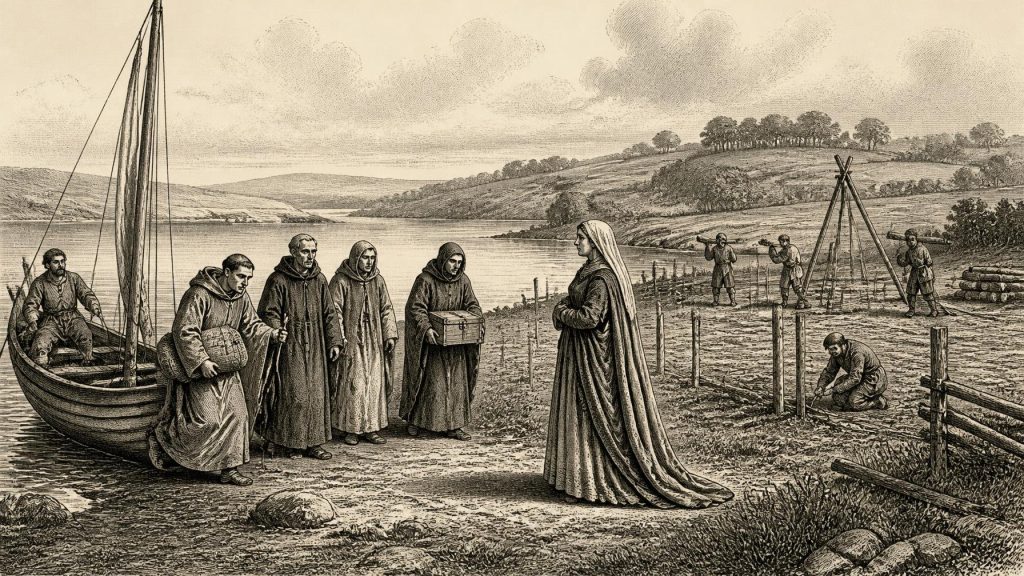
The most enduring event associated with 1193 was Affrica’s foundation of the Cistercian monastery of St Mary of Iugum Dei, later known as Grey Abbey, on Strangford Lough in County Down. Its foundation charter is dated 25 August 1193. Affrica was the founder, not a passive appendage to her husband’s rule, and the new house was settled from Holm Cultram in Cumbria. The choice of a Cumbrian mother house reflects de Courcy and Affrica’s northern Irish Sea connections, while the Cistercian order brought Grey Abbey into a disciplined international religious network.
For contemporaries, founding a monastery was an act of devotion, remembrance and lordly display. It also had practical consequences. A religious community required land, food, buildings, labour and legal protection. Its estate could become a focal point for cultivation, tenancy and exchange; its church offered a setting for worship, burial and commemoration. Construction was not completed in a single year, and it would be misleading to imagine the surviving stone ruins suddenly appearing in 1193. The foundation marked the beginning of an institution whose church and conventual buildings developed over subsequent decades. Nevertheless, the decision of 1193 changed the religious and social landscape of the Ards peninsula.
Church, Patronage and Memory
Grey Abbey was not the year’s only ecclesiastical development. On 2 May 1193, John, lord of Ireland and still the younger brother of King Richard I of England, granted the church of Crumlin, near Dublin, as a prebend to the collegiate church of St Patrick. A prebend was an endowment whose revenues supported a canon. This was therefore a financial and institutional act, tying the income of a parish church and its lands to the developing cathedral community south of Dublin’s walls.
That grant illustrates the changing texture of authority in the Dublin region. Ecclesiastical institutions were not outside politics: rights to churches and their revenues were valuable assets, while royal and aristocratic patronage could strengthen a church’s status. Yet the grant also points to continuity. Crumlin was a local worshipping community with a church, burial ground and agricultural hinterland before it became a source of income for a cathedral canon. The formal reallocation of its revenues did not erase the religious needs of parishioners who baptised children, married, mourned their dead and followed the annual round of feast days there.
The death of Derbfhorgaill at Mellifont in 1193 gave the year a powerful link to the preceding generation of Irish politics. Daughter of Murchad Ua Máelshechlainn of Mide and widow of Tigernán Ua Ruairc of Bréifne, she died in religious retirement at the Cistercian abbey, probably close to eighty-five years old. Later retellings made her supposed abduction by Diarmait Mac Murchada in 1152 a simplistic cause of the Anglo-Norman invasion. That explanation is inadequate. The invasion emerged from a far wider web of Irish dynastic conflict, Diarmait’s exile, military recruitment from Wales and the ambitions of Henry II and his subjects.
Derbfhorgaill’s recorded benefactions offer a better measure of her historical importance. She had endowed Mellifont and was associated with the building of the Nuns’ Church at Clonmacnoise. Her death at Mellifont therefore belongs not merely to personal biography but to the history of religious patronage by Gaelic elites. In 1193, the Cistercian world included both this long-established Irish benefactress at Mellifont and Affrica’s new foundation in Down: two women of different dynastic backgrounds connected by the same reforming order.
Raiding the Shannon Islands
In central Ireland, the annals report the plundering of Inis Cloithrinn—modern Inchcleraun, an island on Lough Ree—by the sons of Oistdealb together with the sons of Conchobar Maenmaige Ua Conchobair. A separate Dominican chronicle attributes the raid instead to Gerald de Lacy. The contradiction cannot be neatly resolved. What can responsibly be said is that the island was remembered as having been plundered in 1193, while the identity of those responsible differed between chronicles.
This was no insignificant target. Islands in the Shannon system could hold churches, ecclesiastical property, cattle, boats and stores, while also serving as defensible places in a landscape structured by waterways. Raiding such a site could yield wealth, intimidate rivals and strike at their sacred prestige. The disagreement over the raiders may itself reflect the tangled politics of the region, where Connacht factions, settlers from Meath and local interests overlapped. It also warns against treating any one annal as a complete camera-like record of events.
Deaths, Dispossession and Uneven Rule
Several deaths registered in 1193 signal changes within local lordships. Diarmait mac Con Brogada Ua Díomasaigh, chief of Clann Máelughra and long-standing ruler of Uí Fhailge, died. Muirchertach mac Murchada Mac Murchada, ruler of Uí Chennselaig in south Leinster, also died. These were territories exposed in different ways to the advance of Anglo-Norman lordship. Their rulers’ deaths could reopen questions of succession, clientship and control of land, even where no battle is recorded.
More starkly, the Annals of the Four Masters state that an Ua Cerbaill, ruler of Airgíalla, was captured by the English, blinded and later hanged. The entry is brief and offers no corroborating detail, so the exact circumstances remain uncertain; nevertheless, it preserves a memory of exceptionally harsh coercion. Another notice says that Áed Ua Máel Brenainn, chief of Clann Conchobair, was killed by the English of Dublin. Such entries show that the new colony’s towns and lordships could project armed power, but they do not show an island passively falling under a single regime.
For most people, 1193 was lived through locally: tending livestock and crops, travelling to markets or churches, meeting obligations to a lord, and seeking safety when a raid or feud approached. The sources do not permit a detailed reconstruction of one ordinary household’s year. They do show, however, why security, access to land and ties of protection mattered so greatly. New castles, old dynastic rivalries, monastic estates and armed retinues shaped daily possibilities across Ireland.
Thus 1193 was not a year of one decisive national turning point. Its importance lies in a cluster of connected developments. A Cistercian abbey was founded on Strangford Lough; a Dublin church was endowed for St Patrick’s; castle-building and killing marked Munster and the north; a Shannon island was plundered; and prominent Gaelic figures died. Together these events reveal Ireland in transition, but not in simple replacement: Gaelic and Anglo-Norman power, religious institutions and Irish Sea connections were all actively remaking the island’s political landscape.
Primary Sources
- The Annals of Ulster: Year U1193
- Annals of the Four Masters: Annal M1193
- Mac Carthaigh's Book: Annal MCB1193
- Annales Dominicani de Roscoman: Entries for 1193
- Irish Annals: Synchronisms, 1192–1219
- Derbfhorgaill
- Affrica (Affraic)
- Courcy, John de
- Charter of Prince John Granting Crumlin as Prebend to St Patrick's
- Calendar of Documents Relating to Ireland, 1171–1307
- Historic Environment Technical Supplement 10: Grey Abbey
- John de Courcy and the Irish Sea World
- Medieval Ireland: Territorial, Political and Economic Divisions
- Annales Hiberniae
- Song of Dermot and the Earl
- Annals of Inisfallen: Part 71
- Annales Dominicani de Roscoman: Editorial Introduction
- Gazetteer of Ireland
- Inchcleraun / Inis Cloithrinn, Placenames Database of Ireland
- Anglo Norman Ireland