Tuam, Passes and Protocol2021 CE
Dateline
For Ireland, 2021 was neither simply a year of pandemic emergency nor simply one of recovery. It was a year in which vaccination altered the terms of everyday life, while COVID-19 continued to dictate work, travel, schooling, worship and sociability. It was also a year of unusually public reckoning with institutional cruelty, renewed anxiety over the Irish border after Brexit, and decisions that shaped the State’s environmental, housing and international future. The island’s two jurisdictions experienced these pressures differently, but both were marked by uncertainty about authority, belonging and the practical meaning of normality.
Vaccination and a Conditional Reopening
The Republic began the year under stringent public-health restrictions following the severe winter wave of COVID-19. Household visits, travel, retail, hospitality, cultural events and much ordinary recreation were curtailed. Schools gradually resumed in March, while the reopening of construction, some outdoor activity and later retail brought visible changes during the spring. These were not straightforward returns to pre-pandemic routines: masks, distancing, capacity limits, testing, isolation and the calculation of personal risk remained embedded in daily life.
The vaccination programme became the central instrument of recovery. It had begun at the end of December 2020, initially concentrating on residents and staff of long-term care facilities and frontline health workers before moving through age and clinical-risk groups. By early July, more than four million doses had been administered; by the end of the year, 95.1 per cent of adults had received a primary course. The programme relied on a broad network of general practitioners, pharmacies, mass vaccination centres and mobile services. Its scale made vaccination one of the most extensive collective public-health efforts in the State’s history.
The European Union Digital COVID Certificate, commonly called the COVID pass, became a conspicuous feature of the reopened society. It enabled access to indoor hospitality and certain events, while also easing international movement. Pubs and restaurants reopened indoors during the summer under rules that linked entry to vaccination or recovery. For workers in hospitality, arts, tourism and entertainment, the return of customers offered relief after prolonged closures, though the rules themselves reminded everyone that reopening was conditional. Families could again plan weddings, funerals, holidays and reunions, but often against changing guidance and reduced numbers.
By 22 October, nightclubs and the remaining parts of the night-time economy could reopen, subject to COVID passes and protective measures. Yet the apparent culmination of reopening proved short-lived. The Omicron variant spread rapidly late in the year. On 17 December the Government announced that, from 20 December, restaurants, cafés and bars would again have to close at 8 p.m.; indoor events faced evening closure and reduced capacities, and outdoor gatherings were also limited. Booster vaccination was accelerated. Thus Christmas 2021 was more open than the previous Christmas, but still shaped by testing, caution and an acute awareness that the emergency had not ended.
The strain on public institutions was evident beyond hospitals. A major cyberattack on the Health Service Executive in May disrupted information systems and added difficulty to an already demanding response. The pandemic also intensified older questions of unequal security: who could work from home, who depended on insecure employment, who had adequate living space, and who could safely isolate. Government wage and business supports continued to cushion some of the economic damage, but did not remove the insecurity experienced by many workers and small businesses.
An Apology and an Unfinished Reckoning
On 12 January the final report of the Commission of Investigation into Mother and Baby Homes and Certain Related Matters was published. The Commission had examined eighteen institutions and related county homes, investigating a system in which unmarried mothers and their children had experienced stigma, confinement, separation and, in many cases, profound loss. Its publication brought survivor testimony and the history of institutions such as the Bon Secours home at Tuam before the country with renewed force.
The following day, Taoiseach Micheál Martin issued a formal State apology in Dáil Éireann. He acknowledged the State’s failure towards mothers and children who had entered mother-and-baby and county-home institutions, and recognised that the system had been sustained by social attitudes as well as by public and religious bodies. The apology was an important official moment, but it did not settle disagreement. Survivors, adoptees, historians and advocates raised serious concerns about elements of the report, access to records, tracing, memorialisation, excavation at Tuam, and the scope of any financial recognition.
During the year the Government developed its response around recognition, remembrance, records and restorative measures. In November it approved proposals for a payment scheme and an action plan for survivors and former residents. Debate centred particularly on eligibility based on length of institutional residence, the position of people boarded out or separated through adoption, and the responsibility of religious congregations and other bodies that had run institutions. In 2021, then, acknowledgement was accompanied by argument over what meaningful repair should entail. The issue showed how the history of church, family, women’s autonomy and State power remained present in contemporary Ireland.
The Protocol and Northern Instability
Brexit gave the island’s constitutional geography a new practical importance. From January, the Protocol on Ireland/Northern Ireland kept Northern Ireland aligned with aspects of the European Union’s goods rules in order to avoid a hard land border. The resulting checks on goods entering Northern Ireland from Great Britain became a focus of unionist anger. For many unionists, the arrangements seemed to create an economic boundary in the Irish Sea and to weaken Northern Ireland’s place within the United Kingdom; for others, including many businesses, the immediate concern was how to make the new trading arrangements work.
In April, disorder in several loyalist areas, especially in Belfast, exposed how combustible the atmosphere had become. Young people and others attacked police, and a bus was set alight. Northern Ireland’s Executive jointly condemned the violence, but the events demonstrated that the Protocol controversy had acquired a street-level as well as a parliamentary dimension. The unrest did not amount to a return to the Troubles, but it unsettled a society whose peace institutions depended upon political co-operation and confidence across communal lines.
The Democratic Unionist Party was itself thrown into leadership crisis. Arlene Foster resigned as First Minister on 14 June, following her earlier decision to step down as DUP leader. Her successor as party leader, Edwin Poots, resigned within weeks amid internal conflict over arrangements for appointing a new First Minister. Paul Givan took office on 17 June, serving alongside Sinn Féin’s deputy First Minister, Michelle O’Neill. The episode revealed sharp division within unionism over the Protocol, the party’s direction and the difficult compromises of devolved government.
Across the border, the Irish Government continued to insist that the Protocol was the jointly agreed means of protecting the Good Friday Agreement’s all-island dimensions while respecting the absence of a land frontier. Dublin’s approach combined support for EU enforcement with calls for practical flexibility. The tension was a reminder that post-Brexit diplomacy was not abstract: it affected supermarket supply chains, medicines, transport, farming and the everyday operation of relations across these islands.
Homes, Climate and an Open Economy
Housing remained the Republic’s most pressing domestic social problem. High rents, homelessness, constrained supply and the difficulty faced by first-time buyers gave the issue political urgency even as the pandemic complicated construction and planning. On 2 September the coalition Government launched Housing for All, its plan to 2030. It proposed an average output of 33,000 homes annually over the following decade, combining social, affordable, cost-rental and private housing measures with investment in land, infrastructure and construction capacity. Its announcement recognised the depth of the crisis; whether targets could become habitable homes was a question that would extend far beyond 2021.
The economy recovered unevenly as restrictions eased. Multinational corporations, concentrated in technology, pharmaceuticals and other export-oriented sectors, continued to give Irish national accounts an exceptional profile, one that did not neatly describe household circumstances. Meanwhile, rising energy and consumer prices late in the year added pressure to household budgets. On 7 October, Ireland joined the OECD agreement on international corporate-tax reform. It accepted a 15 per cent minimum effective rate for large multinationals within the agreement’s scope, while retaining the 12.5 per cent rate for smaller firms. The decision marked a significant adjustment by a small, open economy whose development strategy had long been closely associated with tax competitiveness and foreign direct investment.
Environmental policy also gained a firmer legal basis. The Climate Action and Low Carbon Development (Amendment) Act 2021 was enacted on 23 July and commenced in September. It established a statutory framework for carbon budgets, sectoral emissions ceilings, local-authority climate plans and a national objective of climate neutrality by 2050. The legislation did not resolve the hard choices involved in agriculture, transport, heating, peatlands or energy supply, but it made climate governance a more formal obligation of the State and its public bodies.
Commemoration and International Voice
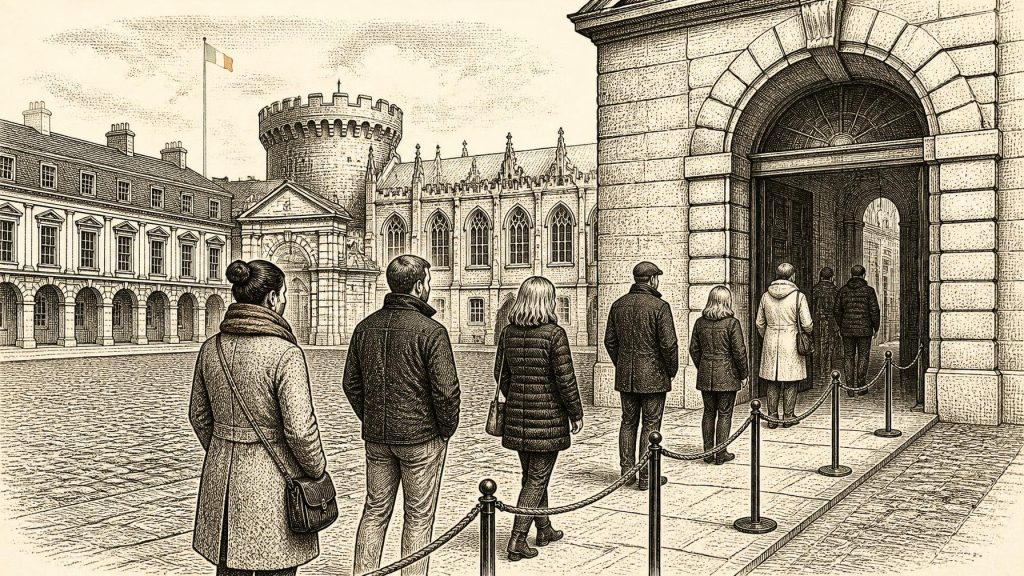
The centenary of the 1921 Anglo-Irish Treaty was marked through exhibitions, lectures, digitisation and cultural events under the Decade of Centenaries programme. These activities encouraged public engagement with a document that had ended one conflict while precipitating another, and whose consequences included partition and the Civil War. In December, the National Archives exhibition The Treaty, 1921: Records from the Archives opened at Dublin Castle. Such commemoration was necessarily careful: the Treaty belonged to no uncomplicated national story.
Ireland also exercised an international role as an elected member of the United Nations Security Council for 2021–22. Holding the Council presidency in September, it promoted themes including peacekeeping transitions, women, peace and security, climate and security, and disarmament. At a time when the rapid Taliban takeover of Afghanistan posed grave questions about humanitarian access and the rights of women and girls, this gave Irish diplomacy a demanding global platform.
By year’s end, Ireland had regained many movements and meetings that the pandemic had suspended, but not their former ease. The country’s experience in 2021 joined intimate concerns—health, family separation, a secure home and a night out—with large structures of law and power: Brexit, public institutions, global taxation and climate responsibility. It was a year of reopening, but also of recognition that recovery required more than reopening doors.
Primary Sources
- Commission of Investigation into Mother and Baby Homes and Certain Related Matters
- Report of the Commission of Investigation into Mother and Baby Homes: Statements – Dáil Éireann, 13 January 2021
- Mother and Baby Homes Redress Scheme: Statements – Seanad Éireann, 30 November 2021
- Climate Action and Low Carbon Development (Amendment) Act 2021
- Climate Action and Low Carbon Development (Amendment) Act 2021: Commencement Information
- Government Launches Housing for All – a New Housing Plan for Ireland
- Housing for All – a New Housing Plan for Ireland
- Post Cabinet Statement – Recovery and Resilience: The Path Ahead, 11 May 2021
- Updates on COVID-19 (Coronavirus) from July–September 2021
- Minister for Health Confirms that Ireland’s COVID-19 Vaccination Programme Will Open to 12–15 Year Olds
- HSE Annual Report and Financial Statements 2021
- Statement on COVID-19 Public Health Measures – 19 October 2021
- New Public Health Measures Announced – Friday 17 December
- Statement from the National Public Health Emergency Team – Wednesday 15 December
- Executive Statement on Violence and Unrest
- Northern Ireland Protocol: Timeline and Key Documents
- Brexit and Beyond: The Ireland/Northern Ireland Protocol – Briefing Paper NIAR 194-2021
- Official Report, Northern Ireland Assembly, 14 June 2021
- MLA Details: Mr Paul Givan
- Ireland Joins OECD International Tax Agreement
- GDP and Growth Rates: Annual National Accounts 2021
- Consumer Price Index December 2021
- Events Online and In-Person to Commemorate the Centenary of the Anglo-Irish Treaty 1921
- Press Conference by Security Council President on Programme of Work for September
- UN Security Council in Review: September 2021