Five Million and Stormont2022 CE
Dateline
In 2022 Ireland moved from the extraordinary disciplines of the pandemic into a year of revived public life, but also of war-driven inflation, a deepening housing emergency and renewed constitutional uncertainty in Northern Ireland. The calendar year contained moments of celebration and commemoration, from the centenary of the Free State’s establishment to the worldwide marking of James Joyce’s Ulysses. Yet its most immediate character was one of adjustment: households, schools, employers, voluntary groups and government departments had to respond at once to the end of Covid restrictions, the arrival of people fleeing Ukraine, and the sharp rise in fuel, food and housing costs.
Leaving Emergency Rules Behind
The year began under the pressure of the Omicron wave. On 5 January, the Government described infection levels as exceptionally high, even as the booster campaign offered considerable protection against severe illness. The priority was to maintain schools, hospitals and essential services while daily routines remained constrained. That context makes the speed of the subsequent reopening more striking. From 6 a.m. on 22 January, capacity limits, early closing for hospitality, Covid passes for many venues and restrictions on nightclubs were removed. A phased return to workplaces followed. Mandatory mask rules in most remaining regulated settings ended on 28 February, although public-health advice continued to urge caution, especially around vulnerable people.
This was not simply a legal change. It restored a social rhythm interrupted repeatedly since 2020: crowded matches and concerts, weddings without numerical limits, office attendance, tourism, nightlife and ordinary cross-border and international movement. On 6 March, Ireland ended its Covid entry requirements for travellers, removing both the need to show vaccination, recovery or test evidence and the passenger locator form. The transition was uneven, however. Infection and isolation still affected workplaces and families, and health services carried the backlog and staff pressures accumulated during the emergency. The lifting of restrictions therefore marked a transition to living with Covid rather than a clean conclusion to its consequences.
War Reaches Ireland
Russia’s full-scale invasion of Ukraine on 24 February immediately reshaped Irish diplomacy and domestic administration. Ireland, militarily non-aligned but a member of the European Union, joined sanctions against Russia and gave political, humanitarian and practical support to Ukraine. The EU activated its Temporary Protection Directive on 4 March, for the first time, and Ireland made its provisions available to people displaced by the invasion. Those eligible could reside in the State, work, enter education, receive healthcare and social supports, and seek accommodation without first going through the ordinary asylum process.
The humanitarian response soon became a major test of capacity. Hotels and guesthouses, pledged homes, emergency rest centres and, later, sites such as Gormanston were used to house arrivals. The State depended heavily on local authorities, charities, schools, community organisations and private householders, while Citywest became a principal arrival and support hub. By the winter, more than 64,000 people from Ukraine had arrived in Ireland, according to the ESRI’s contemporaneous assessment. Welcoming such numbers demonstrated broad public solidarity, but it also exposed the shortage of readily available housing. Ukraine accommodation had to be organised alongside already strained provision for people seeking international protection and for homeless households.
The war had a direct economic effect too. European energy prices surged, feeding into electricity, heating, transport and food bills. Ireland’s trade-dependent economy recovered strongly from the pandemic, and employment rebounded, but that aggregate recovery did not spare households from a severe squeeze on purchasing power. Budget 2023, presented on 27 September, consequently included immediate winter supports as well as measures for the following year: three electricity credits totalling €600 per household, a €400 fuel-allowance payment, double social-welfare payments and an additional child-benefit payment. Such interventions showed that the cost-of-living crisis had become a central fact of everyday life, from the weekly shop to the prospect of heating a home through winter.
Housing, Health and a Growing Population
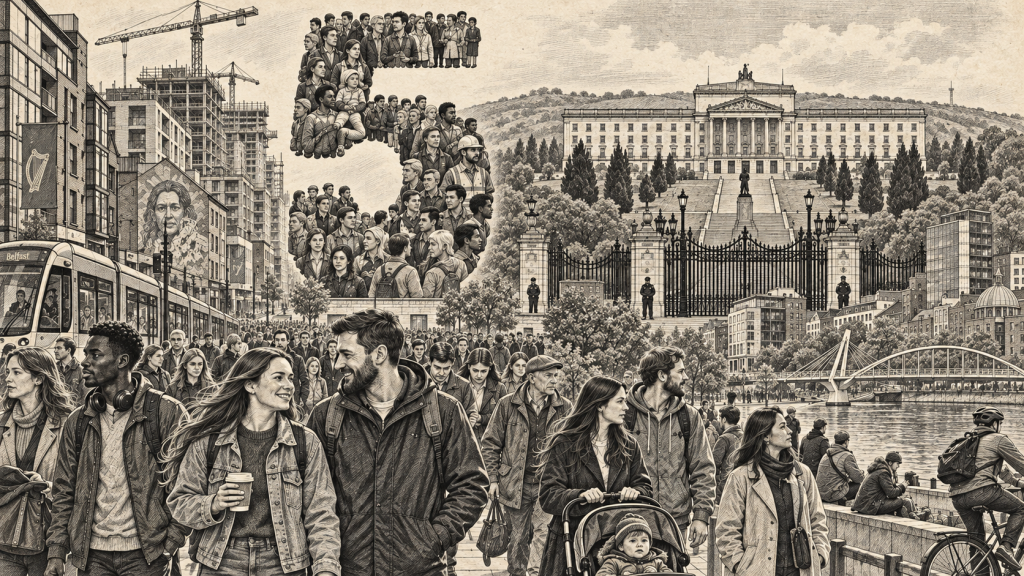
The Census taken on Sunday 3 April supplied a powerful measure of Ireland’s changing scale. Preliminary results released in June counted 5,123,536 people: the first census population above five million since 1851, and an increase of 361,671 since 2016. Every county had grown. Natural increase accounted for part of the change, but net inward migration was even larger. The figures registered a society made more diverse and populous by return migration, international migration and demographic momentum. They also explained why pressures on homes, schools, transport, general practice and other local services were so widely felt.
Housing was the sharpest of those pressures. The census showed a larger housing stock and fewer vacant dwellings than in 2016, but demand was rising faster than many people could secure an affordable place to live. Monthly homelessness returns during the year recorded increasing numbers in emergency accommodation. In July the Government approved tighter controls intended to curb the use of non-principal homes as short-term lets in rent-pressure zones, seeking to return properties to the long-term rental market. The measure was only one response to a problem rooted in supply, rents, construction costs and years of unmet need. For renters, young adults living with parents, families in temporary accommodation and communities receiving new arrivals, the housing shortage shaped daily decisions more than headline indicators of national prosperity did.
Health policy also reflected long-running institutional questions. On 17 May the Government approved the legal framework for relocating the National Maternity Hospital to the St Vincent’s University Hospital campus at Elm Park, Dublin. The proposal promised a modern co-located maternity hospital, but ownership, governance and the historical influence of religious institutions in Irish healthcare prompted extensive public scrutiny. The decision was significant precisely because it brought those questions into a contemporary setting: how a State that had liberalised abortion law in 2018 should guarantee public control and comprehensive care in a major women’s hospital.
Stormont Without an Executive
The most consequential political development north of the border occurred in the Northern Ireland Assembly election of 5 May. Sinn Féin won 27 of the 90 seats, ahead of the Democratic Unionist Party’s 25, becoming the largest party in the Assembly for the first time. The result was symbolically important in a polity created with a unionist majority, and it entitled Sinn Féin to nominate the First Minister under the power-sharing rules. Alliance’s advance to 17 seats also indicated support for a politics not defined solely by the unionist-nationalist division.
But the election did not produce a functioning Executive. The DUP refused to nominate a deputy First Minister or re-enter the Executive until its objections to the post-Brexit Northern Ireland Protocol were addressed. Since the offices of First Minister and deputy First Minister are joint and co-equal, the institutions remained stalled. In June the British Government introduced the Northern Ireland Protocol Bill, proposing unilateral changes to parts of the UK–EU agreement; the European Commission responded with legal action. For the Irish Government, protecting the Good Friday Agreement, avoiding a hard border on the island and preserving EU–UK cooperation remained inseparable aims. The impasse meant that an election of historic significance nevertheless left Northern Ireland without fully operating devolved government.
Climate, Culture and Centenaries
The physical environment supplied another warning. Met Éireann later confirmed that 2022 was Ireland’s warmest year on record, with an average temperature of 10.83°C. Phoenix Park reached 33.0°C on 18 July, Ireland’s highest temperature since 1887, while Durrow, County Laois, set a new August record of 32.1°C. Dry spring and summer conditions affected farming and water supplies in places, before wetter autumn weather and a sharp December cold spell altered the pattern. Against this background, the Government agreed sectoral emissions ceilings on 28 July, assigning maximum emissions for 2021–25 and 2026–30 across areas including electricity, transport, buildings, industry and agriculture. The ceilings converted Ireland’s broad climate commitments into politically difficult sectoral limits.
Public culture offered both continuity and reflection. The centenary of Ulysses, first published in 1922, brought readings, performances, exhibitions and Bloomsday gatherings to Dublin and beyond; Joyce’s imagined city became a stage for an international literary anniversary. In sport, full crowds returned to Croke Park: Limerick beat Kilkenny in the All-Ireland hurling final on 17 July, and Kerry defeated Galway in the football final a week later. These occasions mattered as shared rituals after years in which attendance and travel had been restricted.
2022 was also a centenary year for the institutions and ruptures of the revolutionary period. The State’s Decade of Centenaries programme treated the foundation of the Irish Free State in December 1922 as a process rather than a single uncomplicated triumph, while the destruction of the Public Record Office at the Four Courts and the Civil War received sustained attention. The launch of Beyond 2022: Ireland’s Virtual Record Treasury on 30 June made reconstructed archival material accessible after the loss of so much of the original record in 1922. On 17 December, the coalition’s planned rotation took place: Micheál Martin resigned as Taoiseach and Leo Varadkar was appointed in his place, with Martin becoming Tánaiste and Minister for Foreign Affairs and Defence. The handover was orderly. It closed a year in which the State marked a century of constitutional development while confronting urgent questions of welfare, climate, war and the future of the island.
Primary Sources
- Government announces that most of the public health measures currently in place can be removed
- COVID-19: Reframing the Challenge, Continuing our Recovery and Reconnecting
- Ending of COVID-19 requirements for travellers to Ireland
- Temporary Protection
- Update on provision of accommodation for those fleeing Ukraine and applying for international protection
- Quarterly Economic Commentary, Winter 2022
- Census of Population 2022 – Preliminary Results
- Homelessness data 2022
- Cabinet agrees to stronger controls on short-term lets
- Significant day for women’s health as Government approves legal framework for National Maternity Hospital relocation
- Budget Statement 2023 – Dáil Éireann, 27 September 2022
- Northern Ireland Assembly Elections: 2022
- Northern Ireland Protocol Bill
- Government introduces bill to fix the Northern Ireland Protocol
- Annual Climate Statement for 2022
- Sectoral Emissions Ceilings
- Taoiseach Micheál Martin, Tánaiste Leo Varadkar and Minister Catherine Martin announce the 2022 Programme for the Decade of Centenaries
- Home | Ulysses100
- 2022 GAA Hurling All-Ireland Senior Championship Final – Limerick 1-31 Kilkenny 2-26
- 2022 GAA Football All-Ireland Senior Championship Final – Kerry 0-20 Galway 0-16
- President Higgins presents the seal of the Taoiseach and seal of the Government to Leo Varadkar