Catholic Petition1805 CE
In 1805, Irish Catholics petitioned Westminster for equal political rights after the Union abolished Dublin’s parliament. Introduced by Charles James Fox and Lord Grenville, the loyal, constitutional appeal sought admission to Parliament and major offices, while rejecting papal temporal authority and threats to the Protestant establishment. Parliament decisively rejected it, exposing Catholic exclusion and establishing a pattern of failed emancipation campaigns until 1829. The state simultaneously transported Wicklow insurgent Michael Dwyer and companions to New South Wales. Ireland shared in Napoleonic war’s consequences after Trafalgar, while cultural life included Mary Tighe’s Psyche, William Rowan Hamilton’s birth, and Brian Merriman’s death.
Dateline
In 1805, Ireland’s largest political question was carried across the Irish Sea in the form of a petition. Four years after the Union had abolished the Dublin parliament, Irish Roman Catholics again asked the Westminster parliament for full participation in the political constitution of the United Kingdom. Their appeal did not produce relief. Its overwhelming rejection instead exposed the central contradiction of the new Union: an island with a Catholic majority was governed through a Protestant establishment and a legislature from which Catholics remained excluded.
A Petition to Westminster
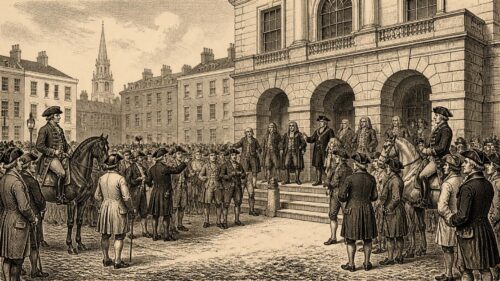
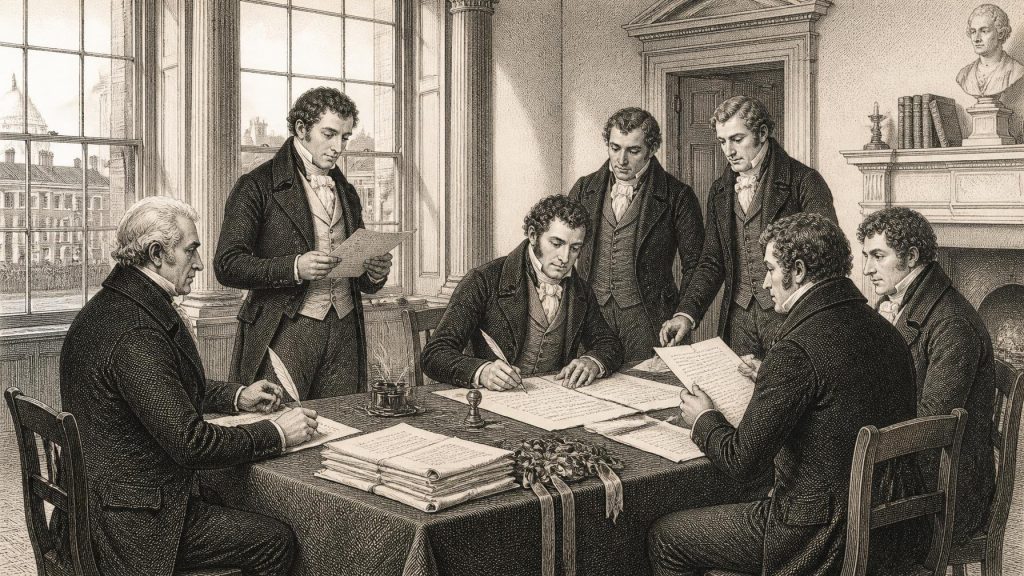
The petition was presented to both Houses of Parliament on 25 March. In the Commons, Charles James Fox introduced it; in the Lords, Lord Grenville did so. The manner mattered. After the violence of the 1798 rebellion and Robert Emmet’s abortive rising of 1803, the petitioners deliberately pursued a constitutional, public and peaceful route. They addressed Parliament as loyal subjects seeking redress, not as a body challenging the Crown or the Union.
The petition emphatically restated Catholic loyalty. It affirmed allegiance to George III and the Hanoverian succession, repudiated any claim that the pope possessed temporal jurisdiction in the realm, rejected religious persecution, and disclaimed an intention to overthrow the Protestant establishment. Such declarations were not incidental formalities. They answered the recurrent charge that Catholic political rights would entail a divided allegiance, threaten Protestant property, or revive the religious conflicts of earlier centuries.
What remained at issue was not freedom of worship alone. The relief measures of the late eighteenth century had removed many of the old penal restrictions. Catholics could own property, vote under the statutory franchise, practise at the bar and hold numerous offices. Yet they were still barred from Parliament and from major offices of state by oaths and tests incompatible with their faith. The petition therefore sought equal civil and political standing, on equal terms with other subjects.
Its timing gave the application unusual significance. Ireland had lost its own legislature on 1 January 1801. Advocates of Union had encouraged an expectation that Catholic claims might receive a fairer hearing in an imperial parliament than in the old Protestant-controlled parliament in Dublin. In 1805 Grenville acknowledged that no formal promise had been made, but argued that such hopes had plainly been raised. The petition became an early test of whether the Union would broaden political inclusion or preserve the old religious hierarchy within a new constitutional frame.
Debating Majority and Power
The debates of May laid bare sharply different readings of Ireland. Grenville told the Lords that Catholics formed roughly three quarters of the Irish population, a fact no government could prudently ignore. Fox made a similar argument in the Commons: excluding so large a share of the population while Britain fought Napoleonic France was neither just nor politically wise. Both men represented relief as a means of attaching Ireland more securely to the United Kingdom.
Supporters also contested the assumption that Catholicism and disloyalty were inseparable. They pointed out that the United Irish movement and the rebellions of 1798 and 1803 had drawn adherents from more than one confession and had sought political revolution rather than Catholic ascendancy. Fox urged Parliament not to turn past insurrection into a permanent collective accusation against Catholics who had petitioned in a restrained and lawful manner.
Opponents did not generally deny the personal loyalty or respectability of individual Catholic gentry. Their objection was constitutional and confessional. They held that the Protestant Church of Ireland had been secured by the Union, that Catholic admission to political power would jeopardise the established church, and that the Catholic hierarchy’s connection to Rome made equality in office unsafe. In speeches of extraordinary hostility, opponents imagined relief leading to the displacement of Protestants, the reopening of old property settlements and even separation from Britain. These were political arguments rooted in inherited fears, not predictions borne out by the petitioners’ declared programme.
The dispute also revealed a social limitation in the immediate campaign. Parliamentary eligibility and high office could directly benefit only a relatively small Catholic elite: landowners, lawyers, merchants and office-holders. Opponents used that point to dismiss the petition as irrelevant to ordinary people. Yet the issue reached much further. It asked whether a Catholic farmer who voted, paid rent and tithes, served in local society and raised a family under the law belonged fully to the state. The answer given in 1805 was still no.
Defeat in May
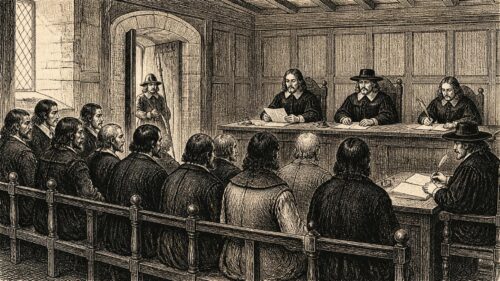
Lord Grenville’s motion to take the petition into committee was defeated in the Lords after debates on 10 and 13 May, by 178 votes to 49. Fox’s corresponding Commons motion was debated on 13 and 14 May and rejected by 336 votes to 124. The scale of the Commons majority was decisive. Parliament had received the Catholics’ case, debated it at length and then refused even the committee stage through which a measure of relief might have been shaped.
For Irish Catholic political leaders, the defeat was a grave disappointment but not an ending. It established a pattern that would recur for more than two decades: petitions, parliamentary speeches, rejection, and renewed organisation. The claim for emancipation survived because it could be articulated in the language of loyalty, equality before the law and the stability of the Union itself. Henry Grattan, returned to parliamentary life in 1805 as member for Malton, would soon become a leading advocate in the continuing campaign. Full Catholic emancipation, however, would not arrive until 1829.
Wicklow’s Prisoners Depart
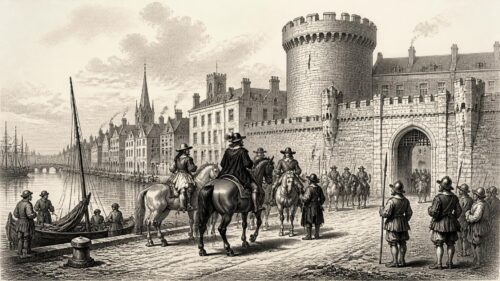
Political authority in Ireland was also visible in a more coercive form. On 25 July, Michael Dwyer left Kilmainham Gaol with his wife Mary, members of the Byrne family, Arthur Devlin, Martin Burke and John Mernagh. Dwyer had been the most durable guerrilla leader associated with the Wicklow aftermath of 1798. After surrendering in late 1803 on terms that had envisaged passage to America, he was held in prison instead. In 1805 he and his companions were sent from Dublin via Cork towards New South Wales.
The transport ship Tellicherry sailed from Cork on 31 August. Dwyer’s removal ended a conspicuous remnant of armed resistance in the Wicklow mountains, but it also showed that the state’s response to rebellion extended beyond executions and local imprisonment. Transportation separated political prisoners from their networks and remade their lives across the empire. Dwyer reached Port Jackson in February 1806; the decision and departure belonged unmistakably to 1805.
For people in Wicklow and Dublin, this was a visible reminder that the relative quiet after Emmet’s rising rested partly on surveillance, garrisons, prisons and the threat of exile. The constitutional petition and the transport ship were very different responses to the Union’s unsettled politics. They occurred in the same year, and together demonstrate the narrow space available for Irish dissent: parliamentary advocacy was defeated, while a former insurgent leader was removed to the other side of the world.
War at Sea, Culture at Home
Ireland was tied to the wider Napoleonic war in ways that reached ports, recruitment and commercial life. On 21 October the Royal Navy defeated the combined French and Spanish fleets at Trafalgar. Irish-born men served among the naval personnel whose birthplaces and careers are preserved in Admiralty muster records. The battle was fought off Spain, not Ireland, but it mattered directly to an island whose security, Atlantic trade and communications depended on British command of surrounding waters.
War also formed the background to the parliamentary debate. Opponents of relief repeatedly invoked the prospect of French invasion and unrest in Ireland; supporters replied that exclusion weakened rather than strengthened the state. Trafalgar did not resolve the Catholic question, but the destruction of the immediate invasion threat changed the strategic atmosphere in which British governments considered Ireland.
Irish cultural life nevertheless registered quieter landmarks. Mary Tighe’s Psyche; or, the Legend of Love was privately printed in 1805 in a small edition for circulation among friends and admirers. Its elaborate Spenserian stanzas and classical subject belonged to a cultivated Anglo-Irish literary world, yet its later influence gave the book a lasting place in Irish Romantic writing. The modest initial printing is a useful reminder that books could travel through sociable networks before reaching a wider public.
On the night of 3–4 August, William Rowan Hamilton was born in Dominick Street, Dublin. Nothing in that infancy foretold the mathematical discoveries for which he would later become famous, but his birth belongs to the city’s learned and professional milieu: his father was a Dublin attorney and his mother came from the Hutton coach-building family. At the other end of a life, the poet and mathematics teacher Brian Merriman died in Limerick on 27 July. Best remembered for the Irish-language poem Cúirt an Mheán Oíche, Merriman’s death marked the passing of a writer whose work retained a vigorous, comic and socially observant Irish voice.
An Unsettled Union
Thus 1805 brought no single Irish turning point comparable to rebellion or famine. Its importance lies in the clarity with which it displayed the new order’s tensions. Westminster was now the arena in which Irish constitutional claims had to be made. Catholic leaders tested that arena with a disciplined petition and found a commanding majority against them. The government removed an inconvenient rebel survivor by transportation. Meanwhile Ireland’s people remained connected to imperial war, and its writers and scholars continued to create work whose consequences would outlast the year’s parliamentary defeat.
The failed petition did not make emancipation inevitable, nor did it settle the question. It did something more immediate: it demonstrated that, in 1805, the Union had united legislatures without reconciling the religious and political divisions that shaped everyday Irish life.
Primary Sources
- Roman Catholic Petition, House of Commons, 25 March 1805
- Roman Catholic Petition, House of Lords, 25 March 1805
- Roman Catholic Petition, House of Lords, 1 April 1805
- Roman Catholic Petition, House of Lords, 10 May 1805
- Roman Catholic Petition, House of Lords, 13 May 1805
- Roman Catholic Petition, House of Commons, 13 May 1805
- Roman Catholic Petition, House of Commons, 14 May 1805
- Catholic Emancipation
- Holdings: Report of the Debate in the House of Commons on Mr Fox's Motion for the House to Resolve Itself into a Committee on the Catholic Petition
- The Irish Catholic Petition of 1805: The Diary of Denys Scully
- Michael Dwyer 1772–1825
- Transportation
- Trafalgar Ancestors: About the Database
- Trafalgar Ancestors: Advanced Search
- Battle of Trafalgar
- Tighe, Mary
- Sources for Irish Women’s History: Mary Tighe, Psyche or the Legend of Love
- Psyche; or, the Legend of Love, 1805
- Hamilton, Sir William Rowan
- Merriman, Brian
- Part 17 of History of the Commercial and Financial Relations between England and Ireland from the Period of the Restoration
- Scarcity and Poor Relief in Eighteenth-Century Ireland: The Subsistence Crisis of 1782–4