Margaret McNamara’s Statute1707 CE
In 1707, Ireland’s brief Dublin parliamentary session exposed post-Williamite government: Protestant elites contested office and revenue, while efforts to admit Protestant Dissenters failed. Legislation created the framework for the Registry of Deeds, protecting property transactions while reinforcing Protestant possession. Margaret McNamara’s abduction prompted safeguards for heiresses and further controls on Catholic marriage. Penal measures restricted Catholic legal participation, religious observance and civic status, while anti-rapparee laws linked crime, vagrancy and suspected disloyalty. Dublin gained a Ballast Office, statutory security for Marsh’s Library, and St Anne’s parish. Measures promoted agriculture and manufacture. Britain’s Anglo-Scottish union excluded Ireland, leaving its parliament separate.
Dateline
In 1707 CE, Ireland’s political life was concentrated in a short but consequential parliamentary session at Dublin, while the wider kingdom experienced the daily pressures of law, landholding, religion, labour and security. There was no single battle or rebellion to define the year. Instead, legislation and proclamations exposed the character of post-Williamite Ireland: government was conducted for a Protestant political interest, Catholic people and institutions faced renewed constraints, and Dublin acquired foundations for institutions that would shape property, learning and commerce for centuries.
A New Lord Lieutenant
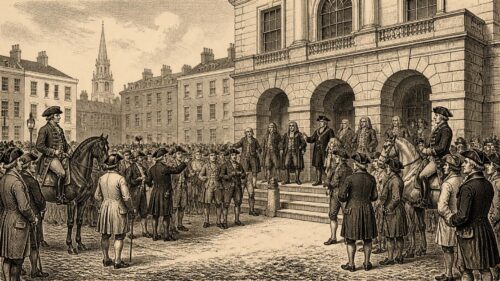
The year opened amid a change at the top of the Irish administration. James Butler, second duke of Ormond, was removed as lord lieutenant on 30 April. His replacement, Thomas Herbert, eighth earl of Pembroke, was appointed with instructions to form a more balanced administration at a time when Irish Protestants were increasingly divided between whig and tory alignments. Pembroke’s arrival in Dublin on 30 June preceded the opening of parliament on 1 July.
The personnel of government signalled the intended adjustment. Richard Freeman replaced Sir Richard Cox as lord chancellor, Alan Brodrick became attorney general in June, and George Doddington arrived as chief secretary. Yet this was not a democratic broadening of Irish government. The struggle was principally within the Protestant political elite: office-holders, bishops, lawyers, borough interests and substantial landowners disputed how the kingdom should be governed and how closely its interests should follow those of the ministry in London.
Pembroke had been asked to seek repeal of the sacramental test attached to the 1704 Act to Prevent the Further Growth of Popery. That clause excluded Protestant Dissenters, including many Presbyterians, from crown and municipal office unless they conformed to the sacramental requirements of the established Church of Ireland. The proposal failed. It encountered determined hostility in the Irish parliament, where high-church sentiment was powerful. This failure is important: even an attempt to unite Protestants against a presumed Catholic threat foundered on disagreement over which Protestants could properly share public authority.
Supply was another test. The crown wanted a grant for two years; Brodrick and others had argued for shorter grants as a means of retaining parliamentary leverage over ministers. A compromise produced revenue for a year and three quarters. The episode was not a declaration of Irish independence, but it showed an established political habit: MPs could affirm loyalty to Queen Anne while resisting a government demand for finance on its preferred terms.
Property, Inheritance and Exclusion
The session ended on 30 October with a substantial body of legislation. Its most enduring measure was the Registration of Deeds Act. It provided for a public office in Dublin to register memorials of conveyances and wills affecting land. The register would not begin operating until 25 March 1708, and the first memorial was entered four days later, so it would be wrong to imagine a functioning registry during 1707 itself. Nevertheless, the act of 1707 created the framework.
Its stated purpose was to protect purchasers and prevent fraudulent conveyances. But its language also explicitly portrayed supposed abuses by “papists” as a threat to the Protestant interest. The new system therefore belonged both to a developing culture of written title, credit and landed transaction and to the penal order that sought to secure Protestant possession after confiscation and settlement. Registration was not compulsory under the original act, but a registered deed gained priority over an unregistered one. In time, that made the Registry of Deeds a major archive of Irish property and family history; in 1707, it marked an effort to make landholding more legible to the state and safer for those recognised by it.
A second statute reveals the intimate relationship between property, family authority and religion. The Act for preventing the taking away and marrying of children against the will of parents or guardians strengthened penalties for the abduction and marriage of wealthy minors. Its preamble referred specifically to Margaret McNamara, described as a thirteen-year-old heiress allegedly taken by John O’Brien on 18 April. The act arranged protections for her fortune if a marriage had occurred. An official proclamation of 1 August offered a reward for the apprehension of her abductors.
This was not simply a private scandal elevated into law. It shows why inheritance was a matter of public power. A marriage could transfer an heiress’s estate, redirect a lineage’s land and alter the standing of families. The statute also made a Catholic priest who knowingly married a Protestant, or performed such a prohibited marriage, liable to the harsh penalties imposed on a Catholic regular clergyman. Thus a law ostensibly protecting minors also extended confessional control over marriage and property.
Other measures bore down more directly on Catholics. One act made it easier to prosecute Catholics acting as solicitors, agents or clerks in legal business without the required oaths, raised the financial penalty, and restricted Catholic service on grand juries unless insufficient Protestants could be found. Such provisions did not mean that Catholics ceased to use law, make contracts or defend interests. They did mean that access to legal professions, court records and juries was deliberately narrowed by religion.
Order, Labour and Fear
The year’s laws and proclamations also provide unusual glimpses of insecurity. The Tories, Robbers and Rapparees Act took effect from 29 September. “Rapparee”, once associated with irregular soldiers of the Williamite war, had become an official label for robbers and suspected lawbreakers. The act treated crime, vagrancy and social dependence as closely connected. It targeted people described as idle wanderers, including those claiming the status of Irish gentlemen while refusing regular work, and authorised their imprisonment and possible transportation to the fleet or plantations unless they found security for good behaviour.
Its language was deeply coercive and sectarian. The act alleged that Catholics supplied intelligence to French enemies and that French privateers were often manned by Irish Catholics; where robberies were attributed to that danger, compensation might be levied on Catholic inhabitants of the locality. These allegations should not be mistaken for proof that whole communities were disloyal. They show, rather, how wartime fears during the War of the Spanish Succession gave officials a legal vocabulary for collective suspicion and financial punishment.
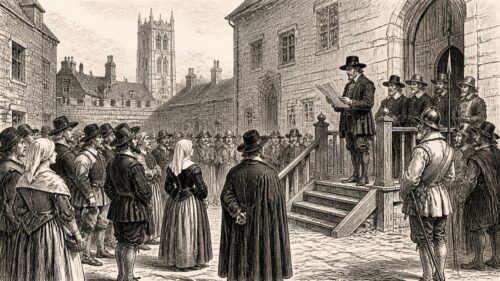
Proclamations from later in the year show the state’s practical preoccupations: soldiers were ordered back to their quarters; rewards were offered in cases of murder, arson, sheep-killing and theft of beehives; and a reward was issued against rapparees responsible for murder in County Longford. A proclamation of 1 August also fined people who refused to work on Catholic holy days and forbade Catholic priests from publicly announcing such days. These orders cannot measure everyday compliance, but they demonstrate that religious observance, rural labour and public order were treated as connected matters of government.
Dublin’s Institutional Year
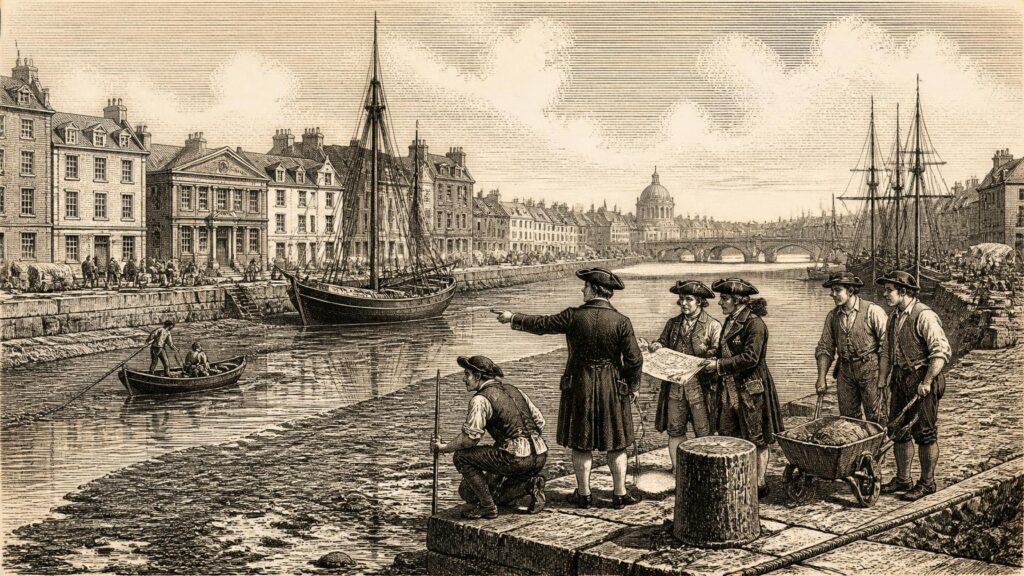
For Dublin, 1707 was especially significant. On 24 October parliament passed an act for cleansing the city’s port, harbour and river and erecting a Ballast Office. A ship’s ballast was essential to stability, but the institution’s remit was larger than its name suggests: it placed the improvement and management of the Liffey approach on a firmer corporate footing. Dublin’s shallow, shifting river entrance constrained a port on which the capital depended for food, fuel, passengers, military movement and overseas commerce. The act did not instantly create the later quays and walls, but it established an administrative beginning for their long transformation.
On 17 September, Thomas Burgh, surveyor general of Ireland, presented thoughts to the Dublin Society on improving the harbour, warning of the dangerous bar across the river mouth and proposing sheltered accommodation for shipping. His intervention and the Ballast Office legislation belong together as evidence of a growing practical concern with urban infrastructure. Dublin was not merely the seat of a parliament: it was a working port city whose commercial future depended on managing water, silt, ships and access to the Irish Sea.
The same parliamentary session secured Marsh’s Library. In October an act settled and preserved the library founded by Narcissus Marsh, archbishop of Armagh, in the building beside St Patrick’s Cathedral. Marsh had brought the large Stillingfleet collection to Ireland in 1705 but withheld it until the institution had statutory security. The 1707 act enabled the library to open to readers and placed it under Governors and Guardians, among them Jonathan Swift, dean of St Patrick’s. It was Ireland’s first public library: not public in the modern sense of universal education or equal access, but a remarkable provision for readers outside a university or cathedral library.
Its shelves represented a European scholarly world: theology, classical learning, languages, mathematics, natural history and astronomy, alongside material relevant to Ireland. In a kingdom where formal political power was restricted and literacy uneven, the preservation of such a collection was still a notable cultural investment. It connected Dublin’s Protestant ecclesiastical establishment to the intellectual currents of the early Enlightenment.
Trade, Parish and the British Union
Economic legislation pointed in several directions at once. Parliament passed measures encouraging hemp and flax manufacture and the exportation of corn, while another act addressed the standard of butter casks. Such acts suggest official hopes of expanding tillage, improving marketable produce and supporting linen-related production, particularly significant after the restrictions imposed on Irish woollen exports at the end of the previous century. They should not be read as proof of immediate prosperity: statutes announced policy and incentives, not guaranteed harvests, capital or markets.
Dublin’s physical growth also received a religious-administrative expression. The St Anne’s Parish Act divided existing parishes and created the parish of St Anne in the developing ground between Grafton Street and Merrion Street. Parish boundaries mattered beyond worship. They helped organise local taxation, poor relief, church repair, burial, moral regulation and neighbourhood identity. The measure records expansion on Dublin’s eastern side, where fashionable and commercial development was beginning to reshape the city.
Finally, 1707 was the year in which the union of England and Scotland created the kingdom of Great Britain. Ireland was not included. It remained a separate kingdom under the same crown, with its own parliament, but under severe constitutional and commercial constraints and without representatives at Westminster. Some Irish observers suggested an Irish union with the new British state, yet no such settlement followed. The contrast sharpened an existing question: Ireland possessed a parliament, but how far could it determine the laws, revenue and trade of the kingdom?
A Year Written into Institutions
1707 is best remembered not for a dramatic change in sovereignty but for the mechanisms it left behind. The Registry of Deeds promised more secure Protestant property; the penal statutes and proclamations made exclusion more exacting; the McNamara case exposed the stakes of marriage and inheritance; and Dublin gained statutory support for its port and library. Together these developments show an Ireland where state power reached into title deeds, juries, holy days, labour, family arrangements, books and the river that supplied the capital.
Primary Sources
- Registration of Deeds Act 1707
- Our History
- Introduction to the Memorials and Transcription Books at the Registry of Deeds
- Discover Our History
- Marsh's Library Background, Purpose & Vision
- Herbert, Thomas
- Brodrick, Alan
- HERBERT, Thomas (c. 1656-1733)
- The Sixth Year of Anne – Chap. VI.
- The Sixth Year of Anne – Chap. XI.
- The Sixth Year of Anne – Chap. XVI.
- Statutes in Chronological Order – The Reign of Queen Anne
- Statute Law Revision Act 2015
- Constitutional Differences
- History of Port
- Dublin Port Archive
- Dublin in 1707: A Year in the Life of the City
- Report on Vagrancy and Related Offences
- History of the Commercial and Financial Relations between England and Ireland from the Period of the Restoration
- The Patronage Network of the Duke of Ormond
- Additional MS 61633 – British Library Archives and Manuscripts Catalogue
- Statutes Passed by the Irish Parliament, 1692-1800