Belfast Volunteers1780 CE
In 1780, Irish commercial concessions eased some restrictions on trade, but their dependence on Westminster reinforced Patriot demands for legislative authority. Henry Grattan’s April motion declaring that only Ireland’s King, Lords and Commons could legislate for the kingdom was defeated. On 13 July, 2,700 Ulster Volunteers assembled at Belfast and publicly endorsed the principle, transforming a defence force into a political movement. Volunteers connected civic organisation, commerce and constitutional agitation, although they were Protestant and excluded most Catholics. War, economic uncertainty and reform shaped the year. Administrative change brought Carlisle as lord lieutenant, but Ireland entered 1781 without legislative independence.
Dateline
In 1780, Ireland’s most consequential public act was neither a battle nor a statute passed in Dublin. It was an address carried by armed Volunteers at Belfast in July: a declaration that only the King, Lords and Commons of Ireland could make laws binding the kingdom. The claim had not become law, and its advocates had not yet won their constitutional contest. Yet the gathering showed that a movement raised ostensibly for defence against foreign attack had become an organised political force. In a year of imperial war, uncertain commerce and restricted political rights, the question of who could govern Ireland moved decisively from learned argument to public mobilisation.
Concessions Without Security
The immediate background was the commercial agitation of 1779. Ireland had long been constrained by legislation made at Westminster: restrictions bore especially heavily on overseas trade and manufacturing, while war disrupted customary markets and shipping. Under pressure from Irish merchants, parliamentary Patriots and Volunteer corps, the British government began removing particular restrictions late in 1779. Further measures followed during 1780. On 24 February, an Act permitted trade between Ireland and the British colonies and plantations in America and the West Indies on terms comparable to those available from Britain; another March measure widened Irish access to imports and exports available to British merchants in the Levant trade.
These changes mattered. They enlarged the legal scope for merchants at Dublin, Cork, Belfast, Limerick, Waterford and smaller ports to seek markets beyond the old narrow channels. They also gave a powerful boost to the language of Irish economic improvement. Manufacturers, exporters, shipowners and shopkeepers could plausibly hope that linen, provisions, glass and other goods might find wider outlets. The Dublin Society, continuing its practical work in agriculture, manufactures and the useful arts, recorded proceedings from November 1780 which demonstrate that schemes of ‘improvement’ remained part of the institutional life of the capital.
But free trade was incomplete, conditional and vulnerable. Ireland remained excluded from the East India Company’s monopoly, and the wartime Atlantic was hazardous rather than open. More fundamentally, the concessions had been bestowed by Acts of the British parliament. For Patriots, that exposed their weakness: what Westminster had relaxed, Westminster might restore. Commercial relief therefore sharpened, rather than settled, the constitutional dispute. It encouraged the conviction that a secure Irish economy required a legislature whose authority was itself secure.
Grattan’s Defeated Resolution
That argument reached the Irish House of Commons on 19 April. Henry Grattan, MP for Charlemont and the outstanding parliamentary voice of the Patriot interest, moved for a declaration of Irish legislative right. His proposed principle was direct: the King, Lords and Commons of Ireland alone were competent to enact laws binding Ireland. The motion challenged the practical consequences of Poynings’ Law, under which Irish bills passed through the Irish and British privy councils before reaching parliament, and the claim made by the British Declaratory Act of 1719 to legislate for Ireland and to determine Irish appeals.
Grattan’s speech was an event in itself. Francis Wheatley’s great contemporary painting of the Irish House of Commons fixes the scene in the public imagination: a crowded chamber, attentive members and Grattan rising at the right of the table. The artwork should not be mistaken for a literal transcript of every person present or every word spoken, but it is valuable evidence of the drama and social visibility of parliamentary politics. The debate lasted into the following morning. Grattan’s motion was defeated. No constitutional independence was established in 1780, and Dublin Castle still commanded a substantial parliamentary following.
Defeat did not diminish the issue. Grattan had given a coherent parliamentary form to sentiments already circulating among Volunteers, merchants and political clubs. His case did not demand separation from the Crown. On the contrary, Patriots commonly envisaged Ireland and Great Britain as connected by a shared monarch, while insisting that Ireland was a distinct kingdom with its own legislature. That distinction is essential: the politics of 1780 concerned legislative authority within the British and imperial connection, not an achieved modern national independence.
Armed Citizens at Belfast
The Volunteers supplied the year’s most striking demonstration of organised opinion. They had emerged from 1778 amid fears of French attack while regular forces were committed elsewhere in Britain’s expanding war against the American colonies, France and Spain. Locally raised corps drilled, paraded, elected or accepted officers, acquired uniforms and arms, and cultivated the language of patriotic service. They were unpaid part-time associations rather than a regular army. Their strength cannot responsibly be reduced to one certain figure: contemporary and later estimates varied greatly, while companies differed widely in activity, equipment and social composition.
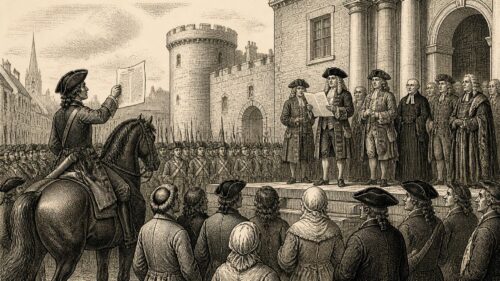
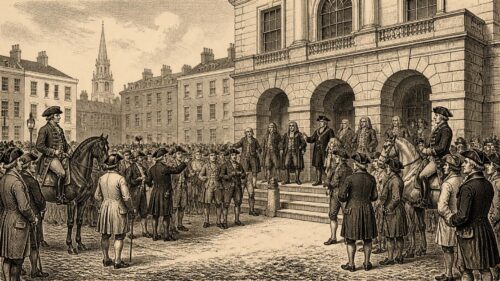
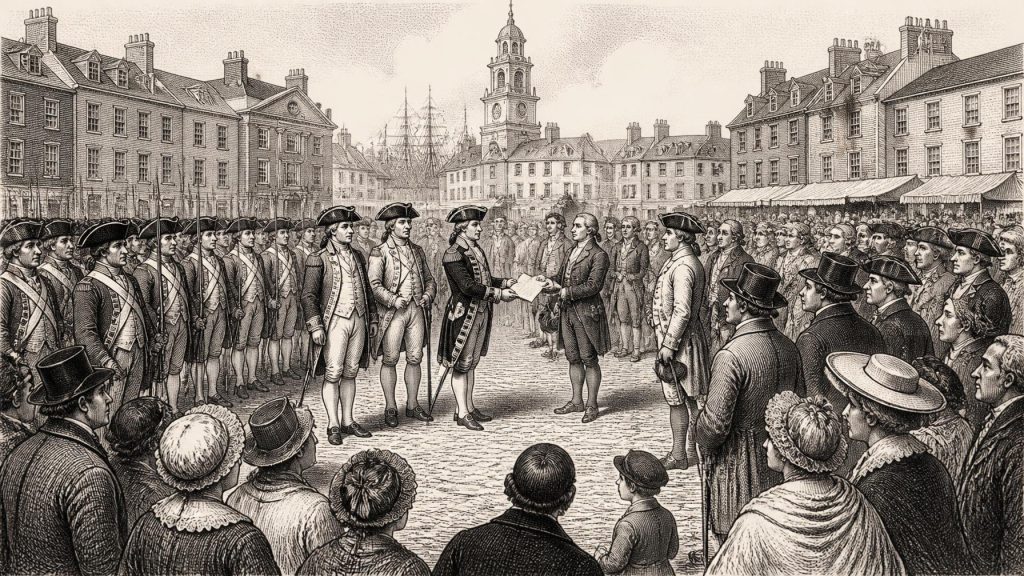
What is firmly dated is the Belfast assembly of 13 July 1780. An Ulster Volunteer contingent reported as 2,700 strong assembled there and addressed James Caulfeild, earl of Charlemont, who had assumed the largely honorary but influential role of Volunteer commander-in-chief. The address asserted that the King, Lords and Commons of Ireland alone possessed the power to bind the kingdom. It thus took Grattan’s defeated proposition beyond College Green and placed it before a large armed gathering in the leading commercial town of Ulster.
The significance lay in organisation as much as numbers. Belfast’s merchants, Presbyterians, artisans and professional men inhabited a town closely tied through trade and migration to the Atlantic world. Volunteer reviews linked local corps into county battalions and provincial networks; addresses, resolutions, newspapers and correspondence allowed political language to travel with them. At Newtownstewart in March, for example, companies were formally combined as the Tyrone Battalion, with named officers, chaplain, surgeon and adjutant. Such records reveal the civic infrastructure behind the parade ground: subscriptions, committee work, ranks, medical provision, clerical participation and print.
Yet the Volunteers did not represent all Ireland. They were overwhelmingly Protestant, and their leadership rested principally with landed gentlemen and the middling ranks of Protestant urban society. Catholics remained excluded from parliament and from the franchise, and laws against Catholic arms continued to shape who could safely and lawfully serve. Their political language could invoke ‘the nation’, but the constitutional public of 1780 was narrowly constituted. The movement nevertheless enlarged political participation beyond the small electorate and made it harder for ministers to treat public opinion as confined to the House of Commons.
War, Religion and Everyday Constraint
Foreign war gave the Volunteers their original justification and remained present in everyday government. A proclamation issued in late December 1779 appointed a general fast throughout Ireland for 4 February 1780. Such observance joined religious practice to the Crown’s wartime appeal for national penitence and divine favour. Government notices during the opening months also warned that assistance to the king’s enemies would be rigorously prosecuted and offered pardons to military deserters who surrendered before May. These were routine instruments of a state under pressure, but they indicate why defence, loyalty and political rights were entangled.
Religion also marked the limits of reform. The Catholic Relief Act of 1778 had permitted Catholics, subject to an oath, to take long leases and inherit property more securely; this mattered in a land of leasehold estates and could encourage investment and improvement. It did not grant a vote, a seat in parliament or equal access to public power. No comparable general Catholic emancipation occurred in 1780. The Volunteer agitation could therefore combine a rhetoric of Irish liberty with a political order in which the great Catholic majority remained excluded. Presbyterians, though increasingly prominent in Ulster’s commercial and Volunteer life, also lived under an established Church of Ireland system which did not reflect their religion.
For most households, high constitutional argument was filtered through prices, employment, rents, credit and local security. The earlier commercial crisis had been severe, and opening new legal routes did not instantly create customers, ships or capital. War could create demand for provisions and shipping while simultaneously raising risk, interrupting exchange and drawing men into military service. In rural districts, the rhythms of tillage, livestock and seasonal labour continued; in towns, workshops, quays, markets and shops depended on credit and access to imports as well as local demand. The promise of freer trade was therefore compelling precisely because material improvement was uncertain.
A Changing Administration
The parliamentary session which had opened in October 1779 ended on 2 September 1780. John Hobart, earl of Buckinghamshire, left the viceroyalty amid ministerial dissatisfaction with the handling of Ireland’s mounting political tensions. Frederick Howard, fifth earl of Carlisle, was appointed lord lieutenant on 29 November and sworn in on 23 December, accompanied by William Eden as chief secretary. This was an administrative change, not a settlement. Carlisle inherited an Irish parliament still constrained by constitutional procedures, a Castle administration dependent upon management and patronage, and Volunteer bodies increasingly ready to speak on public affairs.
Across the Atlantic, news of Ireland’s commercial gains had already acquired symbolic value. On 17 March 1780 George Washington ordered that work and fatigue parties in the Continental Army cease for St Patrick’s Day, congratulating the Irish people on proceedings thought likely to relieve trade restrictions and advance the American cause. The gesture did not make Irish Patriots allies of the American revolutionaries, nor did it erase their loyalty to George III. It does show, however, that Irish commercial and constitutional controversy belonged to a wider Atlantic argument about representation, liberty, war and imperial power.
By year’s end, Ireland had not gained legislative independence; that lay in the future and must not be read back into 1780. Its achievements were more provisional but historically important. Commercial barriers had been materially loosened. Grattan had made Irish legislative right the central Patriot demand. At Belfast, Volunteers had shown that armed civic associations could turn that demand into a public programme. The kingdom entered 1781 with the constitutional issue unresolved, but no longer avoidable.
Primary Sources
- Grattan, Henry | Dictionary of Irish Biography
- Caulfeild, James | Dictionary of Irish Biography
- Howard, Frederick | Dictionary of Irish Biography
- Meeting Ireland’s Terms | UK Parliament
- History of the Commercial and Financial Relations between England and Ireland from the Period of the Restoration
- Part 12: History of the Commercial and Financial Relations between England and Ireland from the Period of the Restoration
- Belfast Battalion, August 28th, 1780 | National Library of Ireland Catalogue
- An Alphabetical List of the Various Corps of Irish Volunteers | National Library of Ireland Catalogue
- Proceedings 1780 | RDS Digital Archive
- The Dublin Gazette, Number 3780, February 1780 | Virtual Record Treasury of Ireland
- The Registry of Deeds – Delving Deeper | Virtual Record Treasury of Ireland
- Statute Law Revision Act 2015
- General Washington’s St Patrick’s Day General Order | Mount Vernon
- St Patrick’s Day 1780 in Jockey Hollow | U.S. National Park Service
- The Catholic Question in the Eighteenth Century | History Ireland
- The Catholic Relief Act, 1778
- Patriotism, Classical Republicanism, and the Volunteers, 1780–1782 | Oxford Academic
- 1782–85: Fencible Men and the Militia Reconsidered | Cambridge Core
- A Collection of Several British and Irish Acts Relating to the Trade and Revenue of Ireland | Folger Shakespeare Library
- Acts of the Privy Council: Colonial Series, Volume V | Ames Foundation, Harvard Law School
- Irish House of Commons 1780 with Henry Grattan Urging Claim of Irish Right | UK Parliament Heritage Collections
- Henry Grattan, by Francis Wheatley, 1780 | National Portrait Gallery
- Wheatley, Francis | Dictionary of Irish Biography
- Some Thoughts on the General Improvement of Ireland | Wellcome Collection