Suairlech’s Uncertain Year869 CE
Ireland’s history for 869 is defined by chronological uncertainty. Annalistic material aligned with AD 869 is conventionally discussed under 870, requiring caution over events including Suairlech’s death at Clonard. Áed Findliath, king of Tara, was consolidating authority after his 868 victory over opponents from Brega, Leinster and Scandinavian groups. Ireland remained tense, with Leinster, Osraige and Dublin poised for conflict. Clonard, a major religious and political centre, faced the impending loss of its influential bishop-abbot. Violence, including Amlaíb’s assault on Armagh, exposed ecclesiastical vulnerability. The following year’s Leinster campaign illuminates pressures building, while Dublin’s Scandinavian power shaped alliances and rivalries.
Dateline
For Ireland in 869, the most important fact is a problem of dating. The surviving annals preserve a sequence headed by the Kalends of January which their modern editor aligns with AD 869, yet the same material is conventionally discussed under 870 in modern historical works. This is not a trivial technicality. It means that a careful account of 869 must resist shifting an attractive story backwards by a year merely to fill the page. The kingdom of Tara, Leinster and Osraige were moving towards a major confrontation; the great church of Clonard was nearing a change of leadership; and Scandinavian power based at Dublin remained a decisive factor in Irish politics. But the fullest reports of these developments belong securely to the following annalistic year, conventionally 870.
That uncertainty itself reveals something important about early medieval Ireland. Events were recorded in monastic chronicles, copied and reorganised over generations. Their year headings were calculated through systems based on Kalends and regnal reckonings, rather than by a universally administered civil calendar. A modern date is therefore often a scholarly reconciliation, not an original timestamp. The annals can be exceptionally precise about people, places and violence, while still requiring care over the year to which an entry belongs.
A King of Tara After Rebellion
In 869, Áed Findliath of Cenél nÉogain was king of Tara, the position conventionally treated as Ireland’s foremost overkingship. His authority was real but negotiated. It depended on kinship, military followings, alliances with provincial rulers, church connections, tribute and the taking of hostages; it was not a central government ruling a unified state. Áed had succeeded in 862 or 863, after the death of Máel Sechnaill mac Máele Ruanaid of Clann Cholmáin, and was still consolidating a kingship whose reach varied sharply from region to region.
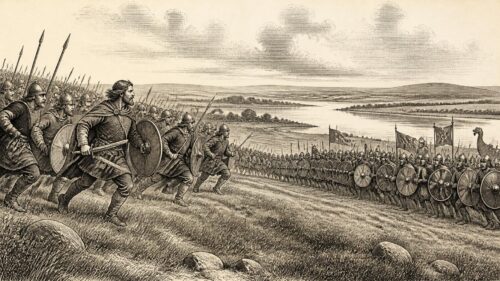
The immediate political background was tense. In 868, according to the corrected chronology of the principal annals, Áed defeated a coalition at Cell Ua nDaigri, probably in the Boyne region. The opposition included Flann mac Conaing of Brega, men of Leinster and some Scandinavian forces. Flann was killed, but so was Fachtna, a member of Áed’s northern Uí Néill following. The battle was neither a simple Irish victory over foreign raiders nor a national war. It was a contest among Irish dynasties in which Vikings could be allies, hired fighters or independent political actors.
That aftermath matters for 869. Leinster had helped oppose Áed, while Brega lay close to the contested approaches to Tara and to the Scandinavian base at Áth Cliath, Dublin. The absence of a securely dated great battle in 869 should not be mistaken for calm. Rather, Ireland stood in the interval after a damaging clash and before further royal pressure on Leinster. The political landscape was one of armed readiness, uncertain submission and carefully maintained alliances.
Clonard and Suairlech
The figure most closely associated with the date problem is Suairlech ind Eidnén, bishop, anchorite and abbot of Clonard in modern County Meath. The Annals of Ulster praise him as the finest exponent of religion in all Ireland. Such language is formulaic but meaningful: it identifies him as a churchman of national standing, not simply the head of a local religious house. He had already appeared at major royal assemblies in 851 and 859, where the leading clerics of Mide stood alongside powerful secular rulers.
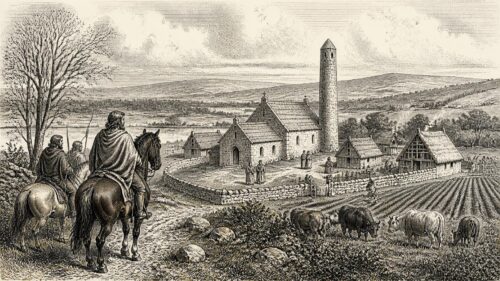
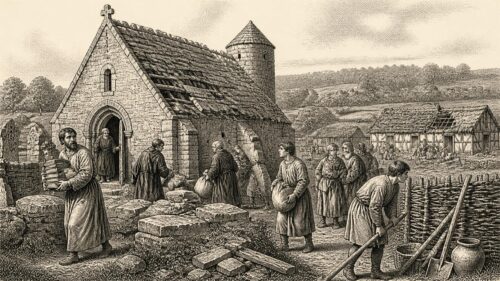
Clonard, Cluain Iraird or ‘Irard’s meadow’, was a major ecclesiastical centre in the Irish midlands. Its prestige rested on the remembered authority of its founder, Finnian, but in the ninth century its importance was also practical. A leading monastery was a landed community, a place of worship, hospitality, education, writing and political negotiation. Its senior clergy could witness agreements, foster ties with ruling families and help define what legitimate kingship looked like. Archaeological survey at Clonard has identified subsurface features consistent with an extensive former monastic settlement, although the visible medieval complex has not survived.
Suairlech’s death is recorded in the annalistic sequence whose heading is aligned by CELT with AD 869, but the parallel chronicles and modern biographical reference works conventionally place it in 870. A martyrological commemoration, probably on 23 April, reinforces the existence of a later cult but does not remove the chronological difficulty. It would therefore be unsafe to state flatly that Suairlech died during calendar year 869. What can be said is that, in or extremely close to this year, the community of Clonard was approaching the loss of a particularly influential abbot. His eventual successor, Áedán, is barely visible in the sources, a reminder that even great institutions often preserve the names of renowned leaders more readily than the workings of succession.
Religion in a Violent Political World
The language used for Suairlech also shows how ninth-century Irish religious life cannot be separated from politics. He was both bishop and abbot, while ‘anchorite’ marked an ideal of ascetic devotion. These descriptions should not suggest separate modern professions. A senior cleric could combine pastoral rank, institutional leadership, learning and a reputation for personal holiness. Monasteries were not remote from the world: they were nodes in the networks through which kings travelled, goods moved and written memory was produced.
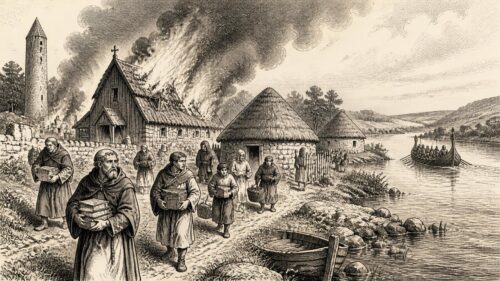
Yet the churches were vulnerable. The previous year’s annals record the plundering and burning of Armagh by Amlaíb, with its oratories burned and a stark claim that one thousand people were carried off or killed. The number may be rhetorical or rounded, and it should not be treated as a census. Still, the entry conveys the scale of shock felt by an ecclesiastical centre that was also rich in movable wealth and human resources. For communities such as Clonard, 869 was lived in the shadow of such attacks: books, metalwork, livestock, food stores and captives were all at risk when armies or fleets moved.
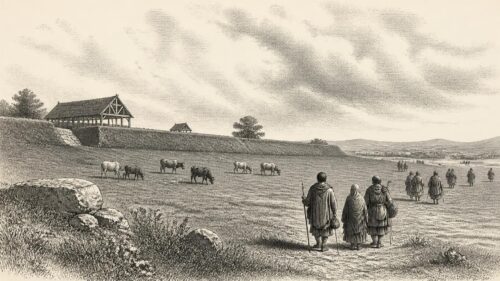
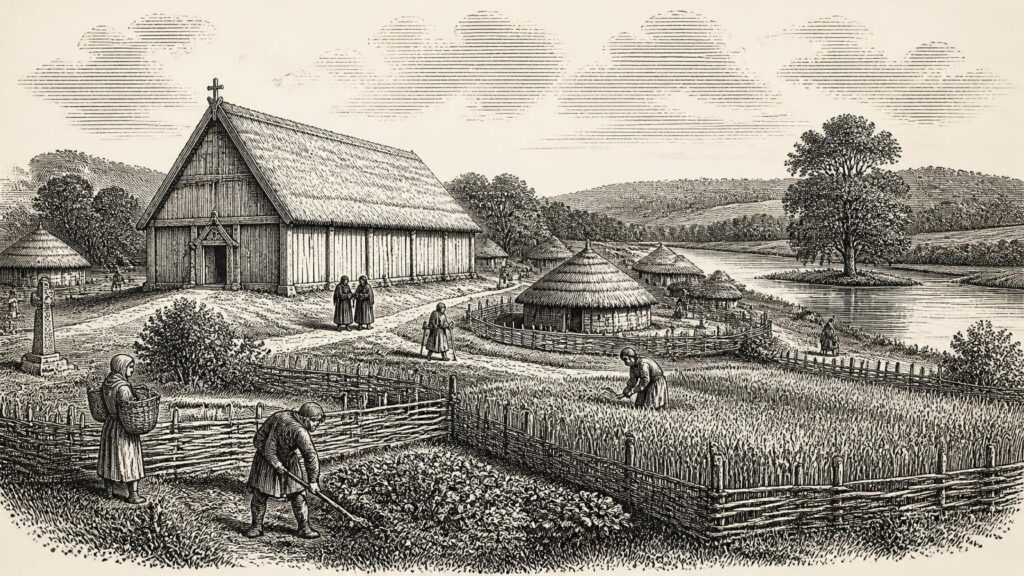
There is no responsible basis for assigning a particular raid on Clonard, a famine, an epidemic or exceptional weather to 869. Silence in the annals does not prove that ordinary hardship was absent; it merely means that the evidence does not allow it to be dated. The daily rhythm of the monastery and surrounding households nonetheless continued: cultivation and stock-rearing supported religious communities; tenants and clients owed renders and labour; travellers required hospitality; and clerics, scribes and students maintained the learning for which houses such as Clonard were celebrated.
Leinster Under Pressure
Leinster was the region most plainly poised for renewed conflict. It was governed through competing branches of the Uí Dúnlainge, while its eastern coast and river approaches were exposed to Dublin-based Scandinavian forces. To its west and south-west stood Cerball mac Dúngail, king of Osraige, one of the most formidable Irish rulers of his generation. Cerball was bound to Áed through family as well as interest: his sister Lann had married Áed, and her son Cennétig of Loíches was another valuable connection in the alliance.
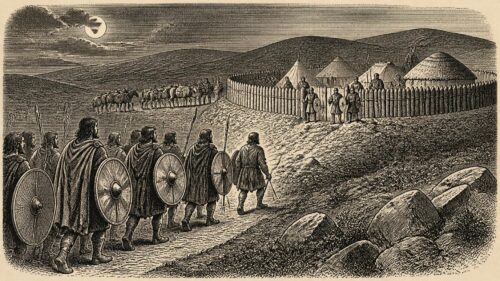
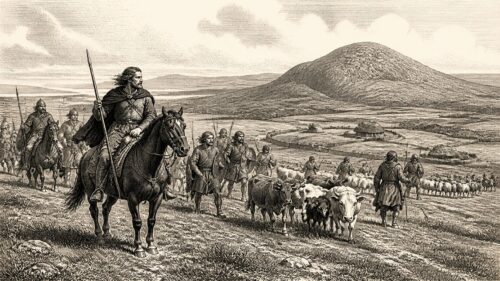
The campaign reported in the next annalistic year demonstrates the pressure already bearing on Leinster in 869. Áed overran Leinster from Dublin to Gabruán, while Cerball and Cennétig entered from the Osraige side and made camp at Dún Bolg. The Fragmentary Annals of Ireland preserve a dramatic account of a Leinster night attack on that camp, followed by a withdrawal and further losses among scattered Leinster men. They also report that the Leinster king refused Áed both tribute and hostages. The colourful narrative was compiled long after the events and frames the fighting through dynastic and saintly loyalties, so its speeches and miracles cannot be read as verbatim history. Its core agreement with shorter annalistic notices, however, makes the expedition significant.
It must remain a horizon, not an event falsely transferred to 869. It tells us why the preceding year mattered: Áed’s victory of 868 had not brought Leinster into settled obedience; Cerball’s power made a two-directional assault possible; and the political map was being redrawn through plunder, movement of troops and demands for submission.
Dublin, Sea-Routes and Limits of the Record
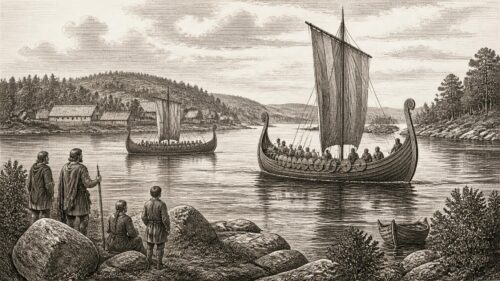
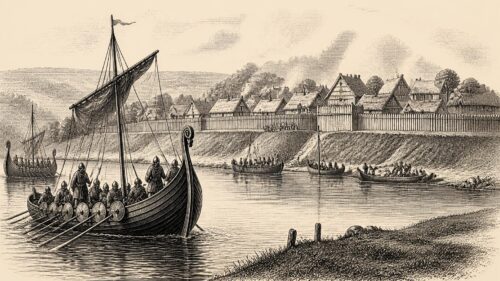
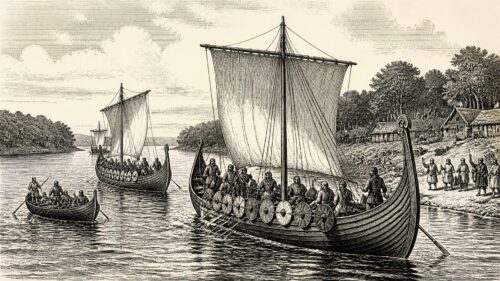
Dublin was by now more than a raiders’ camp. It was a Scandinavian political base linked to the Irish Sea, Britain and wider northern networks, though its development into a fully urbanised Hiberno-Scandinavian town lay ahead. Its rulers Amlaíb and Ímar had already demonstrated the capacity to intervene in Irish affairs and to operate across the sea. Their later siege of the fortress of Alt Clut on the Clyde is conventionally dated to 870; it should not be claimed for 869 simply because of the shifting chronology of some annal headings.
For Irish communities in 869, however, the strategic reality was already clear. Sea power connected Dublin to allies, enemies, trading opportunities, slaves and plunder, while rivers and roads carried the consequences inland. Irish rulers did not respond as a single bloc. They fought Scandinavian groups, made alliances with them, and exploited their presence in rivalries with other Irish kings. The politics surrounding Tara, Brega, Leinster and Osraige are best understood through this shifting pattern of competition rather than through a simple opposition of ‘Irish’ and ‘Viking’.
Thus 869 is a year best approached with disciplined restraint. Its firm evidence offers a kingdom of Tara managing the aftermath of rebellion, a leading Midlands church nearing a consequential transition, and provinces whose alliances pointed towards fresh war. It does not permit a confident catalogue of spectacular events. The uncertainty around Suairlech’s death is not a failure of the record; it is part of the history of how Ireland’s ninth-century past was remembered, written and dated.
Primary Sources
- The Annals of Ulster, Year U870 (AD 869)
- The Annals of Ulster, Year U869 (AD 868)
- Chronicon Scotorum, Annal CS870
- Fragmentary Annals of Ireland, Annal FA 387
- Fragmentary Annals of Ireland, preceding annals including Leinster and Cerball
- Annals of the Four Masters
- Suairlech ind Eidnén, Dictionary of Irish Biography
- Áed Findliath, Dictionary of Irish Biography
- Cerball, Dictionary of Irish Biography
- Dúnlaing, Dictionary of Irish Biography
- Locating Historical Dún Bolg and the Early Medieval Landscape of Baltinglass, Co. Wicklow
- The Vikings in Ninth-Century Ireland: Sources and Settlements
- Vikings in Ireland and Scotland
- Viking Ireland: Afterthoughts
- Geophysical Investigation of the Site of the Former Monastic Settlement, Clonard, County Meath, Ireland
- Cluain Ioraird/Clonard, logainm.ie
- Finnian (Vinnianus, Findbarr), Dictionary of Irish Biography
- The Cult of St Finnian of Clonard from the Eighth to the Eleventh Century
- Annals of Inisfallen, CELT edition and source description
- Annals of Inisfallen, bibliographical and manuscript information