
Back Lane and Belfast Harps1792 CE
In 1792, Irish politics was shaped by Catholic relief, reform agitation and anxiety after the French Revolution. The Catholic Relief Act eased restrictions on education, law and mixed marriage but withheld voting and parliamentary rights. December’s Back Lane Convention demonstrated Catholic national organisation and petitioned for constitutional participation. In Belfast, United Irishmen and Volunteers promoted reform, religious unity and sympathy with France, prompting repression. The Belfast Harp Festival preserved a musical tradition through Edward Bunting’s transcription. Economic measures supported linen, fisheries, navigation, roads and enterprise while export embargoes revealed insecurity. Together these developments enlarged Ireland’s public sphere without producing revolution.
Dateline
In 1792 Ireland’s public life was newly charged with argument, organisation and anxiety. The French Revolution had made the language of rights, citizenship and representation impossible to ignore, while the Irish parliament remained a Protestant institution elected through a narrow and heavily managed franchise. Across the island, Catholics pressed for further relief from the penal code; Presbyterian radicals and liberal Anglicans debated parliamentary reform; and the administration at Dublin Castle watched associations, meetings and print with growing suspicion. The year did not bring a revolution in Ireland, nor did it settle the constitutional question. It did, however, reveal competing ideas of what an Irish nation might be.
A Narrow Opening for Catholics
The contest over Catholic relief gave the year its sharpest political edge. On 20 January Dublin Corporation addressed George III in defence of the “Protestant ascendancy”, a phrase already current but given fresh political force by the corporation’s action. Its members presented Protestant control of church, parliament and public office as the essential safeguard of the constitution. The intervention showed how a municipal body, elected by a restricted urban electorate, could claim to speak for Ireland while excluding the great majority of its inhabitants from political power.
There were important voices on the other side. Edmund Burke’s Letter to Sir Hercules Langrishe on the Catholics of Ireland, dated 3 January 1792, argued that the remaining disabilities were unjust and politically shortsighted. Langrishe, a Kilkenny MP, brought proposals before the Irish House of Commons later that month. The resulting statute, 32 George III, chapter 21, received royal assent on 18 April. It removed a number of surviving legal restraints: Catholics could practise at the bar, mixed marriages gained legal recognition, and restrictions affecting Catholic schooling were eased.
This was a real alteration in daily prospects for some Catholic families. A young man with education and means might now imagine a legal career in a way denied to his father; parents and clergy had wider room to organise schooling; and marriages across the confessional boundary no longer carried the same legal danger. Yet the measure was deliberately limited. It did not give Catholics the parliamentary vote, open parliament to them, or undo the established Church of Ireland’s privileged constitutional position. Nor did it transform the poverty, insecure tenures or local dependence experienced by much of the rural population. Relief was therefore both a concession and a reminder of what remained withheld.
The political importance of the Act lay partly in this incompleteness. Supporters could present it as evidence that constitutional petitioning worked. Opponents could insist that any concession endangered Protestant security. Catholic campaigners learnt instead that sustained, national organisation was necessary if modest statutory relief was to become civic equality. Those different readings shaped events before the year was out.
The Catholic Convention at Back Lane
In early December, delegates gathered at Tailors’ Hall in Back Lane, Dublin, in what became known—sometimes admiringly, often hostilely—as the Catholic Convention or “Back Lane Parliament”. It met from 3 to 6 December, after an unprecedented effort to choose delegates across Catholic parishes, counties and towns. The convention was not a parliament in law, and it claimed no right to legislate. Its importance was political: Catholics who had no representation in the legislature had devised a visible, island-wide representative assembly of their own.
John Keogh, the Dublin merchant and leading Catholic organiser, helped give the meeting direction. The presence of senior clergy, including Archbishop John Thomas Troy of Dublin, demonstrated an effort to bind lay activism and ecclesiastical authority together, even though views within Catholic Ireland were far from identical. Landowners, merchants, professional men, clergy and urban tradesmen did not necessarily seek the same pace or extent of change. The Convention’s procedures nevertheless made a powerful point: Catholic political opinion could be collected, debated and expressed beyond the old channels of aristocratic patronage.
Its delegates approved a petition seeking fuller participation in the constitution and decided that it should be presented directly to the king. That decision belongs firmly to 1792; the delegation’s audience at Windsor occurred in January 1793. The distinction matters. By the close of 1792, no new franchise had been won. What had changed was the scale and confidence of Catholic mobilisation, and the government’s awareness that it could not treat Catholic claims as merely local or private grievances.
Belfast, France and Reform
Belfast provided a different, though overlapping, political world. Its growing commercial and linen economy supported a vigorous culture of clubs, newspapers, voluntary associations and religious dissent. The Society of United Irishmen, founded in Belfast in 1791 and soon active in Dublin, sought a reform movement that could unite Catholics, Protestants and Dissenters. In 1792 its language was still principally constitutional: a wider franchise, a more representative parliament, and an end to divisions maintained by religious exclusion. Yet the example of revolutionary France gave those demands an unsettling international resonance.
On 14 July, the anniversary of the fall of the Bastille, Belfast Volunteers paraded, fired celebratory volleys and attended a public dinner. William Drennan’s address to the French National Assembly and Theobald Wolfe Tone’s address to the people of Ireland were proclaimed before the crowd. These were overt gestures of sympathy with French events and an assertion that Irish reform formed part of a wider struggle for civil liberty. They also intensified official fears that volunteer organisation might move from constitutional pressure to armed political action.
Later in the year the United Irishmen’s relationship with the Volunteers sharpened that concern. On 14 December William Drennan’s Address to the Volunteers was printed and circulated. Addressing the old volunteer ideal of the citizen in arms, it criticised an unrepresentative political system and urged renewed public action. The authorities regarded it as seditious. Their reaction was not simply to one pamphlet: in December the Irish executive issued orders against new political associations in Dublin, signalling a harder official attitude towards organised extra-parliamentary reform.
Still, 1792 should not be read backwards as if rebellion were already inevitable. United Irish politics contained constitutional reformers, religious liberals, social radicals and men whose commitments would later diverge. The shared programme of the moment was unity across religious division, not a settled blueprint for insurrection. The tension between that ambitious language and the state’s growing fear of it was one of the year’s most consequential facts.
Harp Music in the Assembly Rooms
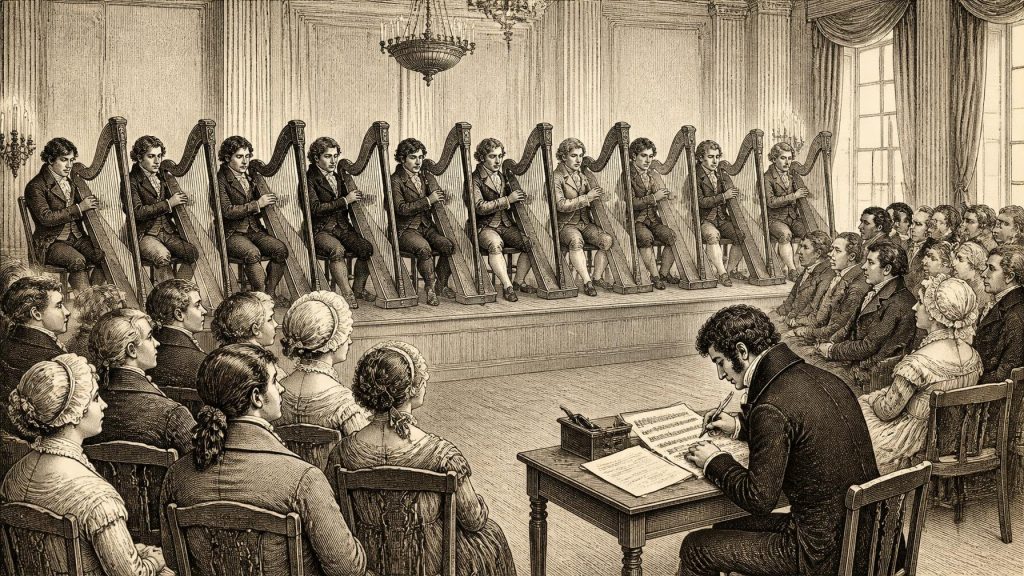
Political Belfast also made room for a remarkable cultural undertaking. The Belfast Harp Festival was held in the town’s Assembly Rooms in July, bringing together ten surviving Irish harpers. Edward Bunting, a young Belfast musician, was engaged to write down their music. Among the performers were Denis Hempson, Arthur O’Neill and Charles Fanning, bearers of a tradition that had long depended upon oral transmission, personal memory and performance rather than printed scores.
The festival was an act of preservation at a moment when the older harp tradition was visibly fragile. Bunting’s notes would later underpin his published collections of ancient Irish music and become a central, if imperfect, record of repertoire and technique. The occasion has sometimes been folded too neatly into the politics of the Bastille anniversary, whose final day coincided with the festival’s close. Recent scholarship urges caution: the harp gathering was not simply a United Irishmen demonstration. Its organisers drew on wider antiquarian and Celtic interests shared across Ireland, Scotland and Wales. Even so, the juxtaposition was meaningful. In the same town and week, people celebrated a living Irish artistic inheritance and argued publicly about political belonging.
Trade, Improvement and Uncertainty
The statutes and enterprises of 1792 also show an Ireland tied together by trade, waterways and urban investment. Parliament made a grant of £4,000 to the trustees of the linen and hempen manufacture, maintained export incentives for selected manufactures, enacted further encouragement for sea fisheries, and passed measures concerning post roads. An Act relating to the Erne navigation addressed the route from Belturbet through Lough Erne towards the sea; another dealt with quay walls in Dublin. Such legislation did not guarantee immediate transformation, but it shows where legislators and investors expected economic value: textiles, coastal resources, communications, internal navigation and port infrastructure.
In Cork, William Beamish and William Crawford entered partnership in January with existing brewers Allen and Barrett, strengthening the business later known as Beamish & Crawford. The episode was modest beside the constitutional struggles in Dublin, but it illuminates the commercial setting of the year: capital, inherited premises, imported raw materials, urban consumers and Atlantic-facing markets. Belfast’s linen interests and Cork’s brewing trade alike depended on networks reaching beyond their towns.
Food and security also intruded upon that commercial optimism. On 26 December the government placed an embargo on the export of corn, flour and related provisions, while a separate order restricted gunpowder and saltpetre. The orders should not be treated as proof of a single, island-wide famine in 1792. They do show, however, that supplies, prices and war fears could quickly become matters of state. Ireland exported grain in this era, but export did not erase the vulnerability of households whose food purchases depended on wages, seasonal work and local markets.
An Organised Public
By the end of 1792, Ireland had not crossed into open conflict. Its parliament sat in Dublin; the Protestant establishment remained secure; and Catholic political rights were still sharply curtailed. Yet the year had changed the terms of public argument. A relief Act had exposed the limits of concession. The Back Lane Convention had demonstrated Catholic collective organisation. Belfast had linked reformist politics, volunteer culture and French revolutionary symbolism, while its harp festival preserved an endangered musical inheritance. Roads, ports, waterways, breweries and textile schemes pointed to an increasingly connected economy. In all these settings, Irish people were learning that association—whether political, religious, cultural or commercial—could make local voices heard on a national stage.
Primary Sources
- Langrishe, Sir Hercules
- A Letter to Sir Hercules Langrishe on the Catholics of Ireland
- Catholic Relief Acts (1771–93)
- Pre-Union Irish Statutes
- Statute Law Revision Act 2007, Schedule 1
- Statute Law Revision Act 2015
- Vindication of the Cause of the Catholics of Ireland
- Catholic Convention
- Back Lane Parliament Meets Again
- From Reform to Revolution
- McAllister, Randal
- Society of United Irishmen of Dublin: Circular Letter
- Strum, Strum and Be Hanged: Reassessing the 1792 Belfast Harp Festival
- Music in Ireland
- The Irish Harpers in Belfast in 1792
- Art Unlocked at The Linen Hall
- History of the Commercial and Financial Relations between England and Ireland: Part 9
- Index 1792
- The Dublin Gazette, Number 5664: Tuesday, 21 February 1792 to Thursday, 23 February 1792
- Beamish, William
- Early Brewing Activity in Cork City: Some Leasehold Evidence
- History of Crawford Art Gallery
- History of The Linen Hall
- Irish and Local Studies