
The Belfast Declaration1791 CE
In 1791, Irish politics became organised without delivering constitutional change or Catholic emancipation. Belfast’s Bastille commemoration and the founding of the Society of United Irishmen linked parliamentary reform, Catholic inclusion and civic unity across religious divisions, influenced by Theobald Wolfe Tone. Dublin radicals, including John Keogh, Edward Byrne, James Napper Tandy and William Drennan, strengthened Catholic and reform movements, provoking divisions with conservative Catholic elites. The Dublin Custom House symbolised both commercial ambition and state authority, while the Grand Canal’s Barrow link improved transport to Waterford. Amid rural inequality, print, association and infrastructure widened horizons, marking transition towards popular politics.
Dateline
In 1791 Ireland acquired no new constitution, no general Catholic emancipation and no decisive break with Britain. Yet the year mattered profoundly because its arguments became organised. In Belfast, radicals made a public language of Irish unity across religious divisions; in Dublin, Catholic laymen challenged the cautious leadership of their own political committee; and the built landscape of commerce changed with the completion of major works at Dublin and Athy. These developments did not make rebellion inevitable. Rather, they showed that the constitutional settlement of the 1780s had failed to settle the questions of representation, religion and power.
French Revolution, Irish Arguments
The French Revolution was the great external presence in Irish political life. Its early promise of constitutional renewal, civic equality and an end to inherited privilege excited many reform-minded Protestants, especially among Ulster Presbyterians who were already resentful of restrictions attached to Dissenting religion and of the narrowness of Irish parliamentary representation. Others, including many members of the governing Protestant establishment, saw French events as a warning that reform could dissolve into disorder.
On 14 July, the second anniversary of the fall of the Bastille, Belfast Volunteers and inhabitants assembled to commemorate the French Revolution. Their declaration praised the destruction of civil and religious bondage and associated Irish political hopes with universal rights. It was a conspicuous public demonstration rather than a secret conspiracy: a procession, a meeting and a printed statement. But it revealed that in Belfast the surviving Volunteer tradition could be joined to a new, more democratic political vocabulary.
Theobald Wolfe Tone supplied much of that vocabulary. His An Argument on Behalf of the Catholics of Ireland, published in 1791 and rapidly reprinted in Belfast, rejected the assumption that Protestant liberty could be secure while the Catholic majority remained politically excluded. Tone, a Church of Ireland lawyer, urged Protestants and Dissenters to see Catholic rights and parliamentary reform as connected causes. His immediate objective was not an insurrection, nor even a fully developed programme for an Irish republic. It was a political alliance capable of ending what he saw as corrupt government sustained by division.
Catholic Politics Finds a Sharper Voice
The disabilities endured by Catholics gave Tone’s case a practical urgency. Catholic worship had become more openly tolerated through earlier relief measures, but Catholics still lacked full civil and political equality. They could not sit in parliament, and the franchise and many offices remained beyond their reach. The Catholic Relief Act enacted at Westminster in 1791 applied to Great Britain; it did not itself transform Irish law. In Ireland, therefore, hopes of further relief depended upon petitioning the Dublin parliament and upon the attitude of Dublin Castle.
That campaign became more contentious during the year. Elections to the Catholic Committee in February brought urban merchants and professional men into greater prominence. John Keogh, a Dublin merchant, emerged with Edward Byrne as a leading figure among those unwilling to accept gradual, deferential lobbying as the limit of Catholic politics. Their constituency was not the whole Catholic population: most people, particularly rural labourers and small farmers, had no direct voice in the committee. Even so, the change indicated that Catholic public action was becoming broader in social composition and more confident in tone.
On 21 October, Thomas Braughall, Theobald McKenna and their associates founded the Catholic Society of Dublin. Its declaration demanded the total repeal of the penal laws as a right, explicitly seeking to remove religious prejudice and to promote unanimity among Irishmen. This was a significant escalation from merely asking favours of government. It also produced a split. More conservative Catholic gentry, led by Lord Kenmare and supported by elements of the hierarchy, withdrew from the committee in December. The division was not simply between Catholics and Protestants; it ran within Catholic political society, between a cautious elite and a more assertive middle-class leadership.
A Society in Belfast
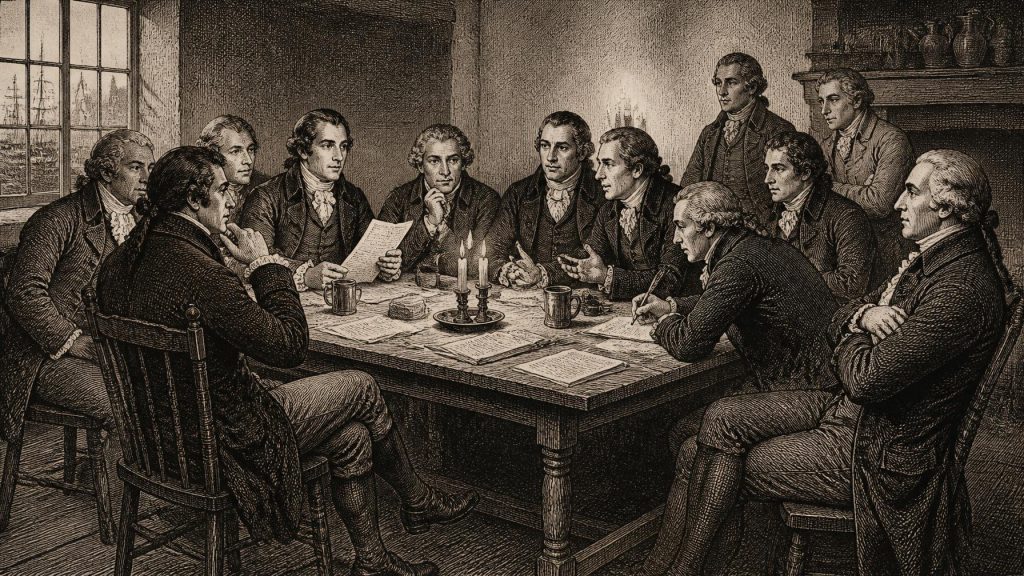
The year’s most consequential organisational event occurred in Belfast. The first Society of United Irishmen was convened on 14 October and held its inaugural meeting on 18 October. Thomas Russell had helped bring Tone north, and Belfast Presbyterian radicals associated with the Northern Whig Club provided the local network. Tone helped frame the society’s declaration and resolutions. Its central demand was “a complete and radical reform” of representation in parliament, coupled with the insistence that reform could not be just or effective if it excluded Irishmen because of religion.
The name mattered. “United Irishmen” proposed a civic identity to supersede the political categories of Protestant, Catholic and Dissenter. It was an ambitious remedy for a society structured by confessional privilege, historical memory and local distrust. Belfast Presbyterian enthusiasm did not mean that anti-Catholic prejudice had vanished, nor did it mean that Catholic communities automatically trusted Presbyterian reformers. Tone himself quickly recognised such limits. Nonetheless, the society placed Catholic inclusion at the centre of a programme devised substantially by Protestants, an unusually bold position in the politics of the Irish kingdom.
Its initial methods remained recognisably constitutional: meetings, resolutions, pamphlets, correspondence and pressure for reform. It was not yet the clandestine, oath-bound revolutionary network of later years. Reading 1791 only as a preliminary to 1798 obscures what participants then believed possible: a reformed Irish parliament, less controlled by patronage and English ministerial influence, representing a wider body of the people.
Dublin Joins the Project
Tone and Russell returned to Dublin after the Belfast meetings. On 9 November James Napper Tandy convened the first Dublin Society of United Irishmen. Tandy was already a prominent city radical and an enthusiastic admirer of the French Revolution; William Drennan became the society’s first president. The Dublin body connected Belfast radicalism with the metropolis, where parliament, the revenue administration, lawyers, printers and political clubs concentrated influence.
Drennan’s role underlines the movement’s longer roots. Before 1791 he had argued that the legislative independence won in 1782 meant little without reform of the Irish House of Commons. The parliament could legislate without the former controls of Poynings’ Law, but it was still dominated by property, patronage and borough interests. Catholics were excluded from the franchise, while many seats rested on tiny electorates or the influence of great landlords. The United Irishmen’s grievance was therefore not merely that Ireland was linked to Britain; it was that the Irish political nation was too narrowly defined.
Revenue, Trade and the Changing Landscape
Political arguments unfolded alongside visible signs of state power and commercial ambition. James Gandon’s new Custom House, completed in 1791, stood on the north bank of the Liffey at the eastern edge of expanding Georgian Dublin. Its sculptural programme and imposing dome proclaimed civic grandeur, but its purpose was practical: it housed the commissioners responsible for customs and excise. John Beresford, chief revenue commissioner, had driven the project despite opposition from merchants worried about moving the customs business downstream from the older commercial centre.
The building therefore carried conflicting meanings. It was a magnificent public work created by skilled architects, masons and sculptors, and a landmark of a city being reshaped eastwards. It was also a monument to revenue collection and to an administration which reformers associated with influence and corruption. Its completion in the same year as the United Irishmen’s foundation made the contrast unusually sharp: official Ireland displayed order, wealth and authority on the riverfront, while critics asked whom that authority truly represented.
Inland transport also advanced. During 1791 the Barrow Line of the Grand Canal reached Athy and connected with the Barrow Navigation. The link offered a through water route between Dublin and Waterford Harbour, using the Barrow southwards from Athy. This was not a sudden transformation of every rural economy, but it lowered the obstacles to moving bulky goods where waterways and markets could be reached. Grain, flour, malt, timber and coal were among the commodities that canal and river transport could carry more cheaply than carts on poor roads. At locks, quays and canal-side towns, the project created work for labourers and opportunities for boatmen, traders, innkeepers and carriers.
Everyday Ireland and a Political Opening
For most inhabitants, life in 1791 remained local and demanding. Ireland was predominantly rural; farming, seasonal labour, domestic textile work, fairs and small-scale exchange structured daily existence. Ulster linen linked spinners, weavers, bleach-greens, merchants and Atlantic markets, while agricultural produce remained central to exports. The impressive buildings of Dublin and the new canal connection did not remove unequal access to land, credit, education or political influence. Nor did radical declarations instantly bridge divisions of class, denomination and region.
Yet print, travel and associational life were widening political horizons. Pamphlets such as Tone’s could be reprinted and discussed far beyond their original place of publication. Volunteer gatherings and public celebrations turned ideas into spectacle. Catholic merchants and professionals learned to organise beyond private petitioning. Canal building tied local places more closely to Dublin, Waterford and their markets. These were modest and uneven connections, but they mattered because they made a national politics more imaginable.
On 2 December Henry Flood died at Farmley, County Kilkenny. Flood had been one of the great Patriot parliamentarians of the preceding generation and an advocate of legislative independence and reform, though his influence had waned. His death marked the passing of a style of politics centred on eloquence inside parliament. The organisations founded or transformed in 1791 did not abandon parliamentary reform, but they increasingly sought strength outside the chamber: in voluntary societies, religious communities, public opinion and a language of popular rights. Ireland had not crossed into revolution. It had, however, entered a year in which the demand to make Irishmen politically united was stated with a new clarity.
Primary Sources
- Tone, Theobald Wolfe | Dictionary of Irish Biography
- Drennan, William | Dictionary of Irish Biography
- Russell, Thomas | Dictionary of Irish Biography
- Tandy, James Napper | Dictionary of Irish Biography
- McKenna, Theobald | Dictionary of Irish Biography
- Braughall, Thomas | Dictionary of Irish Biography
- Keogh, John | Dictionary of Irish Biography
- Flood, Henry | Dictionary of Irish Biography
- Gandon, James | Dictionary of Irish Biography
- Beresford, John | Dictionary of Irish Biography
- Smyth, Edward | Dictionary of Irish Biography
- An Argument on Behalf of the Catholics of Ireland
- An Argument on Behalf of the Catholics of Ireland: National Library of Ireland catalogue record
- The Separatist Idea
- Labour in Irish History
- The United Irishmen: Popular Politics in Ulster and Dublin, 1791–1798
- Wolfe Tone
- Catholic Relief Act (1791)
- The Custom House
- History of the Barrow
- Grand Canal 1751 to 1963
- The Grand Canal: A Heritage Review
- The Irish Linen Trade under the British Mercantile System
- The Exchange Business of the Irish Banks in the Eighteenth Century