
Keogh, Franchise and Ballot1793 CE
In 1793, Ireland combined Catholic relief with intensified state control amid war with revolutionary France. Following John Keogh’s Catholic Convention petition, the Roman Catholic Relief Act enfranchised qualified Catholic forty-shilling freeholders and opened certain employment and educational opportunities, while retaining exclusion from parliament, senior offices and Trinity fellowships. The Gunpowder Act regulated weapons, while the Irish Militia Act introduced parish enrolment and ballots, incorporating Catholics and Presbyterians into government service. The Convention Act restricted representative political assemblies, constraining reformers and United Irishmen. Economic pressures, militia obligations and print culture shaped daily life. The year broadened participation whilst strengthening coercive administration.
Dateline
In 1793 Ireland experienced a striking combination of concession and control. The Irish administration and parliament removed important disabilities from Roman Catholics, most visibly by admitting qualified Catholics to the parliamentary franchise. In the same year, however, government tightened its grip on arms, public political organisation and local manpower. The result was not Catholic emancipation, nor democratic reform, but a reordering of public life in which more Catholics could vote and serve while the state acquired new means to supervise, arm and discipline the population.
A Petition Reaches the King
The year opened with the culminating act of the Catholic Convention, the national gathering that had met in Dublin late in 1792. On 2 January 1793, five delegates—Edward Byrne, John Keogh, James Edward Devereux, Christopher Bellew and Sir Thomas French—presented the Catholics’ petition to George III at St James’s. The petition was the product of a carefully constitutional campaign. Its organisers did not claim a right to overthrow the existing order; rather, they sought relief from laws that made religion a barrier to full civil participation. The Protestant radical Theobald Wolfe Tone, then employed by the Catholic Committee, accompanied the delegation and helped connect Catholic claims with a broader demand for representative reform.
John Keogh, a Dublin merchant and the leading lay Catholic organiser, was central to this achievement. The delegation’s respectful reception in London mattered because it indicated that ministers were prepared to press the Irish parliament towards further relief. That readiness was shaped by events beyond Ireland. Britain and revolutionary France went to war on 1 February. Ireland was strategically exposed across the Irish Sea and Atlantic approaches, while its government feared that discontented Catholics, Presbyterian reformers and Volunteer companies might find common cause under the influence of the French Revolution. Conciliation, in this setting, was a measure of security as well as justice.
Relief, But Not Equality
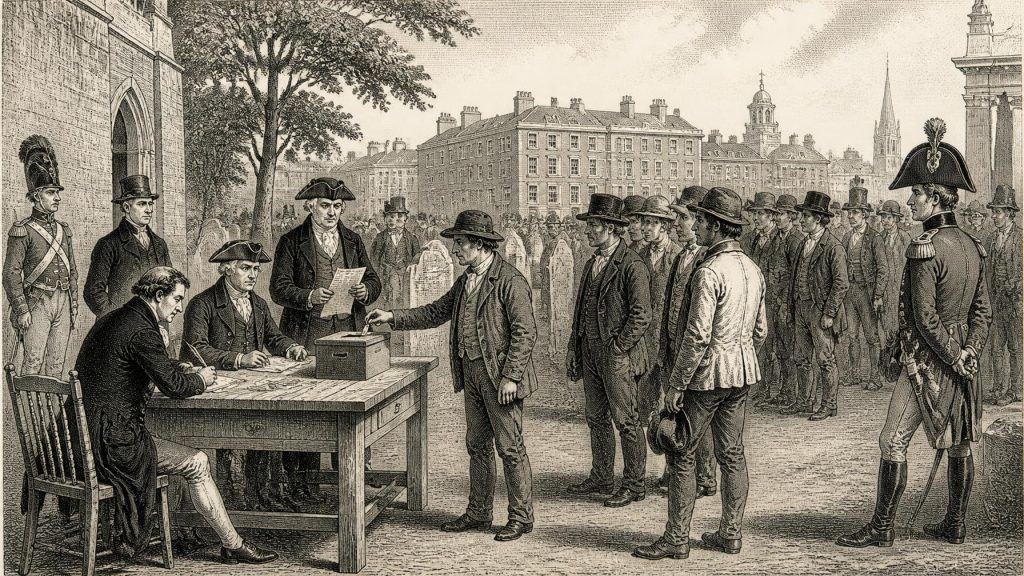
In April the Irish parliament enacted the Roman Catholic Relief Act. Its most consequential provision allowed Roman Catholics who otherwise met the property qualification to vote in parliamentary elections. This restored the franchise to Catholic forty-shilling freeholders: men with a freehold worth forty shillings a year. It was a real and important alteration to the political map. In counties where landlords could create or influence such freeholds, Catholic voters now became a factor which patrons and candidates had to consider.
The statute also removed a range of remaining disabilities affecting property and access to civil and military employment, subject to prescribed oaths. It cleared statutory obstacles to Catholics taking university degrees and allowed access to many offices of trust or profit. Yet its wording reveals the limits of the settlement. Catholics still could not sit or vote in either house of parliament, and they remained barred from the highest offices of state, from the principal judicial posts and from senior positions in the Irish administration. Trinity College Dublin did not become an open Catholic institution: Catholics might benefit from changes concerning degrees, but could not become fellows of the college. The act also required an oath containing explicit assurances about property, the Protestant establishment and Catholic political intentions.
Thus 1793 did not abolish the Protestant ascendancy. The Irish parliament itself remained an Anglican and propertied institution, elected through a narrow, uneven franchise in which many boroughs were effectively controlled by patrons. Nor did the new vote make every Catholic adult a political participant. It applied only to men with the requisite property interest. Nevertheless, the change was substantial because it admitted Catholic freeholders to a constitutional practice from which they had long been excluded. It also placed local priests, tenants, agents and landlords in a newly complicated electoral world, where the registration and management of qualifying votes acquired fresh significance.
War Comes Home
Relief was accompanied by legislation designed to make Ireland more governable in wartime. In February, before the Catholic bill became law, parliament passed a Gunpowder Act restricting the importation, movement and keeping of arms, gunpowder and ammunition without licence. The measure was directed at an atmosphere in which private weapons, Volunteer drilling and rural secret associations troubled officials. It did not by itself disarm Ireland, but it enlarged the state’s capacity to regulate the material means of resistance.
The more immediate transformation came with the new Irish Militia Act. The government wanted a dependable home force because regular troops could be required elsewhere in the war against France. The act provided for a militia raised through parish-based enrolment and ballot. Lists were to be prepared of men aged eighteen to forty-five, and those selected could serve or find substitutes. Catholics and Presbyterians were no longer excluded from the ranks. This was one of the practical consequences of the year’s relief measures: the state sought Catholic loyalty while drawing on Catholic manpower.
The system reached into everyday local life with unusual speed. In May, the governors and deputy governors of Limerick City met at the Exchange to receive the returns of men liable to be balloted. In June, men from county parishes assembled at the courthouse in Carlow for their ballot. Dublin’s city parishes scheduled their own ballots in the week of 12–18 June, using parish churches as venues. Such occasions brought the authority of churchwardens, high constables, magistrates and parish officers into direct contact with householders. For a labourer, artisan or small farmer, the militia was not an abstract act of parliament: it could mean appearing on a list, facing the lottery of selection, negotiating for a substitute, or entering a regiment under officers generally drawn from the established social order.
In this respect the legislation carried a built-in contradiction. Catholic men gained a recognised place in public service, yet many encountered that recognition through compulsory selection for military duty. The militia was intended to replace the political ambiguity of the older Volunteer movement with a force answerable to government. Its county regiments would become an enduring feature of Irish life during the wars that followed, but 1793 was the year in which the administrative machinery of parish lists and ballots was first set in motion.
Closing the Public Political Space
The administration did not treat reforming politics as safely contained by Catholic relief. During the same parliamentary session it enacted the Convention Act, formally titled an act to prevent the election or appointment of unlawful assemblies under the pretence of preparing petitions or addresses. It made it unlawful for bodies elected or appointed as representatives of the people to seek changes in church or state outside parliament. The measure was pointedly relevant to the Catholic Convention, whose delegates had claimed a national representative character, but its implications were wider. It constrained the kind of national conventions through which Volunteers and reformers had attempted to exert pressure during the previous decade.
For the Society of United Irishmen, 1793 was therefore a year of narrowing possibilities. Its Dublin society still printed its Proceedings, and its programme continued to couple parliamentary reform with a union of Irishmen across religious divisions. But the outbreak of war made expressions of sympathy with French revolutionary principles far more dangerous in official eyes. The government’s combination of arms controls, militia organisation and restrictions on representative gatherings signalled that constitutional agitation would be watched closely. By the end of the year, the open reform movement was weakened and divided, even though the United Irish idea had not disappeared.
These developments should not be read backwards as an inevitable march towards rebellion. No general rising occurred in Ireland in 1793. Rather, the year changed the conditions in which later conflict would unfold. It granted Catholic voters a stake in electoral politics while disappointing those who had sought complete equality; it incorporated Catholic men into a government force while intensifying anxieties about arms and loyalty; and it curtailed public representative organisation while leaving unresolved the demand for parliamentary reform.
Work, Print and Historical Memory
The political measures of 1793 operated within an economy still deeply regional. Linen manufacture and export were particularly important in Ulster, while tillage, livestock, local fairs and provisioning tied much of rural Ireland to changing markets. The new war promised military demand but also introduced uncertainty into overseas commerce and coastal traffic. For many households, immediate concerns remained rents, seasonal employment, food prices and the obligations imposed by parish and landlord. The militia ballot added another potential burden, especially where a selected man’s labour mattered to a family enterprise or holding.
Print culture meanwhile offered educated readers different ways to imagine Ireland. A 1793 English edition of Roderic O’Flaherty’s Ogygia, translated by the Revd James Hely, made a major seventeenth-century Latin history of Ireland available in English. The work’s learned chronologies and ancient genealogies belonged to an older scholarly tradition, but its republication shows that Irish historical identity remained a subject of active interest in the age of revolution. It did not create a single national politics; Catholics, Anglicans and Presbyterians approached the past and present from very different positions. Yet the book’s appearance formed part of the wider world of clubs, pamphlets, petitions and newspapers in which arguments about Ireland were being made.
1793 was therefore a hinge rather than a settlement. Keogh and the Catholic Convention obtained a meaningful constitutional advance. Dublin Castle and the Irish parliament answered the perceived dangers of war and radicalism with a more intrusive apparatus of regulation and service. The franchise, the parish ballot and the Convention Act each reached into public life in different ways. Together they made this a year in which inclusion and coercion advanced side by side.
Primary Sources
- The Catholic Relief Act, 1793
- Keogh, John | Dictionary of Irish Biography
- Tone, Theobald Wolfe | Dictionary of Irish Biography
- Wolfe Tone papers
- Proceedings of the Society of United Irishmen of Dublin
- The Petition of the Catholics of Ireland, to the King's Most Excellent Majesty
- Raising the Irish Militia
- The Irish Militia—1793–1816
- Limerick County Militia, 1797–1846
- A History of the Co. Wicklow Regt. of Militia Part 1
- II. United Irish Plans of Parliamentary Reform, 1793
- The United Irish Society in Disarray
- Ireland in the Age of Revolution, 1760–1805, Part II, Volume 4
- History of the Commercial and Financial Relations between England and Ireland from the Period of the Restoration, Part 14
- O'Flaherty: Ogygia
- Ogygia: or, A Chronological Account of Irish Events
- A Picturesque and Descriptive View of the City of Dublin: National Library of Ireland Holdings
- Background: Chronology of Key Events 1169 to 1799
- Ireland 1778–1803: Historical Investigations and Interpretations
- Convention (Ireland) Act Repeal Bill—Bill 4
- Unlawful Societies in Ireland Bill
- Irish Legislation Database: Display Record