

Achad Mic Erclaige860 CE
In 860, Irish politics were shaped by warfare, alliance and contested authority. Cerball mac Dúnlainge of Osraige defeated raiders associated with Port Láirge at Achad mic Erclaige, probably Agha near Kilkenny, protecting inland routes and royal prestige. Máel Sechnaill mac Máele Ruanaid assembled a broad coalition for a northern campaign against Áed Findliath, but failed to secure lasting supremacy. Annalistic accounts, especially the Fragmentary Annals, combine historical evidence with pro-Cerball literary embellishment. Armagh’s church leadership mediated oaths and legitimised power, while Scandinavian groups remained political actors. Notices of deaths among rulers and scholars reveal interconnected secular, ecclesiastical and local communities.
Dateline
The year 860 is best approached through two linked contests rather than a single national story: a northern challenge to Máel Sechnaill mac Máele Ruanaid, king of Tara, and a violent encounter in Osraige between Cerball mac Dúnlainge and seaborne raiders associated with Port Láirge. Neither episode made Ireland a united kingdom or expelled Scandinavian forces from its coasts. Together, however, they show how power worked in the ninth century: through personal alliances, hostages, mobile warbands, control of river routes and the authority claimed by kings and churches.
There is an important warning about the evidence. Irish annals preserve invaluable contemporary or near-contemporary traditions, but their surviving compilations differ in wording and chronology. The Fragmentary Annals of Ireland assigns both the Osraige battle and Máel Sechnaill’s northern hosting to 860; the later Annals of the Four Masters also places Cerball’s victory in the corresponding year, though under an offset annal. The dramatic details in the Fragmentary Annals are not all equally secure as literal reportage. They preserve a strongly pro-Cerball narrative, so its set-piece speeches, heroic candlelight and precise scale of slaughter should be read as literary commemoration around a historical core, not as a modern battle report.
Two Fleets in Osraige
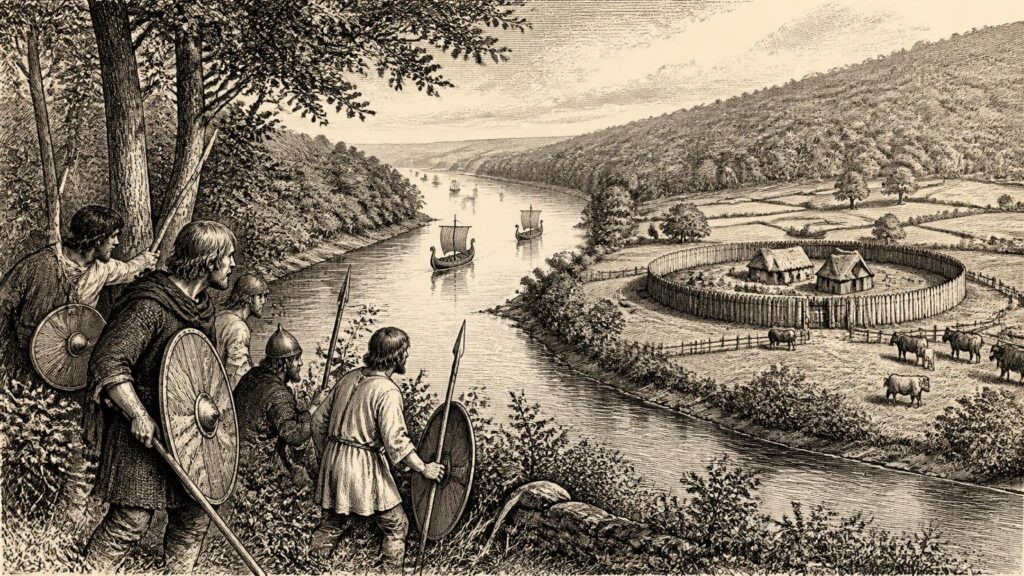
The clearest event connected to 860 was a raid into the kingdom of Osraige, the fertile and strategically placed territory centred on the Nore valley, broadly corresponding to much of later County Kilkenny and adjoining districts. The Fragmentary Annals says that men from two fleets of Norsemen entered Cerball’s lands seeking plunder. Its account ends with Cerball defeating them at Achad mic Erclaige, generally identified with Agha, near Kilkenny. The Four Masters gives the leaner corroborating notice that Cerball won a victory over the fleet of Port Láirge at the same place.
That short agreement matters more than the colourful later narrative. It is responsible to say that Cerball defeated a maritime force which had moved inland against Osraige in or closely around 860. It is less responsible to insist that every raider was Norwegian, that two complete fleets fought as a single army, or that Cerball’s men killed more than half their opponents. Such claims belong to the rhetoric of a text constructed to celebrate an exceptional ruler. The image of a king summoned from drink, seizing his weapons in the night and driving enemies back to their ships tells us much about ideals of rulership: readiness, physical bravery, generosity in distributing spoils and a king’s duty to defend his people.
The route itself is historically revealing. A force described through Port Láirge, modern Waterford, could exploit the south-eastern river system to strike inland. Waterborne mobility was the central military advantage of Scandinavian groups, but it also made their forces vulnerable once they were beyond the coast and confronted by a local ruler able to assemble fighters quickly. Osraige lay between Munster and Leinster, while its river corridors connected it to coastal traffic. Cerball’s success at Achad mic Erclaige therefore protected more than a settlement: it defended a kingdom’s food-producing heartland, its people and cattle, and the prestige on which a king’s rule depended.
It would be misleading, though, to describe this as a simple victory of “the Irish” over “the Vikings”. Scandinavian leaders and forces were already participants in Irish political life, sometimes enemies and sometimes allies of Irish dynasties. Nor does the expression “fleet of Port Láirge” prove that Waterford was already a permanent town in the later medieval sense. It does demonstrate that the harbour and river zone had become a meaningful operational base. Archaeology at Woodstown on the Suir, west of Waterford, has since confirmed the importance of substantial Viking-period activity in the wider region, though it cannot turn every annalistic label into a precise map of the force defeated in 860.
Máel Sechnaill’s Northern Hosting
At the same time, Máel Sechnaill sought to demonstrate a far wider supremacy. He belonged to Clann Cholmáin of the Southern Uí Néill and had built an unusually formidable position from Mide and Tara. In the previous decade he had imposed his authority on rivals, extracted hostages from Munster and cultivated political relationships across the island. Yet the claim to be king of Tara was never the same as unquestioned command of Ireland. The principal counterweight in 860 was Áed Findliath of Cenél nÉogain, leader of a northern Uí Néill dynasty whose power base lay in the north-west.
The Fragmentary Annals records that Máel Sechnaill led a great hosting with Cerball to Mag Macha, the plain around Armagh. It presents an imposing coalition: men of Leinster, Munster, Connacht, Ulaid and Brega gathered around the king’s encampment. Modern scholarship accepts the broad fact of a campaign in the north-west and the participation of support from Munster, Leinster and Connacht, while stressing that it achieved no clear permanent settlement. The coalition was a performance of high kingship as much as an instrument of conquest. To bring regional rulers and their forces into one host was to make a claim that their obligations ran to Máel Sechnaill.
The account says that Áed, despite a peace pledge made through Fethgna, successor of Patrick at Armagh, attacked the camp by night. Máel Sechnaill, forewarned and keeping his allied contingents armed around his tent, repelled the assault; Amlaíb, a Dublin Scandinavian ruler, is said to have been with Áed. The essentials fit the wider political situation: Áed was challenging southern dominance, and alliances crossed ethnic and religious lines. But the exact conduct of the night attack rests on the Fragmentary Annals alone. It should be treated as plausible tradition, not firm detail. Its larger significance is secure enough: Máel Sechnaill’s expedition exposed the limits of his authority and foreshadowed the struggle that would intensify after his death in 862.
Armagh, Oaths and Political Religion
Fethgna’s appearance is particularly significant. As successor of Patrick, the head of Armagh possessed authority that kings could invoke when making peace, binding agreements and displaying legitimate rule. The annalistic tale makes the alleged breach of an oath a religious as well as political offence, and explains Máel Sechnaill’s survival as divine judgement. This is not neutral reporting. It shows the language through which elites expected conflict to be understood: God favoured the righteous king; saints’ successors could witness and validate public settlements; an oath was a practical device with sacred consequences.
Churchmen and church institutions were not spectators. Major monasteries and ecclesiastical federations possessed land, labour, learning, treasures and political connections. Armagh’s standing gave its successor influence far beyond the immediate settlement. Yet 860 supplies no evidence for imagining every monastery as either a quiet scholarly refuge or an isolated target awaiting raiders. Religious communities were embedded in the same networks of patronage, kinship, tribute and warfare as secular lordships. The northern campaign’s use of an Armagh churchman as peace broker captures that entanglement better than a simple contrast between sacred and secular Ireland.
Learning and Loss
The year’s notices also record quieter changes in elite society. The Fragmentary Annals places the death of Óengus, described as a learned man of Cluain Ferta Mo-Lua, in 860. It also records the death of Flannacán son of Colmán and the killing of Áed son of Dub dá Bairenn, king of Uí Fidgenti in Munster. These terse entries do not allow biographies or firm conclusions about local succession. They do remind us that Ireland’s political map was made up not merely of Tara, Dublin and the largest provincial dynasties, but of many smaller lordships and ecclesiastical communities whose personnel mattered enough to enter historical memory.
Learning was institutional and social: a learned man’s standing rested on a church community, patrons, manuscripts, teaching and the legal-historical knowledge needed by rulers. The record of Óengus’s death is not proof of a particular book or school lesson in 860, but it does show that intellectual rank was publicly recognised. In a society where genealogy, law, liturgy and history helped establish rights and status, scholars were part of the machinery of power.
A Year of Connected Frontiers
For ordinary households, the year’s most immediate realities were likely seasonal farming, livestock, food stores, rents and local obligations. The sources do not furnish a diary of those lives. What they do reveal is why conflict could be so disruptive: raiding armies consumed provisions, took cattle and captives, threatened communications and compelled local rulers to mobilise men. The prize at Achad mic Erclaige was therefore not simply battlefield fame. Control of the Nore corridor helped determine who could protect, tax and draw allegiance from communities living along it.
By the close of 860, neither side had settled Ireland’s wider contest. Cerball had enhanced his martial reputation in Osraige; Máel Sechnaill had displayed a remarkable coalition but failed to eliminate Áed Findliath’s challenge; Scandinavian seafaring groups remained potent political and military actors. The year is best remembered not as a turning point that ended raids, but as a sharply documented moment when inland kingship, ecclesiastical authority and riverborne warfare met in the same unsettled landscape.
Primary Sources
- The Annals of Ulster, Year U861 (AD 860)
- Fragmentary Annals of Ireland
- Annals of the Four Masters, Volume 1: M860
- Annals of the Four Masters, Irish text: M858 [=860] to M864
- Annals of the Kingdom of Ireland: Annals of the Four Masters
- Máel-Sechnaill
- Áed Findliath
- Donnchad Midi
- Vikings in Ireland: A Review
- Vikings in Scotland and Ireland in the Ninth Century
- Viking Ireland: Afterthoughts
- The Vikings in Ninth-Century Ireland: Sources and Settlements
- Rodulf and Ubba: In Search of a Frisian-Danish Viking
- Vikings in Early Medieval Ireland: Church-Raiding, Politics and Kingship
- Vikings in Early Medieval Ireland: Review
- The Chronology and Sources of the Early Irish Annals
- Chronological Synchronisation of the Irish Annals
- The Irish Annals: Their Genesis, Evolution and History
- Viking Woodstown: A Viking-Age Settlement in County Waterford
- Ground-breaking Archaeological Dig Seeks to Shine Light on Ireland and Norway’s Shared Viking Past
- Irish Texts at CELT
- CELT: List of Published Texts


