Fires and Hostages1020 CE
In 1020, Ireland remained politically fragmented after Clontarf. Máel Sechnaill mac Domnaill led a coalition including Uí Néill, Donnchad mac Briain and Art Ua Ruairc to the Shannon, receiving Connacht hostages and asserting overkingship. Northern and eastern lesser kingdoms experienced blinding, killings and rapid succession disputes. Fires devastated Kildare, Glendalough, Clonard, Clonmacnoise, Swords and Armagh, damaging churches, treasures and settlement districts. Armagh’s blaze then preceded Máel Muire’s death and Amalgaid’s installation as Patrick’s successor; Patrick’s shrine and bell were also plundered. Annals additionally commemorate learned clerics, revealing churches as centres of wealth, scholarship, authority and vulnerability amid violent political competition.
Dateline
The year 1020 in Ireland is unusually vivid in the annalistic record because several notices converge on two great themes: the continuing struggle for political supremacy after Brian Bóruma’s death, and a series of destructive fires and attacks on major ecclesiastical settlements. The surviving entries are brief, written by churchmen and preserved in later manuscripts, so they do not give a rounded diary of the year. They do, however, allow a responsible annual account of a country in which kingship, learning, sacred authority and wealth were closely bound together.
Power After Clontarf
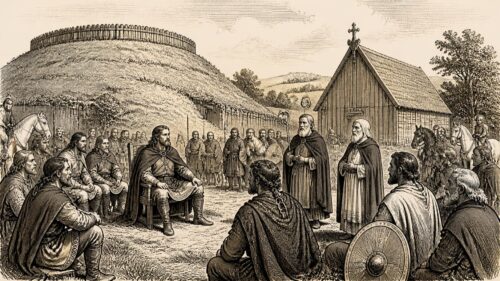
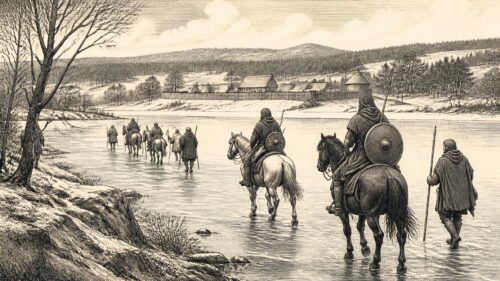
Six years after the Battle of Clontarf, no single dynasty had permanently transformed Irish politics. Máel Sechnaill mac Domnaill of Clann Cholmáin, king of Mide and former rival of Brian Bóruma, was again the leading claimant to the overkingship. The Annals of Tigernach place in 1020 a major hosting by Máel Sechnaill, the Uí Néill, Donnchad mac Briain and Art Ua Ruairc, king of Bréifne, as far as the Shannon. The result, according to that notice, was that the hostages of Connacht were given to Máel Sechnaill.
This was not simply a raid. In early medieval Irish politics, the taking or receiving of hostages was a public sign that one ruler had compelled acknowledgement from another people. The Shannon also mattered: it was a frontier, an artery of movement and a symbolic line between the midlands, Connacht and the wider politics of Ireland. The notice suggests that in 1020 Máel Sechnaill could still coordinate northern Uí Néill interests, his own midland power and the cooperation of Donnchad mac Briain, Brian’s surviving son and successor in Munster. Such cooperation need not imply friendship in a modern sense. It was a practical alignment in a political world where allies might become rivals as circumstances changed.
Donnchad’s presence is particularly revealing. A notice immediately before 1020 in the Annals of Inisfallen and Tigernach records that he had recently suffered a severe sword-blow from Domnall of the Uí Chaisíne, losing part of his right hand. That injury belonged to the political background of 1020 rather than to a securely dated event in the year itself, but it underlines the precariousness of royal authority. A king’s body was political. Mutilation could damage a ruler’s prestige and, in some circumstances, his right to rule. Yet Donnchad was still active enough to appear in a major expedition alongside Máel Sechnaill.
Violence Among Northern Kingdoms
The annals also record local and regional violence. Flaithbertach Ua hEochada was blinded by Niall son of Eochaid. This was almost certainly more than personal cruelty. Blinding was a recognised method of removing a rival from political competition, especially where kingship required bodily wholeness and public honour. The names point towards the politics of Ulaid and neighbouring kindreds, where rival branches of ruling families competed for supremacy.
Other notices are terse and difficult to harmonise. The Annals of Ulster say that Gilla Ciaráin son of Oiséne, king of Mugdorna, was killed by the Fir Rois, and that Mael Muad son of Oiséne, king of Mugdorna for one day, was then killed by the Uí Moccu Uais of Brega. The Annals of Loch Cé preserve a related but shorter entry. The safest conclusion is that 1020 saw a brief and violent succession crisis among the Mugdorna, a people associated with the borderlands between Airgialla and the eastern midlands. A kingship that could last “one day” in the annalists’ phrasing reveals how quickly rivals could move when a ruler fell.
The Annals of Loch Cé also record the killing of Aed Ua hInnrechtaig, king of Uí Méith, by the Uí Niallain. This belongs to the same wider northern and north-eastern pattern: small kingdoms, important local dynasties and larger overkingdoms interacting through raids, killings, hostage-taking and opportunistic alliances. These entries are not isolated anecdotes. They are glimpses of how authority was made and unmade below the level of the great overkings.
A Year of Burning Churches
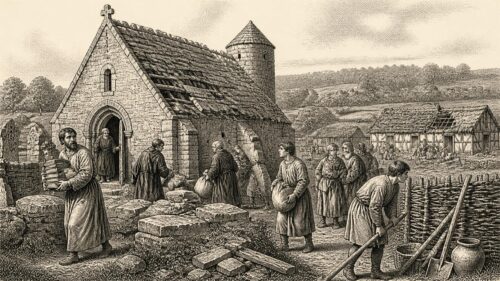
The most striking feature of 1020 is the number of ecclesiastical burnings. The Annals of Ulster state that Kildare was burned with its oratory; all Glendalough was burned with its oratories; Clonard, Clonmacnoise and a third of Swords of Colum Cille were also burned. The Annals of Loch Cé and Tigernach give closely related notices. The annalists do not always tell us whether these fires were accidental, caused by warfare, or connected with plundering. In some cases “burned” may imply attack; in others, dense settlement, timber buildings, hearths and workshops made fire a constant danger.
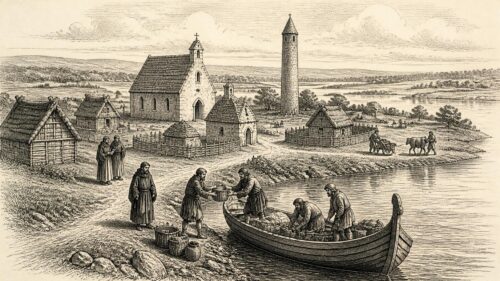
The named places were not minor chapels. Kildare was associated with Brigid and with one of Ireland’s most prestigious female-founded churches. Glendalough, in the Wicklow mountains, was a major centre of the cult of Cóemgen, or Kevin, and an important place of learning and pilgrimage. Clonard in Mide was connected with Finnian and with traditions of teaching. Clonmacnoise, on the Shannon, was one of the great religious and political centres of the midlands. Swords, north of Dublin, belonged to the Columban world and stood in a region shaped by its proximity to Hiberno-Scandinavian Dublin.
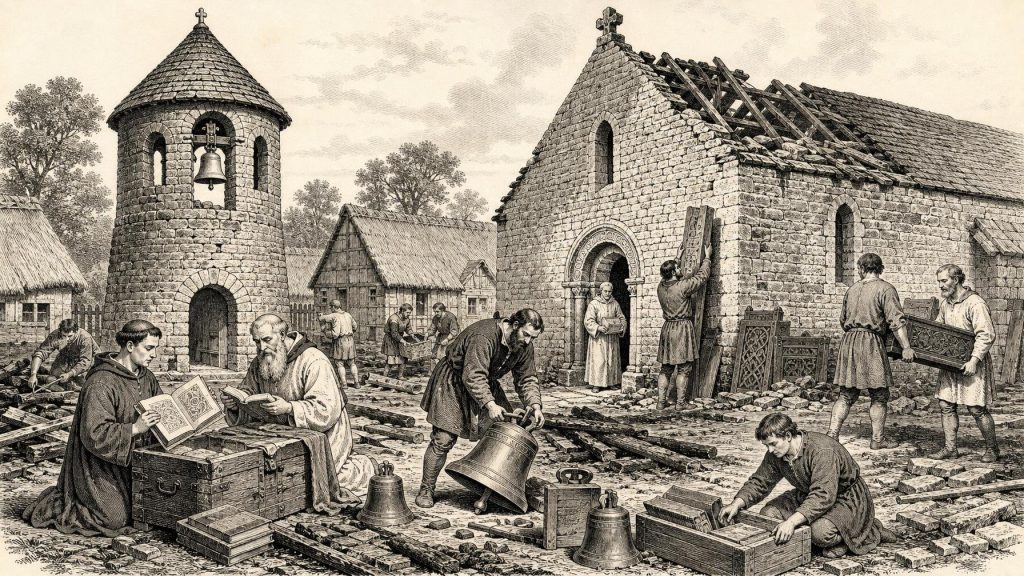
These burnings therefore mattered beyond local loss. Monasteries were landholders, schools, treasuries, burial places, craft centres and political actors. Their churches and enclosures contained clerics, students, tenants, labourers, dependants and visitors. A fire could destroy not only roofs and walls but books, relic-cases, vestments, stores of food, legal documents and the tools of craftsmen. The notices from 1020 show how vulnerable even famous sacred landscapes remained.
Armagh and Patrick’s Authority
The best dated disaster of the year was the burning of Armagh. The Annals of Ulster give the date as 30 May, the Monday before Whitsun, and describe a sweeping fire: the great stone church with its lead roof, the bellhouse with its bells, the Saball church, the Tóae church, the abbots’ chariot and the old preaching chair were burned. The Annals of Loch Cé repeat the essentials. The Annals of Tigernach add that many houses in the “thirds” of the settlement were burned and that gold, silver and other treasures were lost, while the library alone was spared in one version of the tradition.
This is one of the richest descriptions of an Irish ecclesiastical settlement in the early eleventh century. Armagh was not merely a cluster of hermits’ cells. It had stone churches, a bellhouse, specialised sacred buildings, high-status possessions, vehicles used by abbots, precious metals and a remembered preaching chair. Its “thirds” indicate a settlement with distinct districts or suburbs outside the central sacred enclosure. The lead roof of the great stone church also signals wealth and architectural ambition.
Armagh’s importance rested on its claim to be Patrick’s principal church and, by extension, a church with authority over Ireland. Brian Bóruma had recognised that claim in 1005 when he made a celebrated offering there and had his kingship acknowledged in the Book of Armagh. In 1020, that same institution suffered fire and then a rapid change of leadership. Máel Muire son of Eochaid, comarba Pátraic — successor of Patrick — died on 3 June, only days after the burning, in the twentieth year of his rule. The Annals of Ulster call him head of the clerics of the north-west of Europe; related annals broaden the phrase to the west of Europe. Such language is praise, but it also reflects the scale of Armagh’s self-understanding.
Amalgaid was installed as successor of Patrick “by the wish of laity and church”. That phrase is important. It suggests that the succession to Armagh was not only an internal clerical matter. Lay powers, local elites and ecclesiastical communities all had interests in who controlled Patrick’s church, its lands, revenues, relics and prestige. The transition from Máel Muire to Amalgaid was therefore a major political as well as religious development.
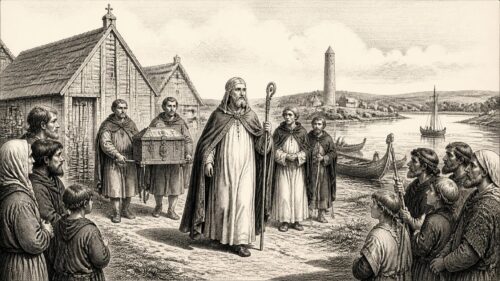
The Annals of Tigernach also record that the shrine and the bell called the Sweet-Voiced of Patrick were plundered by the Uí Aidith and by people of Lower Uí Echach, who carried off seven hundred cows. Whether this was part of the same crisis as the fire or a separate act in the same year cannot be proved. But the entry shows that relics and insignia associated with Patrick were not just devotional objects. They were portable embodiments of authority, and attacks on them could be tied to cattle wealth, tribute and regional power.
Learning, Wealth and Everyday Life
The death notices of 1020 also point to Ireland’s learned culture. The Annals of Inisfallen record the deaths of Muiredach Ua hAililléin, lector of Tuaim Gréine; Cormac Ua Finn, described as a learned bishop; and Maelgorm Ruad, a learned man from Eóganacht. These entries are brief, but titles such as lector and learned bishop show the value placed on teaching, scholarship, biblical study and the transmission of Latin and Irish learning. The same year that fires damaged famous churches, annalists remembered scholars by name.
For most people, 1020 would have been experienced through obligations to kin, lord and church: herding cattle, producing grain, paying food-rents, serving in hostings, attending local assemblies and honouring saints’ festivals. The prominence of cattle in the Patrick relic notice is typical. Cows were wealth, food, compensation, tribute and political leverage. Silver and coin had become more visible through Dublin and other Hiberno-Scandinavian towns, and Sitriuc Silkbeard’s Dublin had been minting silver pennies since the late tenth century. Yet much of rural Ireland still measured value through livestock, labour, clientship and honour.
Dublin itself is not the centre of the 1020 entries, but its world formed part of the background. The eastern churches burned that year — Kildare, Swords, Clonard and Clonmacnoise — lay in regions connected by roads, rivers, political rivalry and access to the Irish Sea economy. Hiberno-Scandinavian towns brought craft production, maritime trade, silver exchange and imported goods into Irish politics. Kings sought their wealth, fought their rulers and used their fleets or markets when useful. The absence of a major Dublin battle in 1020 should not be mistaken for irrelevance.
The Shape of the Year
What, then, can be said securely of Ireland in 1020? Máel Sechnaill remained the most prominent overking, strong enough to receive Connacht hostages after a major expedition. Donnchad mac Briain, despite recent injury and the unsettled legacy of Clontarf, still acted on the island-wide political stage. Northern and north-eastern kingdoms saw violent removals, killings and succession struggles. Above all, a chain of fires and attacks struck some of Ireland’s greatest churches, culminating in the burning of Armagh and the death and replacement of Patrick’s successor.
The year does not present a single decisive turning point. Instead it reveals the texture of early eleventh-century Ireland: ambitious kings, fragile alliances, churches rich enough to attract danger, scholars remembered beside warriors, and sacred places rebuilt after repeated catastrophe. In 1020, power was negotiated through hostages and blades, but also through books, bells, relics and the authority of saints.
Primary Sources
- The Annals of Ulster: Year U1020
- The Annals of Tigernach: Annal T1020
- CELT Project: Annals of Inisfallen
- Annals of Loch Cé: Annal LC1020
- Chronicon Scotorum: Annal CS1020
- CELT Project: The Annals of Ulster
- CELT Project: Annals of Tigernach
- CELT Project: Annals of Loch Cé
- CELT Project: Chronicon Scotorum
- 950–1450: Vikings, Normans and Medieval Mints
- Viking
- What do we really know about the early Irish Church?
- Early Medieval Ireland: Archaeological Excavations, 1930–2009
- Clonmacnoise Monastic Site
- Glendalough’s Monastic Sites
- Glendalough
- Welcome to Swords
- Swords Castle Conservation Plan
- St. Brigid’s Cathedral… Before the Normans
- The Book of Armagh
- The cult of St Finnian of Clonard from the eighth to the eleventh century
- Sitriuc Silkbeard (Sitric, Sigtryggr Ólafsson Silkiskeggi)
- Donnchad