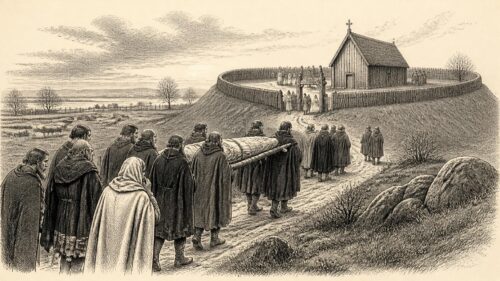
Rahugh’s Reordered Allegiance859 CE
In 859, Máel Sechnaill mac Máele Ruanaid, king of Tara, faced an invasion of Mide by Osraige’s Cerball mac Dúnlainge allied with Scandinavian leaders Amlaíb and Ímar. A royal assembly at Ráith Áeda Meic Bric, probably Rahugh, negotiated peace under ecclesiastical witness. Cerball accepted dues to Patrick’s community, and Osraige was reoriented from Munster towards Leth Cuinn, strengthening Máel Sechnaill while preserving Cerball’s rule. Munster’s king, Máel Gualae, guaranteed the settlement but was later killed by Scandinavians. Conflicting annalistic chronologies and narratives complicate details. The settlement demonstrated church-backed negotiation amid shifting Irish-Scandinavian alliances, yet failed to end warfare and instability.
Dateline
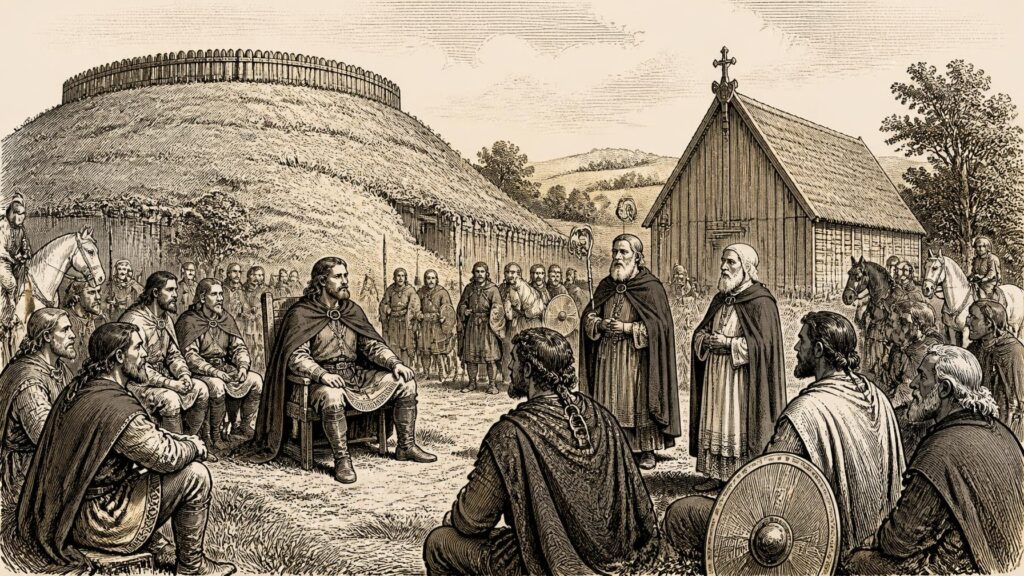
In 859, the political map of Ireland did not acquire a new border in any modern sense, but one royal settlement altered the language of power. At Ráith Áeda Meic Bric, probably Rahugh in present-day County Westmeath, Máel Sechnaill mac Máele Ruanaid, king of Tara, convened leading secular and ecclesiastical figures. Their agreement addressed a dangerous combination: the king of Osraige, Cerball mac Dúnlainge, had joined the Scandinavian rulers Amlaíb and Ímar in an attack on Mide, the heartland of Máel Sechnaill’s authority. The eventual settlement made Osraige answer to Leth Cuinn, the northern half of Ireland in traditional political geography, rather than to Munster. It was an assertion of overlordship achieved through negotiation, church patronage and the containment of a formidable regional king.
A Year with Difficult Dates
The events belong conventionally to 859, but the dating deserves care. The Annals of Ulster place them under the annal headed U859, although its internal chronological notation reads AD 858; this is part of a known discrepancy in the annals’ ninth-century dating. The Annals of Inisfallen place the death of Máel Gualae and a Cerball campaign under 859. The much later Annals of the Four Masters place several of the same events under 857, reflecting a different chronology rather than a convincing case for moving the events two years earlier. Modern discussion normally treats the royal assembly and the alliance’s invasion of Mide as events of 859. No source supplies a day or month for the assembly, so its place within the year cannot responsibly be fixed more closely.
The annals are terse records shaped by the interests of churches and ruling dynasties; the Fragmentary Annals of Ireland, though invaluable, are especially favourable to Cerball and preserve expanded narrative material from later compilation. Their differences matter. They agree on the broad essentials—military pressure on Mide, a major conference, the political repositioning of Osraige, and the death of Munster’s king—but not on every detail of sequence, responsibility or duration. The year is therefore best understood not as a simple Viking raid followed by a peace meeting, but as a swiftly changing contest among Irish rulers who could fight with, bargain with and turn against Scandinavian leaders.
The Mide Offensive
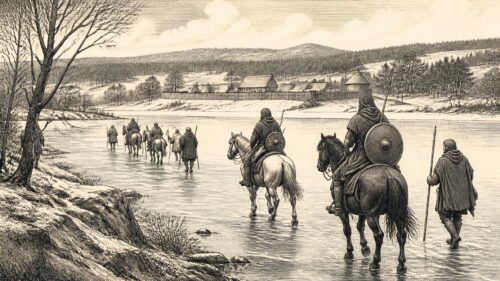
The most firmly attested military event is starkly stated by the Annals of Ulster: Amlaíb, Ímar and Cerball led a great army into Mide. Amlaíb and Ímar were leading figures among the foreigners based in or associated with Dublin’s maritime power; Cerball ruled Osraige, the kingdom centred on the Barrow–Nore region. Their coalition crossed a crucial political threshold. Mide was not merely a fertile midlands kingdom: it was the base of Máel Sechnaill’s Clann Cholmáin dynasty and contained Tara, the symbolic centre of high kingship. An attack there challenged the king of Tara where his authority was most tangible—in tribute, hostages, client rulers and the security of the roads and estates on which royal forces moved.
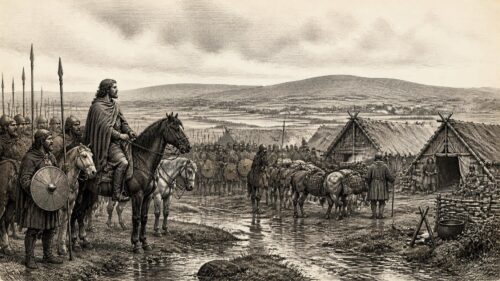
The Fragmentary Annals adds that Cerball campaigned with a Norwegian army and devastated Máel Sechnaill’s territory for three months. Its language is vivid, but the duration and its fuller claims should be treated as the testimony of a source eager to magnify the Osraige king, not as a timetable that can be independently checked. Even so, its account explains why the gathering at Rahugh was necessary: this was more than a brief foray. The Annals of Inisfallen preserve a differently framed notice of Cerball campaigning with the men of Munster among the Uí Néill, from Martinmas, 11 November, until an unnamed feast, ravaging as far as Sliab Fúait on the modern Armagh–Monaghan border; it says that the North submitted. Whether every element describes the same operation cannot be proved. Together, however, the accounts show that the crisis reached well beyond a single field of battle.
For those living in Mide, “plundering” meant a practical assault on survival and status: animals driven off, food stores seized, farms and residences threatened, dependants displaced, and captives or hostages taken. Early medieval Irish political economy rested heavily on livestock, agricultural produce and labour. A ruler’s ability to protect or recover these resources was fundamental to his reputation. The previous annal year had recorded a rainy autumn destructive to crops, a firmly dated notice for 858 rather than proof of conditions throughout 859; nevertheless, it supplies immediate context for the vulnerability of food supplies during the following year’s campaigning.
The Assembly at Ráith Áeda
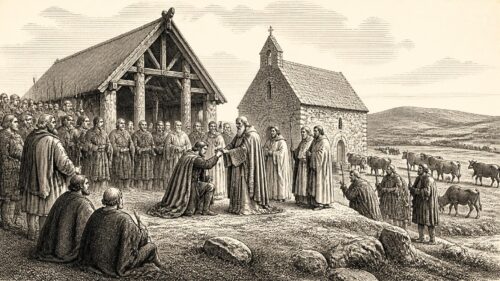
The answer was a rígdál, a royal conference. The Annals of Ulster say that the nobles of Ireland met at Ráith Áeda Meic Bric with Máel Sechnaill, Fethgna, successor of Patrick, and Suairlech, successor of Finnian, to make “peace and amity” among the men of Ireland. The phrase was ambitious. Ireland was not a unified state, and the meeting did not erase competing kingships. Rather, it was a public attempt to restore an order in which rival rulers acknowledged obligations, ecclesiastical communities had recognised claims, and violence was subject to negotiated restraint.
Its principal outcome concerned Osraige. Cerball gave his full dues to Patrick’s community and its successor; the annal then says that the Osraige were “alienated to Leth Cuinn”, with Máel Gualae, king of Munster, guaranteeing the arrangement. This should not be mistaken for an annexation by a central Irish government. It meant a reorientation of superior allegiance. Osraige, long entangled in Munster’s sphere, was now formally attached to the political orbit claimed by Máel Sechnaill. Cerball had to acknowledge a relationship to the Patrician church, above all Armagh’s powerful federation of churches, as part of the settlement. Religious authority was not ornamental: the successor of Patrick could validate obligations, mobilise institutional prestige and provide a language in which a king’s submission could be represented as a lawful peace rather than mere defeat.
The arrangement also shows Cerball’s strength. A lesser ruler might simply have been punished or replaced. Instead, he was brought back into a hierarchy while retaining his kingship. Máel Sechnaill gained a strategically important client on Munster’s northern approaches and separated Cerball from his Scandinavian partners; Cerball gained recognition of Osraige’s distinct standing and escaped a purely Munster-centred settlement. The king of Munster’s role as guarantor indicates consent under pressure, not necessarily enthusiasm. In one conference, military coercion, ecclesiastical dues and the geography of overlordship were bound together.
The Killing of Máel Gualae
Munster nevertheless lost its king in this same year. Máel Gualae mac Donngaile, king of Cashel, was killed by Norsemen, according to the Annals of Ulster. The basic fact is well supported, but the manner of death is less secure. Chronicon Scotorum and the Annals of the Four Masters say that he was stoned to death; the Fragmentary Annals instead says that he was captured and died in captivity. The Annals of Inisfallen records only his death. It is safest to say that Máel Gualae died violently at the hands of Scandinavian raiders or warriors in 859, without choosing between incompatible narratives.
His death was consequential because he had just appeared as the guarantor of the Rahugh arrangement. It exposed the fragility of royal authority in Munster and removed a participant able to speak for Cashel in dealings with Máel Sechnaill and Cerball. Yet it would be misleading to describe his death as the collapse of Munster or as evidence that the foreigners controlled the island. Scandinavian leaders were indispensable allies in one campaign and deadly enemies in another; Irish kings likewise formed shifting coalitions according to immediate advantage.
Churches, Learning and Commemoration
The year’s obituaries register the density of Ireland’s ecclesiastical landscape. The Annals of Ulster record the deaths of Suairlech of Achad Bó, Ailill of Banbán of Birr, Máel Coba of Cluain Uama and Faelgus of Ros Cré. Such entries are not mere clerical bookkeeping. Major churches were centres of worship, burial, learning, landholding and political connection. Their abbots and senior churchmen could act in diplomacy, as the presence of Patrick’s and Finnian’s successors at Rahugh demonstrates. The obituaries also remind us that local communities experienced 859 not only through armies and kings, but through the loss of religious leaders whose institutions organised prayer, hospitality, education and memory.
The Fragmentary Annals says that poets praised Cerball’s victories and singles out Óengus, the learned successor of Molua, as especially active. None of those praise poems survives here as a securely datable composition, so their wording cannot be reconstructed. The notice is still revealing. Reputation was political capital. A king who could attract poets and church scholars did not simply celebrate success after the fact; he helped fashion a claim that military prowess, learning and legitimate rule belonged together.
A Settlement That Did Not End Conflict
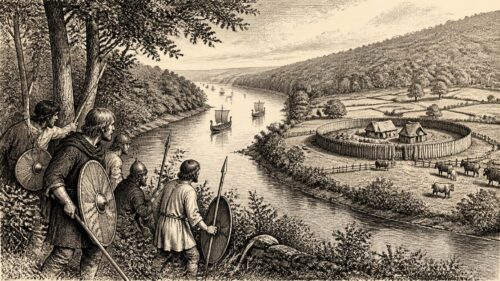
Most people in 859 lived in rural settlements: ringforts and other farmsteads housing families, livestock, stores and craft work. Dublin’s Scandinavian settlement, while already a significant armed and commercial base, did not make Ireland uniformly urban or Scandinavian. Archaeology instead points to a mixed world of farming, cattle, dairy production, textiles, metalworking and river–sea movement, in which imported goods and silver could circulate alongside older systems of tribute and clientship. The political events of 859 affected this world because armies required food, animals, ships, guides and labour, while settlements bore the cost of raids and royal exactions.
Rahugh did not bring lasting tranquillity. The following years saw further attacks on Mide, shifting Irish–Scandinavian alliances and renewed rivalry among the Uí Néill. Its importance lies elsewhere. In 859 Máel Sechnaill showed that kingship at Tara could respond to a serious coalition not solely by battle, but by convening a kingdom-wide settlement under ecclesiastical witness. Cerball’s submission and Osraige’s transfer to Leth Cuinn gave that settlement substance. The killing of Máel Gualae, however, made equally plain that agreements could be overtaken by violence. Ireland’s politics remained plural, mobile and precarious—held together, briefly, at a royal assembly in the midlands.
Primary Sources
- The Annals of Ulster, Year U859
- Fragmentary Annals of Ireland, Part 14
- Fragmentary Annals of Ireland, Part 15
- Annals of Inisfallen
- Annals of the Four Masters
- Chronicon Scotorum
- Chronicon Scotorum: Irish Text
- Viking Ireland—Afterthoughts
- Vikings in Ireland
- Vikings in Ireland and Scotland
- The Vikings in Ninth-Century Ireland: Sources and Settlements
- Kingship, the Church, and Silver in Ireland
- Viking
- Exhibition Galleries
- Ringforts / Ráthanna
- The Earthen Rath or Lios
- National Monuments Service: Monument Class and Scope Notes
- Early Medieval Farmsteads
- Animals and the Economy of Medieval Ireland: A Zooarchaeological Analysis of the Faunal Remains from Caherconnell Cashel, Co. Clare
- Nation and Kingship
- Bibliography: The Cambridge History of Ireland