Clonmacnoise’s Burned Termon832 CE
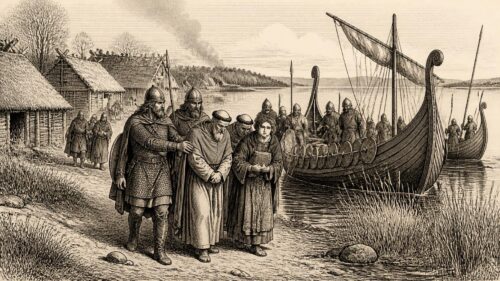
In 832, Irish annals recorded contested kingship, monastic violence and Scandinavian raids. Conchobor of Tara and Artrí of Armagh died, succeeded in Tara by Niall Caille, who defeated foreigners near Derry. Feidlimid of Cashel killed members of Clonmacnoise and Durrow and burned their protected territories, demonstrating that Irish rulers also threatened ecclesiastical centres. Cellach son of Bran attacked Kildare’s community. Foreign raiders plundered Clondalkin, burned Drumiskin and raided Loch Bricrenn, where Congalach died near ships. Regional rulers and churchmen also died, while Lismore and southern Munster suffered violence. The sources preserve consequences, but often omit motives, perpetrators and ordinary experience.
Dateline
The events recorded for 832 CE make this one of the starkest years in early medieval Irish annals. The entries do not describe a single national war or a unified campaign. Instead, they reveal overlapping struggles: a succession at Tara, attacks by Scandinavian raiders, violence between Irish rulers and church communities, and the vulnerability of major ecclesiastical settlements whose land, people and prestige made them political prizes. The most memorable notice concerns Feidlimid mac Crimthainn, king of Cashel, whose assault on Clonmacnoise and Durrow demonstrated that danger to monasteries did not come only from overseas.
A Year Fixed by the Annals
There is an important chronological caution. The principal contemporary-derived record, the Annals of Ulster, places these notices under an annal headed AD 832, although the surviving manuscript sequence labels it U833. Later annals sometimes arrange the same material differently. The Annals of the Four Masters, for example, places much of it under 832 but assigns the conflict at Kildare to its preceding annal. Such variation is normal in medieval Irish chronicle traditions. The events discussed here can responsibly be connected with 832, but the sources do not supply a complete narrative or a dependable order for every occurrence.
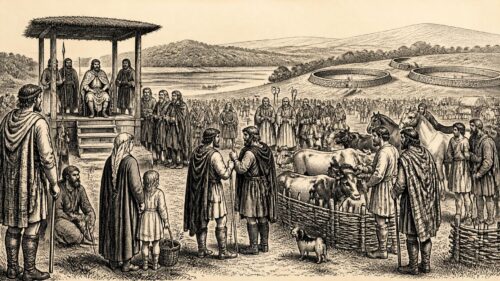
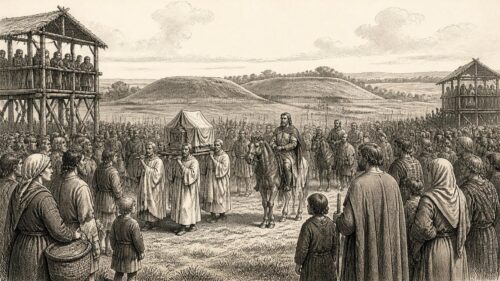
Two deaths announced in the same month marked a change at the centre of Irish kingship. Conchobor son of Donnchad, king of Tara, died, as did Artrí son of Conchobor, abbot of Armagh. Conchobor belonged to Clann Cholmáin, the leading dynasty of the southern Uí Néill; Artrí’s position at Armagh joined his family to Ireland’s foremost Patrician church. Their deaths did not mean that Tara ruled Ireland as a modern capital rules a state. The kingship of Tara was an exceptionally prestigious overkingship, asserted through kinship, military power, hostage-taking, assemblies and the recognition of provincial rulers. Its practical reach was always contested.
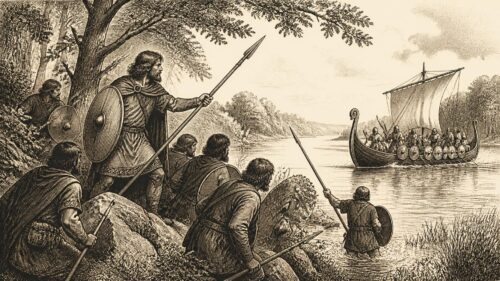
Niall Caille, son of Áed Oirdnide of the northern Uí Néill, began his reign after Conchobor’s death. The annal immediately associates the new king with action: Niall and Murchad routed the Gaill, or foreigners, at Daire Calgaig, modern Derry. No figures, leaders, ships or tactics are given, so it would be unsafe to turn the entry into a set-piece battle. Yet the notice matters. It places a northern Irish ruler in successful conflict with Scandinavian raiders at the beginning of a reign that would be shaped by both dynastic rivalry and the growing presence of seaborne warbands.
Monasteries as Political Landscapes
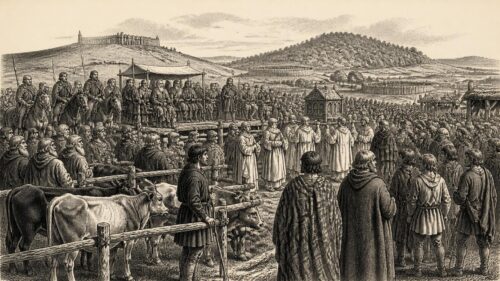
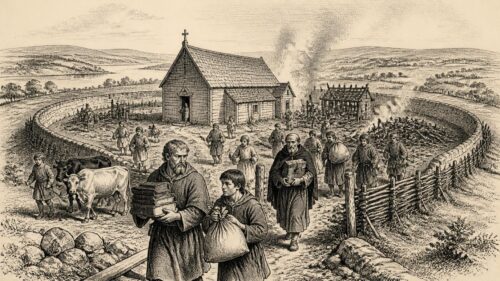
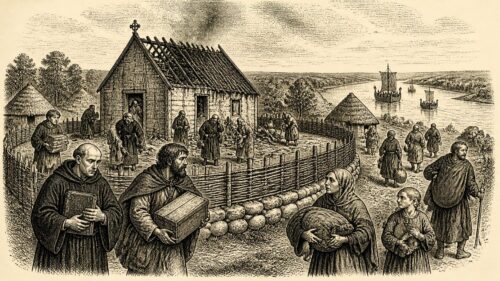
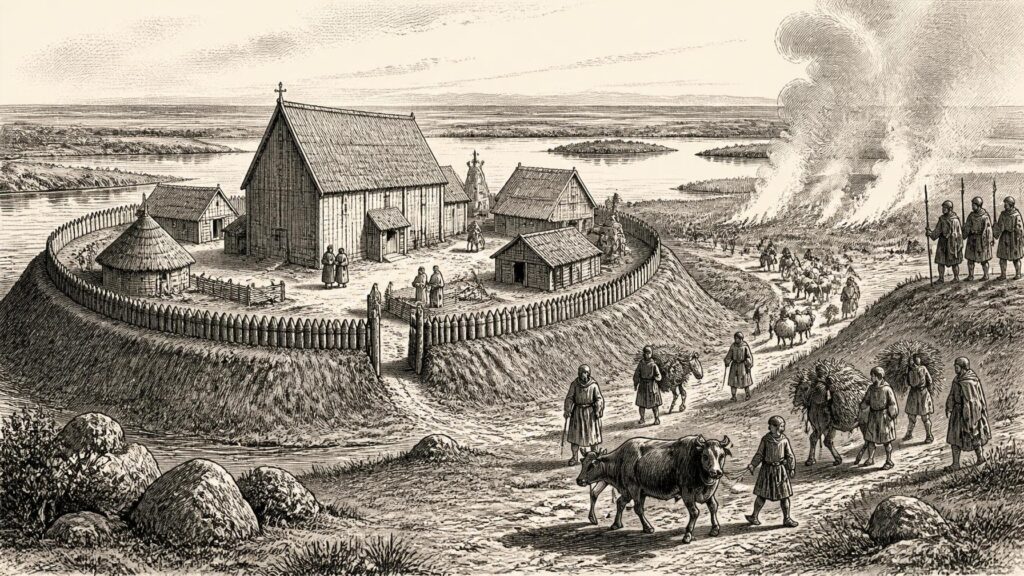
The year’s most serious Irish-on-Irish violence was directed at Clonmacnoise and Durrow. The Annals of Ulster state that Feidlimid, king of Cashel, put members of the community of Clonmacnoise to death and burned its termon as far as the door of the church; the community of Durrow was treated in the same way. The traditional English translation conveys a frightening image of destruction brought to the edge of sanctuary. Modern discussion of annalistic terminology, however, advises precision: termon denotes protected ecclesiastical territory, and the phrase may mean that the devastation reached the monastery gateway rather than that every building within the enclosure was burned. The annal does not say that either church itself was destroyed.
That qualification does not lessen the gravity of the attack. A monastic settlement was not simply a place where a small body of monks prayed. It was a religious community with clergy, tenants, labourers, dependants, estates, storehouses and links to powerful lay families. Its churches preserved relics and provided sanctuary; its learned men taught, copied and maintained texts; its agricultural lands generated food and dues. To burn its territory and kill members of its community was to strike at a network of authority as well as at sacred space.
Clonmacnoise, on the Shannon crossing in the Irish midlands, was especially valuable. Its riverine position brought it into contact with the north–south Shannon route and east–west land communications. It was already a major centre of religion, learning, craft and exchange, with a substantial lay population around its ecclesiastical core. Durrow, in the territory of the southern Uí Néill, had similarly deep political associations. The attack on both houses was therefore a challenge to interests extending far beyond their enclosures.
Feidlimid’s actions should be read in the context of his wider struggle for dominance, not as evidence that religious belief had become irrelevant to kingship. Feidlimid was himself described in later tradition as a religious man as well as king of Cashel. He had intervened in the contested leadership of Clonmacnoise earlier in his reign, supporting Flann son of Flaithbertach, a Munsterman, as vice-abbot. His return in 832 may have been intended to reinforce that influence. This is an informed interpretation, not something stated by the annal. What is firmly recorded is the killing and burning; the precise immediate motive remains unstated.
Kildare and the Contest for Leinster
Another ecclesiastical community suffered violence from an Irish ruler. The Ulster annalist reports that Cellach son of Bran routed the community of Kildare in a battle “in their monastery”, with many killed. Unlike most notices for the year, this one carries a day: it occurred on 29 August, the autumn feast of St John. Cellach was a Leinster dynast aligned with Feidlimid’s interests. Kildare, associated with St Brigit and commanding extensive religious and political prestige, was no detached refuge from provincial conflict. The entry shows armed confrontation entering the monastic precinct itself.
This episode also warns against an overly simple contrast between peaceful Irish monasteries and foreign marauders. Scandinavian raiders were a real and escalating danger, but Irish kings and their followers also attacked church settlements when power, land, tribute or dynastic allegiance were at stake. Ecclesiastical communities had moral authority and legal protections, yet they were embedded in the same competitive world as kingships. The annals preserve outrage in their language of slaughter and burning, while also revealing how frequently political calculation could override sanctuary.
Foreign Raiders on Waterways
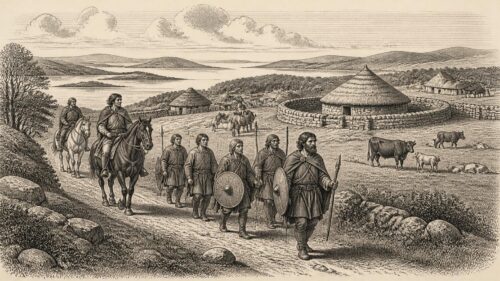
The annals nevertheless record several attacks explicitly attributed to “heathens” or foreigners. Cluain Dolcáin, now Clondalkin west of Dublin, was plundered. Druim Inasclainn, usually identified with Drumiskin in present-day County Louth, was burned. These concise notices offer no casualty totals, no named commanders and no proof of permanent Scandinavian settlement at either place in 832. They do show that raiders could reach prosperous inland church communities along the east-coast river and coastal network.
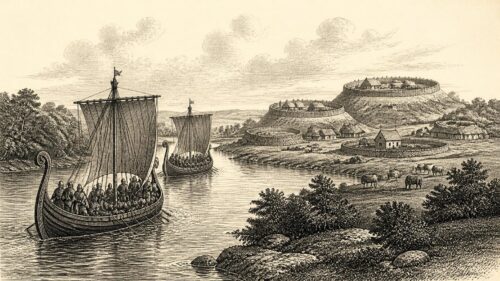
A further notice concerns Loch Bricrenn. The Annals of Ulster report that the lake was plundered to the detriment of Congalach son of Echaid and that he was killed afterwards “at the ships”. The later Annals of the Four Masters explicitly identifies the attackers as foreigners and says that Congalach was first taken prisoner. The agreement on plunder, ships and his death is strong; the fuller attribution belongs to the later compilation and should be treated accordingly. Even so, the episode captures the strategic importance of water transport. Lakes and rivers could be routes for movement, raiding and escape, not merely boundaries between territories.
These notices belong to an early phase of the Viking Age in Ireland. Raiding had begun decades before, but the durable coastal longphuirt and urban settlements associated with Dublin, Waterford and Limerick lay largely in the future. In 832, the evidence is for mobile attacks and local encounters rather than for a settled Scandinavian town controlling the island’s politics. The Irish annals call the attackers foreigners and heathens, terms reflecting the perspective of Christian record-keepers; they do not give enough information to identify every group’s homeland or intentions.
Deaths, Fire and Unrecorded Lives
The annal also records the death of Diarmait son of Tomaltach, king of Connacht, and that of Cobthach son of Máel Dúin, ruler of Iarmumu, or western Munster. These were regional changes of leadership, but the brief notices do not explain the political settlements that followed. A burning at Lismore, the church of Mochutu, is coupled with a slaughter of the people of Desmumu. The text does not name the perpetrators, and no responsible account can assign blame merely because Feidlimid ruled Munster. The item is evidence of violence in the southern province, not a clear description of a campaign.
Two church leaders, Rechtabra of Cell Achaid and Tipraite of Domnach Sechnaill, are also recorded as dead. Their obits are reminders of what the dramatic entries can obscure: the continuity of local religious life. Communities still required abbots, clergy, scribes, tenants and patrons; they continued to regulate land and worship, remember their dead and preserve knowledge. The survival of annals themselves is part of that longer continuity, although the manuscripts now extant are much later copies of material compiled over generations.
For ordinary people, 832 is visible chiefly through consequences rather than personal testimony: communities killed, territories burned, captives implied by later versions of events, and authority transferred after death. The sources say nothing reliable about harvests, weather, prices or disease in this calendar year. Silence should not be filled with invented famine, prosperity or climatic disaster. What can be said is that the year exposed the risks faced by people living around wealthy religious centres and contested routes. In Ireland’s political geography, sanctuaries, lakes, rivers and monasteries were sources of livelihood and learning, but also targets in the struggle for power.
Primary Sources
- The Annals of Ulster: AD 832
- Annala Uladh: Year U833, with AD 832 heading
- The Annals of Ulster: Background Details and Bibliographic Information
- Annals of the Four Masters: Annals M830–M833
- CELT Project: Annals of the Four Masters
- Annals of Inisfallen: Annal AI833
- Annals of Inisfallen
- Fedelmid (Feidlimid)
- Niall Caille
- Conchobar
- Notes on Terminology in the Annals of Ulster, 650–1050
- Atoning for Killing: The Practice of Penance and the Perception of Bloodshed among the Early Medieval Irish, Fifth to Ninth Century
- A County by County Reference List for Viking Activities in Ireland as Described in the Annals
- Woodstown in the Irish Annals
- Vikings in Ireland
- Irish Texts at CELT
- List of Published Texts at CELT
- Clonmacnoise Monastic Site
- Clonmacnoise Visitor Guide
- Irish School of Illumination, c. 650–1100