Rural Hardship669 CE
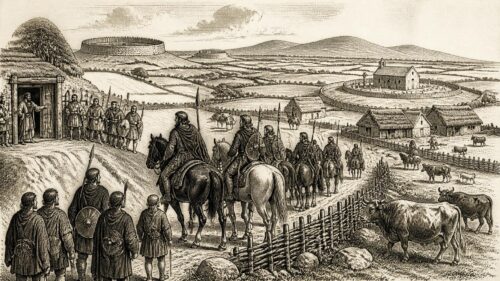
In 669, Irish annals record a great snowfall and famine, indicating severe pressure on rural food supplies. The year also saw the deaths of Cumméne Find, abbot of Iona, and Crítán, abbot of Bangor, marking changes at influential monastic centres linked across Ireland and northern Britain. Máel Fothartaig, king of Uí Thuirtri, died and was commemorated in verse, reflecting the importance of regional kingship and praise poetry. Máel Dúin son of Máenach was killed, while deaths in Pictland underline Ireland’s wider connections. These fragmentary notices reveal hardship, institutional continuity, local political loss and an interconnected Irish Sea world.
Dateline
In 669 CE, Ireland’s surviving annalistic tradition preserves a brief but unusually revealing cluster of notices: a great snowfall and famine; the deaths of leading churchmen; the passing of Máel Fothartaig, king of Uí Thuirtri; and the killing of Máel Dúin son of Máenach. These are sparse records, not a continuous narrative, and they must be handled carefully. The early Irish annals have notorious chronological offsets between manuscripts and modern calendar years. Yet the severe snow and famine are placed under a heading explicitly equated with AD 669 in the Annals of Ulster, while Cumméne Find’s death is conventionally dated to 669 by modern scholarship and is entered under that year in related annalistic traditions. Together, the notices make 669 a year of material hardship, institutional loss and local political change.
Snow and Scarcity
The starkest entry reads simply: “A great snowfall occurred. A great famine.” The annalist gives no month, duration, district, harvest figures or death toll. It would be irresponsible to turn those few words into a detailed disaster story. We do not know whether snow lay for weeks, whether it chiefly damaged winter grazing, blocked travel, delayed spring cultivation, or followed an earlier failure of crops. Nor can it be shown that every part of Ireland suffered equally. What can be said is that the writer considered both the weather and the resulting scarcity important enough to preserve.
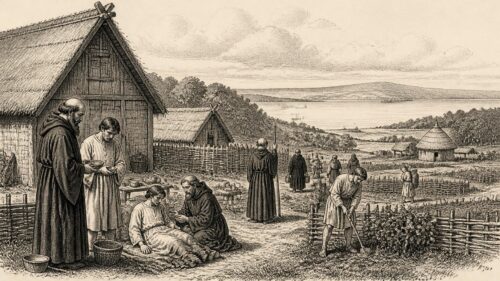
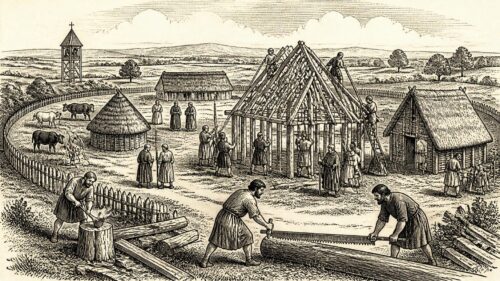
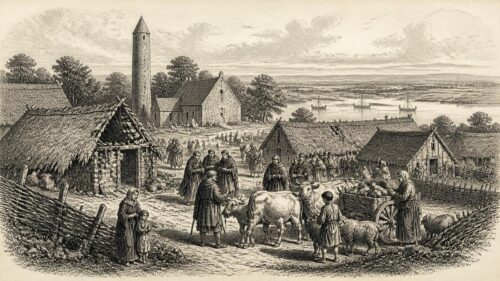
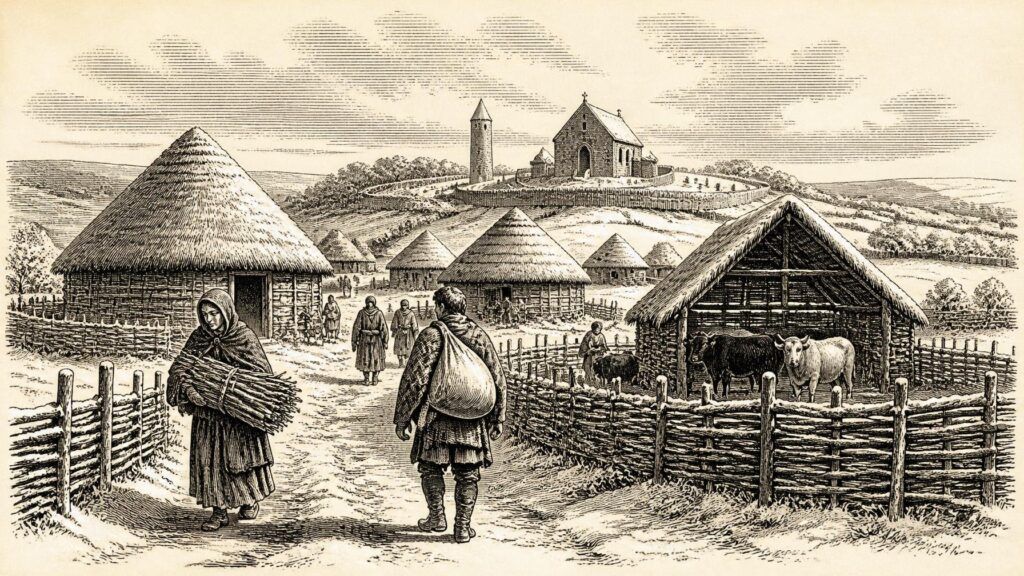
For an overwhelmingly rural society, such a pairing carried grave implications. Most people lived in dispersed farming settlements, dependent on grain, dairy produce and livestock, supplemented by fishing, gathering and seasonal resources. Heavy snow could obstruct movement between households and estates, restrict access to pasture and fuel, and make the transport of food difficult. A famine notice need not mean universal starvation; it signifies a severe failure of normal provisioning, which could range from depleted stores and rising dependence on patrons to hunger, disease and death among the most vulnerable. The record does not permit a precise reconstruction, but it firmly places subsistence under pressure in 669.
The event also belongs to a troubled wider generation. Ireland and the Irish Sea world had recently endured the great epidemic conventionally associated with the Buide Chonaill, recorded from the mid-660s and remembered for the deaths of rulers, abbots and many unnamed people. It is tempting to make the snow famine a direct continuation of that epidemic, but the sources do not demonstrate a single uninterrupted crisis. The safer conclusion is narrower: communities facing the scarcity of 669 did so within living memory of extensive mortality and institutional disruption. That recent experience would have made the loss of food, animals and labour especially difficult to absorb.
An Abbot of the Columban World
The death of Cumméne Find, or Cumméne the Fair, was the most significant ecclesiastical loss recorded for the year. He had been abbot of Í, the island monastery better known as Iona, from 657 until his death in 669. Iona lies off the coast of modern Scotland, but its history was inseparable from Ireland. Its founder, Colum Cille, came from the Cenél Conaill of north-west Ireland; its abbots, patrons, monks and affiliated houses linked Ulster, the north Midlands, western Scotland and northern Britain. Cumméne himself belonged to this northern Irish dynastic and ecclesiastical milieu.
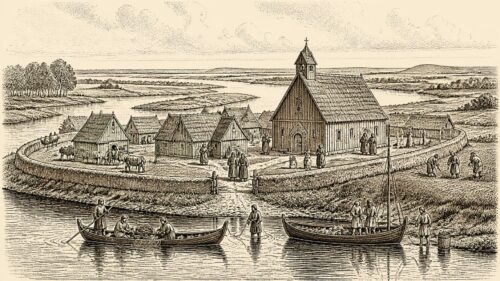
An abbot of Iona was not merely the superior of one island community. He headed a religious family whose influence rested on kinship, travelling clergy, landed support, learned reputation and the authority of Colum Cille’s cult. The network extended across the Irish Sea. It had supplied missionaries and bishops to Northumbria, maintained connections with Irish foundations, and carried books, relics, people and news between coastal communities. The retirement of the Ionan bishop Colmán from Lindisfarne after the Synod of Whitby in 664, and his subsequent foundation on Inis Bó Finne, show how directly ecclesiastical disagreement and travel bound Ireland to Britain during Cumméne’s abbacy.
Cumméne’s literary importance outlasted him. Adomnán, a later abbot of Iona, names him as the author of a book on Colum Cille’s miracles and virtues. Only fragments and traces survive, incorporated into later hagiographical tradition, but the attribution matters. It shows that the Iona community was actively shaping its founder’s memory in Latin prose within a few generations of Colum Cille’s death. Such writing was not antiquarian decoration. A saint’s remembered miracles, relationships with kings and protection of communities could validate an institution’s status, claims and spiritual authority.
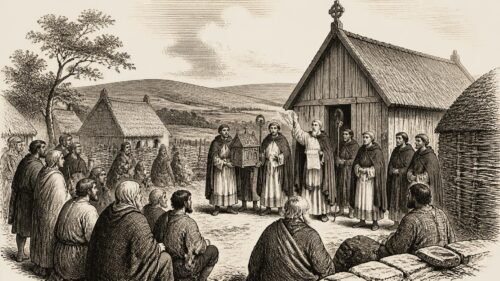
Cumméne’s death therefore marked a change in leadership at a major Irish-linked centre of learning and devotion. His successor was Fáilbe, whose abbacy began in 669. There is no surviving account of an election, funeral or dispute, and no reason to invent one. The smooth sequence of names is nevertheless meaningful: continuity in the abbacy helped secure the standing of the Columban federation at a moment when its customs had recently been challenged in Northumbria and when Ireland’s monasteries were still recovering from epidemic losses.
Bangor and the Clerical Landscape
The same annalistic notice records the death of Crítán, abbot of Bennchor, modern Bangor in County Down, and of Mo-Chua son of Cust. Bangor was another prominent monastery in the north, associated with strict communal observance, teaching and far-reaching clerical connections. The record is frustratingly concise: it offers no biography of Crítán and no description of the community’s response. Still, the simultaneous commemoration of an abbot of Iona and an abbot of Bangor illustrates how annalists viewed senior religious figures as people whose deaths merited island-wide remembrance.
These notices should not be mistaken for a complete list of Irish deaths in 669. Annals preserve what particular record-keeping communities considered memorable, and their survival is uneven. Nor does the concentration of clerical names prove that monks alone suffered during the famine. It does, however, reveal where literacy was concentrated. Monasteries maintained calendars, commemorated benefactors and leaders, trained readers and scribes, and preserved verse as well as prose. They were places of worship, but also centres through which news, authority and learned culture travelled.
The King of Uí Thuirtri
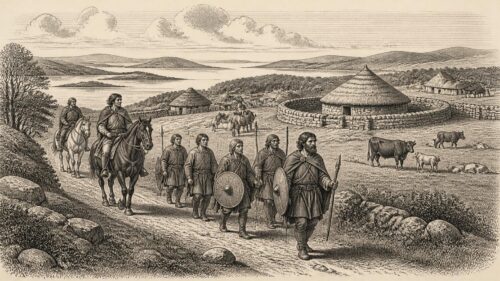
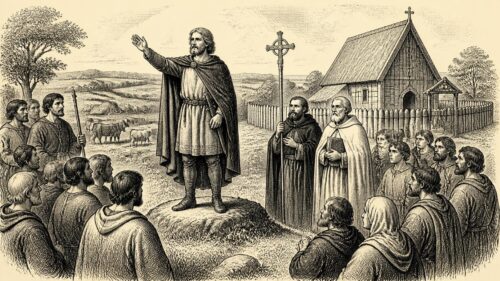
Alongside the churchmen, the annals record the death of Máel Fothartaig son of Suibne, king of Uí Thuirtri. Uí Thuirtri was a northern Irish people, later associated with territory in the region of Lough Neagh and the lower Bann. The title “king” should not suggest a ruler of a unified Irish state. Seventh-century Ireland was made up of numerous kingdoms and kin-groups, with power exercised locally through control of land, clients, tribute, military followers and alliances. Kingship was personal and precarious, and the death of a regional ruler could rearrange obligations far beyond his household.
The Annals of Ulster preserve four lines of verse on Máel Fothartaig’s death: the poet says that no other king was dearer to him after Máel Fothartaig had been carried in his shroud to Daire. The poem is too short to establish the king’s character, policies or place of burial with certainty. Daire probably refers to an important northern ecclesiastical place, often identified with Derry, but the wording alone should not be pressed further. Its value lies in the survival of an immediate-sounding elegiac response. A named ruler was mourned not only in a prose obituary but in carefully composed Irish verse.
The poem also offers a glimpse of political culture. Praise poetry was part of the machinery of reputation: it could commemorate generosity, ancestry and loss, and it connected rulers to learned specialists. The annal attributes the lines to a Cenn Fáelad, but that name was borne by more than one prominent seventh-century figure, so the poet cannot safely be identified from this entry alone. What is secure is that vernacular poetry and Latin-derived annalistic record-keeping could coexist in the same learned environment. Ireland’s cultural world was bilingual in function, even when individual texts were written principally in Irish or Latin.
Violence and Connections Across the Sea
The final Irish political notice is the killing of Máel Dúin son of Máenach. No location, motive, killer or consequence is supplied. It is evidence of violence, but not of a battle, feud or national campaign. The restraint required here is important: seventh-century annals frequently name a death without explaining it, and silence cannot be filled with dramatic conjecture.
Two further deaths were recorded “among the Picts”: Itarnan and Corindu. Their entry does not describe an Irish expedition or a Pictish political event. Yet it belongs in an Irish year because the annals that preserve it were interested in the ecclesiastical and political world around the Irish Sea. Iona’s Columban connections made Pictland, Dál Riata and northern Britain part of the horizon of Irish record-keepers. The entry is a reminder that early medieval Ireland was not isolated, even in a year when snow and famine may have made ordinary travel and exchange more difficult.
A Year Seen in Fragments
669 does not yield a royal assembly, a major battle or a securely documented diplomatic settlement. Its importance lies elsewhere. The great snowfall and famine expose the dependence of everyday life on weather and stored food. The deaths of Cumméne and Crítán show how leading monasteries remained central to authority and learning. Máel Fothartaig’s obituary and elegy reveal the enduring local force of regional kingship and professional praise. A killing, and notices from Pictland, complete a record of vulnerability, connection and change.
The annals give no single story because no single institution ruled Ireland. Instead they preserve a mosaic: a hungry countryside, religious houses renewing their leadership, a northern king carried to Daire, and a learned writer deciding that these losses and hardships should be remembered. That selective record is enough to make 669 a distinctly human year in Irish history, while also setting firm limits on what can be claimed.
Primary Sources
- The Annals of Ulster, Year U669
- The Annals of Ulster, Year U670
- Chronicon Scotorum, Annals CS669–CS673
- Fragmentary Annals of Ireland, Annals FA 41–FA 49
- The Annals of Ulster
- Chronicon Scotorum
- Fragmentary Annals of Ireland
- Cumméne (Cummíne, Cummian) Find
- Blathmac
- Cenn-Fáelad
- Cenn-Fáelad
- Cuimmíne m. Arnáine, abbot of Iona
- Í > IOUA > IONA – Iona’s Namescape
- Early Mechanisms of Abbatial Succession: The Case of Iona (563–704)
- Iona, Abbots of: (act. 563–927)
- The Life of Columba, Written by Adamnan
- The Life of Columba, Part 87
- The Chronology and Sources of the Early Irish Annals
- Chronological Synchronisation of the Irish Annals
- Medieval Irish Chronicles Reveal Persistent Volcanic Forcing of Severe Winter Cold Events, 431–1649 CE
- Medieval Irish Chronicles Reveal Persistent Volcanic Forcing of Severe Winter Cold Events, 431–1649 CE
- The Historic Record of Cold Spells in Ireland
- The Ecclesiastical History of England