Samthann and Bodbráith739 CE
In 739, Irish annals record the death of Samthann, abbess of Cluain Brónaig near Granard, alongside deaths of the scribe Cúán of Treóit, Bishop Flann of Rechru, another bishop, and Ailill, king of Uí Chremthainn. They also describe the burning at Bodbráith of followers belonging to a Domnall, in which Ailill of Brí Léith died in a banqueting hall. The event’s cause and Domnall’s identity remain uncertain. These sparse notices, set after warfare in Leinster, reveal interconnected religious communities, regional dynasties and dependants. Churches were centres of landholding, learning and authority, while rural farming sustained ecclesiastical institutions and political households.
Dateline
In 739 CE, Ireland’s surviving annalistic record is brief but unusually revealing. It preserves the death of Samthann, abbess of Cluain Brónaig in what is now County Longford; the killing of men attached to a ruler named Domnall in a burning at Bodbráith; and notices of scribes, bishops and regional kings. None amounts to a continuous narrative of the year. Together, however, they show an island in which religious communities, local dynasties and household followings were deeply interwoven. The evidence must be read carefully: the Annals of Tigernach places these notices under 739, while the surviving Annals of Ulster has a chronological offset in this part of its text. Modern reference scholarship nevertheless dates Samthann’s death to 739, and that conventional calendar year is followed here.
A Year of Sparse but Telling Notices
The annals were not diaries. Their compilers selected deaths, warfare, ecclesiastical changes and extraordinary occurrences thought worthy of remembrance, often from records first kept at major churches. Silence does not mean that nothing else happened. It means that much of ordinary life—ploughing, dairying, fostering children, repairing houses, tending livestock, bargaining at assemblies and travelling between settlements—went unrecorded. In 739, the preserved notices are especially concentrated on death and sudden violence. That pattern gives the year a sombre cast, but it should not be mistaken for a complete measure of life in Ireland.
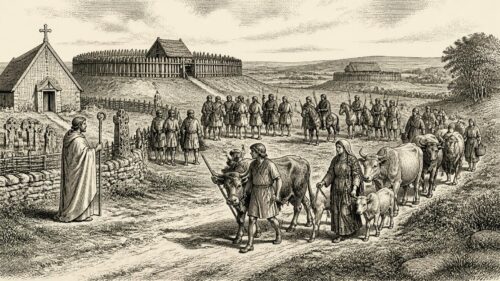
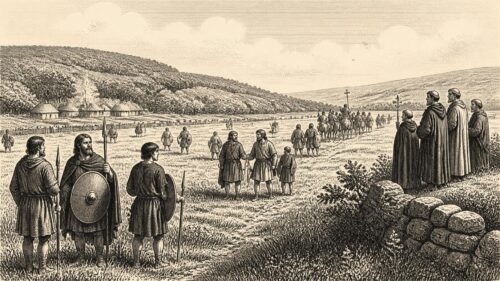
The political background was unsettled. Áed Allán of Cenél nÉogain, king of Tara in the north, had won a crushing victory over Leinster at Áth Senaig in 738. Cathal son of Finguine, the powerful ruler of Munster, had also campaigned into Leinster in that previous year. Thus 739 opened in the shadow of heavy fighting and hostage-taking, not in a united kingdom governed from a fixed capital. “Ireland” was a network of kingdoms, peoples and ecclesiastical jurisdictions. A king of Tara could claim an island-wide pre-eminence, but authority was exercised through alliances, submissions, tribute, military expeditions and the influence of churches rather than a permanent central administration.
A later annalistic tradition, the Annals of the Four Masters, calls 739 the first year of Domnall son of Murchad over Ireland. That cannot simply be treated as a securely dated accession. The better-supported chronology places Domnall Midi’s acquisition of the kingship of Tara after he defeated Áed Allán in 743. The Four Masters entry is valuable as evidence of later regnal tradition, but it should not displace the contemporary political sequence. In 739 Domnall Midi was already a major Clann Cholmáin ruler in the midlands, not yet securely identifiable as king of Tara.
Fire at Bodbráith
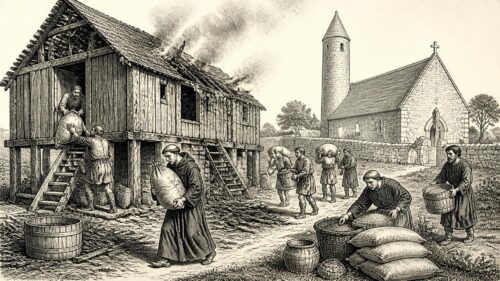
The most violent Irish entry assigned to the year concerns “the burning of the family of Domnall” at Bodbráith. Ailill of Brí Léith died in the tech midchúarta, the banqueting house. “Family” here does not mean a household in the modern narrow sense. In early medieval political language it could include a lord’s dependants, retainers and armed following: people bound to him through service, patronage, kinship and reward. The loss was therefore political as well as personal.
Bodbráith has not been securely identified, and the annal does not tell us whether the fire was an attack, an accident or a deliberate act within a dispute. Nor does it name Domnall by patronymic. It is tempting to connect him with Domnall Midi, whose midland power makes the association plausible, but the text itself does not settle the question. The detail that Ailill died in a banqueting house is striking. Such halls were places where a ruler displayed status through hospitality, received clients and negotiated loyalties. Their destruction, whether intentional or not, would have hit at the visible centre of lordship.
Ailill’s byname links him with Brí Léith, an important central-Irish landscape associated with the later Ardagh area. The notice consequently points towards the broad zone of Tethbae and the midlands, where overlapping dynastic interests, church estates and routeways connected the Shannon basin with Brega and the north-east. It also offers a corrective to any image of early Irish warfare as only open-field battle. Violence could erupt at a residence, among a lord’s own followers, in the very setting intended to stage feasting and security.
Samthann of Cluain Brónaig
The death of Samthann of Cluain Brónaig is the year’s most important religious notice. Her community, at Clonbroney near Granard in modern County Longford, lay in the same wider midland world as Brí Léith. Samthann is more than a name in an obit. She is one of the relatively few early Irish women saints for whom both annalistic notice and a later Latin Life survive, though the Life must not be read as a straightforward biography. It builds miracles and idealised scenes around a historical abbess remembered for ascetic authority.
Modern scholarship finds a historical figure beneath the hagiographical elaboration. Samthann appears to have been respected for rigorous religious practice and practical counsel, and later sources associate her with currents of spiritual reform that would become more visible in the eighth-century movement conventionally called the Céli Dé, the “clients” or companions of God. That association requires caution: the later reform movement should not be projected wholesale back onto 739. Yet her commemoration indicates that female religious leadership could carry real standing beyond a single enclosed community.
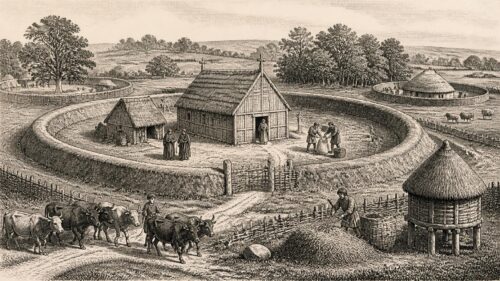
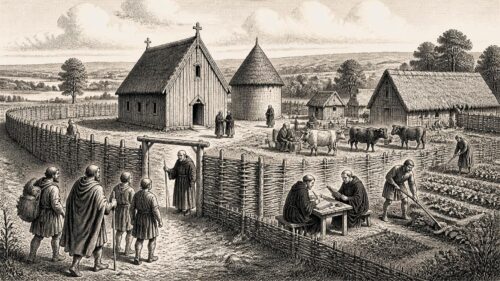
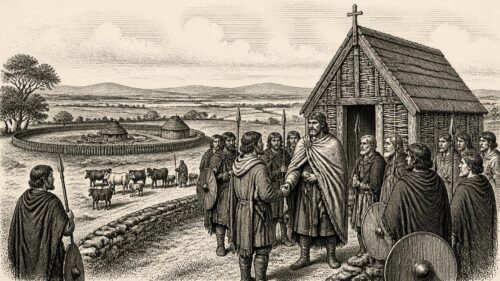
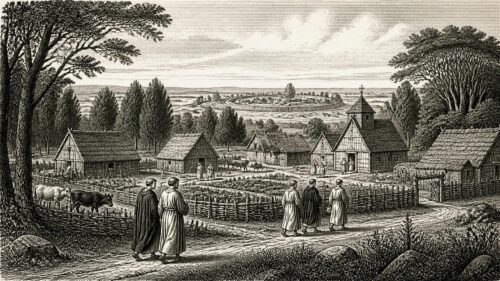
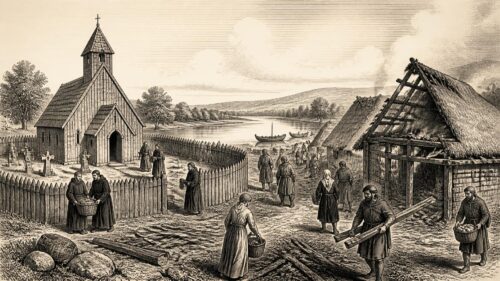
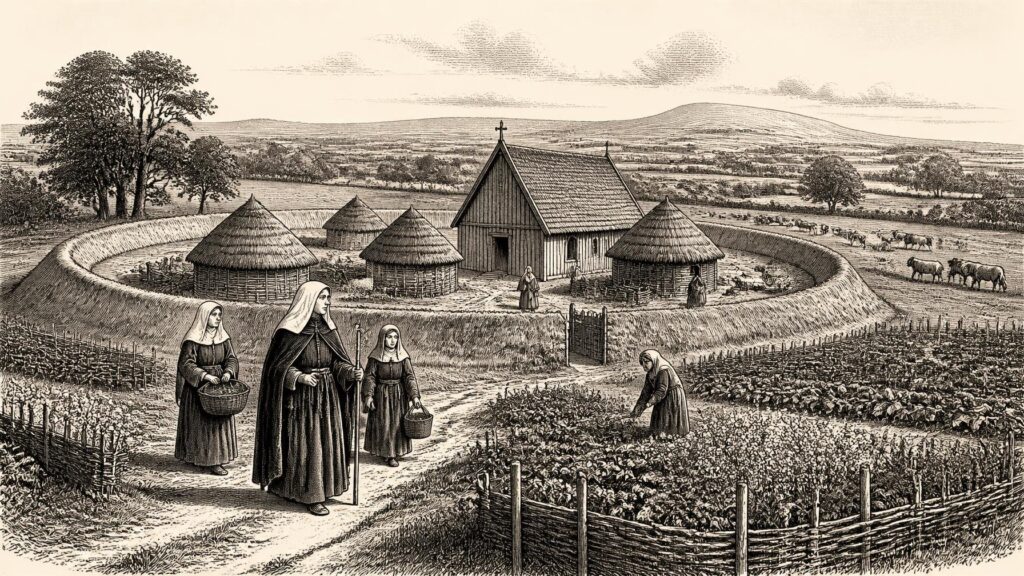
Cluain Brónaig was not a remote convent detached from society. Early Irish churches were often substantial settlements, with churches, burial ground, workshops, cultivated land, guests, clerics, dependants and tenants within or around their enclosures. Their leaders managed property and relationships with secular patrons. An abbess’s death therefore mattered to kin groups and neighbouring rulers as well as to the women and men of her own community. Samthann’s passing was a moment when spiritual prestige, landholding and local political protection had to be renewed through successors and allies.
Scribes, Bishops and Island Churches
The annals also record the death of Cúán grandson of Bésán, described as scribe of Treóit, generally identified with Trevet in County Meath. The title matters. Writing was a specialised craft concentrated in ecclesiastical settings, serving liturgy, legal memory, genealogy, correspondence and the preservation of Latin and Irish learning. A scribe’s obituary is a small but direct reminder that books and documentary expertise were valued enough to enter the historical record. Ireland in 739 had no royal bureaucracy comparable to that of the Carolingian Franks, but literate church communities formed durable centres of administration and cultural transmission.
Flann son of Cellach son of Crunnmael, bishop of Rechru, also died. Rechru is Lambay Island off the Dublin coast, and its appearance illustrates the maritime character of Irish ecclesiastical life. Islands could be places of retreat, cultivation and monastic residence, but they were not cut off from the mainland. Boats connected coastal churches, fishing grounds and communities around the Irish Sea. The bishop’s title should not automatically be equated with the office of a modern diocesan bishop: early Irish church organisation was diverse, and bishops frequently operated within monastic and kin-based ecclesiastical networks.
The same cluster of entries includes the death of an unnamed bishop, described only as a grandson of Máel Dáithnéin, and the death of Ailill son of Tuathal, king of Uí Chremthainn. Such compressed notices preserve status rather than explanation. They show that ecclesiastical rank and local kingship were both essential categories for annalists. They also show the limits of the evidence: we cannot reconstruct succession disputes, funerary rites or the day-to-day consequences of these deaths from a line or two of text.
Land, Livelihood and Change
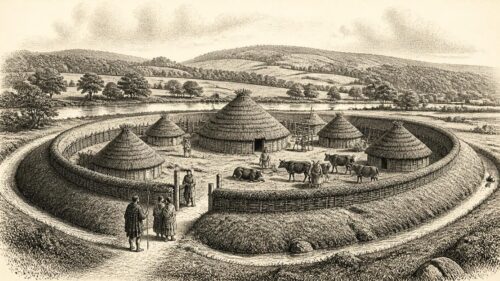
For most people, the decisive realities of 739 were agricultural. Ringforts and stone cashels, together with unenclosed homes and dispersed farmsteads, anchored households across the island. Cattle remained central to wealth, food production and social valuation, while cereals were grown, dried and ground into meal. Archaeology suggests that the eighth century was also a period in which some communities increasingly invested in grain processing and occupied locations favourable for tillage. This was gradual regional change, not an event demonstrably begun in 739; it nevertheless describes the economic landscape in which that year’s elites collected food-renders and maintained followers.
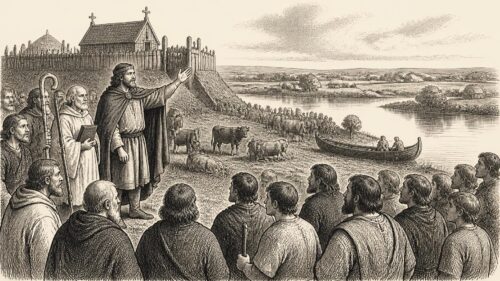
Churches participated in this rural economy. Their communities required grain, dairy produce, labour, timber, metalwork and transport. Their estates could support schools and scribes, while their sacred standing gave them a role in negotiating conflict and commemorating the dead. The deaths of Samthann, Cúán and Flann therefore belong not only to religious history but to the practical structures that linked learning, food supply, land and authority.
What 739 Can—and Cannot—Show
The year does not yield a single dramatic national turning point. Its significance lies in the texture of the record. At Bodbráith, a fire destroyed members of a powerful household and killed a man associated with Brí Léith. At Cluain Brónaig, an abbess whose reputation outlasted her community’s early history died. At Treóit and Rechru, the annals marked losses among the people who sustained literacy and ecclesiastical leadership. Around them, farmers and craftworkers continued to support kingdoms and churches whose political boundaries remained negotiable and whose security could be abruptly broken.
That is the responsible picture of Ireland in 739: not a blank year, but a thinly documented one. Its surviving notices preserve a society in which faith, learning and local power were inseparable; where a woman religious could become a lasting public memory; and where a lord’s hall, the emblem of hospitality, could become the setting of catastrophe.
Primary Sources
- The Annals of Ulster, Year U739
- The Annals of Tigernach, Annal T739
- Annals of the Four Masters, Part 57 (Annals M737–M742)
- Annals of Inisfallen
- Samthann
- Domnall Midi
- Áed Allán
- Murchad Midi
- Sléibíne
- Cluain Brónaigh/Clonbroney: official place-name record
- An tOrdú Logainmneacha (Contae an Longfoirt)
- Early Medieval Farmsteads
- Farming and Archaeology: The Irish Historic Landscape
- Changing human-cattle relationships in Ireland: a 6000-year isotopic perspective
- Land Use and Economy AD 500–1100
- Ireland To 1170 (with Andrew Woods)
- Churches and Ecclesiastical Enclosures / Shéipéil agus Ráthanna
- Ordinary People in Early Christian Ireland
- Money in Early Christian Ireland According to the Irish Laws
- Ways of death: cremation and belief in first-millennium AD Ireland
- The Chronicle of Ireland: then and now
- Exploring the Irish Annals