Dún Cremthainn650 CE
In 650, the battle of Dún Cremthainn reflected continuing rivalry within the northern Uí Néill. Óengus, son of the former Cenél Conaill ruler Domnall mac Áedo, was killed by his cousins Cellach and Conall Cóel, sons of Máel Coba. The victory did not secure lasting supremacy, as later conflicts displaced both victors. Annalistic dating is uncertain, and other notices assigned to the year include local warfare, deaths of rulers and abbots, and church activity. Ireland remained a patchwork of small kingdoms, lordships and ecclesiastical centres. Rural life depended on farming, cattle wealth and labour, while churches preserved learning and maintained wider connections.
Dateline
In 650 CE, Ireland’s surviving historical record centres on a violent dispute within the northern Uí Néill, but it also offers unusually revealing glimpses of the island’s fragmented political world. The annals place a battle at Dún Cremthainn in this year, in which Óengus, son of Domnall, was killed by Cellach and Conall Cóel, sons of Máel Coba. Yet early Irish chronology requires care. The Annals of Ulster labels this as its entry U650 while its calendrical heading equates that annal-number with AD 649; modern reference works conventionally place the battle in 650. Other annalistic compilations assign different Irish events to their year 650. The responsible conclusion is not that every notice can be tied to a particular day in the modern calendar, but that 650 marks a real and important moment of dynastic conflict, remembered in several strands of Irish historical tradition.
A Dynastic Killing
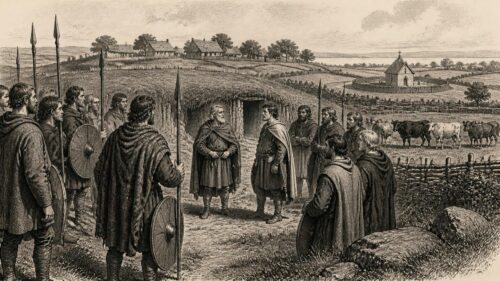
The short entry for Dún Cremthainn is stark: Óengus son of Domnall fell; Cellach and Conall were the victors. It does not name the battlefield’s modern location, describe the armies, or explain who began the fighting. Such silences matter. It would be unsafe to picture a national war, a siege, or a clash between clearly bounded states. Nevertheless, the identities of those named make the encounter politically significant. The combatants belonged to the wider northern Uí Néill, the dominant kindred grouping of the north and midlands whose leading branches repeatedly competed for regional pre-eminence.
Óengus was a son of Domnall mac Áedo, the powerful Cenél Conaill ruler who had died in 642. Cellach and Conall were sons of Máel Coba and, therefore, Óengus’s cousins within the same broad dynasty. The battle was accordingly a family struggle for authority, not a confrontation between Ireland and an external enemy. Modern historians connect it with the unsettled succession after Domnall’s death. Cellach and Conall had risen to prominence among the Cenél Conaill, while Óengus represented an alternative line with an equally persuasive claim to inherited standing. His death removed one claimant, but did not settle the larger contest over supremacy among the Uí Néill.
It is tempting to call Cellach and Conall ‘high kings’, since later king-lists and annalistic traditions associate them with the kingship of Tara. That language can conceal as much as it reveals. Mid-seventh-century Ireland was not a united kingdom governed from a capital. Kingship worked through overlapping claims, personal alliances, tribute, hostage-taking, military followings and control of important places. A ruler might be recognised as an overking by some neighbouring dynasties while being resisted, ignored or challenged by others. Dún Cremthainn shows how precarious such superiority could be: even men of the same ruling lineage had to establish it by force.
What the Battle Can Tell Us
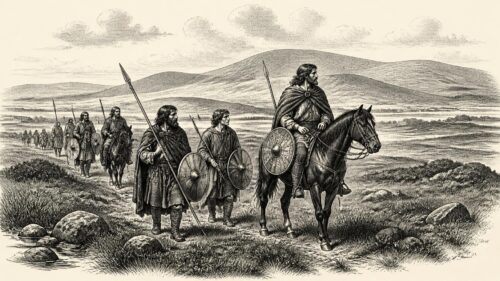
The sources do not record the number of casualties beyond Óengus, nor do they identify the ordinary fighters who made the victory possible. They were likely drawn from the warbands and dependent communities of competing lords, but the scale remains unknown. Early medieval Irish conflict could involve rapid raids, the seizure of cattle and captives, attacks on settlements and set-piece encounters. A victory brought more than prestige. It could determine access to clients, tribute, land, church patronage and the resources needed to reward followers. Defeat endangered not only a king’s life but the political standing of his descendants and allies.
The battle’s consequences can be traced only cautiously. Cellach and Conall remained prominent afterwards, but their position was not secure for long. In 654 Conall was killed in a conflict associated with Diarmait Ruanaid, of the southern Uí Néill branch Síl nÁedo Sláine. Cellach was subsequently captured and died a few years later. Thus the victory of 650 was an episode in a continuing reshaping of power, rather than the foundation of a stable regime. By the later 650s, Diarmait and his brother Blathmac had become leading figures in the midlands. The political map of Ireland was made and remade through precisely this kind of interlocking dynastic rivalry.
Nor was the northern Uí Néill the whole of Ireland. Munster was dominated by branches of the Eóganachta; Leinster contained several competing dynasties; Connacht was divided among powerful kindreds; Ulaid and Airgíalla had their own rulers; and the midlands contained a dense patchwork of lordships. Even the vocabulary of ‘province’ risks projecting later neatness onto a landscape of local kingdoms. Most people owed their closest political obligations to a túath, a small kingdom or people, and to the lordly household that could protect them, exact food-renders and mobilise them for service.
Other Notices Assigned to 650
The seventeenth-century Annals of the Four Masters, drawing on earlier materials but compiled many centuries after the events, places several different notices under 650. It records the deaths of Aithchen, abbot of Tír dá Glas, and Cailcín of Lothra, two churches in the Shannon region. It also reports a battle at Fleascach, where Crunnmael son of Suibne of Cenél nEógain defeated and killed Cumascach son of Ailill, chief of Uí Chremthainn. The same annal notes the death of Crunnmael Erbuilg, described as chief of south Leinster, and of Berach, abbot of Duiblinn.
These notices should not be woven into a single campaign. The compilation supplies no basis for saying that Fleascach was connected to Dún Cremthainn, or that the deaths of churchmen resulted from conflict. Their value lies elsewhere. Taken with appropriate caution, they illustrate the breadth of the political and ecclesiastical networks that an Irish chronicle could notice: northern dynastic warfare, a local lordship in Uí Chremthainn, Leinster leadership, Dublin’s church, and monastic communities along the Shannon. They also underline the limits of exact dating. For 650, the Annals of Ulster and the Four Masters preserve overlapping but not identical memories; neither should be treated as a modern yearbook.
Churches as Centres of Power
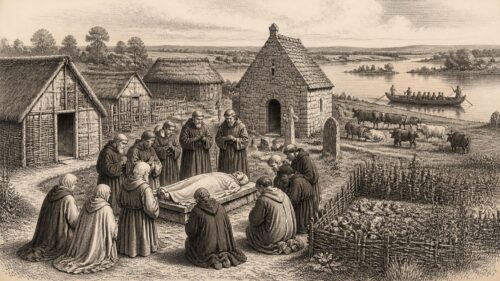
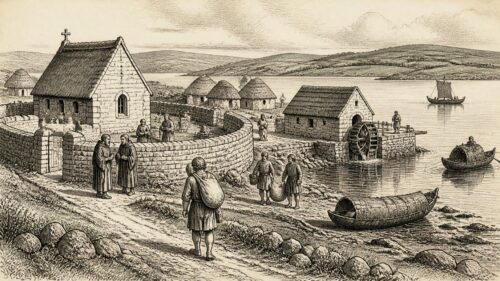
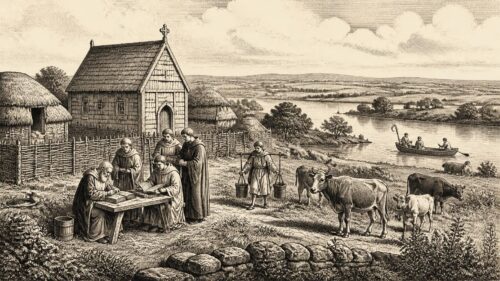
Christian institutions were embedded in this political landscape. Tír dá Glas, later Terryglass in County Tipperary, and Lothra, near the Shannon at Lorrha, belonged to a growing network of ecclesiastical settlements whose communities prayed, taught, copied texts, cultivated land and maintained ties with ruling families. An abbot’s death could deserve annalistic notice because major churches held people, livestock, food-renders and landed rights, as well as spiritual authority. Their leaders were not merely isolated holy men: they could be patrons, advisers, scribes, diplomats and members of influential kin groups.
The notice of Crónán of Mag Bili in the Annals of Ulster belongs in the same world. The annal simply records his death, while later tradition supplied fuller saintly associations. What can securely be said is that the commemoration of church leaders formed part of the annalists’ understanding of public history. Ireland’s monastic and church settlements were important permanent gathering places in a country without Roman-style towns. They brought together religious specialists, craftworkers, tenants, travellers and lay patrons. Some grew into major centres of learning and exchange, although their scale and character varied greatly from site to site.
Literacy gave churches a special role in preserving memory. Latin learning and written Christian culture had taken deep root in Ireland by the seventh century, alongside an exceptionally rich vernacular tradition in Irish. The entry for U650 even notes events in neighbouring Britain — a battle involving Oswiu and Penda — and the birth of Bede. This does not make those English events Irish events, but it demonstrates that Irish chroniclers and their source traditions situated Ireland within a sea-linked intellectual world extending to Iona, Northumbria, western Britain and the Frankish realms.
Work, Food and Settlement
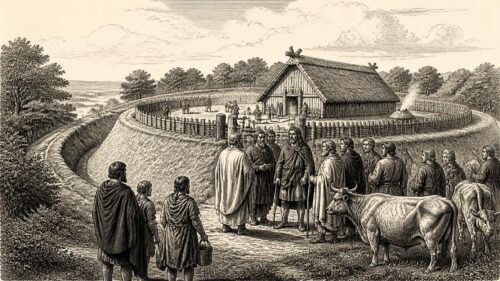
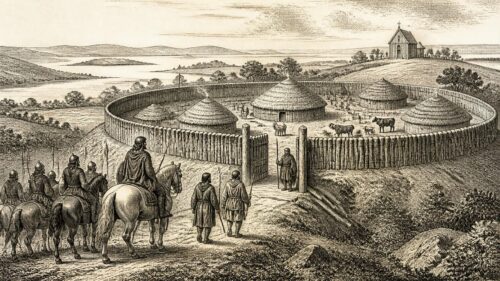
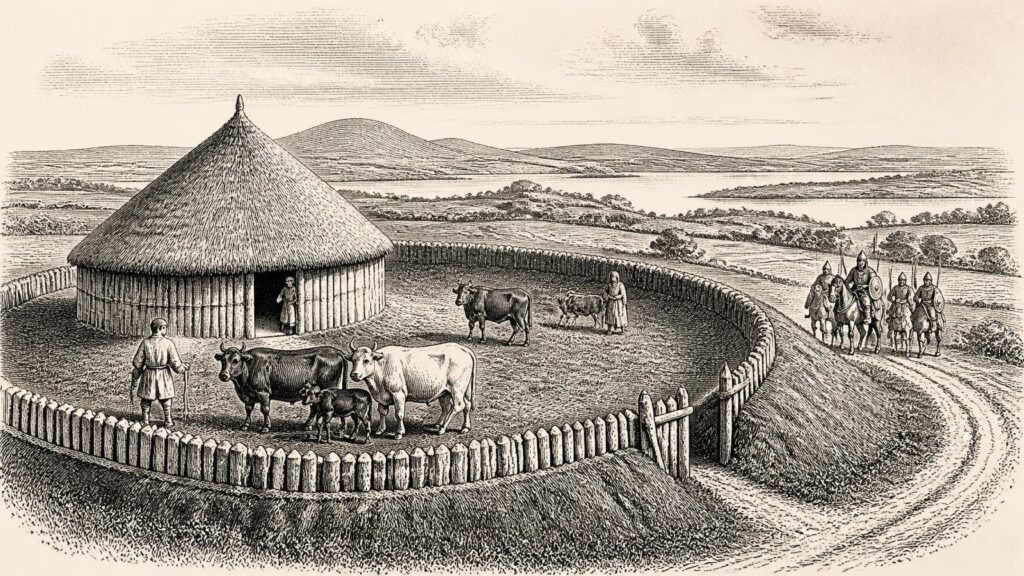
For most inhabitants, the decisive rhythms of 650 were agricultural rather than annalistic. Archaeology and early legal material indicate an overwhelmingly rural society of dispersed farmsteads, enclosed settlements, fields, trackways and, in some regions, crannogs. Ringforts were not castles in the later medieval sense. They were enclosed domestic and farming places, often closely connected to the management and protection of livestock. Their banks and ditches expressed status as well as practical security.
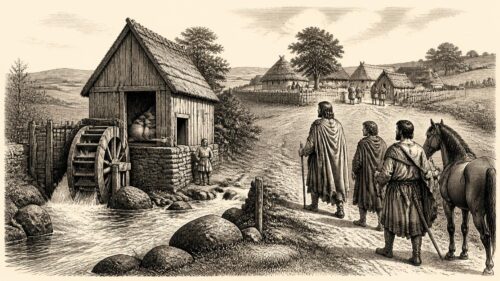
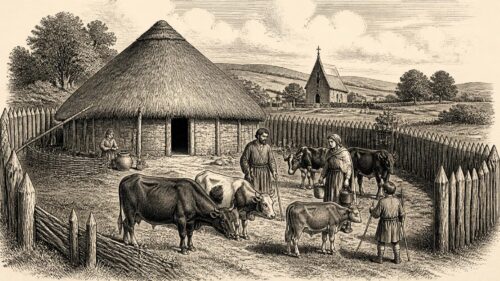
Cattle stood at the heart of wealth, social ranking and political obligation. They supplied milk, butter, cheese, meat, hides and, crucially, a recognised measure of value. Sheep and pigs were also important, while barley and oats supported bread, porridge, ale and animal fodder. Milling, dairying, spinning, weaving, woodworking, ironworking and food preservation filled daily life. The work of women, men, children, dependants and enslaved people sustained elite households, churches and fighting forces alike. A king’s capacity to lead in battle depended ultimately on this productive countryside: food for retainers, cattle for gifts and compensation, and labour for maintaining estates.
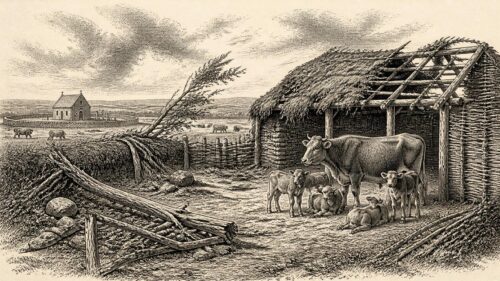
There is no securely dated report of famine, epidemic, exceptional weather or environmental disaster in Ireland for 650 itself. Later in the century, disease would cause catastrophic mortality, but it should not be anticipated here. Equally, there is no reason to imagine an isolated island. Archaeological evidence for the wider period from 600 to 800 includes contacts with Britain and the Continent, including imported Frankish pottery. Such finds do not prove a particular ship arrived in 650; they show instead that communities capable of sustaining long-distance connections existed alongside the local agricultural economy.
A Year of Contested Authority
What makes 650 memorable is therefore not a claim that Ireland underwent a single transformation in twelve months. It is the surviving record of contest. At Dún Cremthainn, the killing of Óengus demonstrated that descent from a celebrated ruler did not guarantee succession. In notices assigned by another chronicle to the same year, churchmen died, local rulers fought and institutions from Dublin to the Shannon entered the historical record. Beneath these terse entries lay a society where lordship, kinship, cattle wealth and Christian learning were inseparable. The year’s evidence is limited, but it captures a central reality of early medieval Ireland: power was intensely local, fiercely negotiated and never permanently won.
Primary Sources
- The Annals of Ulster, U650
- The Annals of Ulster: diplomatic text, U650
- Annals of the Four Masters, M648–M656
- Conall Cóel (‘the slender’)
- Chronological Synchronisation of the Irish Annals
- Built to Last: An Archaeological Investigation of the Early Medieval Royal Sites of Cashel and Glendalough
- The Economy of Early Medieval Ireland
- The Economy of Early Medieval Ireland: EMAP Report 7.1
- Early Medieval Ireland: Archaeological Excavations, 1930–2009
- Early Medieval Dwellings and Settlements in Ireland, AD 400–1100, Volume 1: Text
- Changing Human-Cattle Relationships in Ireland: A 6000-Year Isotopic Perspective
- Religion and Society in Ireland
- Ireland to 1170
- The Idea of the Three Orders of Society and Social Stratification in Early Medieval Ireland
- How Did Early Church Sites Differ from One Another? A Comparative Approach within the Kingdom of Fir Maige, Ireland
- Landscapes of Kingship in Early Medieval Ireland, AD 400–1150
- Corpus of Early Medieval Architecture of Ireland
- Medieval Ireland: Territorial, Political and Economic Divisions
- Clonmacnoise Monastic Site
- Monasteries and Abbeys