Sailtír Battles637 CE
In 637, despite uncertainties in annalistic dating, Domnall mac Áedo’s victories at Mag Rath and Sailtír strengthened his position as ruler of Tara. At Mag Rath, Congal Cáech of Ulaid was killed, ending a major challenge to Domnall and weakening Dál nAraide; Sailtír defeated opposing elements within Cenél nEógain. The conflicts may have involved links with Dál Riata across the Irish Sea, though later military details are unreliable. The year also saw the death of Failbe Flann, king of Mumu, and the recorded death of Mo-Chutu of Raithen. Together, these notices show Ireland as a network of competing dynasties and politically influential churches.
Dateline
In 637 CE, Ireland’s most consequential recorded development was a pair of connected battles: Mag Rath and Sailtír. Medieval annals place them on the same day and present them as a decisive victory for Domnall mac Áedo, the leading Uí Néill ruler of the north-west, over the challenge mounted by Congal Cáech, overking of Ulaid. The year also brought the death of Failbe Flann, king of Mumu, and the recorded repose of the churchman Mo-Chutu of Raithen. These notices are brief, but together they reveal a kingdom of rival dynasties, military followings and powerful churches, tied to western Scotland as well as to Ireland’s internal political geography.
A Date with Difficulties
The events conventionally discussed under 637 CE require one preliminary caution. The Annals of Ulster file Mag Rath and Sailtír under their heading for U637, yet their calendrical line labels that entry AD 636. Other annalistic compilations place the same cluster at differing numerical positions: the Annals of Tigernach record it under 639, while the Annals of Inisfallen do so under 639 and explicitly cross-reference the Ulster annal for 637. Such displacement is a familiar problem in the early Irish annals, caused by inherited chronological systems and later copying. Historians nevertheless commonly associate the battles and Congal’s death with 637 CE. It is safer to treat the year as securely connected with the events, while avoiding claims for a precise modern calendar day.
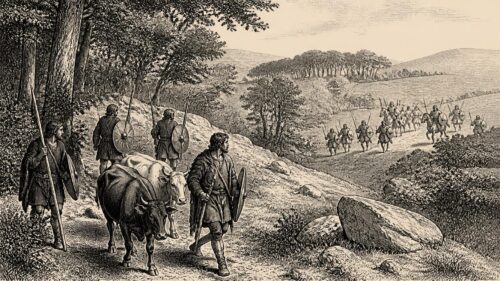
The core testimony is unusually clear about the political outcome. Chronicon Scotorum states that Mag Roth was won by Domnall son of Áed and by the sons of Áed Sláine, while Domnall held Temair, Tara. Congal Cáech, king of Ulaid, fell there, along with Faelchú and many nobles. The Annals of Tigernach likewise names Congal, describes Domnall as ruler of Tara, and includes Suibne son of Colmán Cuar among the dead. These terse notices do not provide a battle narrative, troop totals or a reliable account of manoeuvres. Later tales supply all three in abundance, but they must not be mistaken for a contemporary campaign report.
The Defeat of Congal Cáech
Congal had been a formidable figure before 637. He belonged to Dál nAraide, a Cruithin dynasty based in the region east of Lough Neagh, and had acquired the overkingship of Ulaid in the later 620s. His epithet Cáech, often rendered “one-eyed” or “squinting”, became the starting point for memorable later stories, including a tale that a bee-sting damaged his eye. That story is preserved in literary and legal tradition, not in the annal for 637; it cannot establish the immediate cause of the war. What is firm is that Congal’s position and ambitions collided with those of Domnall mac Áedo.
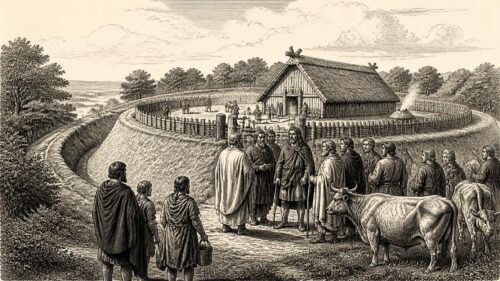
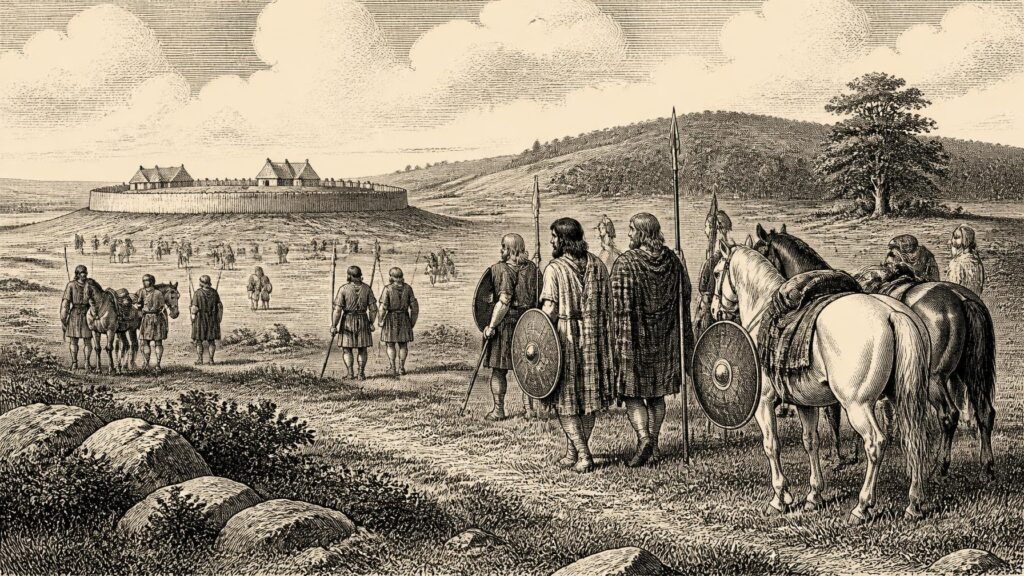
Domnall came from Cenél Conaill, a northern branch of the Uí Néill. His authority did not resemble the government of a unitary Irish state. Tara was an exceptionally potent royal and ideological centre, but its holder relied on kinship, military support, tribute, hostages, negotiated alliances and the willingness of other rulers to acknowledge precedence. A victory at Mag Rath therefore mattered not only because men died on the field. It removed a rival whose claims drew on the prestige of Ulaid and Dál nAraide, and it strengthened Domnall’s ability to act as king of Tara.
Later historical tradition links Congal’s cause with Domnall Brecc, king of Dál Riata, the sea-spanning Gaelic kingdom whose territories lay in north-east Ireland and western Scotland. The connection is plausible in the setting of the 630s and is accepted by leading modern accounts, but the concise entry for Mag Rath does not itself name Domnall Brecc. Nor should spectacular later claims about the size of the armies be repeated as fact. The reliable conclusion is more modest and more significant: the conflict brought the politics of Ulaid, the northern Uí Néill and Dál Riata into one crisis, demonstrating that the Irish Sea was a route of communication and alliance rather than a hard frontier.
The Other Battle
The Annals of Ulster insist that Sailtír was fought on the very same day as Mag Rath. At Sailtír, Conall Cáel son of Máel Cobo was victorious. He is identified as a member of Cenél nEógain and as an adherent of Domnall mac Áedo; his opponents are also called Cenél nEógain. The entry is a useful corrective to any picture of early Irish peoples as politically uniform blocs. Cenél nEógain was a powerful Uí Néill kindred, but its constituent branches and leaders could pursue competing interests. In 637, at least one important division within that wider group was settled by force in a way favourable to Domnall’s side.
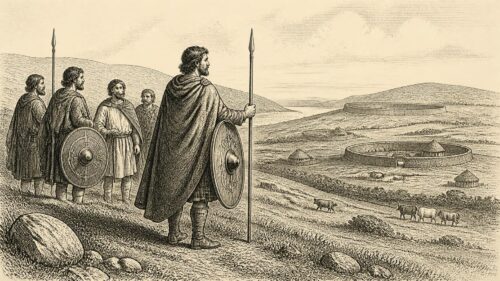
Sailtír is sometimes interpreted in modern reconstructions as an engagement connected to the sea lanes between Ireland and Dál Riata. The annals themselves, however, offer neither a description of ships nor a secure location. It is best understood simply as a co-ordinated or coincident victory that prevented Congal’s wider alignment from succeeding. Mag Rath destroyed the principal challenger; Sailtír checked opposition among a northern Uí Néill people whose backing could have altered the balance. The pairing of the two battles in the annals is itself evidence that contemporaries or early compilers understood them as one political emergency.
Power, Loss and Succession
For Domnall mac Áedo, the year marked the high point of a hard-won ascendancy. The annalists’ wording—Domnall “ruled Tara” at the time—signals the importance they attached to his position. Yet it would be misleading to call Mag Rath the creation of a permanent, centrally administered high kingship. Ireland remained a mosaic of overkingdoms and lesser lordships, each supported by landed kin groups and clients. Kingship depended upon personal leadership, the distribution of wealth and food-renders, control of cattle and land, and the capacity to call armed men into service.
The fall of Congal altered the politics of Ulaid sharply. Dál nAraide had supplied an overking capable of challenging an Uí Néill king of Tara. After Congal’s death, Dál Fiatach—its long-standing rival within Ulaid—recovered the provincial overkingship. This was not an inevitable outcome mechanically produced by a single battle: succession remained contested, and our surviving evidence is thin. But 637 removed the leader around whom a particularly ambitious anti-Uí Néill coalition had gathered, reducing Dál nAraide’s immediate leverage.
The annals also record the death of Failbe Flann of Femen, king of Mumu, in the same year. They do not say that he fought at Mag Rath, died in battle or was a party to the northern conflict. His death should therefore be kept separate from the military narrative. Still, its placement beside the battles is a reminder that Mumu, broadly Munster, had its own royal politics. Failbe’s career had included warfare against rivals in Connacht and Leinster, and his passing created a significant vacancy in the southern hierarchy at precisely the moment that Domnall’s northern position was being reinforced.
Churches in a Violent Year
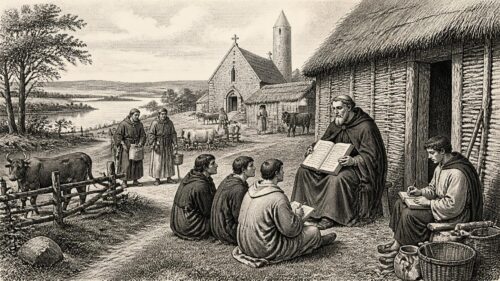
The final major notice for 637 concerns Mo-Chutu of Raithen, also known as Carthach or Mochuda. The Annals of Ulster simply say that he “rests”; Chronicon Scotorum gives a date equivalent to 14 May. The latter precision belongs to that chronicle’s entry, but should not conceal the larger chronological uncertainty affecting this period. What can safely be said is that the saint’s death was connected by the annalistic tradition to this year.
Mo-Chutu’s final years show that religious communities were embedded in secular politics rather than insulated from them. Chronicon Scotorum records his expulsion from Raithen at Eastertide in the preceding entry, conventionally assigned to 636. A later annalistic notice associates him with the foundation of Lismore, but that foundation is not an event securely assignable to 637 and should not be transferred into this year. His recorded death at Raithen instead preserves a snapshot of a mobile religious leader whose community had faced displacement and whose cult would later become closely identified with Lismore.
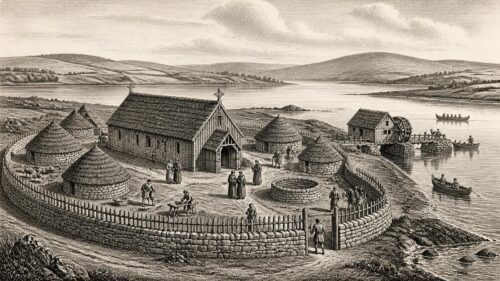
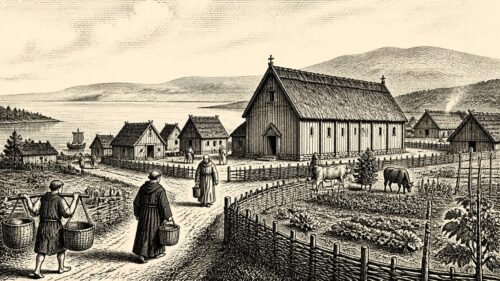
Churches were places of worship, burial, hospitality, learning and estate management. They also possessed land, dependants and political patrons. The annals’ decision to record Mo-Chutu alongside kings and battles is therefore unsurprising. It reflects an Ireland in which ecclesiastical and dynastic authority were mutually entangled: a ruler could endow or pressure a church, while a major saintly foundation could give legitimacy, literacy and enduring prestige to those associated with it.
What the Year Does Not Show
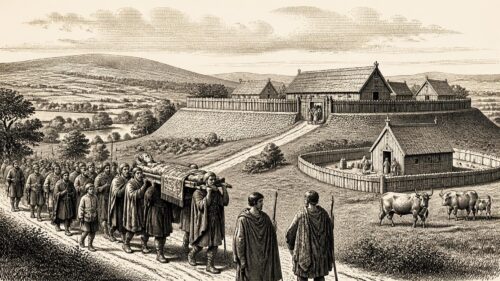
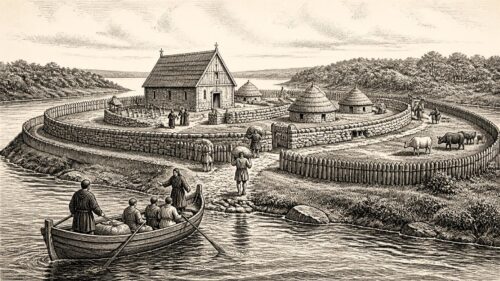
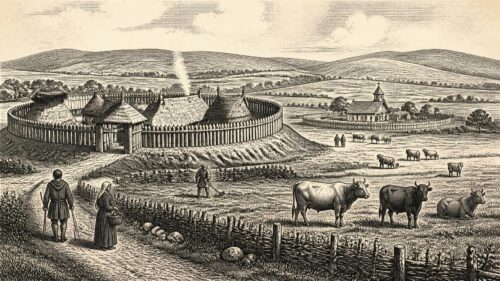
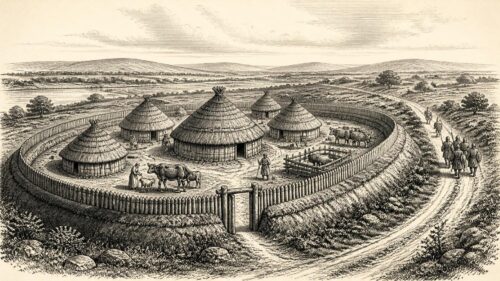
There is no annalistic evidence for a nationwide famine, epidemic, environmental disaster or general economic transformation in 637 CE. Nor is there a basis for imagining the whole island mobilised behind either side. Most people were rural producers, living in and around enclosed farmsteads now commonly represented by ringforts or, in stonier districts, cashels. Their households combined cattle-keeping with tillage; cattle remained a principal measure of wealth, while cereals sustained people and helped meet obligations. A large campaign could disrupt this world by demanding provisions, transport, lodging and fighting men, but the sources do not allow the scale of that disruption in 637 to be measured.
The documentary record is also silent about ordinary voices: the women maintaining households during musters, cultivators safeguarding crops and animals, artisans repairing weapons or vessels, and dependants bearing the cost of elite rivalry. Their absence is a limitation of the sources, not evidence of their insignificance. What survives is the perspective of learned ecclesiastical writers, for whom the deaths of kings, saints and named nobles formed the skeleton of history.
A Turning Point, Carefully Understood
Mag Rath and Sailtír made 637 CE a turning point in Irish political memory. Congal’s death ended the most serious recorded challenge of his generation to Domnall mac Áedo’s position at Tara. The two same-day victories exposed fractures among northern elites and curtailed the prospects of a coalition extending across the Irish Sea. Yet the achievement was personal and contingent, not the birth of a unified realm. Regional kings remained powerful; Mumu faced its own succession after Failbe Flann; churches continued to negotiate influence through land, patronage and sanctity.
The year’s sparse entries gain force when read together. One ruler was killed, another was affirmed at Tara, a separate king died in Mumu, and a renowned churchman was commemorated at Raithen. In that concentration of battle, succession and religious remembrance lies the clearest picture of Ireland in 637: a politically connected island whose local rivalries reached across water, and whose chroniclers measured change through the fortunes of kings and holy men.

Primary Sources
- The Annals of Ulster, U637
- CELT: The Annals of Ulster
- Chronicon Scotorum
- Chronicon Scotorum, Annals CS634–CS638
- The Annals of Tigernach
- Annals of Inisfallen, Annals AI634–AI643
- CELT: Annals of Inisfallen
- Congal Cloen (Cáech)
- Congal Cáech: (d. 637), high-king of Ireland
- Domnall mac Áeda: (d. 642), high-king of Ireland
- Demonising the Enemy: A Study of Congal Cáech
- Law, Law-Books and Tradition in Early Medieval Ireland
- Exploring the Irish Annals
- Buile Shuibhne: Background Information
- The Annals attributed to Tigernach
- Leaps, Curses and Flight: Suibne Geilt and the Roots of Early Irish Culture
- The Annals of Tigernach: National Library of Ireland Catalogue Record
- Farming and Archaeology: The Irish Historic Landscape
- Traditional Buildings of Ireland: The Rural Settlement Pattern
- Cultural Heritage Resources: River Shannon, Meelick to Limerick