Editorial — Ath Abla
Welcome to the Emerald Archives Gazette. In today’s issue we look back at the latest additions to the archive. Late Late — First BroadcastRTÉ archive material places the first broadcast of The Late Late Show on 6 July 1962 at 11.20 pm. It notes that, at the time, a live talk and entertainment programme so late in the schedule was unusual, and that the service stayed on air after midnight for the first time. The same archive item lists the opening-night guests as Count Cyril McCormack, Ken Gray, George Desmond Hodnett, and Harry Thuillier.A later RTÉ Guide review describes the programme as informal and unrehearsed, with Gay Byrne hosting alongside a trio of regular visitors.
Dateline
The Day in Irish History
Welcome to the Emerald Archives Gazette. In today’s issue we look back at the latest additions to the archive.
Late Late — First BroadcastRTÉ archive material places the first broadcast of The Late Late Show on 6 July 1962 at 11.20 pm. It notes that, at the time, a live talk and entertainment programme so late in the schedule was unusual, and that the service stayed on air after midnight for the first time. The same archive item lists the opening-night guests as Count Cyril McCormack, Ken Gray, George Desmond Hodnett, and Harry Thuillier.A later RTÉ Guide review describes the programme as informal and unrehearsed, with Gay Byrne hosting alongside a trio of regular visitors. It says the show could be seen…
Health Infrastructure — Plague ArrivalThe earliest notice places plague in Ireland in 664 and says it reached the island on the Kalends of August. The same year adds that the plague first raged in Mag Itha of Fotharta. In the same cluster of entries, an abbot is also recorded as having died, showing that a disease notice and an ecclesiastical death notice can stand side by side. The passage is brief, but it ties illness to place with unusual directness.Later entries repeat this pattern on a larger scale. In 1383 a great and virulent plague is said to have raged universally throughout Ireland,…
Irish Sport — Gaelic Games — Archive ScopeThe O Fiaich library describes its sporting holdings as a major and popular part of the collection. Its chief emphasis is on native Irish sports and pastimes, especially the Gaelic games and road bowls named in the catalogue. The same passage also notes hundreds of books on these subjects and identifies minute-books of the Ulster Council of the GAA among the most valuable items, placing books and records side by side.The GAA Museum and Archive presents a different but related description. It identifies itself as the national repository for the Association's records, archives, and publications, and says that its…
Agreement Profile — Agreement ProfileCETA is identified in official material as the Comprehensive Economic and Trade Agreement between Canada and the European Union. The EU describes it as a trade deal intended to lower customs tariffs and other barriers, while preserving high standards in areas such as food safety, workers’ rights, the environment, and the right to regulate for legitimate policy aims. Canada’s own pages likewise describe CETA as governing economic relations and creating new commercial opportunities.The same official record places Ireland among the EU member states named in the agreement’s preamble. It also shows that CETA was provisionally applied in 2017 and…
Education Convention — National OriginsThe record identifies a national education convention held in 1993 and describes it as an unprecedented public consultative process. One account says it convened over an extended period in October 1993, with participants drawn from the education sector and civil society. Another summary says the convention's outcomes were later synthesized into a report by the secretary general. These excerpts directly show a formal national process, a broad participant base, and a report that followed from the discussions.A later summary places the first national education convention within a wider sequence of policy developments in the 1990s. It names an OECD…
Private Relief — Winter ScarcityThe annalistic notice for 764 places weather, scarcity, famine, and disease close together in one sequence. It begins with a snowfall lasting almost three months, then records a great scarcity and famine, followed later by an abnormally great drought and a bloody flux throughout Ireland. Within the same passage, the year is also marked by deaths of abbots, kings, and other named men. The excerpt offers a compact record of hardship rather than explanation, and it does not connect those events to any wider economic system.The same annalistic page also preserves three showers of silver, wheat, and honey in…
Inclusive Services — School AccessThe surviving school-related records described by the National Archives show education as an administrated public activity rather than a private matter alone. The archives hold material from several schools and educational institutions, with records from the 1800s onward. The guide also notes that school registers can preserve home addresses, parents’ occupations, academic progress, attendance, religious affiliation, and the last national school attended, which makes the school a site where personal detail entered official record.The same guide places the Commissioners for National Education in 1831 and says they were empowered to grant aid to existing schools, pay teachers, provide equipment,…
Housing Justice — Health HousingThe housing accounts place health at the centre of early reform. One text says that responses to industrialization were driven by slum housing, poor sanitation, and the spread of disease, and that these conditions prompted public health and later social housing actions. Another places a chapter on housing beside a chapter on health and welfare in its contents, a simple but visible sign that the two themes are treated as linked rather than separate fields of study.The same summary also links housing policy to disease control rather than to building alone. It states that industrialization produced poor sanitation and…
Dublin Renewal — Archive RecordsDublin City Council describes the Dublin City Archaeological Archive as a joint project of Dublin City Archaeology, Dublin City Archives and the Heritage Office. Its remit is to preserve records from private-sector archaeological investigations in the city, with special reference to excavations carried out before 2004. The page also notes that the archive is based at Dublin City Library and Archive in Pearse Street, and that records are prepared under published guidelines for submission.The archive page lists a wide range of site collections available in the reading room, including Thomas Street, Back Lane, Fumbally Lane, Smithfield, Moore Street and…
Famine Diaspora — Famine RecordsThe surviving material used here is not a single narrative of famine and diaspora but a set of institutional descriptions and record guides. One annal edition describes its manuscript basis, lacunae, and editorial limits, while the National Archives and National Library pages frame famine research as a matter of collections, reports, and surviving documents. The result is a picture built from records that are incomplete, edited, or catalogued for research use rather than from a continuous historical chronicle.The annalistic sources themselves are presented as edited texts with manuscript provenance and gaps. One edition specifies the surviving manuscript witnesses and…
Flood Resilience — Annal WeatherThe annals preserve scattered weather notices rather than a continuous climate record. In one passage for 1107, snow falls for a day and night, and the same year brings much wet and bad weather that ruins the corn. Another annal for 1505 records wet weather continually, with crops destroyed in great part and especially in Fir-Manach. These entries show direct concern with weather effects on food production, not abstract measurement.The same annalistic format can also record inundation itself. In the Four Masters, the waters of a sea inundation over land are noted in the story of Parthalon, alongside repeated…
Private Memory — Archive RoomsCAIN presents itself as a web service on conflict and politics in Northern Ireland and says it contains information and source material on the Troubles from 1968 to 2007. It also lists main sections that include background to the conflicts, key events, key issues, databases and bibliographies, Northern Ireland society, and conflict studies. The archive additionally notes that archived copies exist in several web repositories and that an offline copy appears in the Troubles Gallery of the Ulster Museum.The same site describes a searchable database of external resources. Its subject menu includes history, culture, governance, media, the peace process,…
Remote Congestion — Policy FrameIrish policy texts frame remote work as a governed workplace arrangement rather than a temporary emergency measure. The national strategy describes remote working as a permanent feature of the Irish workplace and says the objective is to maximise economic, social, and environmental benefits. A later statutory review notes that the right to request a remote working arrangement came into force for all employees in March 2024 and sits within the Work Life Balance Act, showing a move from strategy toward formal entitlement.The statutory review also sets limits on what it addresses. It was confined to the operation of the…
Irish Winters — Winter BeginningsOlympedia’s country summary states that Ireland entered the Olympic Winter Games in 1992 and then competed continuously from 1998 onward. It also lists the winter disciplines represented: alpine skiing, bobsleigh, cross-country skiing, freestyle skiing, luge, skeleton, and snowboarding. The same summary notes that Ireland has not won a Winter Olympic medal, while also identifying a near medal result in 2002. These are table-based claims, not narrative explanation, and they establish the outline of Ireland’s winter presence.The participation tables show a small number of Irish competitors at each Winter Games listed there, with totals changing from edition to edition. For…
Road Reckoning — Measured ScaleThe Garda archive of road collision statistics presents a long numerical record from 1961 to 2007. In that series, 1961 is listed with 332 killed, 8,210 injured, and 8,675 total collisions, while 2007 is listed with 338 killed, 7,806 injured, and 8,144 total collisions. The figures show a broad historical scale rather than a single isolated year, and they preserve counts for deaths, injuries, and totals together.The same archive shows that the annual totals moved across the decades. For example, 1970 is listed with 540 killed and 9,809 injured, while 2001 is listed with 411 killed, 10,222 injured, and…
Care Rights — Legal FrameThe legal record gathered here begins with institutions and procedures rather than with modern rights language. The 1821 Lunacy Act for Ireland provided for asylums for the lunatic poor and for the custody of insane persons charged with offences. The 1845 Act then created a central asylum for criminal lunatics and placed the Commissioners of Public Works at the centre of acquiring land and arranging buildings. Together, these texts show disability-related welfare being treated through public administration and confinement.The 1821 Act also linked welfare to district organisation and financial provision. It allowed the lord lieutenant and privy council to…
Plague Records — Plague NoticeOne annal places the plague in Ireland on the Kalends of August in 664 and sets that notice beside darkness on the Kalends of May, a sky that seemed on fire, an earthquake in Britain, and the deaths of abbots. The passage is a compact register of occurrences. It links disease with other unusual events in the same annual notice, presenting them together rather than separating illness from the wider sequence of happenings recorded in the year.The same short form appears in the surrounding annalistic entries. Cernach son of Diarmait is recorded as dead, and an earthquake and the…
Croom Union — Union OriginsThe record summary identifies Croom as a Poor Law union declared in March 1850, with a new workhouse built there in 1852. It also notes that the union was formed by regrouping electoral divisions that had previously belonged to Rathkeale, Newcastle West, and Limerick. Those are the only origin details stated in the description, and they are presented as administrative facts rather than as narrative explanation.A separate archival description repeats the same basic chronology and adds that the minute books are for the Croom Union Board of Guardians, beginning in 1852 and continuing to 1922. The description gives the…
Ireland Trade — Trade EntryThe records place Ireland’s entry into the European Communities in 1972 and 1973. One account states that 83 percent of voters supported membership in the May 1972 referendum and that membership officially began on 1 January 1973. Another notes that the accession treaty was signed in Brussels on 22 January 1972. Read together, these passages show a clear sequence from referendum to signature to membership.Before membership, the Commission describes Ireland as relying heavily on the UK market and on agricultural exports to British markets. It also says the country had been regarded as economically dependent and that protectionism sat…
Eowyn Recovery — Power StrainStorm Éowyn left a wide electricity burden behind it. Met Éireann described hurricane-force winds and gusts up to 184 km/h, while ESB Networks said the storm produced extensive damage to the electricity network and widespread customer outages. RTÉ’s reporting from early February described hundreds of thousands of homes and businesses plunged into darkness. Taken together, these accounts show that recovery began with a basic struggle to restore power and keep daily life functioning.Local accounts show how uneven that restoration was. In Conamara and north Galway, households were still without electricity a week after the storm, and phone services were…
Guarding Neutrality — Legal BasisThe legal framework was framed in wartime terms rather than by any explicit statutory language of neutrality. The Emergency Powers Act, enacted on 3 September 1939, states that it made provision for securing public safety and the preservation of the state in time of war, and in particular for maintaining public order and controlling supplies and services essential to community life. Those words place the state’s wartime response inside a legal structure of emergency administration.The same year’s statute list places the Emergency Powers Act among other 1939 Acts of the Oireachtas, including the Defence Forces (Temporary Provisions) Act, the…
Trusted Care — Hospitality TrustIn the annalistic notices, hospitality is repeatedly rendered as an observable quality of people and houses. One entry describes a woman as full of hospitality, while another praises a man as the supporter of the indigent and of a house of hospitality. A further notice says that one bishop was commended for his hospitality, and lists the cattle grazing under his care in named places. The evidence connects generosity with household standing, but it does not spell out a doctrine of trust.The same passages place hospitality beside forms of practical support. In one annal, a death notice for a…
Aughinish Alumina — Ownership Structure — Sanctions ContextAughinish Alumina entered the sanctions debate as a refinery in County Limerick whose status was repeatedly discussed in relation to Russia. Reporting in March 2026 described it as Europe’s largest alumina refinery and said its output was not sanctioned by the EU, even as critics argued that exports from the plant were reaching Russian smelters and, later, military industry. The same reporting noted that the Irish Government had lobbied to keep Rusal free of sanctions.Earlier reporting in 2022 showed that the plant was already being discussed in terms of possible EU measures against Russia. At that stage, the Government…
Ireland Strategy — Strategic FrameIreland’s national AI strategy appeared in 2021 as an official policy paper that presented AI as a means to support both the economy and society. The document describes a people-centred and ethical approach to development, adoption and use. In the available record, this is the earliest explicit national AI framing, and it sits within a broader publication set on artificial intelligence and the business environment rather than a narrow technical programme. The wording shows the policy scope without detailing implementation.By 2025, the European Commission was describing Ireland through the Digital Decade framework rather than through the earlier standalone AI…
Rural Change — Rural ContextThe museum material places rural Ireland in a landscape shaped by land, resources, and daily work. One exhibition says that most people lived off the land in 1850, while a small number of wealthy landowners owned it and leased it to tenants. Another adds that the fertility of land affected quality of life, and that local materials such as stone, sod, clay, straw, rushes, and reeds shaped buildings and household goods. Taken together, these passages present rural life as closely tied to land and material availability.The same museum evidence also narrows the setting to a broad historical interval rather…
Nosegay Ireland — Word MeaningIn the dictionary evidence, nosegay is defined as a small bunch of fragrant flowers or herbs, tied together and meant to be held or worn. One entry also describes it as a flower arrangement that could be given as a present. Another notes that the word is old-fashioned and was associated with carrying flowers to soften unpleasant street odors. These descriptions agree on the core sense: a compact, scented floral bundle rather than a large bouquet or general flower display.The same dictionary material also places nosegay among related forms such as bouquet, corsage, boutonniere, and posy. That comparison is…
Motorcycle Arrival — Earliest SightingThe clearest directly dated appearance of a motorbike in Ireland in the available record is 20 May 1902, when a motorbike was seen in Tuam, County Galway. The account describes it as the first time the motorbike was seen in the west of Ireland and places the event before a large crowd. On that basis, the evidence points to an early public appearance in Ireland rather than to a later, more familiar stage of motorcycling life.This date matters because it is specific, whereas many other references in the record are broader in scope. The Tuam account names a day,…
Irish Coffee — Origins StoryIrish coffee is presented in modern accounts as a drink born in the setting of wartime aviation at Foynes in County Limerick. One account places its invention in 1943, when returning passengers were served coffee with whiskey and sugared cream after a difficult flight; another dates the creation to late 1944 or early 1945. Both agree that Joe Sheridan was the chef associated with the drink’s origin and that Foynes was the place where it first emerged. [7][8][9][10]The accounts also agree on the basic composition of the drink: hot coffee, Irish whiskey, sugar, and cream. The museum description says…
Whiskey Origins — Early RecordThe earliest dated reference in these excerpts belongs to 1405 and appears in a note on the drinking of usquebagh or whisky. That note identifies the passage as the earliest extant reference to the national beverage and summarizes the episode as a death after drinking uisce-betha. The wording is brief, but it is enough to show that the drink was already named in a form recognizably connected to later whisky terminology.The same note also places the 1405 reference alongside later sixteenth- and seventeenth-century mentions of the drink in Irish social habits. It does not provide those later passages in…
Urban Roads — Road CodesThe statutory outline begins with the Roads Act 1920, which was framed to deal with excise duties on mechanically propelled vehicles and carriages, and also to make further provision for roads and vehicles used on roads. A later listing of repealed enactments shows that this Act removed or altered earlier provisions touching roads, locomotives, lighting, and public roads. The evidence points to an early legal framework in which road use, finance, and vehicle regulation were already joined together.By 1961 the road traffic code had become much broader. Its arrangement includes rules for vehicles in public places, weights, inspections, driving…
Dublin Housing — Urban StrainAt the turn of the twentieth century, Dublin is described as a depressed city shaped by declining industry, overcrowding, unemployment, and poor housing. One account links those conditions with disease and says the civic authority recorded measures to curb infectious illness. Another contemporary report, preserved in archival form, presents the housing question as one of the city’s most visible social pressures. These passages do not give a full urban survey, but they do show a shared concern with deprivation and dwelling conditions.The same material also shows how housing was framed through official inquiry. A housing committee report was commissioned…
Shared Inquiry — Research FrameThe available material defines a narrow but usable frame for disability research. One guide for disability studies explicitly groups primary sources as memoirs, treatment records, education methods, remediation forms, and the proceedings and policies of organizations and institutions. It also points to virtual artifacts, museum exhibits, and collections of texts and images. Read together, these descriptions show that disability history can be approached through both written records and curated visual material, without any single category being presented as sufficient on its own.A second guide entry on research databases adds that a collection may be built from many material types…
Storm Chandra — Flood Response — Storm ContextMet Éireann described Storm Chandra as a low-pressure system bringing strong winds and heavy rain to Ireland from the night of 26 January and during 27 January 2026. The bulletin said the rain would fall on already saturated ground, with many rivers approaching or exceeding bank-full conditions, and warned of localised flooding and river flooding. It also issued yellow rain and wind warnings and advised people to stay back from rivers, lakes, and coasts.A Met Office account described Chandra as a rapidly deepening system that swept across the UK from 26 to 27 January with severe weather, persistent heavy…
Currach Heritage — Museum RecordThe museum record places the currach project on Inis Oedrr in 1968, where a two-person team documented Michael Conneely building a boat for the national collection. The material identifies him as a carpenter, farmer, and currach builder from West Village. It also says Ciare1n Baire9ad recommended him after the museum sought advice on who could build a traditional Irish currach for the collection. [2][6]Another museum page states that the team travelled to Inis Oedrr aboard the Naomh c9anna ferry and spent eight days recording a 19-and-a-half-foot, three-man currach complete with mast and sail. The same page says curator John…
Irish Schools — Policy FrameUniversity College Cork presents gender identity as an institutional matter within ordinary university life. Its policy says the university aims to provide a positive working and learning environment free from discrimination, harassment, or victimisation, and states that it will not discriminate on grounds of transgender or non-binary expression or identity. It also says discrimination relating to gender transition will not be tolerated. The language is formal, direct, and framed as institutional practice rather than private preference.The same policy also limits any claim to completeness. It says it does not anticipate every situation involving transgender or non-binary staff or students,…
Gerald Griffin — Family Removal — Early LifeThe chronology places Gerald Griffin’s birth in Limerick on 12 December 1803 and identifies his family as Catholic and literate in outlook. It says he was one of fifteen surviving children, that his father Patrick Griffin was a brewery farmer, and that his mother Ellen Griffin came from the O’Briens. The same entry sketches a move around 1810, when the family left Limerick for Fairy Lawn, where his childhood is described as close-knit and rural in setting.The same chronology links Griffin’s early education with changing family circumstances. It states that he received a classical education that was often irregular,…
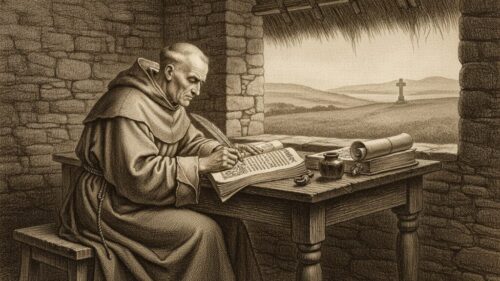
Saint Kevin of Glendalough — Saint Kevin of Glendalough was a pivotal figure in early Irish Christianity, credited with founding one of the most significant monastic settlements in Europe during the sixth century. While historical records from his era are sparse, tradition preserves the story of a man deeply committed to asceticism, solitude, and a profound harmony with the natural world. He is primarily remembered as the abbot who established the monastic city at Glendalough in County Wicklow. Early Life Tradition identifies Kevin's parents as Caomhlugh and Caoimheall. According to hagiographical accounts, his early years were marked by spiritual promise; legendary narratives describe a blessing…
Inis Medcoit — Year WitnessThe year 627 appears in the annals as a brief cluster of notices, not as a continuous narrative. In the Four Masters, the entry is explicitly marked as the Age of Christ 627 and as the fourth year of Domhnall. It then records the battle of Ath Abla, the death of Dicul son of Fearghus at the hands of the Munstermen, and the foundation of Inis Medcoit by Bishop Aedhan.Chronicon Scotorum also preserves a 627 entry, but its contents are different. In the supplied excerpt, the year is marked under the Kalends and then records the battle of Ard…
Fursa’s Vision — Yearly FrameThe clearest evidence for 626 CE comes from the annal entries that explicitly mark the year in their own sequence. The Annals of Ulster place several notices under AD 626, including a battle at Ard Corann, a battle at Carn Feradaig in Cliu, and a vision seen by Fursa. The same textual frame also identifies the death of Fiachna son of Demán within that year, so the surviving record is not empty, only brief and selective.The year is also legible through adjacent annal traditions, though not every entry stands in the same place in every compilation. The Annals of…
Dark Ireland — Year MarkersThe annalistic record for 625 CE is compact, and its most explicit year-marker comes from the Annals of Ulster, which opens the entry with the kalends of January and then describes the year as dark. That same notice places several deaths in the year: Áedán son of Cumuscach, Colmán son of Comgallán, Rónán son of Tuathal, and Mongán son of Fiachna of Lurga. The entry also preserves a poetic aside attached to those deaths.A parallel compilation, the Annals of Inisfallen, presents the same year with a different selection of notices. Its 625 entry records the repose of Colmán Stélláin,…
Boyne Battle — Battle SettingThe battle is dated to 1 July 1690 in one museum account and to 12 July 1690 in another, the latter noting the difference between modern and old style dating. Both accounts place the fighting at the Boyne River near Drogheda, about 50 kilometres north of Dublin, or at Oldbridge in County Meath. One source also says that the armies met on Irish soil in the largest engagement there. This wording identifies the same event through closely related place descriptions.The same museum descriptions identify the opposing rulers as King James II and King William III. One account says the…
Domhnall’s Accession — Year MarkersThe year 624 CE is fixed most clearly in the Annals of Ulster, where the calendrical notice gives AD 624 and immediately characterizes the year as dark. That opening does not narrate events in itself, but it does frame the notices that follow as belonging to that year. The same compilation then lists several deaths under the same year heading, allowing the year to be identified without importing material from elsewhere.The Annals of the Four Masters also mark the year explicitly, giving the Age of Christ, 624, and then noting the first year of Domhnall, son of Aedh, son…
Thank you for reading today’s Gazette. Follow any of the links above to read the full article and explore its sources.