Whitehead
Whitehead is securely attested as a settlement in historical and authoritative place-name sources, and the modern Irish-language form given by the Placenames Database of Ireland is An Cionn Bán. Logainm places Whitehead in County Antrim and glosses the name elements as bán (“white”) and ceann / cionn (“head, headland”), confirming the Irish-language interpretation of the English name rather than treating it as a later invention 1. The same authority also records the genitive form an Chinn Bháin, showing that the Irish form is fully integrated into standard placename treatment 1.
Dateline
Settlement and name
Whitehead is securely attested as a settlement in historical and authoritative place-name sources, and the modern Irish-language form given by the Placenames Database of Ireland is An Cionn Bán. Logainm places Whitehead in County Antrim and glosses the name elements as bán (“white”) and ceann / cionn (“head, headland”), confirming the Irish-language interpretation of the English name rather than treating it as a later invention 1. The same authority also records the genitive form an Chinn Bháin, showing that the Irish form is fully integrated into standard placename treatment 1.
Historical place-name scholarship and gazetteers also treat Whitehead as an Antrim settlement, and a Vision of Britain gazetteer entry notes it as a place in historic County Antrim, with variant historical writing using the plain form “WHITEHEAD” 2. This supports the settlement’s identity as a discrete historic locality rather than only a modern suburb or neighborhood.
From hamlet to railway resort
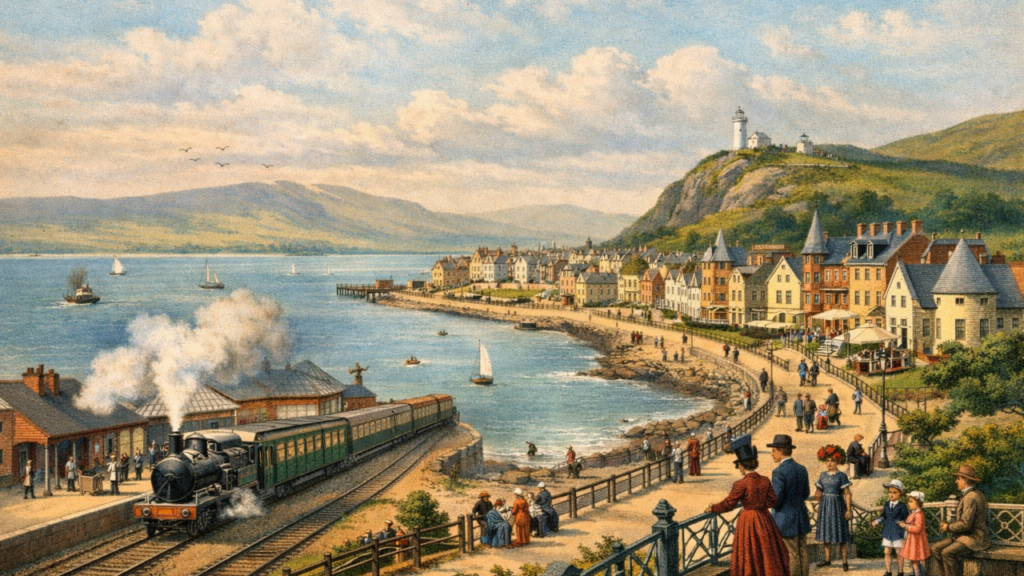
The clearest historical turning point in Whitehead’s development was the railway age. The Gazetteer of British Place Names states that before the railway arrived in 1863, Whitehead was “a hamlet slightly inland” 3. That fits the broader pattern of Victorian coastal resort growth on the east Antrim shore. By the early twentieth century, the settlement had become a well-known seaside resort: the 1910 Ulster Towns Directory describes “WHITEHEAD, CO. ANTRIM” as “a well-known and popular seaside resort” and places it on the County Antrim coast 4.
The directory also shows the developed civic and transport life of the town by 1910: a post office, coastguard station, railway station, golf clubs, yacht club, churches, and a range of holiday and residential institutions were all established there 4. Taken together, these details show that Whitehead’s growth was not ancient urban expansion but a comparatively late nineteenth-century transformation, driven by rail access and seaside recreation 34.
Administrative county and urban status
Historical administrative records confirm Whitehead’s county assignment to Antrim. In 1925, the Belfast Gazette’s order establishing the town boundaries refers repeatedly to “the Town of Whitehead” in the “Administrative County of Antrim,” and describes the boundary as including parts of the townlands of Castletown and Whitehead in the Rural District of Larne and County Antrim 5. This is strong evidence for the settlement’s historical county context in official state documentation, not merely in modern description.
By that point, Whitehead had clearly become a defined urban place, not just a named coastal promontory. The 1925 order is therefore an important marker in its history: it captures Whitehead at the moment when its Victorian resort character had matured into an administratively recognized town within County Antrim 5.
In short, the historical record supports Whitehead as a County Antrim settlement with the Irish form An Cionn Bán, a nineteenth-century transformation from hamlet to railway resort, and formal recognition in twentieth-century local government records 1345.