Castlepook’s Marked Reindeer Femur Revisited31915 BCE
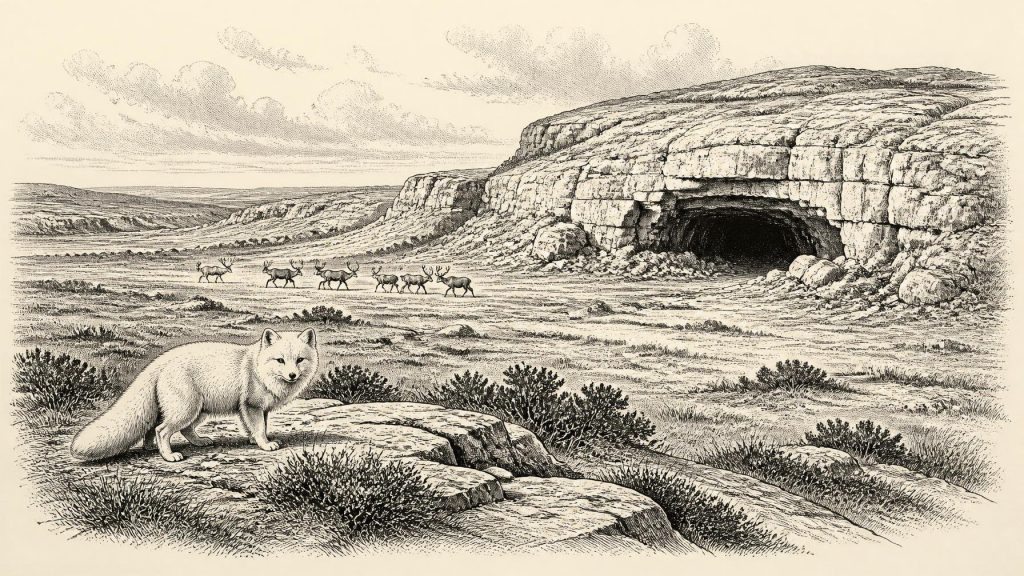
At roughly 31,915 BCE, Ireland lay within the unstable Late Pleistocene, before maximum glaciation, with open cold landscapes supporting diverse mammals. Castlepook Cave, County Cork, preserves bones of reindeer, mammoth, giant deer, predators and smaller cold-adapted species, although its deposits combine material from different periods and processes. A marked reindeer femur, approximately 33,000 radiocarbon years old, may record stone-tool butchery and potentially very early human activity. Yet it cannot prove settlement, population or social life. Ireland lacks securely contemporary human remains, tools, camps or ritual evidence. Subsequent ice advance destroyed much surviving evidence, leaving Castlepook a vital but uncertain archive.
Dateline
Modern calendar-year precision is not available for Ireland in 31,915 BCE. The number is a useful point on a modern timeline, not a date at which archaeology can identify an Irish event, ruler, battle or settlement. In archaeological terms it lies roughly 33,865 years before AD 1950 and belongs broadly within Marine Isotope Stage 3, an unstable phase of the Late Pleistocene. Dates from this depth of time are normally expressed as calibrated ranges, and the conversion of radiocarbon measurements into calendar years carries substantial uncertainty. The responsible question is therefore not what happened in Ireland in one numbered year, but what evidence can illuminate the island and its inhabitants—animal and perhaps human—within the surrounding millennia.
A Landscape Before Maximum Glaciation
Ireland was then in the last Ice Age, but not yet necessarily in the uniform, ice-covered condition popularly imagined for the whole period. The major expansion of the British–Irish Ice Sheet towards its later maximum was approaching and did not occur everywhere at precisely the same time. Reconstructions of the ice sheet show asynchronous growth and advance across Ireland, Britain and the continental shelf. Around this date, conditions could alter sharply over comparatively short geological intervals as North Atlantic climate switched between colder stadials and less severe interstadials. Any picture of a fixed, timeless frozen Ireland is therefore misleading.
The surviving evidence suggests an exposed, cold landscape capable at times of supporting large grazing animals and their predators. It was not the wooded island familiar today. Tree cover would have been very limited; open herb-rich grassland, tundra-like vegetation, bare ground and low shrubs are better analogies, though the exact mixture varied with temperature, moisture, soil and exposure. Rivers flowed through landscapes later reshaped or removed by advancing ice. Sea level was much lower globally than today, changing coastlines and narrowing some water crossings, but the precise geography of routes between Ireland and Britain remains debated. Neither a simple permanent land bridge nor an effortless overland approach should be assumed.
Castlepook’s Long Archive
The principal Irish evidence relevant to this distant period comes from limestone caves, above all Castlepook Cave near Doneraile in north County Cork. Caves protected bone better than most open-air Irish settings and preserved a remarkable, if difficult, record assembled across many thousands of years. Earlier excavations recovered remains attributed to woolly mammoth, giant deer, reindeer, brown bear, wolf, Arctic fox, mountain hare, lemmings and spotted hyaena. This is an exceptional fauna for Ireland, but it must not be turned into a single scene. A cave deposit can mix material introduced at different times by carnivores, water, sediment movement and earlier excavation.
Modern radiocarbon work has made that warning especially important. The Irish Quaternary Fauna Project and later re-dating showed that some older determinations needed revision and that individual Castlepook bones belong to distinct phases. The cave’s Middle-to-Late Pleistocene assemblage records animal presence over a long span rather than proving that every listed species lived together in 31,915 BCE. Nevertheless, the assemblage firmly establishes that parts of pre-maximum-glaciation Ireland supported a far richer large-mammal community than later Ice Age and post-glacial Ireland. Its bones provide direct evidence of animals; the wider environmental reconstruction remains an interpretation built from species, dating, sediment and comparison with better-preserved continental records.
Reindeer, Predators and Carcasses
Reindeer are central to this reconstruction. Their presence indicates a cold-adapted grazing animal able to use open country, while lemmings and Arctic fox point towards harsh northern conditions. Mammoth and giant deer evoke an ecosystem with substantial plant resources, although their finds need not represent large resident herds on every occasion. Wolves and hyaenas reveal another reality: carcasses were contested resources. Spotted hyaenas are particularly significant because Castlepook is Ireland’s key recorded locality for them. Gnawing, breakage and the accumulation of bones may reflect carnivore denning, scavenging and transport into the cave rather than deaths where the animals were first killed.
This distinction changes how the evidence should be read. An animal bone in Castlepook proves that the animal, or part of it, reached the cave; it does not automatically identify a hunting ground, a population size or a season. Carnivores could carry limbs and skulls from elsewhere. Water and collapsing sediments could redistribute them afterwards. Yet the scale and variety of the collection show that Ireland was not biologically empty in this phase. It formed part of a north-west European world in which animal populations moved, expanded and contracted as climate and ice margins changed.
A Single Mark and a Larger Question
The most intriguing possible human trace is a reindeer femur from Castlepook reported to bear a sharp cut mark and to date to roughly 33,000 radiocarbon years before present. Its calendar-age equivalent is appreciably older than the radiocarbon number itself and should be expressed through a calibrated range rather than assigned to a precise BCE year. The mark has been interpreted as evidence that a hominin used a stone tool while butchering the animal. If that interpretation is sustained by microscopic analysis, secure dating and further contextual work, it would push evidence for human activity in Ireland dramatically earlier than the better-known Late Upper Palaeolithic bear-bone evidence from Alice and Gwendoline Cave in County Clare, dated to about 12,800–12,590 calibrated years before present.
For now, however, the Castlepook femur is best treated as important proposed evidence, not as proof of a settled Irish population. A single modified bone cannot tell us whether people lived nearby, came on a brief hunting excursion, travelled as a small family group or repeatedly visited the island. Nor does it identify the maker with certainty. Modern humans were widespread in parts of Europe at this time, but Ireland has yielded no human bone, unequivocal stone-tool assemblage, hearth, dwelling floor or securely excavated camp of comparable age. The original cave collections also lack the fine stratigraphic context expected from modern excavation. Ongoing work at Castlepook aims precisely to recover surviving deposits and test these questions with improved dating, taphonomy and biomolecular methods.
No Polities, No Proven Religion
Political affairs, diplomacy and organised warfare cannot responsibly be reconstructed for Ireland at this date. There are no named peoples, territories, chiefs, formal institutions or written sources. Even the existence of a continuous human community is unproven. It would be anachronistic to project later Irish kingdoms, ethnic labels, Celtic languages or Gaelic traditions back into the Pleistocene. The same limit applies to religion, art, learning and social rank. Ireland has no securely dated shrine, grave, image, ceremonial deposit or teaching tradition from around 31,915 BCE.
That absence is meaningful, but it is not evidence that visitors, if present, lacked language, kinship, ritual or knowledge. Mobile Upper Palaeolithic groups elsewhere in Europe possessed sophisticated stone technologies, social networks, symbolic practices and detailed ecological understanding. Such comparisons show what was possible, not what has been demonstrated in Ireland. The cautious conclusion is narrower: the Irish record has not yet preserved—or identified—material evidence sufficient to describe those dimensions of life here.
Subsistence Without an Economy
There is likewise no evidence for farming, herding, villages, metalworking, exchange systems or regular trade in Ireland at this time. If the modified reindeer femur represents human butchery, it implies only the immediate handling of animal food and perhaps hide, sinew, marrow or bone. Reindeer hunting could have offered a portable and valuable resource to highly mobile people, but a single bone cannot prove a specialised hunting economy. The cave fauna itself may owe more to hyaenas and other natural processes than to people.
What can be said is that survival in such a landscape required acute practical knowledge: reading animal movement, finding shelter, managing cold and obtaining food across a seasonally demanding terrain. Whether that knowledge was exercised by humans in Ireland, and how often, remains the outstanding problem. The evidence is stronger for an Ice Age ecosystem than for an Ice Age society.
The Approaching Transformation
The long-term significance of this period lies in what followed. Ice-sheet growth and advance would later overwhelm or radically alter much of Ireland, eroding landscapes and making the archaeological record exceptionally fragmentary. That subsequent destruction helps explain why caves and old museum collections matter so much. They are not complete histories, but rare survivals from a world otherwise largely lost. Later deglaciation would create entirely different conditions for animals and eventually for demonstrable human settlement.
Thus Ireland around 31,915 BCE is best understood through Castlepook’s reindeer femur and its wider cave fauna: evidence of a cold, changeable island landscape inhabited by large mammals and formidable carnivores, with a tantalising but still limited indication of human action. The mark on one bone invites a major revision of Ireland’s earliest human story. It does not yet licence a populated prehistoric Ireland, let alone a year-by-year narrative of its people. In this case, historical honesty lies in preserving the scale of both the discovery and the uncertainty.
Primary Sources
- A reconsideration of the radiocarbon dating of the Marine Isotope Stage 3 fauna from southern Ireland
- The Irish Quaternary Fauna Project
- Castlepook Cave, County Cork: County Geological Site Report
- Archaeology Research Excavation Grant 2022: Final Report
- 32564: Castlepook Cave, Castlepook South, Cork
- Growth and retreat of the last British–Irish Ice Sheet, 31,000 to 15,000 years ago: the BRITICE-CHRONO reconstruction
- The timing and magnitude of the British–Irish Ice Sheet between Marine Isotope Stages 5d and 2: implications for glacio-isostatic adjustment, high relative sea levels and ‘giant erratic’ emplacement
- Exploring controls of the early and stepped deglaciation on the western margin of the British Irish Ice Sheet
- Pattern and timing of retreat of the last British-Irish Ice Sheet
- Maximum extent and readvance dynamics of the Irish Sea Ice Stream and Irish Sea Glacier since the Last Glacial Maximum
- Dimensions and chronology of the last ice sheet in Western Ireland
- Timing, pace and controls on ice sheet retreat: an introduction to the BRITICE-CHRONO transect reconstructions of the British-Irish Ice Sheet
- First evidence of a Late Upper Palaeolithic human presence in Ireland
- New insights on the fauna of Ireland's Younger Dryas and Early Holocene from Alice & Gwendoline Cave
- Palaeolithic Ireland – New Evidence Emerges from the Emerald Isle
- Sedimentary ancient DNA reveals Late Pleistocene faunal connectivity between Ireland and Eurasia
- The IntCal20 Northern Hemisphere Radiocarbon Age Calibration Curve (0–55 cal kBP)
- The nature of MIS 3 stadial–interstadial transitions in Europe: New insights from model–data comparisons
- The problem of a late Quaternary landbridge between Britain and Ireland
- Stoats (Mustela erminea) provide evidence of natural overland colonization of Ireland
- The Colonization of Ireland: A Human Ecology Perspective
- Archaeological Heritage of County Cork
- Exhibition Galleries: National Museum of Ireland – Natural History