
Saville, Civil Partnership, Bailout2010 CE
Ireland faced financial collapse as bank rescues, NAMA loan transfers, austerity and unemployment eroded confidence. In November, the Government sought an €85 billion EU–IMF assistance programme, followed by Budget 2011 cuts and taxes. Emigration rose sharply amid household insecurity. Civil partnership legislation recognised same-sex couples, while clerical-abuse revelations sustained scrutiny of Church authority. In Northern Ireland, policing and justice powers devolved, and the Saville report found Bloody Sunday killings unjustified, prompting Britain’s apology. Improving Anglo-Irish relations included plans for a royal visit. Tipperary and Cork won All-Ireland titles, while severe December cold disrupted life nationwide and severely strained public services.
Dateline
In 2010 Ireland confronted a crisis that was at once financial, political and personal. The State’s banking emergency moved from a grave domestic problem to an international rescue programme; unemployment and renewed emigration altered household decisions across the country; and the winter ended with extraordinary cold. Yet the year also brought consequential developments in rights, in relations across the island, and in the public reckoning with violence and institutional failure. The contrasting events of 2010 made clear that Ireland’s recent boom had ended, but they also showed a society and its institutions continuing to change.
A State Under Financial Strain
Brian Cowen’s Fianna Fáil–Green Party Government entered the year under intense pressure. The collapse of the property-centred boom had devastated tax revenues, construction employment and the balance sheets of Irish banks. Measures announced in the December 2009 budget shaped daily life through 2010: public-service pay reductions, altered social-welfare payments, a new carbon tax and other retrenchment measures reflected an attempt to close a deficit that was far beyond normal peacetime experience. Ministers argued that fiscal correction was unavoidable; opponents disputed both the distribution of the burden and the Government’s handling of the banking system.
The National Asset Management Agency, NAMA, became a central instrument of that response. Created under legislation passed in 2009, it began taking transfers of troubled property-related loans from the participating banks in late March 2010. Its task was to remove impaired development and land loans from the banks’ books, manage the underlying assets and seek the best obtainable return for the State over time. The transfers demonstrated the scale of the preceding property frenzy: by the end of 2010, NAMA had acquired loans with a nominal value exceeding €71 billion. The discounts applied to those loans recognised the collapse in property values, but they did not remove the wider public exposure to bank losses.
Banking costs increasingly overshadowed every other calculation. The Government extended guarantees and supplied capital while markets became less willing to lend to the State. In September, the Government disclosed that bank support would cause an exceptional increase in the 2010 deficit. The prospect that sovereign borrowing might become unaffordable made a recovery based simply on domestic adjustment look progressively less credible. Ireland’s export-oriented firms still sold into overseas markets, and the Government pointed to stabilisation in output, but those limited signs of resilience sat beside a deepening loss of confidence in the financial system.
The EU–IMF Programme
The decisive turn came in November. On 21 November, the Government formally requested financial assistance from the European Union and International Monetary Fund. A staff-level agreement followed a week later, and the assistance programme was formally settled in December. Its overall size was €85 billion, combining external support with Irish resources, including the State’s cash reserves and pension funds. The EU and IMF component amounted to €67.5 billion. In return, Ireland accepted a programme directed at restructuring the banks, reducing the fiscal deficit and pursuing labour-market and other reforms.
The programme did not arrive as an isolated foreign imposition. The Government had published its National Recovery Plan for 2011–2014 on 24 November, while negotiations were under way, setting out a multi-year programme of spending reductions, tax measures and structural change. Still, the speed with which international officials from the European Commission, European Central Bank and IMF became central to Irish economic policy gave the word “bailout” an enduring emotional force. It was widely understood as a national humiliation as well as a financial arrangement, because the State that had celebrated exceptional prosperity only a few years earlier was now dependent on official external lending.
Budget 2011, delivered in the Dáil on 7 December, translated that direction into immediate policy. It sought a €6 billion adjustment through expenditure cuts and tax increases. Public debate focused on social-welfare reductions, lower pay floors, taxation, public services and the fairness of protecting some interests while asking others to bear losses. Earlier in the year, the Public Service Agreement, generally known as the Croke Park Agreement, had offered a different kind of bargain. Reached with trade unions and representative bodies for Gardaí and Defence Forces personnel, it linked public-service reform and staffing reductions to commitments against further general pay cuts and compulsory redundancies, subject to savings being achieved. The agreement showed how austerity was negotiated as well as legislated.
Work, Migration and Households
The aggregate figures conveyed only part of the crisis’s human meaning. In the final quarter of 2010, 299,000 people were unemployed and the unemployment rate stood at 14.1 per cent. Employment had fallen by 64,500 over the preceding year. Men were especially exposed because construction and related trades had contracted so sharply, although economic insecurity reached far beyond those sectors. Families adjusted spending, postponed plans and relied more heavily on welfare, relatives and local networks. For younger adults in particular, the promise of secure work at home had again become uncertain.
Migration supplied a powerful measure of the reversal. In the year to April 2010, the Central Statistics Office estimated that 65,300 people had emigrated, while immigration had fallen markedly to 30,800. Net outward migration was estimated at 34,500, the highest level since 1989. Significantly, 27,700 Irish nationals left during that period, a sharp increase on the previous year. Ireland’s total population nevertheless reached about 4.47 million, sustained by a strong excess of births over deaths. Thus the country was not simply returning to the demographic Ireland of the 1980s: it remained more populous and diverse than before the boom, but outward movement had again become a practical option—or necessity—for many.
Rights and Religious Reckoning
Amid recession, the Oireachtas enacted a major change in family law. President Mary McAleese signed the Civil Partnership and Certain Rights and Obligations of Cohabitants Act on 19 July. The Act provided for the registration of same-sex civil partnerships and set out consequential rights and obligations in areas including property, succession, maintenance and pensions. It also established a redress scheme for qualifying cohabitants. It was not marriage equality, and it did not provide every right associated with marriage, but it was a substantial legal recognition of same-sex couples in the Republic and an important marker in the longer transformation of Irish social policy.
The authority of the Catholic Church remained under a different and painful scrutiny. On 19 March Pope Benedict XVI issued a pastoral letter to Catholics in Ireland in response to the abuse crisis exposed by earlier official inquiries. He addressed survivors, criticised failures by bishops and religious authorities, and called for repentance, reform and an apostolic visitation. The letter did not settle the anger generated by revelations of clerical abuse and institutional concealment. Rather, its appearance during 2010 underlined how seriously confidence in Church leadership had been damaged. The year’s legal recognition of civil partnership and the Church’s crisis of credibility belonged to distinct histories, but together they illustrated the diminishing ability of traditional religious authority to define Irish public life without challenge.
Justice, Memory and the North
Developments in Northern Ireland gave 2010 an all-island significance beyond the recession. The Hillsborough Castle Agreement of 5 February resolved a prolonged dispute between the Democratic Unionist Party and Sinn Féin over the devolution of policing and justice. On 12 April those responsibilities transferred to the Northern Ireland Executive, and a new devolved Department of Justice began work. This was the last major field of government to be transferred from Westminster under the peace-process arrangements. The settlement did not remove disagreement over parades, flags, identity or the legacy of the Troubles, but it represented another important normalisation of power-sharing institutions.
On 15 June the publication of the Saville Inquiry’s report into Bloody Sunday brought a separate but connected moment of reckoning. The inquiry had examined the shooting of civil-rights demonstrators in Derry on 30 January 1972. Its report concluded that none of those killed or wounded had been posing a threat that justified the soldiers’ use of lethal force, and that the shooting was unjustified. British Prime Minister David Cameron responded in the House of Commons with an unequivocal apology on behalf of the British Government. In Derry, where families had pursued the inquiry for decades, the findings and apology were received as a profound vindication. They could not undo the killings, but they altered the public record of one of the Troubles’ defining events.
Relations between Dublin and London also continued to improve. During a June meeting at Downing Street, Cowen indicated that the Irish Government would invite Queen Elizabeth II to make a State visit before McAleese’s presidency ended. The proposed visit was not yet a completed event in 2010, but the decision to pursue it was historically meaningful. A visit by the reigning monarch would once have been politically inconceivable; its preparation reflected the confidence created by the Belfast/Good Friday Agreement and the practical co-operation of the two governments.
Shared Arenas and a Severe Winter
Sport offered a visible shared arena in a difficult year. At Croke Park on 5 September, Tipperary defeated Kilkenny by 4–17 to 1–18 in the All-Ireland hurling final. Lar Corbett’s hat-trick secured Tipperary’s first senior title since 2001 and stopped Kilkenny’s attempt to win an unprecedented five successive championships. Two weeks later Cork beat Down by a point, 0–16 to 0–15, to win the All-Ireland football title for the first time since 1990. These occasions did not erase economic anxiety, but their packed crowds, county rituals and nationwide attention showed the continued capacity of Gaelic games to create local pride and a wider national conversation.
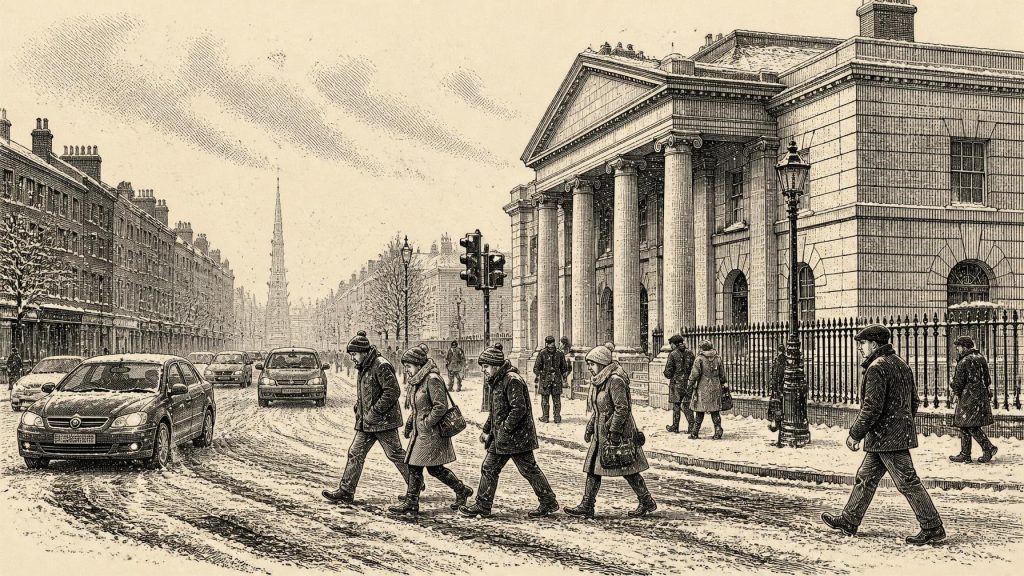
The year closed in a winter that made hardship more immediate. Cold conditions intensified from late November. December was the coldest on record at many observing stations, bringing heavy snow, dangerous roads, disrupted transport and pressure on homes and public services. At Straide in County Mayo, a temperature of −17.5°C was recorded on Christmas Day, the lowest December temperature recorded in the Republic. The exceptional weather became part of 2010’s remembered texture: a frozen landscape accompanying frozen credit, curtailed journeys and a country entering an uncertain new decade.
Primary Sources
- Hillsborough Castle Agreement
- About the Department of Justice
- Report of the Bloody Sunday Inquiry
- PM: Statement on Saville Inquiry
- The Economic Adjustment Programme for Ireland
- Council Agrees on Joint EU-IMF Financial Assistance Package for Ireland
- IMF Lending Case Study: Ireland
- The National Recovery Plan 2011–2014
- Budget 2011
- Croke Park Agreement
- Population and Migration Estimates: April 2010
- Quarterly National Household Survey: Quarter 4 2010
- Special Report 76: National Asset Management Agency – Acquisition of Bank Assets
- Written Answers – Dáil Éireann, 21 July 2011
- Civil Partnership and Certain Rights and Obligations of Cohabitants Act 2010
- The President: 2010 Legislation
- Pastoral Letter of His Holiness Benedict XVI to the Catholics of Ireland
- December 2010: Coldest December on Record
- All-Ireland Senior Hurling Championship Final – Tipperary 4-17 Kilkenny 1-18
- Down Edged Out in Thriller
- Queen to Get Invitation to Visit Before President’s Term Ends