
Decriminalisation and Downing Street1993 CE
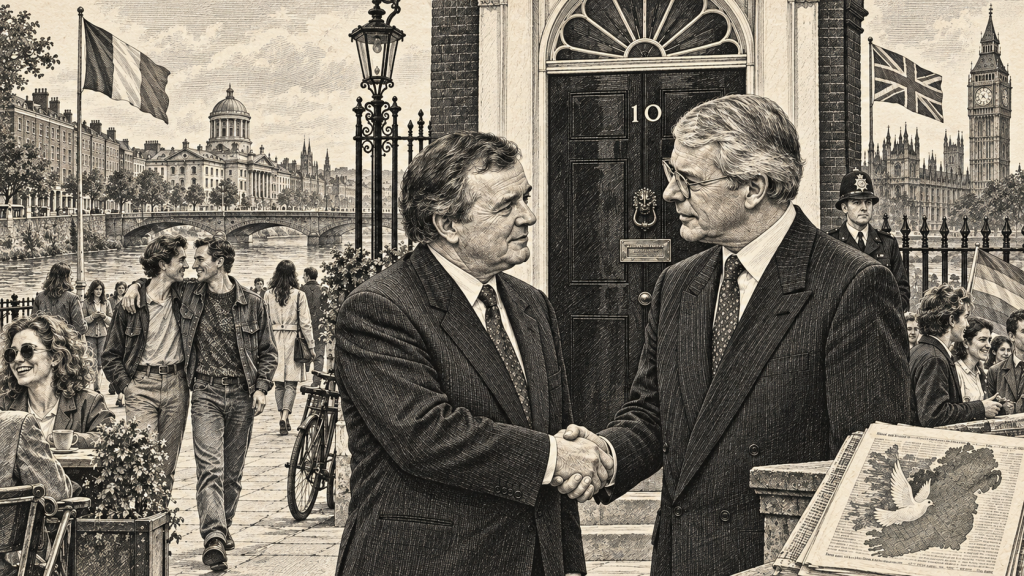
In 1993, Albert Reynolds led Ireland’s first Fianna Fáil–Labour coalition, with Dick Spring as Tánaiste and Foreign Affairs Minister, reflecting changing electoral politics. The Criminal Law (Sexual Offences) Act decriminalised consensual sex between adult men, ending Victorian-era provisions after David Norris’s campaign and European court ruling. European integration advanced through the single market and Maastricht Treaty’s creation of the European Union. Reynolds and John Major’s Downing Street Declaration provided a constitutional, peaceful framework for Northern Ireland, despite continuing violence. Unemployment remained 15.7 per cent, but investment, European funding and policy reforms foreshadowed growth, while social divisions and emigration persisted nationally.
Dateline
In 1993 Ireland entered a new political phase. Albert Reynolds remained Taoiseach, but from January he led an unprecedented Fianna Fáil–Labour coalition with Dick Spring as Tánaiste and Minister for Foreign Affairs. The year brought major change in law and society, most notably the decriminalisation of consensual sexual activity between adult men. It also produced one of the defining documents of the Northern Ireland peace process, the Downing Street Declaration of December 1993.
At the same time, Ireland was becoming more deeply integrated into Europe. The European single market began on 1 January, and the Maastricht Treaty entered into force on 1 November, formally creating the European Union. These developments did not remove domestic difficulties: unemployment remained very high, public finances were still constrained and the Troubles continued. Nevertheless, 1993 stands out as a year in which the legal, political and European framework of modern Ireland shifted significantly.
A New Coalition
The government formed on 12 January 1993 brought Fianna Fáil and Labour together in coalition for the first time. Albert Reynolds remained Taoiseach while Dick Spring became Tánaiste and Minister for Foreign Affairs. The arrangement reflected the fragmented result of the November 1992 general election, when Labour had made major gains and neither of the traditional large parties could easily form a government alone.
The coalition also demonstrated how normal coalition government had become in the Republic. Fianna Fáil had once defined itself by its ability to govern alone, but by the early 1990s parliamentary arithmetic and changing voter loyalties made partnership increasingly necessary. The Fianna Fáil–Labour agreement was politically striking because the parties differed in culture, policy and electoral base, yet they found common ground on economic policy, social reform and the peace process.
Decriminalisation of Homosexuality
One of the most important legal changes of the year came with the Criminal Law (Sexual Offences) Act 1993. Enacted in July, it abolished the offence of buggery between consenting adults and removed the Victorian-era criminal laws that had been used against homosexual men. The reform followed a long campaign by Senator David Norris and the 1988 judgment of the European Court of Human Rights in Norris v Ireland.
The change was historically significant because it marked a clear break with an older legal and social order. The law did not end discrimination, nor did it create full equality for lesbian and gay people, but it removed criminal sanctions from private consensual relationships between adult men. Minister for Justice Máire Geoghegan-Quinn acknowledged Norris’s persistence when presenting the legislation. In later years the State formally apologised for the harm caused by the old laws.
Europe Changes Shape
On 1 January 1993 the European single market formally came into operation, establishing the free movement of goods, services, people and capital as a central organising principle of the European Community. For Ireland, a small export-oriented economy, the removal of barriers across Europe strengthened the importance of foreign investment and access to continental markets.
On 1 November the Maastricht Treaty entered into force and the European Union formally came into being. Irish voters had approved the treaty in the previous year. Maastricht widened European cooperation beyond economics, introduced European citizenship, strengthened the path towards monetary union and expanded cooperation in foreign policy and justice. Ireland’s political and economic future was now even more closely connected to European institutions.
The Downing Street Declaration
The most important political development concerning Northern Ireland came on 15 December 1993, when Taoiseach Albert Reynolds and British Prime Minister John Major issued the Joint Declaration on Peace, generally known as the Downing Street Declaration. The document affirmed the principle that any constitutional change in Northern Ireland required the consent of a majority there, while also recognising the right of the people of Ireland, North and South, to pursue agreement by peaceful and democratic means.
The declaration did not produce an immediate ceasefire. The IRA continued its campaign and loyalist violence also persisted. Yet the document created a framework within which republican participation in constitutional politics could become possible if violence ended. It was one of the most important foundations for the ceasefires of 1994 and the later talks that culminated in the Good Friday Agreement.
Economy and Society
Despite the atmosphere of political change, economic conditions remained difficult for many people. Central Statistics Office figures place the annual unemployment rate at about 15.7 per cent in 1993, the highest point of the early 1990s. Emigration, though lower than at the end of the 1980s, remained part of family life, and youth unemployment continued to be a major concern.
Yet the structural conditions for faster growth were strengthening. Foreign direct investment, European funding, a young workforce and access to the single market were combining with the fiscal and wage policies developed since the late 1980s. The dramatic fall in unemployment associated with the Celtic Tiger had not yet happened, but the economic framework that would support it was increasingly visible.
The Year in Perspective
By the end of 1993 Ireland had experienced three changes of lasting importance: a new coalition model in government, a major liberalisation of criminal law and a peace declaration jointly issued by Dublin and London. At the same time, membership of the newly created European Union deepened Ireland’s connection to continental politics and markets.
The country remained socially divided and economically uncertain, and Northern Ireland remained violent. But 1993 was a year in which old boundaries began to move. The State was becoming more European, more open in its social legislation and more willing to pursue a negotiated settlement of the conflict in Northern Ireland.
Primary Sources
- Department of the Taoiseach: Twenty-Seventh Dáil
- Criminal Law (Sexual Offences) Act 1993
- Irish Statute Book: Commencement of the 1993 Act
- Houses of the Oireachtas: Decriminalisation of homosexuality, 1993
- Department of Justice: 25th anniversary of decriminalisation
- CAIN: Downing Street Declaration, 15 December 1993
- European Union: History 1990–1999
- European Union: Maastricht Treaty
- Central Statistics Office: Historical unemployment rates